How writing is like building a storage shed
Posted: March 24, 2013 Filed under: Fiction, Memoir, Mystery, Writing | Tags: building a shed, Fears, Memoir, Writing 3 Comments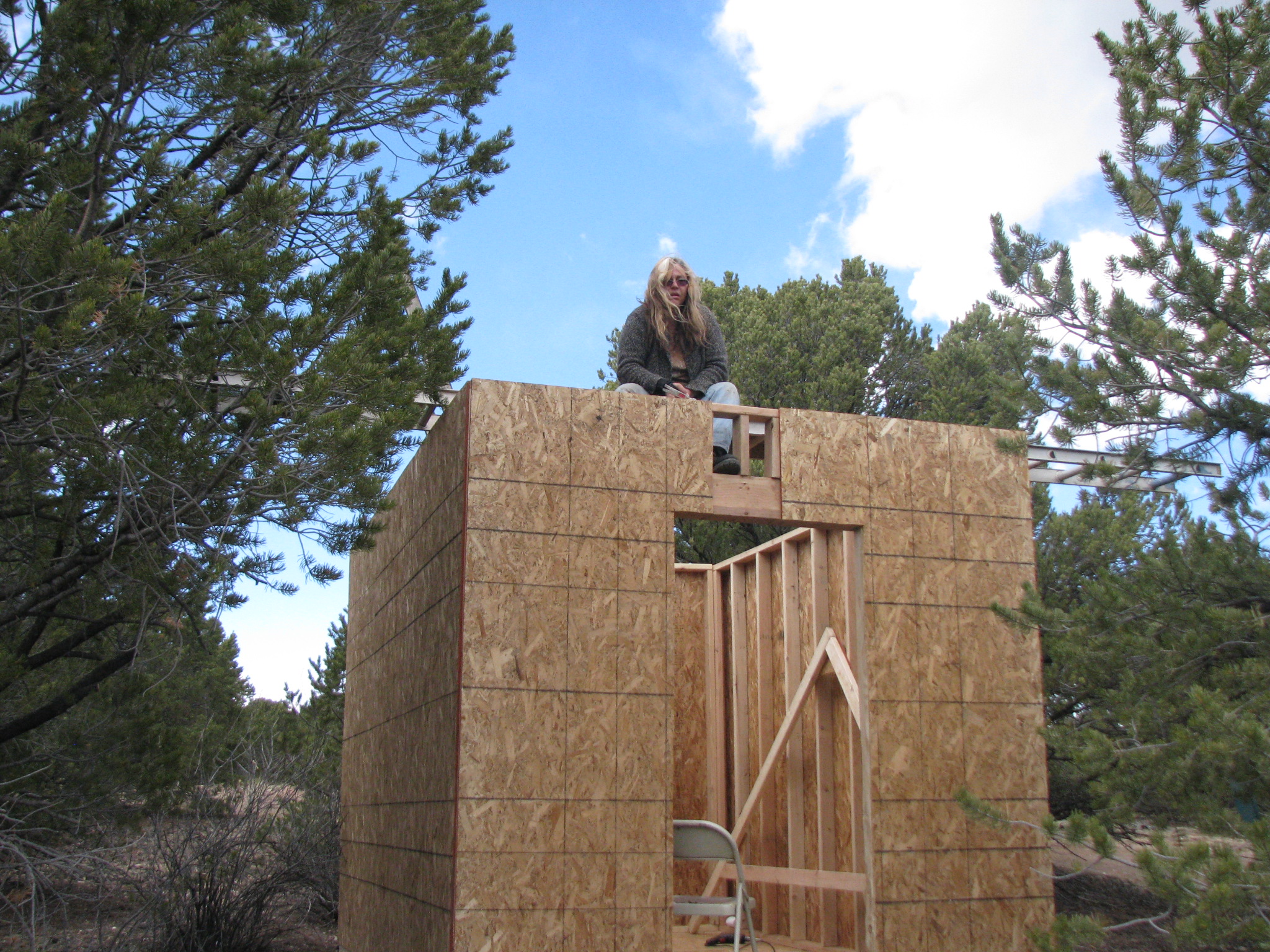 My husband asked me to help him build a storage shed and I agreed to the task. How hard could it be, right? Except that I am not a carpenter, and I was committing time away from my writing. Well, that’s not true either. I’m never very far from my writing. I’m always thinking about my writing in my head, even when I’m physically occupied with other tasks. So, although I was out hammering nails, my thoughts kept straying to how building this shed related to the YA mystery I am working on for my Genres II class.
The good solid twang you hear when you hit the nail head on reminds me of the feeling I get when I find an element the story is missing and added it in, knowing I’ve nailed it, (pun intended). But more often, I don’t get that direct hit, the story elements shooting off pell-mell into the forest, like the nails that I miss, or curling up like the nails that hit knots and won’t be driven forward, and I have to keep going at it from different angles until I am able to drive it home.
The story is sort of along the tradition of the Nancy Drew mysteries, with two young girls, growing up in the 1940’s as the protagonists. The story is three-quarters of the way finished, but I keep second guessing myself on what it is lacking. As I begin to pound nails into a new wall, I notice that I am starting on one side, with the intent to work my way to the other, yet I begin halfway up from the bottom corner. I wonder why I chose to start where I did, and it occurs to me just how many different places there are to begin on this wall, just as there is in my story. There is no hard and fast rule that a story has to start at the beginning, just as there’s no law that says you must start nailing a wall from the top right hand corner. With the wall, where I begin won’t really make a lot of difference in the end, but with my story it might. I toy with the idea of changing the point where I begin the story until I’m abruptly brought back to the here and now by the throbbing in my thumb after I missed the nail and hit it with the hammer. All these thought about writing are very distracting, which isn’t necessarily a good thing.
I’m afraid of heights. It’s a fear I’ve been dealing with for the past thirty years. I believe the official term is acrophobia, from the Greek words that combine “summit”, “edge” or “peak” and the word meaning “fear”. Merriam Webster’s Dictionary defines it as an “abnormal dread of being in a high place”, although I’m not sure I would define it as abnormal. I like to think of it as a healthy fear of potentially dangerous situations. That being said, I am a firm believer in meeting my fears head on and overcoming them. I have forced myself to face this one on many occasions, yet it still keeps rearing its ugly head to challenge me.
When I agreed to help with this project, I knew that at some point I would be required to climb a ladder to help with the roof, but we weren’t to that point yet, so his request that I climb up and slid across the ladder he had positioned across the top, extending from one side of the building to the other to nail in a small board caught me by surprise. I had gone for four solid hours and was tired when I started out this morning, and I couldn’t muster the energy to fight off my fear. Instead something inside my brain just mentally snapped.
“Oh, no. Oh, no,no,no,” I said even as I picked up my hammer and nails and began to climb the ladder with tears streaming down my face.
“What? Just climb up there and pound in a couple of nails. What’s so hard about that?” my husband asked, absorbed in whatever he was working on and not really paying attention to my reaction.
“I’m going,” I said.
There must have been something in my voice that made him look up and take notice. “Are you crying?” he asked. “Really?” He was puzzled by my reaction because I usually just buckle down and do what needs doing in situations like this, without making a big deal of it.
I swung my legs over the vertical ladder and slid my butt across it. “No, I’m fine,” I said, hammering in two nails as quickly as I could. When I turned to slide back the way I had come, my body didn’t move. I was temporarily frozen. I’d had this happen before when I climbed out under a large cement bridge that spanned the Colorado River to get pictures of my party of rafters, so I knew eventually my body would respond to my minds commands to move, once I got control of my fear, but knowing that made the experience no less terrifying for the moment.
“Wait, I’ll get a picture of you up there,” my husband offered.
“No!” I said.
“It’s okay,” he replied. “You look good up there. Just stop crying a minute and look up at the camera.”
Having my picture taken was the last thing I wanted at that moment, but as I was stuck for the moment, there was nothing to do about it. So, I wiped the tears from my face and resolved myself to the fact that I would have a photo to capture the moment. My eyes remained glued to the top of the front wall however, because every time I tried to look down at him with the camera, I felt my fear rise once more.
“Oh, you decided to come down,” he said, as I finally emerged from the opening that would be the door. He had gone about his business, allowing me time to gather my courage and get myself down from above. “I thought maybe you were going to make a nest up there.”
Now, with my feet firmly planted on the ground, his statement made me realize what a great opportunity I had missed because of my dumb fear and it made me angry. There I was, sitting with a bird’s eye view of the forest around me and I hadn’t taken advantage of it. I’d been too scared to even notice.
That’s when I realized that I’ve been doing the same thing with my memoir. Writing the story of my son’s death and my own grief is a difficult task. There are many issues that the memories stir that I’m not sure I’m ready to deal with. I’ve been putting off doing the research for several sections for this very reason, because I didn’t want to rehash the pain that interviewing the people who knew my son would inevitably produce. My instructor at Western State, Barb Chepaitis, has emphasized that eventually I must face these memories in order to portray the story honestly, and I suddenly realized how right she is. By putting off the necessary interviews because I fear the pain they will bring, I’m depriving myself of the full picture, just as I deprived myself of that high altitude view that would have allowed me to see the world a little differently. Eventually, I’m going to have to do them to present an honest portrayal of the story I need to tell, and by putting it off, I risk losing track of the key players. It’s already been four years since my son died. His friends have all gone on with their lives. They aren’t just hanging around waiting to be interviewed by me.
That night, I got on the computer and sent messages to several of the people who knew Mike, asking for their assistance. Already, I’m going to have to track down some that I no longer know how to contact. Once I have this part of the research done, I still won’t have a finished book, any more than pounding in those two nails produced a finished shed, but it will bring me one step closer to having all the material I will need to do the job.
Share this:

It’s Not About Speed
Posted: March 2, 2013 Filed under: Writing | Tags: Writing, writing advice, Writing Process 7 Comments I’ve heard a good average for writers is one book a year. For some of us aspiring writers, that seems like a break-neck pace. Then there are those that whip out a novel in a month’s time for NaNoWriMo each year, and there’s a girl in my class who participated in a 365 stories project where she wrote a story a day for a year. Many of us may not write that fast though. I’ve done NaNoWriMo twice unsuccessfully. Those who do finish may have something that resembles a novel, but it’s far from a polished manuscript. It’s good to be able to write fast if you’re writing to deadline or if you want to make a living as a novelist, producing one or more books per year. But the fact of the matter is, it’s not how fast you write that is important, as much as it is that what you write is good, quality writing.
What is important, my instructors at Western State will tell you, is that you find a writing speed that is comfortable for you, that allows you to produce quality writing and set your own pace. I’ve heard it suggested that if you write three hundred words a day, which probably adds up to a couple of hours on slow days, you can complete a novel in a year, and supposedly, that’s a reasonable pace. That’s probably true, and it at least shows dedication, but some writers may find that even meeting that three hundred word per day mark is difficult at times. I know for me, if I have what I want to write, firmly planted in my head before I start, I can write a lot faster than that. But, if I start out with only a vague idea that I’m not sure how I want to express it, those three hundred words may come agonizingly slow, like pulling cactus needles from my derriere after not choosing my seat carefully on a long mountain hike.
I wrote the first draft of my first novel, Delilah, in six months, which I’m told is pretty good. I wrote between 600 and 1,000 words a day on the days I actively wrote. But honestly, I didn’t write on Delilah every single day of that six months. Many days I just worked out stuff in my head, figuring out what I wanted to write and how I would write it. It was a pace that worked for me. I didn’t feel I was pushing it too hard I sand I still produced some quality writing. I still have a lot of work to do on the rewrites, but it feels good to know I have a good solid base that can withstand some minor alterations or even major reconstruction if necessary.
Writers are human beings, and just as each and every one of us are unique individuals with different strengths and weaknesses, every writer has their own speed at which they write. Can someone else write a first draft faster than I did? Yes, my instructor, Barb Chepaitis, wrote a novel in a weekend. It probably took her longer to regain her sanity afterwards, than it did to write the story, but it is possible. She did it to see if she could. It’s not her normal writing speed, but she does write much faster than I do. Other writers struggle to get a first draft done in a year.
On the first day of class last summer, Barb asked us if we knew how many words we could write in an hour. Being beginning MFA students, most of us did not. She said it was important that we know how fast we write, but she didn’t say it was important that we write fast. Finding that comfortable rhythm where the story flows out without being forced is what produces good quality writing. It doesn’t matter if you only put down two hundred words a day, as long as they are good words. It’s not about speed. The story will always get told in its own time. It’s our job to our job as writers to make sure it’s told well.
Share this:

A Closer Look at My Own Writing Process
Posted: January 6, 2013 Filed under: Fiction, Writing | Tags: Delilah, Fiction, Writing, Writing Process Leave a comment Since I’ve been seeking my MFA through Western State University, my posts here have been dwindling. On top of my school work, I’ve been writing a western novel and I’m close to having it completed, but this also has put a strain the limits of my writing time, not to mention several curveballs that life has thrown at me recently. However, I’m learning some really neat things about my own writing process that can be shared here, so perhaps my readers will forgive me for slacking off a bit.
In my Craft & Practice I class, my instructor, Barbara Chepaitis, guided us in analyzing our own writing process and taught us about the different types of writing processes. This is a subject I’d never thought much about before. While some writing processes are very structured, with outlines and plot lines and story arcs, others are more organic, just letting the words flow to the page, and still others are somewhere in between. While I’ve done outlines for my nonfiction writing process, I’ve tended to be more organic in my fiction writing process. I just sit down and start writing and see what comes about.
That’s what I did with the western novel I’ve been diligently working on. Delilah started as a character driven story, when I was assigned to do a western excerpt for my class this summer. I created the character of Delilah for the excerpt and it built itself one scene at a time as the character showed me what happened next. It’s been a fun journey since trouble seems to have a way of finding Delilah, but as I neared the finish line, I needed to make sure that my plot and all of my sub-plots wrapped up neatly. I didn’t want to inadvertently leave any loose ends. So, I found it necessary to plot it out and take a look at my story arcs, one for the plot and one for each sub-plot, to make sure they all had a beginning, a middle and an end, and see how they interrelated with each other.
In doing this, I was surprised to see how many different story arcs my story actually has. After drawing out the main plotline, I drew a story arc in a different color for each of my different sub-plots and ended up with eight different story arcs, including the main arc. Every motivation or relationship that Delilah has, creates a different sub-plot with a story arc of its own. Like a good stew, where each separate ingredient mixes its own flavor into the pot to create that delicious stew taste, each separate story arc adds to the flavor of my story. Below is a picture of what I came out with.
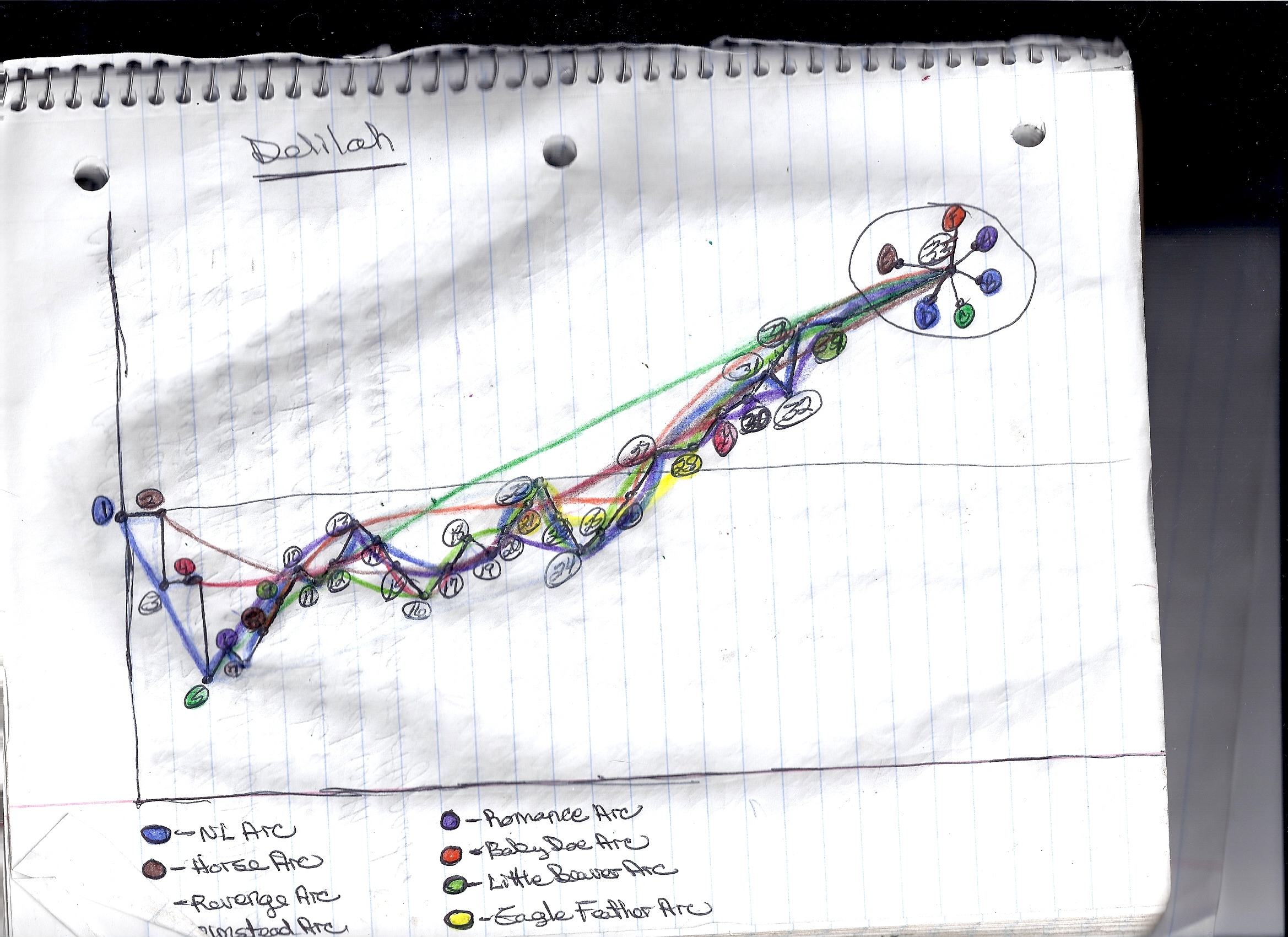
This enabled me to see where things were missing and envision how it will all come together in the end. It has required me to revise some parts of my story, but I can see the value in doing this. The different colors represent the individual story arcs and the colored circles represent the plot points where each one begins and ends. The main story arc includes every plot point, while the sub-plots start at different plot points, further into the story and some end before the main story ends, while at least five of them are tied in together and conclude at the end, along with the main plot. This is what I think a good story should do, so I am pleased with the results. Now that I have discovered how it all ends, all that’s left to do is to write it.
My instructor, Barb did not try to tell us that one process was better than another and she encouraged us to explore different processes to see what worked for us and what didn’t. I’ve discovered that my process needs to be both structured and organic. I’ve never tried the structured approach to fiction before, so with my next novel, which is an action/adventure story, I’ve started with the plotting. In fact, I already have the main plot line of the major events drawn out. Although this story is based on a character, Betty Lou Dutton, that I created and used for two scenes in Barb’s class, this approach will be a basic reversal of my usual process. As I write, I may find that more story arcs need to be added, although I already know there will be at least four sub-plots, it will be interesting to see how well this turns out. Wish me luck.
Share this:

The Craft is What it is All About
Posted: October 14, 2012 Filed under: Fiction, Writing | Tags: craft, Fiction, Novel, School, Stories, Writing 3 Comments Before I decided to seek my MFA in Creative Writing, I hadn’t really thought much about the craft of writing. I would simply take an idea or character, or a situation and start writing, not thinking much about why I put this sentence here or that one there. Of course, I thought about word choices, but I usually just knew that I needed a different word, not thinking about why the one I had wasn’t right, or why this one was better. I never thought about why one story seemed to read smoothly, while another just didn’t seem to flow right at all. I didn’t think about things like pacing, focus, or what archetypes I was using. I didn’t question why a character did what they did. I just wrote what felt natural to me. Even though I knew how to manipulate these elements in my writing, I wasn’t able to articulate them. I didn’t think about the how and why of what I did. Most of the time I just sat back and watched as my story unfolded. In a graduate program, however, that is what you do. You dissect writing, pick it apart and examine the various elements to discover how and why they work, or don’t work.
When I started classes last summer, I was asked if my stories were character driven or plot driven. The honest answer would have been that I didn’t know, because I hadn’t really thought about it. But everyone else seemed to know what drove their writing, so rather than clue them in to the fact that I was a self-taught writer, I said that my writing was plot driven.
Looking back over stories that I have written in the past, understanding now how to look at my work critically, I found that it depends on the story. I have a YA mystery that isn’t a mystery yet, (but it will be), which began with the characters of two young girls; a sci-fi piece that started with the idea of a situation from a Writer’s Digest prompt, and developed from there; a short story that began with the idea of a naked woman walking into a waterfall; and the western I’m working on started with my female protagonist seeing something that looked like a body in the scrub brush. The ideas for my children’s series started with the birds and forest creatures that visited my yard and became my characters and they are definitely character driven. What I’ve learned from my courses is that my stories can be either plot or character driven, or both.
In class, we’re looking at what good dialog is; how pacing affects the story; character development; plot lines and sub-plot lines; how to move the story forward; the differences in POV; past and present tense; and how to use visual, auditory and kinetic details to enhance a story. What I found fascinating is that much of this stuff was already going on with my writing. I just didn’t realize it, because I never looked at it that way before. Now that I am conscious of the elements in a story and I’m learning how to better manipulate them to achieve a desired effect, my writing is stronger and more focused. Writing consciously means being aware of what you are doing with your story. I’ve always known what I wanted to do with my stories, but now I know how to do it. Now the elements don’t just fall into place wherever they want. Now they go where I put them and stay there, unless I move them. Now I am aware if my pace is too slow, I can see where my character is inconsistent, I understand when more detail is needed and I know what and where to put it. Okay, not always, but I am getting better at these things. I’m looking at my writing differently. I see my story in terms of craft now and I think that is a good thing, because I want my writing to be good. I want people to want to read it, and most people want to read a well-crafted story.
Share this:

The Power of Constructive Criticism
Posted: September 1, 2012 Filed under: Writing | Tags: Critiques, Novel, School, Writing 3 Comments Being in the classroom setting amongst other writers, some very accomplished, at first made me feel quite insignificant. It made me wonder what I was doing there, or if I really belonged in a group with such talented people. I have always felt that my work was good enough for publication, but sitting in the midst of others, many of whom have already been published, and who all seemed so knowledgeable about the business of writing was a little bit intimidating. Suddenly, I found myself questioning the value of my writing, although I had never doubted my abilities before. There was nothing to do, except jump right in and hope for the best.
The assignments were challenging and that is how I approached them. My first assignment was to write an excerpt from a Western novel. Those that follow me know that short stories have been my forte in the past. I had never written an excerpt from a novel, because I have not yet written a novel. However, I had written a short story that was in the Western genre, which hadn’t turned out too bad, so I was confident that I could pull it off. In fact, I turned out a piece that I was pleased with, but turning it in to be critiqued by my writing peers made me more than a little nervous.
The challenge for me in this assignment was that I only had nine days in which to write it. I saw flashbacks of my horrible NaNoWriMo failure of two years ago. I didn’t have to produce a completed novel within that time frame, but I did have to form some idea of where the story was going. I had to have at least a vague idea of what the plot might be, and how it might turn out.
The piece I turned in received mostly positive responses from my writing peers, and the instructor’s feedback was encouraging, as well. It is amazing what constructive criticism can do to boost your sense of confidence. My fears of inadequacy were unfounded and my confidence regained. I used to do the critique thing online, but I got nervous about having my work out there where it could so easily be stolen, copyrights be damned, that I stopped posting on those sites. I had forgotten how much feedback can motivate you. Even criticism of your work can be motivating, when you can look at the suggestions of others and play with them to see what works. Having a set of peers, whether in the classroom, in a critique group or via online feedback can be quite valuable in keeping you focused and on track, providing motivation and other points of view, as well as in providing a sharper awareness and improving editing skills. When my schooling is completed, I think I will think seriously about finding a critique group.
Since, the summer semester ended, I have continued working to develop Delilah into more than just an excerpt. The eleven pages that I originally turned in have grown to twenty-five. Considering the small amounts of time that busy life has allowed me lately for writing, I think that I have made good progress and I am pleased with my content, as well. The challenge that I have set for myself now, is to turn this material into a full-fledged novel. I still have a long way to go, but the work shows promise, and I am hopeful for the results of my labor. I’ll let you know how it turns out.
Share this:

The Power of Words
Posted: August 12, 2012 Filed under: Stories, Writing | Tags: Stories, Words, Writers, Writing Leave a comment Recently, I was told, “it’s all about the story”. If you believe that – and I do – that makes the writer’s job a very important one. It is the job of the writer to get the story out. More importantly, it is the writer’s job to tell the story the way that it wants to be told, and that is no small task. Without the right words, we don’t stand a chance.
English teachers and editors can tell you the rules. They can make sure that you have proper sentence structure and syntax; that your grammar and punctuation are correct in every way. But, writers know that the real trick is in knowing when the rules apply, and when it might be better to overlook them.
Writers are challenged with word choices every day, and it is a challenge to have to select just the right words. Writers must choose words that will state what we want to say in a clear or concise manner, while at the same time drawing readers in and compelling them to read on. Above and beyond that though, we are charged with the task of putting words to page that will stir emotion within readers – touching, inspiring, shocking, or tantalizing.
We are challenged to not only find the words, but also to put them in an order that will set the right tone and pace, and present a clear picture for the reader. The words we choose portray our characters and settings in a manner that allows readers to form a mental picture of what we are describing, thus bringing the reader into the story with us. Our words and the way we put them to the page also set the tone and mood, intensifying reader experience. The point is, that as writers we make choices every day that affect the shape of the story, as well as the outcome, and a gazillion events that occur as the plot unfolds. Without words, there is no story, and the writers are the ones that choose the words.
It is all about the story and often, stories just don’t care about the rules. For instance, to write realistic dialog that will be believable for the reader, you may not always have complete sentences. When we talk, we do not always use complete sentences, and dialog that is written in complete sentences may come out sounding very stiff and formal. Unless your characters are members of nobility during the seventeenth century, the dialog may not seem natural. Your dialog needs to fit your character.
I recently discovered what it’s like to have one of my characters speak to me, something I had heard of, but didn’t really understand. Now I do, and let me tell you, my character, a woman of the old west, did not speak in complete sentences. In fact, she did not even pronounce some of her words properly. Because her background and upbringing, that is the way she talks, and to portray her on the page in any other way, would be dishonest to my readers, and disrespectful of my character’s essence.
In addition to choosing the right words for our characters, we must choose words that our readers will comprehend and relate to; words that are right for the setting of the story; words that express the true character of our characters. We must sequence them so that the story moves at a pace that is fast enough to keep the reader’s attention, but not so fast that we leave them behind.
It is obvious that words are powerful. As it happens, words are the tools of the writer’s trade. Words are what gives us power. Just as the way a ruler welds his power determines whether he is loved or despised by his people, the way we weld ours determines whether we are good writers or bad, and whether anyone actually wants to read our writing. So, choose your words carefully and weld your power wisely.
Share this:

Inside the Writing Process: Listening to Your Characters
Posted: August 5, 2012 Filed under: Fiction, Writing | Tags: characters, plot flaws, Story, Writing Leave a comment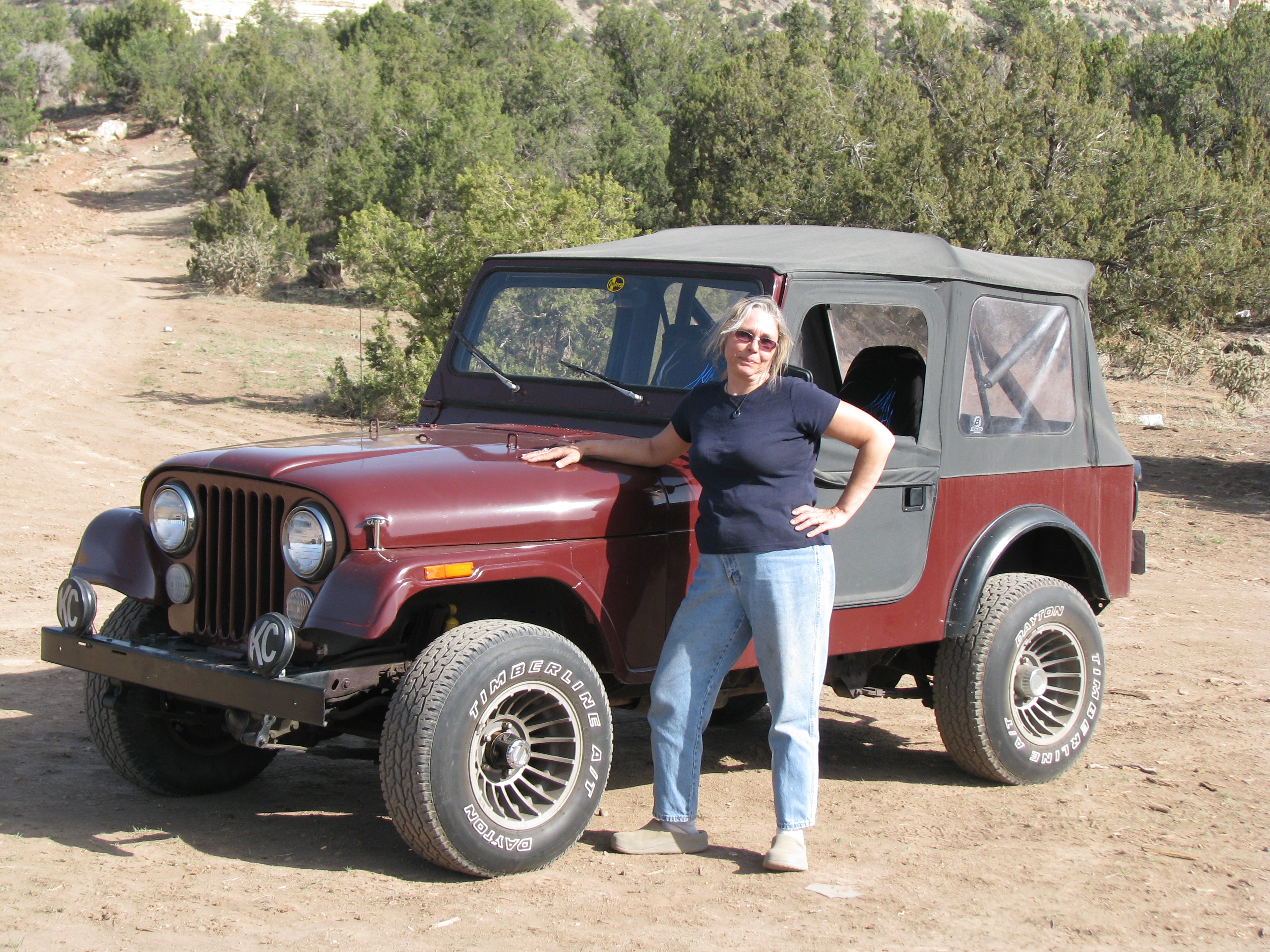 Rest and relaxation: that was the agenda for the day. After two intense weeks of me attending classes, while Greg sat in a dorm without even one working cable hook-up, and then a five-day work week, while we simultaneously tried to catch up on everything that had fallen behind while we were gone, we were due for some recreational activities. We were heading up the old stage road that runs on the north side of the Arkansas, from just east of Howard, all the way to Wellsville. We had chosen this route because a portion of this road is four-wheel drive, and we wanted to give our Jeep a little workout.
So, here we are, bumping along a particularly rocky patch, and I find myself thinking about the area terrain and how it might be worked into the western story that I began for class three weeks ago. It occurs to me that one of the changes that I made to the story last night is going to cause me a major plot flaw. Where an act of nature is my protagonist’s saving grace, it seems that, were it real, it would also cause her horse to kill her. I’m trying to work it out in my head, but I just can’t find any way around it. If lightning strikes, the horse is going to get scared and take off, dragging my character, Delilah, along by the noose around her neck, which happens to be attached to his saddle horn, and she will be helpless to stop it. I hardly notice the roughness of the terrain, as I am bumped and jostled, my thoughts overshadowing the external world.
The scene I’m trying to hash out follows the brutal beating and rape of my protagonist. After reading my first draft, my instructor felt a hesitation in my writing of this scene, and he was right. I was hesitant to write this scene. I knew that it was risky, and I might turn some readers off with it, but I felt that it is a crucial part of the story, which sets up everything that follows, so I had chosen to try to write it anyway. “If you are going to write it, don’t do it half-way,” he said, meaning that I should depict the horrendousness of the scene fully and not let my own hesitation show through in my writing. I thought about and decided that this scene really is integral to my story, so I must hurdle my own hesitancy, and write the scene, so my readers can buy into it.
My current dilemma is that I’ve chosen to scrap the scene that follows and start over, so I have to figure out a way for Delilah to survive the horrendous scene and go on, without the handsome stranger riding in to save her, (after all, it is a western, not a romance), because I wrote him out when I scrapped it, so he no longer exists. From out of nowhere, I hear a voice, “Why do I have ta be so damn passive?”
It startles me out of my thoughts about the book. I look around to see where the voice had come from, but we are still rocking and bouncing along, and even if we weren’t, there’s not a soul for miles along this little used trail. Greg didn’t appear to have heard anything unusual, and I wasn’t about to say anything. After living with me for thirty years, he knows I’m a little crazy, but I don’t see the need to remind him of this.
“Do ya really think I’m just gonna lie down and take it? Yer instructor told you that I was too passive, and yer peers agreed, so why won’t ya listen to ‘em?” The voice piped up again. It is a distinctly female voice, and now I recognize it. It is the voice of Delilah.
Another one of my instructors had talked about letting your characters speak to you, because they’re the only ones that know what is supposed to happen in the story. You see, it’s not really your story. She said that it’s their story, and if you listen, the characters will tell you what is supposed to happen next, because they know, even when you don’t. I had never created a character that was real enough to talk to me, so I don’t think I really got it at the time. Now, here is Delilah, talking in my head, telling me how to fix what’s not right in my story! I can really hear her, even if my husband doesn’t. Now, I get it!
“Okay.” I say in my head, (again, no need to alarm my poor husband). “But what can you do? Your hands are tied behind your back, and the noose is around your neck. Can you really do anything but be passive at this point?”
“What if my hands weren’t tied?” she asks.
“But, your hands are tied,” I say.
“What if they weren’t?” she counters.
I sigh. “Okay. If your hands weren’t tied, you might be able to save yourself, assuming the impact of the fall doesn’t knock you out cold.” I had assumed that it would, but perhaps Delilah is tougher than I had, at first, believed.
“So I’ll ask ya again. Why are ya making me so damn passive?”
“Well you certainly aren’t passive when it comes to giving me advice on the story,” I reply, with more than a little indignity. “But if your hands weren’t tied, you wouldn’t be in this situation in the first place. You are only passive because you have no choice, given the situation.”
“Exactly!” she says. “So, allow me to change the situation.”
By now, my mind is shifting gears. If her hands were freed somehow, at the end of the scene, she might still be dragged by her horse, but she might be able to prevent him strangling her to death. “So, you’re saying that your character wouldn’t just lie there passively? That you would be working to free yourself, even as he is beating you?”
“Now yer using yer head,” she says and, I swear, I felt her wink at me. Then, she was gone. Her exit left a vacuum of space where my mind had been focused. She had only come and stayed long enough to get me back on track, so the story could go where it was supposed to.
“Where do you want to stop?” Greg asked, bringing me back to the rocky trail of reality.
I smile. When we do stop, I will have my pen and paper ready, because now I know what happens in my story. My character told me. Now, all I have to do is write it down.
Share this:

Reflections on a young writing career by an old lady
Posted: August 3, 2012 Filed under: Writing | Tags: Heather Hummingbird, Intimacy, Southern Colorado Literature Examiner, Western State College, Writing 2 Comments
Poetry by Kaye Lynne Booth
My regular readers know that I just spent the last two weeks taking the first classes toward earning my MFA in Creative Writing at Western State Colorado University, in Gunnison. It was an intense two weeks. The first week and a half I put in time in the classroom, making my brain explore uncharted territory in order to learn about my own writing style and process, as well as reinforcing and renewing my knowledge of writing basics, such as dialog punctuation, story structure, plot and character. When not in class, I spent my time actually writing and reading the writing of my peers for critique the following day. The last three days, I attended the 2012 Writing the Rockies conference, as a part of my college credits. How cool is that? The intense pace didn’t really bother me until after I had returned home and gone back to work, but let me assure you that it did catch up to me. I have been exhausted all week, twice actually falling asleep with my laptop in my lap. I was that tired.
While considering whether or not to enroll in Western’s MFA program, there were many things to consider. Could I fit a two week residency in Gunnison each summer into my already bustling schedule? Could I commit the time that it would require to get my master’s degree and still fulfillment my obligations to my family as I have for the past thirty years? And what, exactly, did I hope to accomplish through seeking this degree? Did I think I would be magically transformed into a professional writer once I have that degree in my hand?
I had to do some sincere soul searching to find the answers to all my concerns. While I will surely have to do some rearrangement of my schedule to accommodate residency classes each summer, and I will have to forfeit certain activities that I enjoy in order to study and practice my craft and complete assignments, to me it will be worth it. My hope is that I will come away from this experience with credentials that will demonstrate that I’m not just someone who dabbles as a writer, but a serious author with at least one published book. I don’t expect this to happen through a magical transformation, but through hard work and lots of practice. In the end, it came down to one thing: I want to be a writer more than anything else in the world, so it would be worth whatever sacrifices I had to make to achieve that status. It is how I want to make my living, and I have played around enough at it. It is time to get serious and do what I aspire to do.
Now, with the first classes finished, I have to look at whether my expectations have been met, what I’ve already had to sacrifice, and whether it was worth it. In order to analyze all of this, I also need to examine what I actually learned, and evaluate its value to determine if the payoff is what I had expected. To that end, I thought I might share my thoughts and insights with you, my readers.
By looking at my current resume, you will see that I’ve already taken many steps toward my goal. I have written as the Southern Colorado Literature Examiner for the past three years, as well as keeping up this blog, Writing to be Read, for about five. In addition, I wrote gardening how-to articles for Demand Studios for over a year and a half, had two short stories published in Static Motion, an online publication, and a poem published in Dusk and Dawn magazine, where I made my first $5.00 as a writer, back in 1996. Another of my poems was featured by artist Mitch Barrett, in one of his paintings, Intimacy, which was displayed and sold at Kaleidoscope Gallery, in Batter Sea Park, London. My first children’s book, Heather Hummingbird Makes a New Friend, is scheduled to be released in October of 2012, by 4RV Publishing, as well. So, you see, I have a little bit of a head start on this writing thing, although none of it has paid enough for me to give up my day job.
So, did I come away with from these first classes with anything of value? I believe I did. For one thing, I gained insight into myself as a writer, aspects that I had never examined closely before. For instance, I discovered that I am a closet binge writer. I knew that I wasn’t much for planning, which is probably why I have not been able to make it beyond the short story format. Novels require planning and you have to truly know your characters to make your readers believe in them. Binge writers take an idea and run with it, and that is what I do a lot of the time. It seems that when I try to plan out what I’m going to write, it comes out flat and lifeless, as if the work were forced. So, this is one area that I definitely have to work on. That’s one thing that I learned.
I also learned many basic concepts that are sure to improve my writing style. In fact, they already have. Our assignment to write a novel excerpt in the western genre produced the beginnings of a story narrative, the likes of which, I did not realize that I was capable of. The class might be over, but my work to develop this story is only beginning. Two paragraphs in a genre we had never before written in lead to an epiphany about a YA story that I had written four or five years ago, which was missing something that I couldn’t put my finger on, so I had never done anything with it. The challenge to write in a new genre prompted me to try my hand at mystery, and it suddenly dawned on me that this story should have been a mystery to begin with. That’s what had been missing! The resulting two paragraphs featured the characters from the YA novel and read well enough to convince me it could work.
I gained knowledge about the writing business, as well. Some of the writing activities that I had engaged in, such as publishing with online sites that don’t pay, were cheating both myself and my profession. While I was glad just to have the writing credit, I could be setting myself up to have my work stolen, because it is out there where anyone can grab it. It may have been a mistake, but as a self-taught writer, I launched my writing career the only way that I knew how. I also learned that you really do need an agent, all the professional writers that we heard during class and conference agreed. The agent handles all the legalities of contract, which most writers are not qualified to do, unless prolific in contract law. The how of finding an agent promises to be revealed at a later date. And, I learned the differences between the large publishing houses and the smaller presses, and when to try for each.
In some ways, I had been doing the right things. I have always parked my butt in the chair and wrote, (a theme that had been reiterated over and over again during my brief educational introduction to the world of writing), blocking out the world around me for the sake of putting words to page. I found that although my dialog may set off alarms with spell check, it rings true and encourages reader “buy in”. I discovered that I had ability in areas that were previously untried for me, warranting continued exploration.
Above all, I learned how much I really don’t know. I look forward to exploring and discovering all that I still have left to learn, through Western’s MFA program. I can’t wait for my online classes to begin this fall. I think the payoff will be more than worth it.
To learn more about my work, visit my website at Kaye’s Literary Corner
Share this:

Getting in Shape for Writing
Posted: July 26, 2012 Filed under: Writing | Tags: Western State College, Writing 6 Comments I didn’t even consider that I would be humping up the hills of Western State College carrying my back pack, filled with my laptop and all my books, and my small, but well packed purse. Had I known, I would have trained to get in shape before I headed off to class. Getting to class wasn’t so bad, it was all downhill. However, this was a case of what goes down must go up, and it was all uphill getting back to the dorm at least twice a day, if not more. That hike to the dorm made my unprepared calves moan with misery every time. By the second week, my shoulders burned by the time I arrived at either destination. Next year, I will definitely take steps to prepare me for this.
The classes I am taking are a preparation of another kind. They are designed to get me in shape to be a professional writer, and the writing exercises and assignments that we’re given are mostly painless. They are designed to help us limber up the writing muscles of the brain and expand our literary horizons. In that, they were successful. Thanks to my Patterns & Paradigms in Mainstream & Genre Fiction course, I now have the beginning chapters for a Western Novel, the start of a chapter that I can use to transform a small collection of stories about two young girls growing up in Massachusetts during the depression into a YA mystery novel, and I’m looking forward to experimenting more with the horror genre, even though my first attempt was absolutely awful. (You guessed it. My area of concentration is genre fiction.)
As with any type of training, you must tone up the basic muscles to be used before you try mastering the more difficult stances, or executing some of the more complex maneuvers. In the aforementioned course, I also toned up the basic writing muscles. My dialog punctuation was a little flabby, but learning the proper way to exercise this muscle group should have my character exchanges shaped up in no time. I learned the basic elements of the novel: plot, character and setting; methods to create character; and how the “mono-myth”, or hero’s journey works; and techniques to set the pace and tone which will help to create a tight, shapely narrative. And I learned that I often have a case of, what the course instructor calls, “adverb-itis” in my writing; using adverbs to describe things that don’t really need to be described. Flexing those stagnant writing muscles has already improved my writing.
Just as my calves will require continuous workout to remain toned and build more muscle, I must continue to work those writing muscles every single day. No doubt, I will be in better shape next summer, when it comes time to do this again. I will have a better idea of what lies ahead and will be better able to prepare. Certainly, I will need to exercise my muscles, both the writing ones and the physical ones, so they will be prepared for the extensive two week workout I now know to anticipate on both levels. I may not be ready to run the 10K by then, but perhaps I’ll at least be ready to start planning my thesis.
Share this:

Back to School After All These Years
Posted: July 21, 2012 Filed under: Writing | Tags: back to school, Western State College, Writing 2 Comments Last week was the first week of classes for me, in my quest to obtain my MFA in Creative Writing at Western State College. It was an eye opening experience, to say the least. After thirty years, I found myself back behind a student’s desk, concentrating on the words of two extremely talented writers, whose job it is this semester to educate me and the others in my class. It was amazing! It was a little uncomfortable, being in this new element, so of course I was nervous and it took me awhile to get into my “zone”, as one of my fellow students is fond of saying, but once I settled in, awesome things began to happen.
My instructors, Barbara Chapaitis and Russell Davis are like the yin and yang of the writing spectrum, but both are just bursting with creative energy that I could feel transcending over to their students. Russell Davis is a very nuts and bolts kind of guy, whose job, for these two weeks, at least, is to teach us the basic elements of writing a novel, and that’s what he gets right down to business doing just that. His basic philosophy on writing is, “Sit your ass in the chair and write the damn book!” While Barbara Chapaitis, is a binge writing, free spirit, who is interested in the writing process and helping us to discover how that works for each individual writer. For her class, we sang, we howled, we meditated, we observed a spectacular lightning storm, and we did some free writing exercises to grease the writing wheels and get the ball rolling.
Russell believes that part of his job is to make his students as uncomfortable as possible. He writing assignments are aimed at getting us to write outside the genres that we are most comfortable with and experiment. To that end, last week I wrote a segment of a YA mystery, which I have plans to use to revive a book that has been dead in the water for about five years, and I started on a western piece, that isn’t turning out too bad. I also took a segment of that western and turned it into a horror story, but we won’t talk about that.
At first, I wondered what all the wild things Barbara had us doing had to do with writing. It soon became apparent that she was trying to get us to think about our own processes and be aware of what they are. She talked about the difference between being a planner, who outlines and plots out all the little details before sitting down to actually write the book, and being an organic writer, who gets an idea and just runs with it. Barbara is without doubt an organic writer, who locks herself in her writing space, allows no interruptions, and writes until it’s done. I wondered how she could do that. After all, life doesn’t just disappear while we are writing. She emphasized that the process is different for each one of us and encouraged us to explore our own. I discovered that for me, I’ve learned to write around life, grasping any time that makes itself available to write whenever and wherever I can. As our home is small and I have no closed door to lock myself behind, I have turned my recliner and a small coffee table into “my writing space”, and I have learned to block out the television and other distractions in my environment and immerse myself in the word that I am putting on the page. I have also learned to make whatever space I am in, “my writing space”. I can write on my breaks at work, sitting by my son’s grave, or in the car, while we are on the road, since I commute. (Thankfully, my husband does most of the driving.)
That’s my week in a nutshell. There is so much more that I learned and discovered over the past week, but I must keep this post short, because I have homework. That Western excerpt is due Tuesday; I have to critique the work of my peers, and I have to prepare for the Write the Rockies Conference next weekend, which I will also be covering as the Southern Colorado Literature Examiner. I’ll let you know how it goes.




















