Time Flies
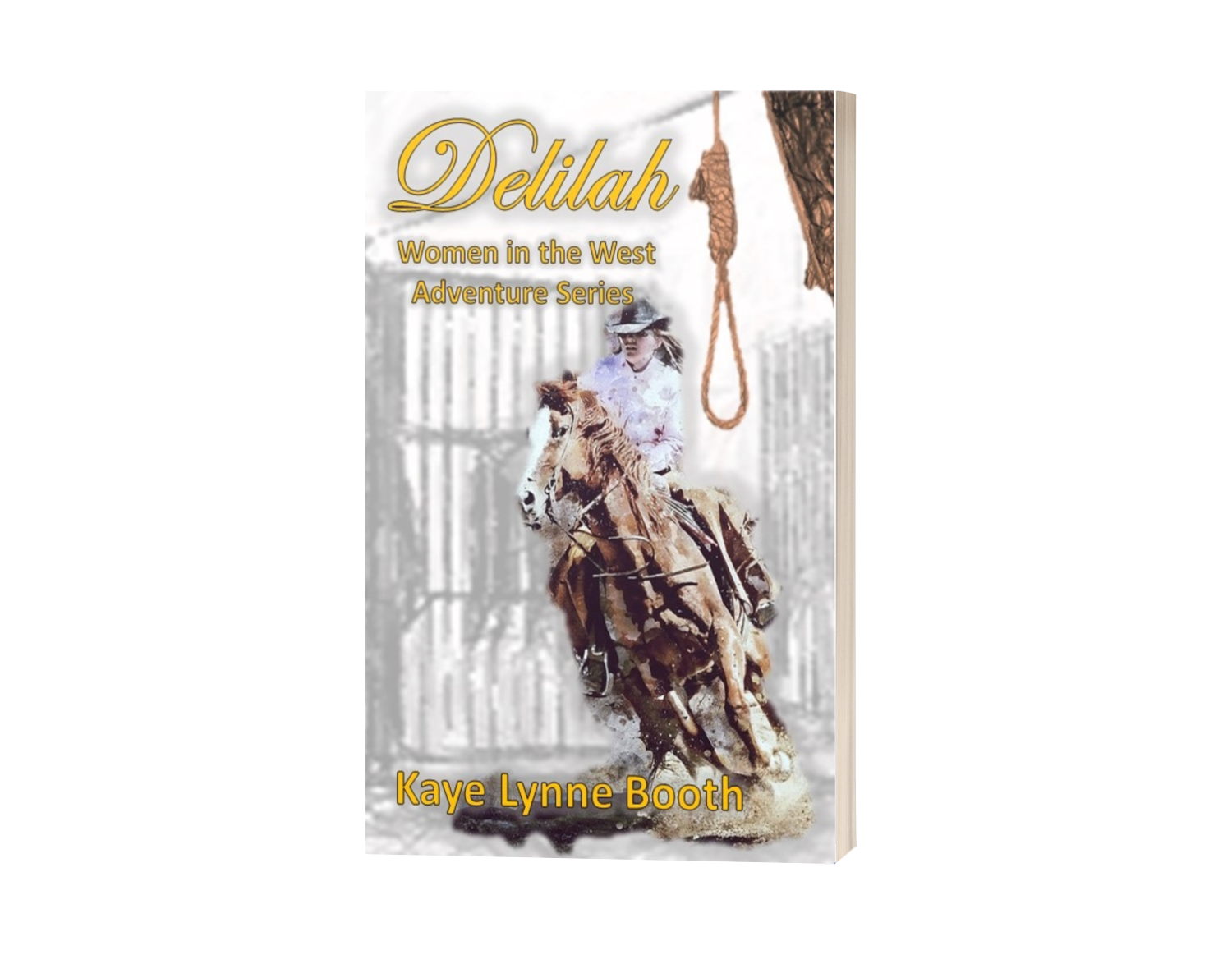
Posted: January 12, 2014 Filed under: Fantasy, Fiction, Mystery, Western, Writing | Tags: Books, Fantasy, Fiction, mystery, New Year, Western, Writing Leave a comment Wow! It’s 2014 and I just realized how long it’s been since I published here, I’ve been busy earning my degree, along with the many other demands that life places on all of us. But hard work and dedication pays off. In fact, since I began the MFA program at Western State Colorado University, I’ve produced rough drafts for two novels, which I’m now working on revising. The first is a western, Delilah, and the second is a middle grade mystery, The Adventures of Ann and Kinzi. I’m currently working on a mythological fiction/fantasy/science fiction novel, with the working title, A Playground for the Gods, which I’m considering using as my thesis.
Delilah is a tough young woman who grew up on the Colorado frontier. On her way home to the San Luis Valley, she’s brutally raped and left for dead, sending her on a quest for vengeance. Her hunt for her tormentors leads her to the Colorado mining town of Leadville, where the colorful inhabitants work their way into Delilah’s heart and give her hope for a future she’d thought lost along with her innocence. Now she must stay alive and protect her new-found friends as she faces the many dangers of the western wilderness and the outlaw elements of the growing new Colorado territory.
The Adventures of Ann and Kinzi is the story of two young girls growing up during the depression. Their shared love of animals and the fact that they’ve both lost their mothers are the common ground on which cements their friendship. When strange things start happening at the McViddie farm, where they care for the horses, and one of their classmates disappears, Ann and Kinzi set out to solve the mystery and save their friend, but they must do it without being caught by the kidnapper themselves.
In A Playground for the Gods, Inanna is the goddess of love and war on a quest to save humanity. The foolish judgement of men and their misuse of the technology the gods have provided have brought them to the brink of self-destruction and convinced the gods that humanity is not ready to receive the secrets of long life and powers that would make them godlike. They’re preparing to find a new planet on which they hope to find a new species to bestow their gifts upon. Inanna must prove that humans are worthy of their godly gifts, and convince them not to leave humanity in such a mess.
That’s it. That’s my excuse for neglecting this Writing to be Read blog. Now all I can do is ask forgiveness from my readers and offer the promise that if they stick with me, I promise to blog on a regular basis in the coming year. I don’t foresee that I will abandon novel-writing, but I do plan to try to organize my time better, so I’ll be able to commit to at least two or three posts a month. I hope you will all join me for the journey.
I’d also welcome any feedback on which of the above stories capture your interest and why. Comments are always appreciated.
Share this:

“Unfinished Business” by Tim Baker an entertaining read
Posted: September 25, 2013 Filed under: Book Review, Fiction, Uncategorized | Tags: Books, Fiction, Tim Baker, Unfinished Business 2 Comments
“Unfinished Business” by Tim Baker
No one is ever ready to die because we never know when our time is up. Some, who die of a terminal illness, may know that death is approaching and have time to put their affairs in order, but death strikes most unprepared and they leave this life with unfinished business hanging… well, unfinished. Unfinished Business by Tim Baker is a creative and original story that explores the possibilities how the universe may balance the scales and take care of those things that have been left unfinished by departed souls. This delightfully entertaining story will tickle your funny bone and keep you guessing.
When Meg Seabury loses her friend and mentor, Lita, she inherits an unexpected gift, although at times she wonders if it isn’t a curse. Suddenly, Meg is able to see the final thoughts of those who cross the threshold of the funeral home where she works, and she soon learns that it is up to her to finish what they didn’t have the chance to take care of. Her new abilities lead her on a strange roller-coaster ride to places she would never go and compels her to do things she would never do in her old “normal” life. Not all that’s left undone are positive events. Meg finds she doesn’t have a choice but to carry through, restoring the balance of the universe, even if it leads her into dangerous situations or could land her in jail.
Unfinished Business is now added to the list of novels by Tim Baker recommended by this reviewer, which also includes Water Hazard, No Good Deed, Pump It Up, Backseat to Justice and Living the Dream. All Tim’s books are available at www.blindoggbooks.com.
Share this:

A Closer Look at My Own Writing Process
Posted: January 6, 2013 Filed under: Fiction, Writing | Tags: Delilah, Fiction, Writing, Writing Process Leave a comment Since I’ve been seeking my MFA through Western State University, my posts here have been dwindling. On top of my school work, I’ve been writing a western novel and I’m close to having it completed, but this also has put a strain the limits of my writing time, not to mention several curveballs that life has thrown at me recently. However, I’m learning some really neat things about my own writing process that can be shared here, so perhaps my readers will forgive me for slacking off a bit.
In my Craft & Practice I class, my instructor, Barbara Chepaitis, guided us in analyzing our own writing process and taught us about the different types of writing processes. This is a subject I’d never thought much about before. While some writing processes are very structured, with outlines and plot lines and story arcs, others are more organic, just letting the words flow to the page, and still others are somewhere in between. While I’ve done outlines for my nonfiction writing process, I’ve tended to be more organic in my fiction writing process. I just sit down and start writing and see what comes about.
That’s what I did with the western novel I’ve been diligently working on. Delilah started as a character driven story, when I was assigned to do a western excerpt for my class this summer. I created the character of Delilah for the excerpt and it built itself one scene at a time as the character showed me what happened next. It’s been a fun journey since trouble seems to have a way of finding Delilah, but as I neared the finish line, I needed to make sure that my plot and all of my sub-plots wrapped up neatly. I didn’t want to inadvertently leave any loose ends. So, I found it necessary to plot it out and take a look at my story arcs, one for the plot and one for each sub-plot, to make sure they all had a beginning, a middle and an end, and see how they interrelated with each other.
In doing this, I was surprised to see how many different story arcs my story actually has. After drawing out the main plotline, I drew a story arc in a different color for each of my different sub-plots and ended up with eight different story arcs, including the main arc. Every motivation or relationship that Delilah has, creates a different sub-plot with a story arc of its own. Like a good stew, where each separate ingredient mixes its own flavor into the pot to create that delicious stew taste, each separate story arc adds to the flavor of my story. Below is a picture of what I came out with.
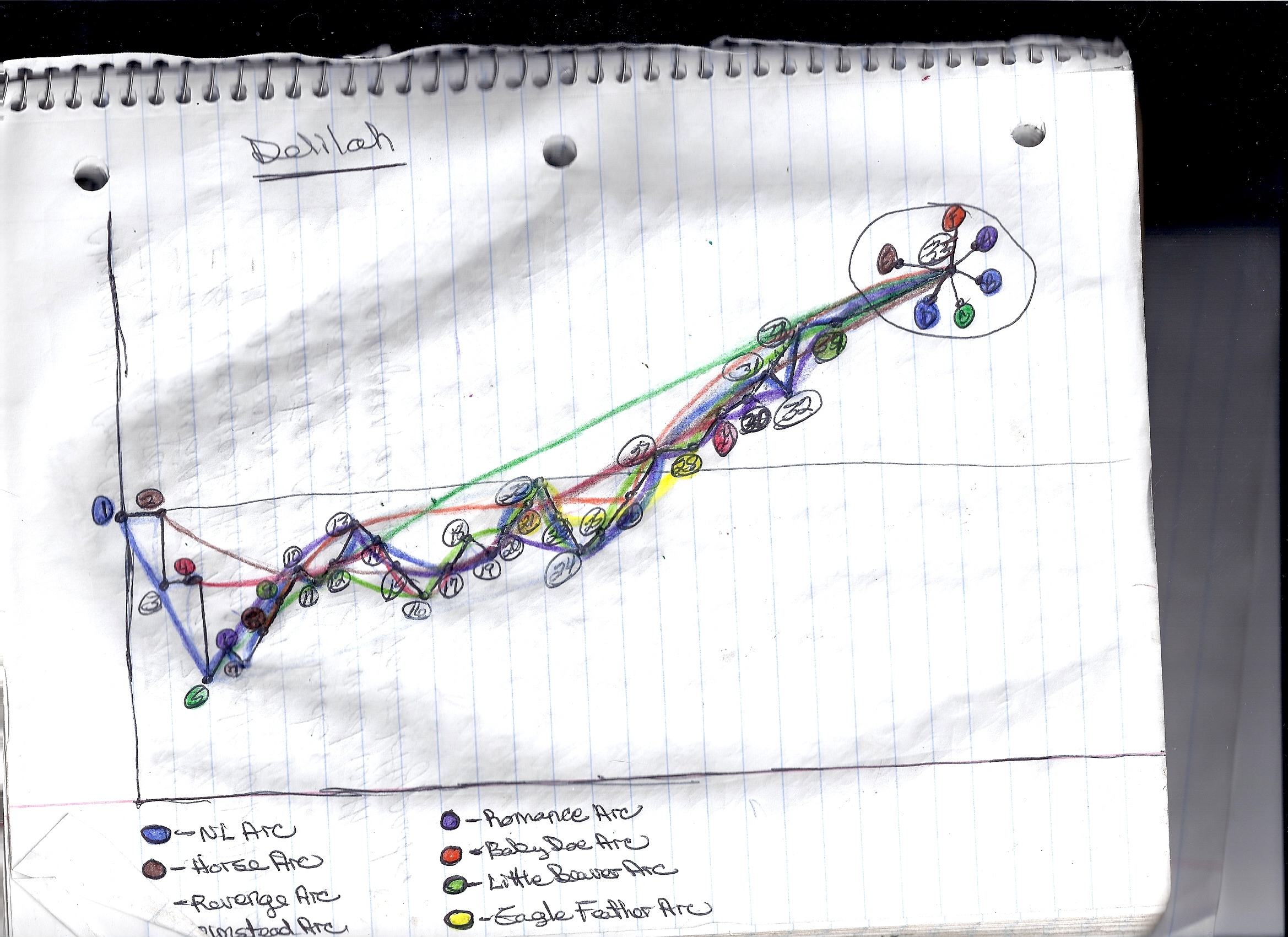
This enabled me to see where things were missing and envision how it will all come together in the end. It has required me to revise some parts of my story, but I can see the value in doing this. The different colors represent the individual story arcs and the colored circles represent the plot points where each one begins and ends. The main story arc includes every plot point, while the sub-plots start at different plot points, further into the story and some end before the main story ends, while at least five of them are tied in together and conclude at the end, along with the main plot. This is what I think a good story should do, so I am pleased with the results. Now that I have discovered how it all ends, all that’s left to do is to write it.
My instructor, Barb did not try to tell us that one process was better than another and she encouraged us to explore different processes to see what worked for us and what didn’t. I’ve discovered that my process needs to be both structured and organic. I’ve never tried the structured approach to fiction before, so with my next novel, which is an action/adventure story, I’ve started with the plotting. In fact, I already have the main plot line of the major events drawn out. Although this story is based on a character, Betty Lou Dutton, that I created and used for two scenes in Barb’s class, this approach will be a basic reversal of my usual process. As I write, I may find that more story arcs need to be added, although I already know there will be at least four sub-plots, it will be interesting to see how well this turns out. Wish me luck.
Share this:

The Craft is What it is All About
Posted: October 14, 2012 Filed under: Fiction, Writing | Tags: craft, Fiction, Novel, School, Stories, Writing 3 CommentsBefore I decided to seek my MFA in Creative Writing, I hadn’t really thought much about the craft of writing. I would simply take an idea or character, or a situation and start writing, not thinking much about why I put this sentence here or that one there. Of course, I thought about word choices, but I usually just knew that I needed a different word, not thinking about why the one I had wasn’t right, or why this one was better. I never thought about why one story seemed to read smoothly, while another just didn’t seem to flow right at all. I didn’t think about things like pacing, focus, or what archetypes I was using. I didn’t question why a character did what they did. I just wrote what felt natural to me. Even though I knew how to manipulate these elements in my writing, I wasn’t able to articulate them. I didn’t think about the how and why of what I did. Most of the time I just sat back and watched as my story unfolded. In a graduate program, however, that is what you do. You dissect writing, pick it apart and examine the various elements to discover how and why they work, or don’t work.
When I started classes last summer, I was asked if my stories were character driven or plot driven. The honest answer would have been that I didn’t know, because I hadn’t really thought about it. But everyone else seemed to know what drove their writing, so rather than clue them in to the fact that I was a self-taught writer, I said that my writing was plot driven.
Looking back over stories that I have written in the past, understanding now how to look at my work critically, I found that it depends on the story. I have a YA mystery that isn’t a mystery yet, (but it will be), which began with the characters of two young girls; a sci-fi piece that started with the idea of a situation from a Writer’s Digest prompt, and developed from there; a short story that began with the idea of a naked woman walking into a waterfall; and the western I’m working on started with my female protagonist seeing something that looked like a body in the scrub brush. The ideas for my children’s series started with the birds and forest creatures that visited my yard and became my characters and they are definitely character driven. What I’ve learned from my courses is that my stories can be either plot or character driven, or both.
In class, we’re looking at what good dialog is; how pacing affects the story; character development; plot lines and sub-plot lines; how to move the story forward; the differences in POV; past and present tense; and how to use visual, auditory and kinetic details to enhance a story. What I found fascinating is that much of this stuff was already going on with my writing. I just didn’t realize it, because I never looked at it that way before. Now that I am conscious of the elements in a story and I’m learning how to better manipulate them to achieve a desired effect, my writing is stronger and more focused. Writing consciously means being aware of what you are doing with your story. I’ve always known what I wanted to do with my stories, but now I know how to do it. Now the elements don’t just fall into place wherever they want. Now they go where I put them and stay there, unless I move them. Now I am aware if my pace is too slow, I can see where my character is inconsistent, I understand when more detail is needed and I know what and where to put it. Okay, not always, but I am getting better at these things. I’m looking at my writing differently. I see my story in terms of craft now and I think that is a good thing, because I want my writing to be good. I want people to want to read it, and most people want to read a well-crafted story.
Share this:

Adventures in Writing
Posted: May 2, 2012 Filed under: Fiction, Writing | Tags: Fiction, goals, Journal Entries, Novels, Writing, writing exercise 2 Comments Last week I started reading The Writer’s Adventure Guide: 12 stages to Writing Your Book, by Beth Barany. The first stage that she outlines involves beginning where you are, but you must discover where that is first. The first exercise involves a 20 minute timed writing that discusses what writing means to you, what your goals are as a writer, and identifying your strengths and weaknesses which stand in your way or help you to meet those goals. She asked that you look at both the inner strengths and weaknesses, as well as those presented by the outer world around you. Part of the objective of this exercise is to help you begin viewing yourself as a writer, and although I’ve been doing that for a long time, I chose to do the exercise anyway. You never know when you may discover something unexpected by doing an exercise that you don’t think you really need. So, the following is the results of that first exercise for me, but I have great ambitions, so I didn’t stop at twenty minutes, but followed it through until I had covered all the areas suggested.
I am a writer. I live to write. Writing makes me feel free, because I can express myself through it. When I write, I can block out the outer world as I explore the inner world of the story or poem. My goal is to become a paid author, able to make enough to support my family and finance my writing career. I see myself 10 years from now traveling from place to place giving lectures, teaching workshops and signing books. I would also like to be attending conferences and workshop to increase my knowledge about writing, as I feel that writers must always continue to learn and grow and to develop their craft.
When I’m not writing, I am reading. I love being the Southern Colorado Literature Examiner and doing my blog, Writing to be Read, because I get to meet other authors and do book reviews. I also do book reviews for Webb Weavers. Doing book reviews puts me into both of the elements that I love. I get to read good books and then write the reviews for them. It’s the best of both worlds. Plus, by functioning in these capacities, I am able to increase my own visibility within the literary community.
Of course, this all revolves around the assumption that I will be a successful author by that time. I already have a children’s book being published, which I am waiting for with much anticipation. I have others written that will follow in the series, that are just lack polishing. Since I already have a publisher for the first book, I think that the chances are good that they will agree to publish the other in the series. I am waiting to submit the second story though, because I want to enter it in a Writer’s Digest writing contest. I truly feel this story is good enough to possibly win. I also have other children’s stories that wouldn’t fit into the series, but I think they might be good enough to stand alone.
In addition, I am planning to attend college this summer to get my MFA in creative writing, which will lend credibility for me as a teacher and help me to complete my novel. I have the story in my head, but I don’t know where to start to put it all in print. In the past I have written short stories and poetry. I have always just sat down and begun writing and the stories just have flowed out for me, but a novel length story presents a challenge, because it requires more detail and more than one or two characters be developed. Acquiring my MFA will help me to gain the skills that I need to overcome my weakness and write the novel that is now, only in my mind.
One day, I also plan to put together a collection of my best poetry, with illustrations. Publishers for poetry may be more difficult to find than they are for books or children’s stories, so I might consider self-publishing my poetry collection, maybe even as an E-book. E-books seem to be the rage these days. I wonder if poetry does well in the E-book format? I think that it might.
Also, in my head, there lies a memoir about my son Michael and his tragic death at the tender age of 19. I have begun many times to write such a book, but there are so many loose ends still, three and a half years later, that I don’t know how to end it. Even a memoir has to have an end to the story, does it not? Before one can see the tragedy of his death for what it is, they must understand who he was, which requires details about his childhood. I can remember details about his life as if they had occurred yesterday, but how much of this actually needs to be relayed to readers? No one will ever know Mike the way that I did, no matter how many words I put down on the page, or how eloquently I relay those details. That’s the problem. Because my words don’t seem to me to express what I want to say adequately, I always end up putting this project down only to start over at a later date, maybe from a different approach, but ultimately with the same results. I have been working on a nonfiction book, as well. It is still in the research stages, but I need to get a better idea of how I want to present the information. Again, I think an outline might help me to clarify my direction in my own mind.
As I said, I have thought of myself as a writer for many years. This exercise did make me look at my unfinished projects and evaluate the reasons why they are unfinished. I do fine with short stories, but longer books are intimidating to me. I think that outlining my story ideas might help in this area. As far as my memoir goes, I think I may still be too close to the story in real life. It isn’t over for me, and I don’t know if it ever will be truly. There are so many questions that I may never have the answers to. I think I need to let more time go by before I attempt to tackle that particular writing project.
So, I did come out with a better idea of my weaknesses and some ways to overcome them, or at least deal with them. I also was able to look at my strengths and the actions that I am taking that push me closer to my goal. My discoveries in this area pleased me. I think the things that I am already doing or have planned for the immediate future are a good start in the right direction.
The rest of the exercise consists of being aware of how my goals might change over the next week, now that I am more aware. Again I will follow through with the exercise, although I don’t think that they will change much. Barony instructs to start your book in this coming week, as well. For me, that will entail constructing an outline and exploring my characters. I’ll keep you posted on my progress, so be sure to drop back in for next week’s blog post.