Weekly Writing Memo: How to Start Writing
Posted: May 18, 2016 Filed under: Fiction, Screenwriting, Uncategorized, Weekly Writing Memo, Writing, Writing Tips Leave a commentIt’s easy to say w hat should be in the beginning of a story and pretend like that is the answer to start writing, but knowing what’s in a beginning is not the same thing as knowing where to begin. If you’ve my old blog post on Author the World: What’s in a Beginning? then you know I believe there should be three things established in the first few pages of a story: character, tone, and something of substance that represents the heart of the story. That is the first step, but what else is needed to get started writing?
Know the Basics.
You have to build your story from something. A character, a setting, a conflict…something. So the first step is to establish the three keys to a beginning. Who is your character? What is the heart of the story about? What tone do you want the story to be told in?
Now, the “heart of the story” may not come right away, but you should have something in mind to start with, and if it changes as the story develops that’s fine. You just have to remember to go back and revise with the new “heart of the story” in mind.
If you’re having trouble establishing these things, then…
Follow the Protagonist.
Personally, I usually start by finding my protagonist. Then I mentally (or sometimes in freewriting) put them in various situations to figure out how they’d react and what kind of person they really are. I follow them around until I have a solid mental picture of who this character is, and then I use that to figure out what kind of trouble they’re most likely to get into.
For example, I have a mystery novel with an anxiety riddled, insecure protagonist. Her name is Cassie. The moment I wrote her I knew the trouble she was most likely to get into was letting her anxiety get carried away and imagining something simple was much worse than it was. In my story, she finds her brother’s apartment in a mess and decides he’s been kidnapped or murdered. Then I asked myself, what if she was right but because of her anxiety and tendency to over-exaggerate no one believed her? Imagine the trouble she’d get into if she had to try to investigate this missing person all on her own.
If you follow your protagonist, and really understand them, then you should be able to see what kind of trouble that protagonist would naturally fall into and find your plot. Finding the plot, or the challenge your character has to overcome, will help you find not only the heart of your story, but the tone as well. For my mystery, the heart of the story is that everyone has multiple sides to them, and sometimes crazy people aren’t as crazy as they seem. The tone for my mystery is humorous, and involves an unreliable narrator.
But where to Begin?
Once I followed my character to discover the conflict, I had to decide where to start her story. I could’ve started off with Cassie going to work and then going to visit her brother, but I didn’t need all that build up to the discovery because the discovery wasn’t the surprising thing in the story, the surprising thing is that no one believes Cassie at first.
I chose to start the story the moment AFTER Cassie discovers her brother’s disheveled apartment. I don’t show her initial panicked reaction because it would have made her immediately seem overly dramatic and unreliable. Instead we see her moments later when she has slight control over her anxiety and is fighting it, which makes her seem like she knows she’s overreacting. She presents the evidence, and tries to rationalize it in various ways but always ends up back at the worst case scenario.
By the time she’s done, the audience is almost convinced that maybe something bad has happened because we’ve seen her thought process and we want to believe her. Then, Cassie’s other brother arrives to the scene and Cassie’s ideas start to seem a bit less believable with a more rational head present. By the time the duo goes to the police station to appease Cassie’s concerns, the audience is all but convinced she’s probably overreacting while Cassie is more convinced than ever that she’s right. This chain of events put her on track for the rest of her story to go off and investigate on her own, and bit-by-bit to prove herself reliable again.
For me, following the protagonist and knowing what I needed to establish early on helped me find where to start my story. That being said, following your protagonist may not always work so there are several other methods for finding where to begin your story.
- Work Backwards.
An alternate method to finding your beginning is to start from the scene you do know and work your way backwards in an outline or mental form. Ask yourself what has to happen in order to get your characters to that one particular moment you do know? Okay, now what part of those events does the audience absolutely need to see in order to enjoy and understand the story? If you only can find big key moments, then chart those.
Try to find the big moments of the story: The Inciting Incident (where things first go wrong), the Catalyst (the thing that forces your protagonist to actively try to solve the problem), The False Win (where it seems like the protagonist has it all figured out and then things go SUPER wrong), and the Resolution (where the problem is finally solved). There are others, of course, depending on which story guide you look at. So choose your favorite story arc spread, decide where the moment you know fits into it, and then plot out the moments that have to happen.
Just remember, you don’t need to write every moment between every key point. You only need the ones that the story, or the character, wouldn’t make sense without.
- Find Normal.
This method doesn’t work for all story types, but for stories that are about a main protagonist being thrown out of their “normal” zone this method can work. Most stories involve this in some way, shape or form, but sometimes it’s not as obvious as others.
For example, if you look at a movie like the action flick “The Losers” with Jeffrey Dean Morgan. The team’s “normal” is being military guys doing missions. When they’re thrown out of their “normal” it’s not that they’re sent back to civilian life or something completely opposite, but rather that they’re forced to work outside the military on their own, outside the law.
To find your story’s beginning using this method start by discovering what your protagonist’s “normal” is. Find a moment as close to when that “normal” is about to be upturned in the story to begin at so you can show the readers what normal is before you throw your protagonist’s life into chaos (so to speak) with the events of the story. You want to do this so your reader can see how the events of the story change your protagonist.
In my mystery, Cassie’s normal is being unsure of herself and filled with anxiety, but the moment her beliefs are rejected by her other brother as well as the police she gains some confidence and determination to act, even if she’s still somewhat unsure of herself. Through investigating her brother’s disappearance, she forces herself to overcome her anxiety and insecurity in order to save her brother. Which completely throws her out of her “normal” zone.
- Start Where You Know.
If you can’t backtrack, and you can’t find “normal”, one of your other options is to simply start where you know. Start at the moment you know is part of the story and write forward until you reach the end, or until you get stuck, or until you figure out more of what comes before. Once you stop writing forward, look back at the story and figure out what else your reader needs to know in order to understand the events you’ve written. Then backtrack if necessary and add those events into the beginning.
Also look at what you’ve written and at the character and plot and see how their arcs look. Does the character change and grow because of the events of the story? Does the plot have a solid beginning, middle, and end? If yes, then maybe the moment you knew and started at was the beginning, you just didn’t know it. If no, then again, backtrack as much as necessary until you have completed the arcs as needed.
Final Words.
No matter how you find your start, or where you start, always remember that once you finish the first draft you absolutely should go back to your beginning and see if the character, tone, and story core you established in the beginning fits the story now that it is over. Many, many times while writing I’ll find that as I’ve written, the character grows, or the tone shifts, or the heart of the story becomes something else. If this happens and you don’t revise your beginning to fit the future text, then the beginning will feel false and disconnected from the rest of the story.
The last thing I’ll say is a piece of advice I got from one of my mentors at the MFA program I graduated from and something to keep in mind whenever you’re writing. I don’t remember if he made it up himself or if he heard it somewhere else, but he always told me to: “start every scene as late as possible, and end every scene as soon as possible.” If you do that, it’ll minimize the excess words and keep your story focused on what’s important.
Share this:

The Making of a Screenplay: The Creative Process (Part 4)
Posted: May 16, 2016 Filed under: Movies, Screenwriting, Writing | Tags: creative process, Screenplays, Screenwriting, Writing, Writing Process 2 Comments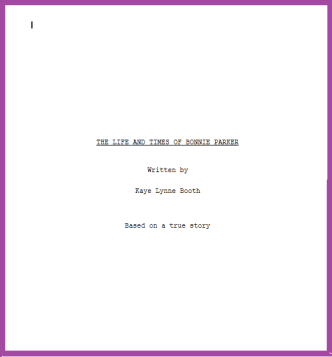
We’ve looked at how a screenplay goes from idea to beat sheet or outline in Part 1. And we’ve seen that the tools used to sell your screenplay, such as the logline and the pitch, are created before you ever start to actually write the script in Part 2. Last week, in Part 3, we looked at the type of research that goes into writing a screenplay. Today, I’d like to look another important step in creating a finished script.
Rewriting
The final step in completing any writing project is rewriting, or revising, to make sure that the finished piece you’re going to submit is the absolute best it can be. In literary writing, it’s called revision, and there may be several revisions before the piece is ready to be sent off in hopes of discovery. But you finish the first draft, before you start revising, or at least some writers do. Me, I’m a firm believer that the more things I fix as I go, the less I will have to fix later, so I do some revision during the writing process of the first draft. In screenwriting, it’s called is rewriting, and it actually takes place all the way through the writing process, which is more in sync with my writing style.
Once the draft for ACT I is finished, you look it over, get feedback from other screenwriters, if available, and then make changes and adjustments to the sections that aren’t working for whatever reason. You repeat the process when you’ve finished the draft up to the end of ACT II, but this time, you also watch to be sure that the two acts flow together well, in addition to ascertaining that ACT II works well. Again, after ACT III is finished, but on the final rewrite, you must be sure that it work as a whole, the flow of the beats are smooth and you’ve maintained a constant tone throughout. If you’ve done a good job on the prior revisions, there may be very little rewriting to do at this point, and it’s really just a matter of fine tuning your script.
For my thesis, I originally wanted to lead viewers through the story with a series of voice-overs by Bonnie, which included imagined journal entries and letters, as well as some of the poetry she actually wrote. I knew I wanted to do this from the start. However, on the last read through, my peers and my instructor brought it to my attention that the way my script was written, I stuck the poetry into scenes where I thought I wanted it, but the way it was written my audience would be looking at a blank screen while they listened to Bonnie’s voice-over, which was not the way I intended it to be.
The majority of my final rewrite was positioning these voice-overs, especially those with the poetry, some of which were quite long at strategic sections where they would seem to refer to what was happening in the story, and to keep the action going during them. In one scene that meant showing Bonnie writing the letter while the voice-over tells us what that letter said. That’s one that I had right. Other scenes needed to have the voice-over over the action, like a car chase. And in some, like at the end of ACT III, I needed the voice-over to play in sync with a montage of single snapshot scenes. There are different ways to write it, so that the voice-over is played the way I wanted it to in each case, and a good portion of my final rewrite consisted of tweaking the scenes with voice-over so they would play the way I wanted them to.
In the end, I came out with a screenplay that flows together well, tells the story I wanted to tell in a compelling and original way, and has a lot of commercial potential. Maybe someday you’ll see The Life and Times of Bonnie Parker on the marquee at the theater as you’re driving down the street.
Like this post? Subscribe to Writing to be Read for e-mail notifications whenever new content is posted.
Share this:

The Poetry of Jessy Randall Shows Us How to Laugh at Life
Posted: May 13, 2016 Filed under: Book Review, Poetry | Tags: Book Review, Jessy Randall, Poetry, Suicide Hotline Hold Music 1 Comment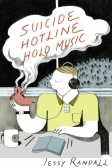
Suicide Hotline Hold Music, by Colorado Springs poet, Jessy Randall, is a quirky collection of poetry and poetry comics which present a comic outlook on some life’s realities that makes the reader want to slap her forehead and exclaim, “Why didn’t I see that?!” Randall’s poems take on thier own unique individual forms, which utilize rhythm and emphasis to the fullest, giving her works a conversational tone, like an old friend pointing out oddities. In “A Different Kind of Stupid”, which was first published in Asimov’s, Randall gives us a fresh analysis of a well-known fairytale.
A Different Kind of Stupid
Rapunzel never compared the weight
of the witch and the prince. How dumb,
if she did. No, she was pregnant,
that’s how the witch found out.
So, a different kind of stupid, up there
in her tower. You could argue
she loved him, and sure, she may have,
but he was the only man she’d ever met.
What kind of love is that?
The stupidest thing of all is how the prince
left her up there, day after day. Some might say
he knew what he was doing, never bringing a rope.
This collection of poetry makes complicated issues seem simple and manageable. The poems allow us to laugh at ourselves and at life, reminding us of times forgotten and left behind. Their innocent nature reminds us of the people we once were.
I give Suicide Hotline Hold Music 3 Quills. 
Kaye Lynne Booth does honest book reviews on Writing to be Read and she never charges for them. Have a book you’d like reviewed? Contact Kaye at kayebooth(at)yahoo(dot)com.
Share this:

Weekly Writing Memo: Word Choice is Everything
Posted: May 11, 2016 Filed under: Fiction, Screenwriting, Uncategorized, Weekly Writing Memo, Writing, Writing Tips 2 Comments Whether you’re writing a screenplay, fiction, or non-fiction, the words you choose to tell your story are vital to relaying meaning to your audience. Word choices set tone, establish character, relay plot, create tension, draw the audience in, and much, much more. The wrong word used in a story, even in a screenplay, can completely change the meaning of what is happening.
In a screenplay, words are used to portray information for how the film should be produced. A bad word decision can take a serious scene and turn it comedic, ruining what the writer intended. In a fiction or non-fiction novel, poor word choices can lead to lack of clarity, lack of character or plot development, and even boredom in the audience. There are a lot of ways you can use word choice to enhance your story, but some of the most common ones are:
Setting the Tone
The way you write about what is happening in the story creates the tone for the story. If you use slang instead of proper terms, it can create a more laid back feel to the story. If you use vague language to describe something technical, it creates confusion and the explanation can lose meaning. Similarly, if you use a lot of words when one will do, it can make the story feel muddled and like it is rambling without purpose.
The key is, you have to decide what the tone you’re going for in your writing before you get too far into telling your story. If you’re going for something light in tone, then the way you write about events, and the words you use to describe them, will change. For example, if you want to describe a dead body and you want it to be serious, you would keep things more technical or focused on the circumstances or scene:
“The woman’s body spilled across the mattress, arms askew and eyes hidden behind movie-star sunglasses. Blood poured from the gunshot in her chest, dripping into a puddle on the floor.”
If you want to make it a scene with a lighter tone, you’d talk about the scene in a different way, and focus on different things:
“The woman sprawled across the mattress like she was sunbathing with her clothes on. Her eyes were masked behind large sunglasses, not that there was any life left in them to be hidden.”
The first example is more serious, focusing on the wound and the damage. The second example lightens things somewhat by comparing the body to something light (a sunbather), and by the narrator having an attitude and being flippant about the body’s eyes being lifeless.
If you look at the first example you’ll also notice I used the word “body” to describe the woman, while I used nothing but “woman” in the second example. This word choice changes the tone as well. In the first, the word “body” draws attention to the fact that someone is dead and immediately sets a more serious tone. The lack of any indication that the woman is dead until the end of the second example helps create the lighter tone.
The tone is set by the words you choose to use, and how you choose to use them, but also remember that sometimes it’s the words you choose NOT to use that matter.
Improving Dialogue
The purpose of dialogue in story is to do two things, to establish character and to further the plot. Every word your characters speak tells the audience something about your character. Do they use slang instead of proper speech? Do they use the wrongs words to describe something? Do they use a lot of words to say something simple?
Whenever you write a character’s dialogue, focus on who that character is and make sure that the dialogue is true to them. If they didn’t graduate high school, they’re most likely not going to speak like a PhD. If they are from a foreign country, they may slip in foreign words now and then. Whoever your character is should come out in their speech, so always figure out each characters’ distinct speaking traits before writing so you can stay consistent.
When using dialogue to further plot, you also need to consider word choice. If you spell things out simply—“I want the diamond or I’ll kill you”—then the dialogue is kind of boring. It’s too straightforward. If, however, you have the threat come out in a different way, such as the classic—“we have ways of making you talk.” It leads to the audience having a different experience.
The vague language leaves room for the imagination to go off and come up with all sorts of possibilities for how the person will be made to talk. In most cases, it’s always better to find a way for characters to say things without them saying “I want this” because most people in real life don’t say directly what they want. People ramble, they beat around the bush, and they play games, so your characters should as well.
Enhancing Descriptions
The words you use to write your descriptions are one of the most important elements of your story. If you use weak or vague words to describe parts of your story it can lead to a lack of clarity and take away from the vividness of your story.
For example, if you say “Mary took a very long walk to the park. She was tired.” It’s not a very interesting sentence, and it’s also kind of vague. What does long mean? A mile? Two miles? A few blocks? How tired is Mary?
Instead, you could say something more specific: “Mary walked the three miles to the park from her house. By the time she returned home, she was sure she could sleep for a month.” It’s not the best pair of sentences in the world, but it’s more descriptive than the first version. The point is, the language you use can relay a lot of information, and if you use vague words like “long, beautiful, tall, smart, etc” then you are missing out on opportunities to create a clearer picture for your audience.
Ultimately, all your audience has to rely on for understanding your story is what you give them, so give them the best that you can.
Share this:

The Making of a Screenplay: The Creative Process (Part 3)
Posted: May 9, 2016 Filed under: Movies, Screenwriting, Writing | Tags: Movies, research, Screenplays, Screenwriting, Writing 3 Comments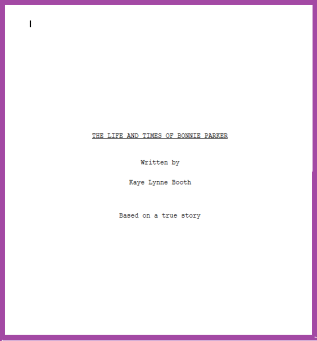
Many students of literary writing issue moans and groans when it comes time to do the research for their book. After all we’re writers, not researchers, right? But the fact is, that in order to write the story, even though it may be fictional, you half to know your stuff, and with literature, that could mean being familiar with the time period you’re writing about, or when certain items or words came into use, or being familiar with the place in which your book is set. If you’re writing a science fiction novel, you must at least be somewhat familiar with the science of the technologies you’re writing about, and even in fantasy works, you must be familiar with what the fantasy creatures you’re writing about are capable of.
It’s no different in screenwriting. You need to be familiar with the time period and location your screenplay takes place in, as well as being familiar with what the tropes are for your genre and what has been done that is similar to your story. But, I haven’t heard screenwriters complaining, maybe because the research is a little bit different than literary research. In fact, research in screenwritng can be fun.
In Parts 1, I talked about how the story goes from idea to beat sheet and/or outline. In Part 2, I described the tools used to sell a screenplay. Now, let’s look at the research that goes into a screenplay, and don’t shy away, because in screenwriting, the research is the fun part.
Research
Both literary writing and screenwriting require research. The type and extent of research required depends on what you’re writing. I watched every documentary on Bonnie and Clyde that I could find, as well as every DIY film on YouTube I could find, in order to get a feel for who these two people were. This helped a lot in determining what their bios would look like and how they would be portrayed in the film. I also visited websites with information on them and websites on the depression era, where I picked up slang from the 20s, which I salted my screenplay with to give it the proper feel.
But there’s a different kind of research you do in screenwriting, in addition to the research mentioned above. In screenwriting, you examine movies that are similar to yours in some way to learn what’s been done, and what worked and what didn’t. Sometimes you may chose a movie just because it has a scene similar to one you’re trying to do and you want to see how they went about it. This is one of the neatest things about screenwriting, you get to sit around and watch movies and call it work.
For my thesis, obviously any fictional portrayals of the outlaw couple needed to be on my list, but I also wanted to watch other gangster type movies to get a feel for the lifestyle, and the era. I watched biographical pictures to learn how they make real life events fit into the screenplay formula, and buddy love films to see how they allow one character to lead another into things, without portraying the leading character as a villain. It was amazing when I realized the different things I learned from each one.
Movie List
- Bonnie and Clyde, 1967, written by David Newman and Robert Benton – this was the original movie that we all think of when we think of the outlaw couple. It glamourizes Bonnie and Clyde, what they did and how they lived, and portrayed them as cold, blood-thirsty killers. This was not how I wanted to portray them, and I didn’t want to do what had already been done, so this film showed me what I didn’t want to do.
- Bonnie and Clyde 2013 miniseries on the History channel – this portrayal of the couple really played up the cold blooded killer image of all of them, Blanche and Buck, as well as Bonnie and Clyde, and it’s a ruthlessness that I don’t believe was truly there. Again, I learned what not to do. I wanted my screenplay to be very different from this.
- Donnie Brasco, 1997, adapted by Paul Attanatio from the book by Joseph D. Pistone and Richard Woodley– I found this to be one of the best mob movies I had ever seen. I was truly impressed with the craftsmanship seen in this film. I chose it because of the similar situation, getting caught up in circumstance and events beyond the character’s control.
- Black Mass, 2015, written by Mark Mallouk and Jez Butterworth – Not only is this film a crime drama, but it is a bio-pic, based on the true story of the criminal career of mobster Whitey Bulger. The similarity here was found in the way the character Whitey Bulger rationalized his actions, which I considered when having Bonnie rationalize her actions, and what she was willing to do in order to be with Clyde. I also looked at this film in regards to how they set the events to the beats in the film.
- Dillinger, 1973, written and directed by John Millius – Not only is this a bio-pic, but they make mention of Bonnie and Clyde in this movie, which gave me the idea to make mention of Dillinger and other well-known gangsters of the time in my own screenplay as a means of marking the time period.
- Scarface, 1983, written by Oliver Stone – This is an excellent movie, but I didn’t take a lot away from it which could be used in my screenplay. Bonnie and Clyde weren’t anywhere near the big time criminal that character Tony Montana a.k.a. Scarface, was in this bio-pic.
- The Untouchables, 1981, written by David Mamet – This movie gave me a feel for the times, and the public sentiment towards the criminal element which was prominent in the times.
- Public Enemies, 2009, written by Michael Mann, Ronan Bennett and Ann Biderman – This is a period film that was set in the same time period as my own screenplay. It deals with the gangster subculture of the times, of which Bonnie and Clyde ran on the fringes.
- Thelma & Louise, 1991, written by Callie Khouri – This buddy love is similar in circumstance to my screenplay in that the protagonist gets swept up in the circumstances, and that the circumstances were created by the choices the protagonist makes, and that they both die in the end.
- The Falcon and the Snowman, 1985, from the book, The Falcon and the Snowman: A Story of True Friends and Espionage, by Robert Lindsay and adapted by Steven Zaillian – I viewed this movie for some of the same reasons I viewed Thelma & Louise. The protagonists gets caught up in circumstances of their own creation, brought about by the choices that they made, which send them on a downward spiral. Plus it is a biographical film, based on a true story.
- Natural Born Killers, 1994, written by Quentin Tarantino and revised by David Veloz – Although this movie is very bizarre, the protagonists are lovers on a crime spree. Like previous portrayals of Bonnie & Clyde, these two are portrayed as cold-blooded killers, ruthless, killing for the fun of it. That is not the story I wanted to tell, therefore this movie showed me more of what I did not want to do in my own screenplay.
- Blow, 2001, adapted by David McKenna and Nick Cassavetes from the book by Bruce Porter, Blow: How a Small Town Boy Made $100 Million with the Medellín Cocaine Cartel and Lost It All – This is a biographical film of cocaine smuggler Gorge Jung, so I was looking at how the events were shaped to make up the beats of the movie, and it is another story where the protagonist gets caught up in the criminal elements due to the choices made, and their life spins out of control in a downward spiral.
- Coal Miner’s Daughter, 1980, written by George Vecsey as an adaption of the biography of country singer, Loretta Lynn – In this film I was looking for how the events were molded into the beat sheet formula of screenplay, as well as the romance elements.
- What’s Love Got to do with It?, 1993, adapted by Kate Lanier from the book I, Tina, by Tina Turner and Kurt Loder – This biographical film tells the story of how Tina Turner found the courage to break out of an abusive relationship. What I took away from this film was the way that Tina rationalized staying with her husband, Ike, how she kept telling herself that things would change, which is very similar to how my Bonnie rationalizes staying with Clyde, first believing he will change and go straight, and when it became obvious that wasn’t going to happen she allowed herself to believe they would go away to California.
Of course, this type of research, the fun stuff, has its equivalent in literary writing. It’s always good to read books in your genre to see what’s out there and know the tropes. The real difference is that in literature, the author is always trying to come up with a totally original idea, but in screenwriting, its acceptable, in fact encouraged, to use movies that have already been done successfully in describing what your movie is about in the logline or pitch, where you explain how your movie is the same as (a movie that’s already out there), but different. It is common practice in Hollywood, apparently, to describe your movie or television series as: (Title of existing movie) with a twist. For example, I described the pilot series that I wrote, titled Unhappily Ever After, as “A reverse Once Upon a Time combined with a humorous Into the Woods.” You can tell a lot about my pilot series from that, but I’ll have to save that for another post.
The point here is, in screenwriting it’s okay to do the same story someone else has done, as long as you give it some kind of twist to set it apart from the rest. For my thesis, I told the story from Bonnie’s perspective and that made it a very different movie from the other portrayals of the same story.
Next week we’ll take a look at the last step in creating the finished screenplay, rewriting. A screenwriter rewrites constantly, for as many drafts as it takes to get the desired results and make her screenplay tell the story she wants to tell, the way she wants to tell it.
Like this post? Subscribe to Writing to be Read for e-mail notifications whenever new content is posted.
Share this:

“The Road Has Eyes” takes readers on a unique and entertaining journey
Posted: May 6, 2016 Filed under: Book Review, Nonfiction | Tags: Art Rosch, Book Review, Books, Nonfiction, The Road Has Eyes 4 Comments
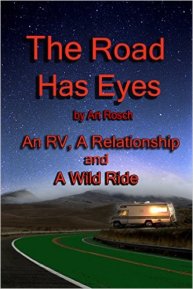
The Road Has Eyes – A Relationship, An RV and A Wild Ride Through Indian Country by Art Rosch is much more than a travel journal. It’s a memoir of a journey, both physical and spiritual, across country and into a new and different way of life. It begins in a relic RV that got them where they were headed, amidst mega doses of anxiety, then moves into a more modern RV that brings them back across the country to settle in to a new, downsized way of life. Along the way, readers get to know the author and his quirky companion, who traces her Native American heritage and links psychically with feral cats and other animals.
The tale is obviously told from an honest and heartfelt perspective, with a relaxed tone that’s easy to read. Rosch’s down to earth sensibilities and ability to see the humor in things, including himself, make this commentary on humanity a fun and amusing read. I found this book to be very entertaining, evoking more than a few chuckles as the pages turned. I can’t wait to start reading another of Rosch’s books, Confessions of an Honest Man. Check back here for my review on that one. I give The Road Has Eyes – A Relationship, An RV and A Wild Ride Through Indian Country four quills.

Share this:

Discouragement or Motivation?
Posted: May 5, 2016 Filed under: Western, Writing | Tags: agents, Delilah, publishers, Rejection, Western, Writing 6 Comments
I finished the final draft of Delilah last month. Normally, in anticipation of its completion, I would scour my Writer’s Market in search of publishers and/or agents that might be in the market for a western novel with a tough, spunky female protagonist and make a list of places to send it out to. But, I pitched Delilah to a publisher I felt would be a perfect fit for this manuscript last summer at the Write the Rockies Conference in Gunnison, and got an invitation to send the manuscript when it was completed. That in itself was amazing, because you usually don’t pitch a manuscript that isn’t complete, but I was doing the pitch for practice, and I actually felt like I’d bungled it pretty badly. My perception of my performance must have been wrong, because the invitation to query was forthcoming.
At any rate, I didn’t make the usual list of submissions for Delilah, because I knew where she was going, and I just knew this publisher was going to make an offer. Instead, I spent my time preparing for submission. I wrote a synopsis and query letter, and prepared a brief excerpt to include. So, as soon as the final revisions were completed, I sent off my query.
I also sent a query to an agent I thought might be good to represent me, using Delilah to entice them. I sent it off on April 21, and on April 29 I received the rejection. Man that was fast. I found it disheartening. I know I have to expect rejections, probably a lot of them, and I’ve had many on other works which I’ve been shopping. In my graduate classes at Western State, they warned us to expect them, and taught us to use them as motivation to get it back out to the next perspective publisher or agent. And, you know, that’s exactly what I’ve done regarding all the other works I’ve sent out. So, why is this rejection any different?
I think it was the speed with which I received this rejection, barely a week, which took me aback. You wait for responses from publishers and agents for weeks, sometimes even months. That’s why you send out simultaneous submissions whenever possible. Get your work read by as many possible avenues of publication as possible. It’s common practice, although some calls for submissions specify that they do not accept simultaneous submissions. (If you think about it, it’s pretty selfish of a publisher to do this, expecting to allow them to consider your work exclusively, when it takes so long for them to respond.) This rejection came from an agent, not a publisher, but I wasn’t expecting a reply so quickly. I didn’t feel like they’d even had time to read what I’d submitted.
I’ve worked on Delilah on and off for four years. I could have finished her sooner, but with school and my freelancing, and holding down a full time job, I wasn’t able to work on her, like I did on my thesis, which I wrote in full within six months, (but that’s another story, for another day). Actually, I had a completed draft of Delilah in that amount of time, but the revisions turned it into a whole other story. It’s true. The final manuscript of Delilah tells a different story than the one I set out to tell originally. I have enough cut scenes from the first draft to almost make up another whole book, which I might do, if Delilah finds a home and does well.
So the question remains, why have I not sent Delilah out to more than one publisher? Why do I have this certainty within me that she will find a home with this one publishing house that I submitted to first? I know this isn’t a realistic expectation and I’m probably setting myself up for disappointment. I do. So, why don’t I treat this novel like my other works? And why did the first rejection from an agent hit me so hard? Maybe because I have put so much of my heart into Delilah, but I think you have to put your heart into any work of creativity in order for it to be truly good. I don’t know what’s so special about this novel, but I know Delilah is special. I feel it. If I find a publisher for her, you can read it and then, you’ll know it, too.
Share this:

The Making of a Screenplay: The Creative Process (Part 2)
Posted: May 2, 2016 Filed under: Screenwriting, Writing | Tags: beat sheet, character bios, character triangles, creative process, logline, pitch, Screenwriting, treatment, Writing 4 Comments
Last week in Part 1, I explored story origins, and the tools you use to shape an idea into a movie plot with a beat sheet. Now I’ll talk about tools, like the step outline, which are used to convince others to read and hopefully, buy your screenplay.
The Pitch
One big difference between screenwriting and literary writing is the way they handle the pitch. While in literary writing, they teach us to do the pitch for our story only when we’re close to having a finished product to sell to an agent or publisher, in screenwriting you write the pitch from the idea, before you ever start writing the actual script. This is because of the difference in the pitch itself, for in literature, your pitch is usually written and submitted in the form of a query, in screenwriting, you must be able to talk about your movie in a brief one line description and in expanded forms that explore more depth and detail, so writing pitches is something we practice a lot. The thing is, often after all the revisions and rewrites, the final product turns out to be something different from what you were pitching. Until I figured out how to write this movie from Bonnie’s perspective, I was just pitching the same movie everybody already knows.
It was during the time I was trying to get my pitch right that the title changed. I had been referring to The Life and Times of Bonnie and Clyde, until I finally figured out that this was really Bonnie’s story, from Bonnie’s perspective. I’d been saying it all along, claiming that was what set my story apart from all the rest, but I hadn’t been doing it. I was still looking at it from the perspective of the two of them as a couple. While I couldn’t change the real life events to fit the formula, I could show different events that gave the story a different perspective, and even a different tone, starting with the title.
In both literary writing and in screenwriting, your pitch is your calling card. It’s your key to the kingdom of either publishing, or production, and it must reach out and grab the reader’s attention and hold it, making them want to know more. They’ll see the pitch first, and it has to tempt them to continue on and read your script or manuscript, and that’s a goal that every writer understands.
The Treatment
A treatment is the outline for your script. It tells everything you want an interested buyer to know about your script. My treatment starts with my logline. A logline is a one to two sentence description of a movie or television series. As a rule, it’s 25 words or less, but it can be presented in longer paragraph form. My logline for The Life and Times of Bonnie Parker is: “The Life and Times of Bonnie Parker is the tragic story of a young woman in the depression era who falls in love with a petty criminal, and is caught up in a whirlwind of lawlessness in their struggle to survive. When theft turns to murder, they’re swept into a life on the road which can only lead to tragedy.”
Character Triangles
Character triangles are one thing that actually works in literature a well as in screenwriting. Every character in every story ever written or thought of has a want or desire which motivates them to take action and move the story forward. Likewise, every character has a fear or flaw, which stands in the way of achieving whatever it is that motivates them, and obstacle to achieving their goal, which must be overcome. And, once their flaw has been overcome, a transformation takes place and the character is changed, creating a character arc for your story. At this point we usually learn what it is that the character actually needs, which is usually something different from what the character’s want is, but it’s achievement must be acquired to achieve the completion of the character arc. The need might be a lesson learned, or self-discovery of an aspect of their personality they were unaware of, but it’s always an inner need. As a general rule, the character’s desire is usually an external want, while the need is internal. This applies to storytelling of any type. It works when applied to both literary writing and screenwriting.
My instructor and screenwriting advisor, J.S. Mayank, always has us determine the character triangles for at least two or three of the main characters before we try to write, because he believes that if you have your triangles figured out, the rest will fall into place. Triangles are an area I have a lot of difficulty with for some reason, and I usually make several shots at it before I get it right. My triangle for Bonnie looked like this:
Want: To be with Clyde
Fear/Flaw: Abandonment
Need: Self-reliance
Unfortunately, Bonnie never achieves her need.
Also included in your treatment are character bios for at least two or three of the main characters. In storytelling of any kind you must know your characters well. It’s a secret to writing well-rounded characters who readers or viewers can relate to. Characters without background, feel flat and two-dimensional. For my characters, the bios are already written, since they are true life characters, but I still had to write a sketch that tells how I see them.
Then comes the actual treatment, or outline, which tells what happens in your movie beat by beat. I like to write mine like a beat sheet, placing each scene in the beat it should be under. Some beats may have more than one scene, but with the formulaic nature of screenwriting, it’s fairly easy to label each beat once you have all the scenes laid out.
Again, there were a lot of revisions and changes in the rewrite, so my original treatment was different in many ways from how the final product turned out. Some scenes were thrown out and replaced by others, some scenes were just tossed out, and some scenes were added where I felt they were needed. The necessity of a revised treatment once the final screenplay is completed is obvious.
These are the tools of persuasion, or explanation which are used to try to sell a screenplay. Next week in Part 3, I’ll take a look at the research that goes into writing a screenplay. It’s the fun part, so don’t miss it.
Share this:

Weekly Writing Memo: 4 Methods for Easier Editing
Posted: April 27, 2016 Filed under: Uncategorized 3 Comments One of the hardest parts of writing is to go back and edit your own work. The problem is, you know what is supposed to be on the page, so often times your brain will fix what you see so you miss things. There are a lot of things you can do to help you edit your work, but there are four things that I find help the most.
Use a New Format
One of the simplest things you can do to make editing easier is to look at the work in a format that is different from how you write. So if you write in a word document, try looking at the work in a PDF. If you write on your computer, try printing out your writing so you can edit it by hand.
One of my favorite methods is to send the document to my Kindle and read it as if it is an eBook. Then I use the highlight function to indicate different types of notes—yellow for typos, blue for story issues, red for inconsistencies, etc. You can also do what a friend of mine does and change the font size of your writing when it’s time to edit, or even change the font itself.
Switching up the format you read your work in when editing can be a major help because it changes the writing from what you are used to seeing and helps create some distance. For me, putting it on my Kindle is a huge help because it makes it easier to tell myself it isn’t my writing and to force myself to look at it objectively. So try several methods until you find the one that works best for you to get into a critical, and objective, mindset.
One Step at a Time
A lot of writers tend to overwhelm themselves when editing by trying to focus on too much all at once. Whenever I go through, I focus on one specific element at a time. Am I look for story, or am I proofreading? The way you look at the story is different for the type of editing you are doing, so make sure to tell yourself up front what your goal is and stay focused on that.
This doesn’t mean you can’t find typos and such when editing for content, it just means that your focus should not be to try and catch everything. The more you try to catch everything in one pass, the more you’ll miss. You should be doing multiple passes anyway, so deciding on a specific type of editing for each pass will help you do a more thorough job, and keep your editing focused.
Stay Detached
It’s incredibly easy when reading your work for editing to get involved in the story and start enjoying your writing. There’s nothing wrong with enjoying your writing or your story, but the more you are focusing on the activity as being one for pleasure or enjoyment, the less critical you are being. So whenever you find yourself getting involved in the story and sitting back to enjoy it, take a break. Stop reading, stop revising, and walk away for a few minutes if needed.
Then, focus on what your goals are as far as editing, and go back at the work like an editor, not a reader. If you let yourself get sucked into your story, you’re going to stop seeing the mistakes and just focus on what you like. So always stay conscious of HOW you are reading, and force yourself to stay somewhat detached.
Take Breaks
Editing is a much harder task than a lot of people think it is. It’s easy to go on autopilot and just start reading without being critical. To prevent this, set specific reading periods and break periods.
When reading a novel, I always stop at the end of every chapter and ask myself a few questions about what I read. Did the characters work? The plot? The setting? Is there anything I’m unclear about? Whatever notes I come up with I jot down, and then I refocus on my goals for editing and start the next chapter. Pausing between sections helps keep you focused, and gives you an opportunity to really think about what you’ve been reading. For something like a screenplay, I set my break times by page number. So every 10-15 pages I stop, let myself process what I’ve read, and then go back at it.
Just remember, the breaks aren’t just about taking time off from reading; they’re about keeping you in a critical mindset, they’re an opportunity to ask yourself questions and analyze what you’ve read so far, and they’re a chance for you to get a sense for the writing.
The biggest thing to remember about editing and revising is that it is a process, and a long one. So give yourself a chance to rest between readings, and make sure as you read that you aren’t growing tired with the task. And remember, while it may be a tedious task, the more serious you take it the better your work will be in the long run.
Share this:

The Making of a Screenplay: The Creative Process (Part 1)
Posted: April 25, 2016 Filed under: Screenwriting, Writing | Tags: beat sheet, creative process, Screenwriting, step outline, Writing 6 Comments
Writing for the screen is very different from literary writing, but there are also many similarities. Although my thesis project, The Life and Times of Bonnie Parker, is for the screenwriting emphasis, I obtained the first emphasis for my M.F.A. in Creative Writing in genre fiction, so I tend to make comparisons with my literary experiences naturally. Screenwriting is visual, whereas literature employs the use of all five senses. Screenwriting is also much more formulaic. Where literature tells us we must have a beginning, middle, and end, and we must throw a climax in there somewhere, screenwriting outlines all the beats and tells us approximately where each one should fall within your script. I think you get the idea. What you’re about to read is what goes into the creative process of writing a full length feature screenplay, from a literary perspective.
Story Origins
My thesis project, The Life and Times of Bonnie Parker, is based on the true life story of 1930’s bank robbers, Clyde Barrow and Bonnie Parker. It’s not an idea I brilliantly plucked from the idea tree that grows in the backyard of my mind, but rather a different version of a story that’s been told many times before. It is the result of viewing the 1967 film, Bonnie and Clyde, with Faye Dunaway and Warren Beatty, as well as numerous documentaries on the couple and their infamous crime spree. From my research, as I compared the many conflicting stories and the different portrayals of this story, it occurred to me, that really, this was a tragic love story, a contemporary Romeo and Juliet, but no one had ever shown that side of it. Their story had always been portrayed with car chases and shoot outs, glamourizing the gangster life, but to me, that wasn’t what Bonnie and Clyde were about. Hence, the idea was born to tell the story of Bonnie and Clyde from Bonnie’s perspective, the story of a young girl caught up in the circumstance of the times, willing to anything for the man she loved, including die for him.
The Beat Sheet
As I mentioned, screenwriting is very formulaic. So, where in literary writing you make an outline before you start writing your novel or book, in screenwriting, you create a beat sheet before you start. The beat sheet outlines each event which propels your story forward, and as I also mentioned each beat is supposed to occur at a certain point within the script.
Now here’s where I had a lot of difficulty, because true life events seldom conform to the formulaic sequence of a screenplay. The story of Bonnie and Clyde was no different. Because of this, and because I still thought of their story as the crime spree they embarked on between 1932 and 1934, the beat sheet I created turned out to be different in many ways from the final script. Once I began looking at things from Bonnie’s perspective, it turned into a very different movie.
Step Outline
In addition to this, a screenwriter must also be able to do a step outline, which chronicles each scene, step by step, very similar to a chapter outline for a literary work. While the beats can be noted in the step outline, this is not the same as the beat sheet.
There’s a lot more that goes into writing a screenplay, but this is how you get started. The beat sheet is a tool for your own use, while the Step Outline is a tool you use to convince a producer or director to buy your screenplay and hopefully, make a movie out of it. Next week, in Part 2 of Making a Screenplay, we’ll talk more about the tools you use to sell your screenplay.




















