The Final Weekly Writing Memo and a Writing Prompt
Posted: November 30, 2016 Filed under: Fiction, Screenwriting, Uncategorized, Weekly Writing Memo, Writing, Writing Tips | Tags: Inspiration, Weekly Writing Memo, Writing, writing prompt 7 CommentsIf you aren’t interested in my update, skip to the bottom for a writing prompt.
The Update
As any readers who have been checking in regularly have probably noticed, I’ve been a little behind on posting these Weekly Writing Memos for the last few months. Between picking up new jobs, constant traveling, and a big move to Los Angeles from Michigan, it’s just been a struggle to keep up. Starting in December I am also going to be embarking on a project involving studying the horror film genre, as well as some new work as a part-time assistant editor for a small publishing company.
With my increasingly complicated schedule, this is going to have to be my last Weekly Writing Memo post for a while. Instead, I’m going to be cutting back to monthly memos and the first post will be sometime in December. I’ll still be doing other guests posts now and then to fill in for Kaye when needed, and I’ll hopefully be posting more on my blog as well. If you have questions, or if just miss me dearly, feel free to contact me at my blog Author the World or on my AtW Facebook page. For my final Weekly Writing Memo, I thought I would go with a writing prompt to leave you all feeling inspired (hopefully).
Writing Prompt – The Breakfast Fight
You have a character in a restaurant. They’re eating breakfast. Start with the restaurant. What kind of place is it? What kind of tables does it have? What kind of waiters or waitresses? What kind of clientele?
Now go to your character. Who are they? What kind of mood are they in? They can start alone at the table but they can’t stay that way. Your character is about to get in an argument. Do they know it yet, or will it be a surprise?
Before the argument starts your character’s breakfast arrives. What are they eating? Is it actually breakfast time? How are they eating it?
Once everything’s in place—the breakfast, the characters—it’s time to start the fight. Have your character continue eating throughout the argument. Try to keep the characters from making the argument into a big scene for as long as possible.
When the fight ends, does your character take out his anger on anyone else? Does he snap at the waitress, or forget to leave her a tip? Does he finish his food or lose his appetite?
Where does your character go next? How will he resolve the conflict? See where the argument takes you from there. Where there’s a conflict, there’s often a story, so follow it. If you decide you don’t like the characters in the argument, try writing it from the waitress’s or another diner’s perspective. Explore the scene and the people in it, and see where the writing leads you.
Share this:

Pros and Cons of Traditional vs. Independent vs. Self-Publishing (Part 7): Interview with Children’s Author, Nancy Oswald
Posted: November 28, 2016 Filed under: Books, Children's Books, Fiction, Publishing, Self-Publishing | Tags: independent publishing, Nancy Oswald, Publishing, Self-Publishing, Traditional Publishing 7 Comments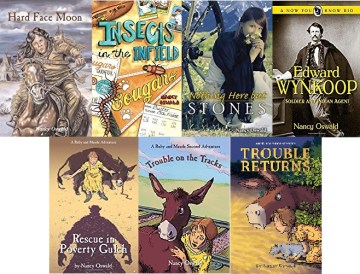
In this series, we’ve taken a look at the publishing industry, which today, isn’t played by the same rules as it was 30 years ago, when traditional or independent publishing houses were about the only options an aspiring writer had. The rise in digital and self-publishing has opened up new options for aspiring authors and changed some of the rules by which the game is now played. We’ve heard from self-published authors, Jeff Bowles, Tim Baker and Arthur Rosch, and traditionally published authors, Stacia Deutsch and Mark Shaw, as well as independently published author, Jordan Elizabeth.
In this week’s interview, we’ll hear from an author who has published work via all three publishing models, award winning children’s author, Nancy Oswald. She’s published traditionally with Holt, a big New York publisher, and a small independent publisher, Filter Press, LLC. In addition, her first book was published by Scholastic Canada, but she later rewrote it and self-published a Create Space version in 2013. Nancy’s Ruby and Maude Adventure series includes Rescue in Poverty Gulch, Trouble on the Tracks and her latest book, to be released this month, Trouble Returns. (Be sure and catch my review of Trouble Returns this Friday on Writing to be Read.) Her other publishing credits include Hard Face Moon, Edward Wynkoop: Soldier and Indian Agent, Nothing Here But Stones, and Insects in the Infield. And she has a very unusual story about how she broke into the publishing industry.
Kaye: When did you know you wanted to be an author?
Nancy: In my early teens, I thought writing children’s books would be really cool and I enjoyed writing—some poetry—but most of it school related. I didn’t get serious about publication until I was in my late twenties.
Kaye: Would you share your own publishing story with us?
Nancy: I wrote several books that I call my “cardboard cover” books for my stepson who was five when I married my husband. They were hand written and crudely illustrated and as you’ve probably guessed, had cardboard covers that were put together with rings that clipped through the pages and the cardboard and held the whole thing together. I did a couple of cardboard cover books for friends, too. But my stepson outgrew his “picture” books, so I started in on a chapter book. We lived in British Columbia at that time, so I mailed him the first chapter for Christmas and sent one chapter a month to him, finishing the book the next Christmas. This book was typed, yes on a typewriter, but still was a FAT cardboard cover book. After many many rewrites, this book became my first published novel for young readers. It had 35 rejections and was finally picked up by Scholastic Canada and five years later was reprinted by them. To this day, thanks to Scholastic’s book club program, it has outsold any of my other books.
Kaye: What do you see as pros and cons of self-publishing?
Nancy: In 2013, I self-published the above mentioned book. I’ve had the rights back since about 1996, so I rewrote the book, adding about 10,000 words and it ended up as a winner in the CIPA Evvy award competition. My likes: I really enjoyed having full control. I used Create Space and used their interior design service, but did the other parts myself. The Create Space team was accessible and helpful, and I had a really positive experience from beginning to end. A word of caution: you really need to have a clear idea of the design, font size, layout ahead of time. You have to be clear in communicating what you want. Negatives: Reviews were hard to get, ALL of the marketing is up to you, and if you don’t have a well-edited, professional looking copy, it will sink you
Share this:

Mark Shaw’s “The Reporter Who Knew Too Much”
Posted: November 25, 2016 Filed under: Uncategorized 3 Comments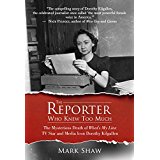
In The Reporter Who Knew Too Much, the author, Mark Shaw, takes on the role of investigative reporter, providing us with the little known facts in the story of Dorothy Kilgallen, and the circumstances surrounding her death in 1965. At the time, this determined female reporter was investigating the assassinations of John F. Kennedy and Lee Harvey Oswald, convinced that a conspiracy and cover-up was in play. Shaw has succeeded in unearthing evidence that Kilgallen’s death was not accidental, nor was it suicide, as has been alleged. In fact, there is a plethora of evidence that points to the fact that Dorothy Kilgallen was murdered, because of what she uncovered about the JFK and Oswald assassinations, the lack of proper investigation of her death part of the extensive cover-up to hide what was really going on at the time.
Dorothy Kilgallen became an icon for both women and aspiring writers, proving that family and career could be balanced and managed, even when holding down three careers at one time, something that was unheard of for the times. Her achievements offer hope to aspiring writers young and old, proving that anything can be accomplished if you want it enough and never give up. When she saw something she wanted, she reached out and grabbed a hold of it. When challenged, she dug in her heels and held tight. In a male dominated industry, she never backed down and proved she could do a better job than most of her male colleagues.
Mark Shaw does an impressive job of presenting us with her achievements and portraying her determination to win in all things she chose to embark upon. His portrayal of Dorothy Kilgallen reveals a woman who was tough and spunky, with a keen mind and sharp wit and the guts to ask the questions no one else dared to ask. Her words rendered her powerful, and although she was well loved by many, she made many enemies in her line of business, as well. As she uncovered more evidence concerning JFK’s death which supported her suspicions of conspiracy, the list of her enemies grew – enemies who were high in the U.S. governmental structure, as well as foreign foes.
Shaw chronicles the known facts of Kilgallen’s investigation up to the day of her death, and the mysterious disappearance of her investigative file, which she carried with her. That and the unexplained circumstances of her death which were only later revealed, certainly lead one to believe a full investigation was, and still is warranted. Mark Shaw approaches the investigation of Kilgallen’s death by following Kilgallen’s example and digging deep to uncover facts that have been purposely held back for fifty years. Certainly, an examination of the facts regarding Kilgallen seem to point to her murder, rather than an accidental death, and Mark Shaw thoroughly reviews the evidence pointing to all of the possible suspects including: Frank Sinatra and others Kilgallen had published unfavorable columns about; her husband Richard Kollmar; or one of the many suspects in the JFK assassination that Kilgallen’s investigation might point a finger at, high level government officials, powerful foreign government emissaries, or perhaps mobsters who had reason to silence the former U.S. leader.
Mark Shaw presents proofs that have been overlooked for lack of any investigation into Kilgallen’s death, that not only is it probable that she was murdered, but also that her investigation of the JFK and Oswald assassinations had uncovered evidence which might have changed history. Shaw points a finger at those who may not have wanted said information revealed. The Reporter Who Knew Too Much may not provide all the answers, but in it, Mark Shaw provides readers plenty of food for thought. It explores the list of suspects and an examination of motives. It goes on to investigate who had opportunity and lays out several scenarios which explain how the murder could have been pulled off by each one.
John F.Kennedy and Lee Harvey Oswald were assassinated before before I was born. Dorothy Kilgallen died before I was a year old. I have been aware of the conspiracy theories that have circulated about the death of JFK, of course, but did not known how they all came about or the true circumstances surrounding it all. Before reviewing The Reporter Who Knew Too Much, I had never heard of Dorothy Kilgallen. Mark Shaw’s investigative skill and the facts he presents here have certainly convinced me that justice has not been served and all three deaths deserve further investigation even after five decades. I give The Reporter Who Knew Too Much five quills.

Kaye Lynne Booth does honest book reviews on Writing to be Read, and she never charges for them. Have a book you’d like reviewed? Contact Kaye at kayebooth(at)yahoo(dot)com.
Share this:

Weekly Writing Memo: Learning to Write
Posted: November 24, 2016 Filed under: Fiction, Screenwriting, Screenwriting, Uncategorized, Weekly Writing Memo, Writing, Writing Tips | Tags: Writing 5 Comments Everyone always wants to know the big secret for how to write. They want the shortcuts, and the formulas, and the rules, but while those things may give you the illusion of a solution, they’re not the real answer. Shortcuts, rules, and formulas for writing can be great and useful, but in the long run, they limit your abilities as a writer. Knowing the rules can be a good foundation, but personally, I believe that it can’t be all you know. While everyone has a different theory about the best way to learn to write, there are a few “tricks” that almost everyone agrees on.
Reading
It amazes me the number of writers, screenwriters or fiction writers, who loudly proclaim how little they read or how much they hate reading in general. Whatever your chosen medium, you should be reading it and absorbing it as much as possible. As a screenwriter, reading scripts can help you learn techniques for telling a story in script format, succinct characterization, how to establish setting and many other things. As a fiction writer, reading novels and short stories can help you learn much the same. The more you immerse yourself in what you want to create, the more natural it will be when you begin writing the material yourself. Everything you read, whether you realize it or not, is integrated into your pre-existing knowledge and expands the “tools” you have at your disposal for writing.
A great example of this that works for most people is something like grammar – if you read a lot, you will gradually pick up grammar rules and standards that you don’t even know you know. Think of every sentence you write. Do you specifically analyze the sentence structure and whether it is grammatically correct, or can you read it and know it “sounds” or “feels” right? Many people who have learned grammar through reading have this ability, where they can correct a grammatically incorrect sentence because the proper format has been ingrained in them through reading, but they can’t explain how the sentence was incorrect.
Learning story and writing works similarly in some ways. If you read enough of the medium you want to write, you will start to build up your ability to recognize what is standard, what is abnormal, and you may even start to recognize typical story structures and character archetypes. You’ll also be able to recognize when a writer does something unusual, and then you can begin to break it down and figure out what they did and why.
Analyzing
This next step is one that I think is critical in learning to write. While reading as much of your preferred medium is the first step, analyzing what you’re reading is the next. Forcing yourself to think critically about what you’re reading is how you can make it easier for yourself to recognize issues in your own work. Whenever you’re reading, ask yourself what is working for you and what isn’t. Then take things one step further and ask yourself why it isn’t working. If you can break down why something isn’t working, then when you encounter it in your own writing you’ll be able to fix it. Every piece of writing has good and bad to it, and learning to identify both in the works you read will help you figure out things you may want to emulate in your writing, as well as things you probably want to avoid.
Writing
The most obvious way to learn to write is by doing. So many writers constantly research how to write, or talk about writing, or dream about writing, but never actually get to the writing part. Writing takes practice, and the more you do it the more you’ll improve. Personally, I think the best way to improve is to constantly push yourself to try new styles and techniques of writing. When I was first starting out I embarked on a 365-day project to write a short story a day for a year. I did this because I wanted to really buckle down and explore my writing so I could improve. I know everyone doesn’t have the time to do something like that, but I do think the most valuable thing I learned from doing it was to try new styles of writing. By trying different styles, genres, techniques, and story structures, you become familiar with them and add them to your “toolbox” of abilities. If you understand how they work, then when you need them in a story you’ll easily be able to work them in. I also think it’s useful because just knowing about the various techniques broadens your abilities when you’re writing. It’s easier to figure out how to tell a story in the best way if you know 100 different methods than it is if you only know 2.
Mentors and Other Writers
Having a mentor can mean joining an MFA program, finding someone in the industry willing to advise you, or finding a workshop group or another writer to get advice from. The important aspect is to find other writers who you can share your work with and get feedback. Ultimately, I think writing stops progressing at a certain point without feedback, so you have to decide what you are looking for and where you can find it. Some people luck into a mentor and find the feedback and guidance that way, but others have to seek out that feedback in their own ways.
I’ve done workshops, worked with other writers, and been in an MFA program, and I think they all have their own benefits depending on what suits you personally. Workshop groups can be great because you get a huge variety of voices on a piece of writing and you can learn a lot about it. They can also be negative, however, because some workshops devolve into a hive mind and are no longer helpful. The problem is, you usually don’t know how helpful the group is until you get there, but the beauty is they usually don’t last long so you can always find another one if needed.
For some, an MFA program is a ridiculous waste of money and gets you nowhere, but I personally found it incredibly helpful because it fit what I was looking for. I did a low-residency MFA program at Western State Colorado University where I studied both genre fiction and screenwriting. I choose my MFA because the focus was on genre fiction rather than literary fiction (I already had a degree in literary fiction), and because the professors in the program were all people actively working in the industries they were teaching about. I also chose to continue studying writing in an MFA program because I wanted to learn as much about writing as I could, as quickly as possible, and an intensive 2-year program would give me that boost to help me write better and make connections.
Ultimately, whether you choose an MFA program, a workshop, or a mentor, it’s all about research and knowing yourself. What method do you learn best? Who are the teachers or writers you’ll be working with? What may the teach you? All that being said, the key to this is finding someone, somewhere, who you can connect with on your writing and learn from. If you have a mentor, or a writing group, or an MFA program that does this, that’s awesome, but the key is getting your work seen and getting a reaction. Writing is meant to be shared, and having a “safe” group to share it with before you go public can be pivotal in your writings’ success.
Final Notes
There are a lot of other tips and tricks you’ll see about how to perfect your writing and become a master, but ultimately they all boil down to these four things: Read what you want to write; Study it, analyze it, and tear it apart until you understand how the writing succeeds and how it doesn’t; Write as much as you can and practice, experiment, and repeat; and find someone to share your work with that you can trust, that you can learn from, and that you can get feedback from. It takes time, and a lot of work, but your writing will show that it’s worth it in the end.
Robin Conley offers great writing advice most Wednesdays and shares an occasional guest review on Writing to be Read. If you just can’t wait until next week to find out more, you can pop into her blog, Author the World, for more tips, or a weekly writing prompt.
Share this:

Pros and Cons of Traditional vs. Independent vs. Self-Publishing (Part 6): Interview with Independently Published YA Author, Jordan Elizabeth
Posted: November 21, 2016 Filed under: Books, Fiction, Opinion, Promotion, Publishing, Steampunk, Writing, Young Adult | Tags: independent publishing, Jordan Elizabeth, Publishing 3 Comments
Share this:

Pros and Cons of Traditional vs. Independent vs. Self-Publishing (Part 5): Interview with Traditionally Published Author, Mark Shaw
Posted: November 14, 2016 Filed under: Books, Nonfiction, Opinion, Publishing, Self-Publishing, Writing | Tags: Mark Shaw, Publishing, Self-Publishing, Subsidy Publishing, Traditional Publishing 3 Comments

Those who remember traditional publishing prior to the digital age, recall an industry which was not easy to break into, but with persistence, it could pay off with large advances, and a contract from one of the “Big Five” publishing houses. Your publisher took care of the rest: editing and proofreading, cover and/or illustrations, publicity and marketing. In many ways, it is the same today, but one thing self-publishing and independent publishing have changed, is that they showed traditional publishers that authors were capable of doing their own promotion and marketing. Today’s authors, it seems, are now expected to carry the weight for these tasks no matter which model is chosen.
The rise of digital and self-publishing also brought about a rise in publishing scams, designed to take advantage of aspiring authors and empty their pocketbooks. In the 1990s, when I began writing, they called them vanity presses.An author would send in their work and receive a very favorable response, praising their work and offering to publish it for a fee. As the author moves through the publishing process, the fees keep adding up. Today they are called subsidy publishers. As with traditional publishers, subsidy publishers hold the rights to the book, although the author is paying them to publish it.
So far in the series we’ve heard from self-published authors, Jeff Bowles, Tim Baker and Art Rosch, and we’ve heard from traditionally published author Stacia Deutsch. Join me today to get more of the traditionally published POV in my interview with author Mark Shaw. Among his 25 published works are books I’ve had the pleasure of reviewing as The Southern Colorado Literature Examiner: The Mask of Holiness, a biography of Thomas Merton, and Stations Along the Way, a biography of former Hitler youth leader, Ursela Martens. In addition to being a traditionally published author, Mark is a literary consultant and entertainment attorney, so he knows of what he speaks.
Kaye: When did you know you wanted to be an author?
Mark: I’m a former criminal defense lawyer and I never considered being an author until I covered the Mike Tyson rape trial for CNN, ESPN, and USA Today. I believed Tyson was denied justice and so I wrote my first book, Down For the Count.
Kaye: Would you share your own publishing story with us?
Mark: I was able to find a literary agent to represent the Tyson book and he found a traditional publisher. I had enjoyed the writing process and the book sold well so I looked for new subjects to write about and within a few years I had published several traditionally published books. Looking for a theme to weave through new books, I landed on “justice denied” and the last four or five I have written including my latest “The Reporter Who Knew Too Much: The Mysterious Death of What’s My Line TV Star and Media Icon Dorothy Kilgallen,” are symbolic of the type of books I write. Sometimes I have to pinch myself that this book will be my 25th since I never had any formal training as a writer but I’m blessed that people have enjoyed the “stop and think” aspect of the books and continue to praise my body of work.
Kaye: What do you see as pros and cons of self-publishing?
Mark: As noted in my book about the publishing process, “How to Become a Published Author: Idea to Publication,” as long as it’s what we call “traditional self-publishing (no subsidy publisher) then okay, but the career of any writer who uses a subsidy publisher where they pay to have the book published (Dorrance, iUniverse, Trafford, AuthorHouse, XLibris, etc.) is doomed with many who have come to me for consulting telling horror stories of losing their life savings, their homes, etc. Subsidy Publishing is the absolute kiss of death and so many writers fall prey to subsidy publishers that promise the moon and end up with boxes of books in the basement they can never sell since libraries and most bookstores won’t touch them. This is unfortunate since aspiring authors can use a combination of Create Space and Ingram Spark to publish a book with very minimal cost and this traditional self-publishing method is a badge of honor and libraries and bookstores will be interested in purchasing and stocking the book.
Kaye: What do you see as the pros and cons of independent publishing?
Mark: There seems to be confusion as to what this term means but as long as it doesn’t include subsidy publishing, I’m all for it.
Kaye: What do you see as the pros and cons of traditional publishing?
Mark: I encourage writers to try the traditional publishing route by using query letters and book proposals and a good strategy for landing a literary agent or publisher and if that doesn’t work, then use traditional self-publishing. The advantages of traditional publishing include the publisher paying for all aspects of the publishing process, editing, layout, cover, etc. without the writer putting up a cent but most importantly traditional publishing includes distribution (my new book has Simon&Schuster distribution) which traditional self-publishing lacks since the author must do the distribution. One disadvantage these days for a first time author is that unlike ten years ago, many traditional publishers will not do much toward promotion and thus the author is expected to do the major part of the work.
Kaye: How much does the non-writing work, (marketing & promotion, illustrations & book covers, etc…), that you must do yourself vary between the different models?
Mark: You are talking about completely different subjects here. With marketing and promotion, regardless of the method of publishing, an author has to understand that he or she must be the guiding force behind book publicity. With illustrations and book covers, etc. traditional publishers will handle this task while the author of any traditional self-published book is responsible for handling these matters and there are several outstanding consultants who can help with this tasks. Again, writers should stay away from subsidy publishers many of whom produce inferior books that cause problems right away with the authors’ reputation.
Kaye: Do you recommend traditional publishing for today’s aspiring authors, and why or why not?
Mark: Absolutely but writers must proceed with a well-developed strategy such as the “10-Step Method” outlined in “How to Become a Published Author.” There are no shortcuts possible here and most writers don’t want to put in the hard work necessary to secure a literary agent so their chances of securing a publisher are optimized.
I want to thank Mark for sharing his thoughts with us. Also, I’m excited to be reviewing his latest book. Be sure and catch my review of The Reporter Who Knew Too Much on November 25, right here on Writing to be Read. To learn more about Mark Shaw or his books visit his website.
Don’t miss next Monday’s post and my interview with independently published YA author, Jordan Elizabeth, and get her thoughts on today’s publishing industry on Writing to be Read.
If you liked this post, subscribe to email and receive a notification each time a new post is made on Writing to be Read.
Share this:

Being a Genie May Not Be All It’s Cracked Up To Be in “Bottled”
Posted: November 11, 2016 Filed under: Book Review, Books, Fantasy, romance | Tags: Book Review, Bottled, Carol Riggs, Magical, romance 1 Comment
Bottled, by Carol Riggs is a delightfully refreshing tale of a young woman turned genie, who is imprisoned in her bottle for centuries, bound to obey whoever has possession of it. Adeelah longs to find Karim, the man she loved when she was still mortal, but she is running from another, Faruq, who seeks her throughout time. The reader doesn’t know all this right away, of course. Instead, Riggs skillfully unfolds the back story throughout the story, revealing the details in small doses which capture and hold readers interest and keeps the pages turning.
—————————Partial Spoiler Below———————-
After a slew of horrible masters, Adeelah finally finds herself with a truly good master, who allows her to search for her Karim, the love in this magical romance. We learn the full story of how Adeelah’s imprisonment came to be, but all is not as it appears. When Adeelah learns the truth about Karim, she has some tough decisions to make. Can she reunite with Karim after learning the truth about his centuries old deceit and betrayal?
Bottled is a well crafted story, with plenty of tension and just the right amount of intrigue to keep the reader coming back for more. Riggs has created a wonderfully unique and interesting character in Adeelah, with just the right amount of naivity to convince me of her eternal youth, and a perfectly evil villain in Faruq, who only wishes to possess Adeelah’s bottle for his own selfish purposes. The pacing, too is perfect and the story moves along smoothly. The rules of the world are established from the beginning, enabling her to deliver fully the promise of the premise. because even genies have their limitations and the reader knows what they are. And I must compliment Riggs on her choice of cover art. The cover for this book is gorgeous. I love it. I give Bottled five quills.

Kaye Lynne Booth does honest book reviews on Writing to be Read, and she never charges for them. Have a book you’d like reviewed? Contact Kaye at kayebooth(at)yahoo(dot)com.
Share this:

Pros and Cons of Traditional vs. Independent vs. Self-Publishing (Part 4): Interview with Traditionally Published Children’s Author, Stacia Deutsch
Posted: November 7, 2016 Filed under: Books, Children's Books, Fiction, Opinion, Promotion, Publishing, Self-Publishing, Writing | Tags: independent publishing, Publishing, Self-Publishing, Stacia Deutsch, Traditional Publishing 3 Comments
So far, in this publishing series, we’ve heard from three self-published authors who say self-publishing is the way to go for today’s authors. In Part 1, we heard from my talented friend and cohort, Jeff Bowles. In Part 2, we heard from tale spinner, Tim Baker. And last week, in Part 3, we heard from storyteller and author, Arthur Rosch. This week, we’ll hear from the other side of the writing field, as I interview a traditionally published author.
Join me for today’s interview with Stacia Deutsch, who is the author of more than two hundred children’s books, both original and write for hire. I had the pleasure of first, being a cohort to and then, studying under this amazing children’s author, so vibrant and full of energy, and always smiling. She is the author of the eight book, award winning, chapter book series Blast to the Past. Her resume includes Nancy Drew and the Clue Crew,The Boxcar Children, and Mean Ghouls from Scholastic. Stacia has also written junior movie tie in novels for summer blockbuster films, including BATMAN, THE DARK KNIGHT and the New York Times Best Sellers: CLOUDY WITH A CHANCE OF MEATBALLS JR. and THE SMURFS.
Kaye: When did you know you wanted to be an author?
Kaye: What do you see as the pros and cons of traditional publishing?
Stacia: I love being with traditional houses and finding my books in the big box stores, or at the airport, or at Scholastic book fairs. There is no other way into those places. The issue is that you aren’t making every cent from your own book, but you have little outlay as well. My agent gets 15% of everything I sell.
Kaye: How much non-writing work, (marketing & promotion, illustrations & book covers, etc…), do you do yourself for your books?
Stacia: It’s a big deal for the author to do their own promotion and really necessary. You have to be devoted to your audience, and build a following to be successful. You need a budget. Do you want to travel, do a book tour? website? blog tour? Everything costs. So, regardless of how you get published, play how much money and time you are willing to put into it.
Kaye: Would you recommend your chosen path to publication, to emerging writers? Why or why not?
Stacia: I am an advocate for traditional publishing. I think agents and editors are gate keepers for quality. But if you have a good idea, that doesn’t fit what houses are looking for, go for it. Just be aware of what you’ll need to do to make it work.
Share this:

A Peculiar Experience: Miss Peregrine’s Home for Peculiar Children
Posted: November 5, 2016 Filed under: Commentary, Film Review, Screenwriting, Screenwriting, Uncategorized, Writing | Tags: Movies, Opinion, Review, Reviews 1 Comment
The first word that came to mind after seeing Miss Peregrine’s Home for Peculiar Children was peculiar. The movie is peculiar. I went into the film knowing next to nothing about it. I haven’t read the book, I think I may have seen a trailer at some point but don’t really remember it, and I hadn’t looked into the story at all. All I knew about the film was that it was directed by Tim Burton, it was based on a book, and it was about some kind of school for gifted kids.
I am a huge fan of fantasy films, and I love Tim Burton’s work, so I was super excited to see what this movie had in store for me. That being said, by the end of the film I couldn’t quite put my finger on how I felt about it, other than that one word I mentioned above—peculiar. The film is just peculiar. It’s beautifully shot, and the actors, especially Eva Green, do a wonderful job, but the film didn’t leave me feeling satisfied. It left me with a lot of questions, and a few complaints.
——————————SPOILERS BELOW—————————
Visuals and World
I like starting by talking about something I liked, and this film was visually beautiful. It had some great shots, and everything from the camera angles to the clothing was spot on for me. The style and artistic elements of Tim Burton’s films are always one of my favorite parts, and this film was no exception. The one thing that truly kept me hooked throughout was the visual element, and just the fact that I was enjoying looking at the film.
The other element I really liked was just the concept of the world. I loved the idea of Jake traveling through the time loops at the end, working his way back to the peculiars. I’m not sure I have a clear idea of how it would work, but I do think I got enough of a sense that it was believable. The details they gave at the end as well were just enough to create this sort of romanticized image of his journey back to the group without extending the final act unnecessarily, which was perfect.
The Conflict
I think the biggest downfall for me in the film was the fact that the real goal and conflict of the story took more than an hour to get to. I know because I looked at my watch when they finally started discussing Samuel L Jackson’s character and why they had to stop him. I don’t mind a long movie, and I don’t mind giving the plot time to build and unfold, but this film felt like it just took too long. Yes, the visual elements of the movie were stunning and wonderful, and it was a fascinating world to get lost in, but I wish we could have got lost in it while the plot was moving forward.
From the moment Jake first sees Samuel L Jackson’s character outside his grandfather’s house to the moment we finally learn he’s the antagonist almost an hour had passed. I usually have a good memory for details in a story, but by this point in the film I had almost forgotten that Jackson was in it and I was mostly just trying to figure out where the story was going. I feel like part of the problem that made the story seem like it was standing still was that Jake’s goal in the story initially was not to find out what happened to his grandfather, it was to see if his grandfather told the truth. The moment Jake arrives at Miss Peregrine’s we know that he was and then Jake has no real goal, no conflict. Yes, there’s still some information he can find, but he doesn’t actively seek it.
If there had been slight more focus on the thing that killed his grandfather, and more determination behind Jake’s search for answers, I think the time it took to get to the plot wouldn’t have been as bad, but it still went on too long. Getting lost in the world was great, but it felt like the plot paused for a short period of time while we got immersed in the world. Instead, entering the new world should have boosted the plot into action.
Plot Holes
The one thing that really surprised me about this film was that there were three big plot elements that I felt were too big to have been missed. The first is a simple one—Jake’s parents. I love Chris O’Dowd, but the parents disappear from the story when they’re there at all. I guess I could buy the whole impulsive trip across the world for the story, but once they get there the dad becomes almost a burden to the plot. Instead of being a smooth element in the story, a problem Jake has to work around to get where he wants to go, it feels like the dad is forced into the story in a clunky way that makes it completely obvious that he’s supposed to be in the way of Jake’s goal. It’s never more obvious that the dad doesn’t fit in the story then at the end—he doesn’t even get a proper wrap up of his plotline! While I think Chris O’Dowd played the role beautifully, and he always makes me laugh, his character never comes back into the story at all, making it feel like the whole plotline shouldn’t have been in the movie.
The second thing that surprised me is the reveal of the twin’s powers at the end. Throughout the film I wondered about the two of them as they were the only ones to not have their powers clearly shown or mentioned (unless I missed the first mention). At the end when their masks are lifted and the woman turns to stone, it immediately made me think two things. 1. Oh, that’s cool. 2. Wait, why didn’t they just do that to Samuel L Jackson in the house when he first came into the time loop? Their powers defeat the whole movie.
If we had learned about their powers earlier and there was some kind of explanation about why they couldn’t use them all the time—such as on Jackson’s character—it would have ruined the reveal, but it would have kept the sequence of events justifiable. By not having this, we got the cool reveal of their powers at the end, but it makes all the other characters look stupid. The twins could have dropped into the pit with all the evil people and turned them all to stone. They could have done it the first time they saw Jackson. They could have followed Jake downstairs when he goes to rescue the birds and done it then. Not justifying the lack of use of their powers creates a huge plot hole.
Final Notes
Overall, I did enjoy Miss Peregrine’s Home for Peculiar Children despite the flaws. As I said above, visually it’s just a fun movie to watch, and seeing Eva Green embody Miss Peregrine was fabulous. She really is wonderful in the role. The plot holes and issues mentioned above are just things that made the movie go from great to just okay for me. I’ll have to watch it again at some point to see if there’s something I missed regarding the twins or the father, but overall I think the first word that came to mind when watching the movie is the right one. It really is peculiar. It’s fascinating, and alluring, and I wanted to love it, but I just couldn’t get lost in it the way I wanted to no matter how hard I tried.











Movie Review: The Neon Demon
Posted: November 19, 2016 | Author: Author the World | Filed under: Commentary, Film Review, Movies, Opinion, Screenwriting, Screenwriting, Uncategorized | Leave a commentI’m not someone who is particularly a fan of movies that are more about being artistically beautiful than having a solid plot, but after seeing The Neon Demon claimed to be horror, and several friends recommending it to me, I knew I had to see it. A great movie to me is one you can get lost in, either because of the plot, or the characters, or the setting/world, or even because it’s so visually stunning that you just want to stare and don’t care what’s happening. I wasn’t sure about The Neon Demon from the few trailers I saw beforehand, but it looked like it had potential so I decided to check it out despite it not being my typical choice of movie.
***SPOILERS BELOW***
The Neon Demon is a movie that has so much about it that is so brilliantly, beautifully, and boldly done that it’s impressive. I could go on for a long while about some of the amazing craftsmanship that went into this movie (and I will below), but I felt like the movie also had one amazingly large fault—its plot. As I said above, a great movie for me is one I can get lost in, and while I can appreciate a lot of the talent, craftsmanship, and just pure artistic awesomeness of this movie, I couldn’t get lost in it for several reasons. I know I am not the target audience for this style of movie so I don’t fault it in the least, but I do want to discuss the things that I loved individually, as well as the things that kept me from loving the movie as a whole.
Cinematography and Sound
I am pretty sure that at least 90% of the shots in this film could be captured into a still frame picture and hung on a wall somewhere as art without question. It’s beautiful, and scene by scene. It’s captivating in that you want to look at it. The balance of colors and costumes, makeup and posing, works so well throughout that it really is enticing to look at even amidst the gore and violence. The opening shot of Elle Fanning as Jessie laying “dead” on the couch immediately has you intrigued because of the surprising prettiness of it all. You don’t know whether it’s real or a photo shoot and you can’t look away. The trend of that alluring beauty carries throughout the film, and it fits well given The Neon Demon’s themes of narcissism and vanity.
Right along with the cinematography was the sound throughout the film. The music used worked incredibly well to create these intense moments during scenes, but what I loved just as much was the use of silence. There are these intense moments where the silence is distinct, and it makes you focus even more on what you’re seeing. Many films or shows don’t use silence in a noticeable way and there’s always some kind of sound going on, but The Neon Demon embraced it at times to heighten moments such as the scene where Elle Fanning is at her first “real” photo shoot. I also appreciated the silences between characters in dialogue because, while they were long at times, I felt like they were used at appropriate moments for emphasis on specific elements or events.
Acting
The other major thing I have to say I enjoyed in this film is that I felt like every actor was captivating in their own way. The characters themselves may have had some flaws in their development (or lack of), but the actors who played them were amazing. Elle Fanning managed to walk that mysterious line of whether her character was predator or prey perfectly, and Jena Malone as Ruby was simultaneously disturbing yet sympathetic. Surprisingly, though, was the fact that Keanu Reeves almost stole the show. It’s not surprising because of who he is—he’s had plenty of great performances—but it’s surprising because of his minimal amount of screen time. Maybe it was just me, but every time he was on screen I felt like he stole the show. Some of it could be that his character was the most physically expressive of them all, and the most distinct personality-wise of all the characters, but I think a huge portion of it just has to be Keanu Reeves as an actor and his abilities.
The Flow
As shown above, so much about this movie was great and worked incredibly well. I think the first area things really faltered for me was the flow. As I said before, if I’m going to get lost in a movie I have to have something to get lost in. For The Neon Demon, the most likely element for that would have been the pure beauty of it all, but the flow kept that from happening for me. While almost every shot was stunning and perfectly crafted, the flow between shots wasn’t always coherent of consistent. Just as I was being lured in by the imagery and about to stop caring about the plot, the tone or the story thread would abruptly shift and throw me out, leaving me wondering what the heck was going on. A great example of this is when Keanu Reeves’ character breaks into Elle’s room during the dream/vision sequence. At that point, the film’s tone and pacing shifted abruptly changing everything. We are in this vain and edgy world of modeling for 2/3rds of the movie and then suddenly we have potential rapes, necrophilia, murder, and cannibalism.
The Plot
This is the real area that is the main flaw of the film. There isn’t much of a plot built up other than the idea of a young, new girl in town getting into the modeling industry and being preyed upon by others in LA who want something from her. I could handle that as a plot if that’s all it was, but there are so many elements in it that seem to lead somewhere only to be dropped away and forgotten, never explained, or not fully utilized. Because there are all these little threads and elements that are thrown in for either artistic pizzazz or random impulse, and because the main plot is so sparse, things get muddled.
An example of the random plot elements are things like the mountain lion appearing in Elle Fanning’s room. It is really used as an excuse to give Keanu Reeves’ character more screen time and to give her “boyfriend” and excuse to go pay off her debt and be her lapdog. In general, though, the whole set-up of the mountain lion randomly getting into her bedroom just seems weird, and like it’s going to be some kind of plot line later that is explained but never is. I did get the sense that it was supposed to sort of be symbolic that there are predators everywhere she looks lurking in the shadows for her, but that was obvious from the moment Jena Malone’s character laid eyes on Elle Fanning in the first scene and the film didn’t need an actual mountain lion to nail the point home. If the film just had the straight simple plot without the random side unexplained elements, like the mountain lion scene or the scene where Jena Malone’s character seemingly gives birth after eating Elle (which was also never really explained or returned to), then I think it would have been much better off.
Final Notes
Overall, while there was so much brilliance to The Neon Demon and some truly amazing craftsmanship that made me want to love it, it was hard to do so when I was kept from being immersed in it. I could go on for a long while about different aspects of this film, but instead, I’ll end with a final thought I had when thinking about what to write here. The Neon Demon is primarily about beauty, vanity, and narcissism, and the film itself manages to be narcissistic. The film is so focused on being beautiful in every moment that it forgot to add real depth. Some could argue that the metaphor and symbolism of the film could be considered depth in place of a plot, but I’m not so sure because so much of that symbolism was not subtle.
Ultimately, whatever I think about the plot or flow, the film is definitely worth watching for anyone who appreciates cinematography, unusual art, or the just plain odd. I can almost guarantee you’ll be asking yourself “What the **** is going on?” at least once during the film, but I can also almost guarantee you’ll find yourself entranced by the beauty of some of the camera shots and scenes. Just keep in mind it does get pretty dark, and as mentioned above there are scenes of murder, necrophilia, and cannibalism, so it’s definitely not for everyone.
Robin Conley offers great writing advice most Wednesdays and shares an occasional guest review on Writing to be Read. If you just can’t wait until next week to find out more, you can pop into her blog, Author the World, for more tips, or a weekly writing prompt.
Share this: