In Touch With Nature – Meet Pumbaa the Warthog and a treat #southernafricanwildlife #intouchwithnature
Posted: October 22, 2025 Filed under: Africa, Animals, In Touch With Nature, Nature, Nature writing, Poetry, Wildlife | Tags: In Touch With Nature, Photography, Poetry, Robbie Cheadle, South Africa, Warthogs, White Giraffe, Wildlife, Writing to be Read 40 Comments
Disney was as kind to warthog’s as it was unkind to hyenas in its movie, The Lion King. Pumbaa the Warthog is a well-known Southern African cartoon figure among many people, young and old. This is intriguing to me as warthogs, together with poor unloved hyenas, are both part of the Southern African ‘Ugly Five’ group of animals.
I always laugh when I see warthogs running about in the veld. I immediately think of ‘pigs in blankets’ and they are definitely ‘bush snacks’ for many carnivores. So, let’s learn a bit more about these funny looking creatures.
Warthogs are day animals and spend most of their time foraging for food. Socially, they are found in three groups: solitary boars, bachelor groups, and matriarchal groups which consist of adult sows with their young and yearlings. Outside of mating, the boars seldom associate with the sows and play no role in rearing the piglets. Did I mention that warthogs are a member of the pig family? Warthogs are the only pigs that have adapted to living and grazing in savannah like habitats.
A few interesting features of warthogs are that they kneel on their front knees while feeding and foraging and they shelter in (frequently borrowed) burrows at night which they enter tails first. Although they like more dry surroundings, warthogs enjoy wallowing in muddy water every day. This wallowing process is how they stay cool on hot days in the same manner as elephants and buffalo.

Warthogs tend to breed and give birth at the beginning of the rainy season in regions where the seasons are defined. In other environments, warthogs can breed all year around. Warthogs generally have two to three piglets in a litter.

Although I said these creatures are bush snacks for lions, leopards, cheetahs, hyenas and painted dogs, they have longer legs than most pigs and can run very quickly. They are difficult to catch and also difficult to photograph.
Interesting warthog facts
- Warthogs have two pairs of tusks
- Warthogs trot with their tails in the air
- Warthogs can run up to 55 kilometres per hour (35 miles per hour)
- Warthogs fight in a ritualistic way and use their heads and tusks to try to push their opponent over.
- Warthogs have warts on their faces which act as a cushion for blows from their adversaries. Large warts also help protect their eyes during fights.
- A group of female warthogs with young is called a sounder
- Mama warthogs like orderly behaviour and the piglets always run in a fixed order in a line and not in a disorderly group.
- Warthogs are attentive mothers; they leave the sounder when about to give birth and find their own burrow or hole. Mama remains in this hole with her young for the first six to seven weeks after birth, only leaving for short periods to graze.
- Warthogs are hunted for their tusks which are carved for the tourist trade in eastern and southern Africa (don’t buy these!)
- Warthogs communicate using a variety of different noises including loud grunts, growling and squeals. Clacking noises are used by males to entice females.


My Youtube video of a sounder having breakfast:
Poem about warthogs
This poem is extracted from my favourite of my own books, Lion Scream.
Home Thief
I am not beautiful
My head is too big
My face is covered in wartlike protrusions
To protect it during fights
I have four large tusks
***
I prefer to trespass
On ready-built homes
It’s easier if aardvark does the digging
Creating a safe hole
And I just move in
***
My babies enter first
I have up to four
Backing in leaves me prepared to protect them
From many predators
Who view us as snacks
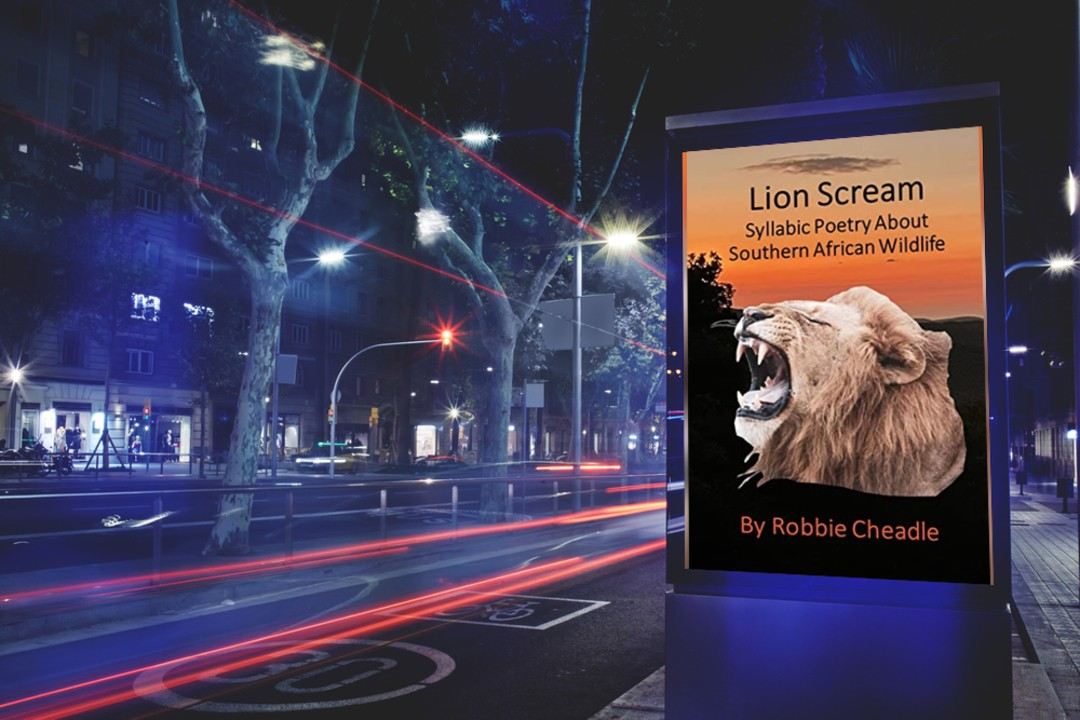
Lion Scream is available from Amazon here: https://www.amazon.com/Lion-Scream-Syllabic-Southern-Wildlife-ebook/dp/B0BXP5N766
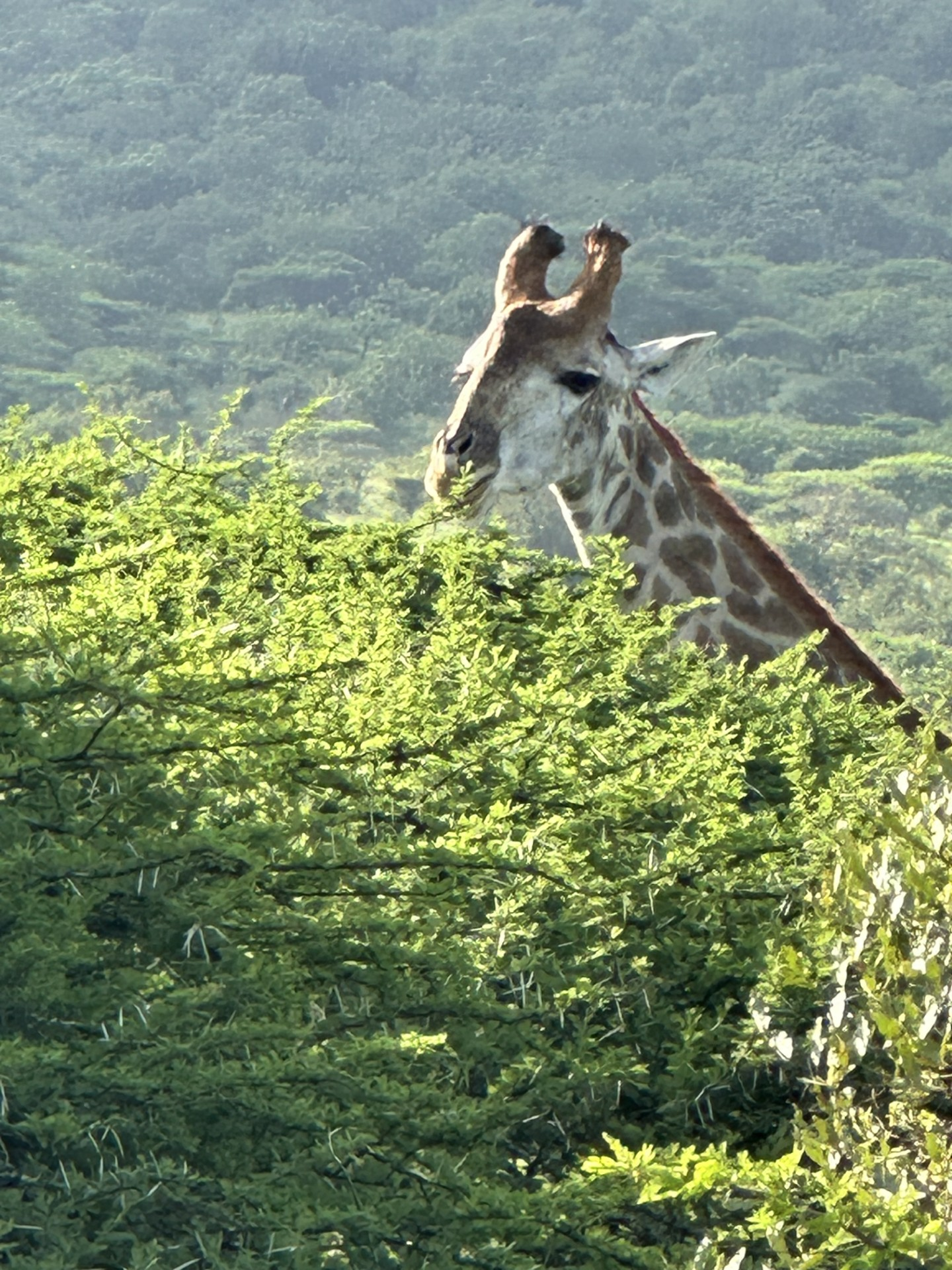
White headed giraffe – a special sighting
During a trip to Babanango Private Game Reserve we had the good fortune to come across this giraffe with large white patches on its face. Very unusual. The guide was very patient and waited for me to get my shots.


About Roberta Eaton Cheadle

Roberta Eaton Cheadle, is a South African writer and poet specialising in historical, paranormal, and horror novels and short stories. She is an avid reader in these genres and her writing has been influenced by famous authors including Bram Stoker, Edgar Allan Poe, Amor Towles, Stephen Crane, Enrich Maria Remarque, George Orwell, Stephen King, and Colleen McCullough.
Roberta has two published novels and a collection of short stories and has horror, paranormal, and fantasy short stories included in several anthologies. She is also a contributor to the Ask the Authors 2022 (WordCrafter Writing Reference series).
Roberta is also the author and illustrator of seventeen children’s books, illustrator to a further three children’s books, and the author and illustrator of four poetry books published under the name of Robbie Cheadle, and has poems and short stories featured in several anthologies under this name.
Roberta’s blog features discussions about classic books, book reviews, poetry, and photography. https://roberta-writes.com/.
Find Roberta Eaton Cheadle
Blog: https://wordpress.com/view/robertawrites235681907.wordpress.com
Bluesky: https://bsky.app/profile/robbiecheadle.bsky.social
Facebook: https://www.facebook.com/robertawrites
Amazon: https://www.amazon.com/Roberta-Eaton-Cheadle/e/B08RSNJQZ5
___________________________________________
Like this post? Are you a fan of this blog series? Did you know you can sponsor your favorite blog series or even a single post with an advertisement for your book? Stop by the WtbR Sponsor Page and let me advertise your book, or you can make a donation to Writing to be Read for as little as a cup of coffee, If you’d like to show your support for this author and WordCrafter Press.
__________________________________________
This segment of “In Touch with Nature” is sponsored by the Midnight Anthology Series and WordCrafter Press.

Midnight Roost: Weird and Creepy Stories: 20 authors bring your nightmares to life in 23 stories of ghosts, paranormal phenomenon and the horror from the dark crevasses of their minds. Stories of stalkers, both human and supernatural, possession and occult rituals, alien visitations of the strange kind, and ghostly tales that will give you goosebumps. These are the tales that will make you fear the dark. Read them at the Midnight Roost… if you dare. https://www.amazon.com/Midnight-Roost-Kaye-Lynne-Booth-ebook/dp/B0CL6FPLVJ
Midnight Garden: Where Dark Tales Grow: 17 authors bring you 21 magnificent dark tales. Stories of magic, monsters and mayhem. Tales of murder and madness which will make your skin crawl. These are the tales that explore your darkest fears. Read them in the Midnight Garden… if you dare. https://www.amazon.com/Midnight-Garden-Where-Tales-Anthology-ebook/dp/B0DJNDQJD3
Midnight Oil: Stories to Fuel Your Nightmares: 14 authors bring you 16 dark tales that explore your deepest fears. These are the stories which nightmares are made of. Tales of monsters, mayhem, and madness which will make you shiver in the dark. Read them while you burn the Midnight Oil… if you dare. https://books2read.com/Midnight-Oil
Share this:

Welcome to the WordCrafter “Poetry Treasures 4: In Touch with Nature” Book Blog Tour
Posted: April 8, 2024 Filed under: Anthology, Book Promotion, Books, Giveaways, Nature, Nature writing, Poetry, Poetry Readings, Treasuring Poetry, WordCrafter Book Blog Tours, WordCrafter Press 100 Comments
It’s day 1 of the WordCrafter Poetry Treasures 4 Book Blog Tour, and today we have contributing poet D.L. Finn with a reading of her poem, “The Island”. Stick with the tour for the rest of the week for readings and guest posts from contributing authors Andrew McDowell, Patricia Furstenberg, Merril D. Smith, Selma Martin and Robbie Cheadle, an interview with contributing author Emily Gmitter, and a review on Carla Loves to Read. If you leave a comment at each stop, you’ll be entered in our great giveaway.
Giveaway
Leave a comment for a chance to win one of three free copies of
Poetry Treasures 4: In Touch with Nature.
Leave a comment at each stop for additional chances.
Winners chosen by random drawing.
You can keep up with the tour through the links in the schedule below, but they won’t work until each stop goes live.
Mon. April 8 – Writing to be Read – Reading by D.L. Finn
Tues. April 9 – Yesterday and Today: Merril’s Historical Musings – Reading by Andrew McDowell
Wed. April 10 – Book Places – Interview w/ Emily Gmitter & Reading by Selma Martin
Thurs. April 11 – d.l. finn author – Guest post by Patricia Furstenberg
Fri. April 12 – Colleen Chesebro, Author & Poet – Guest post by Merril D. Smith
Sat. April 13 – Carla Reads – Review/ Reading by Robbie Cheadle
Book Trailer
About the Anthology
This volume of the Poetry Treasures series is a special one for me because it is the first volume to feature my works. I am proud to be featured along side such talented poets as Colleen Chesebro, D.L. Finn, Frank Prem, and Robbie Cheadle who I have gotten to know and I am familiar with their works. In addition, I got to work woth many creative poets who were new to me, introduced through Robbie’s “Treasuring Poetry” series right along with the series readers. These include Andrew McDowell, Patricia Furstenberg, Emily Gmitter, Marcia Meara, Selma Martin, Luanne Castle, and Merril D. Smith. Without their contributions and willingness to pitch in with the promotions, there would be no anthology. I have so enjoyed working with this group of poets, who have stuggled to meet tight deadlines and put up with my confusions as I shuffled through emails to & from hosts and contributors, and contributors who were also acting as hosts as I put this blog tour together. A big thanks goes out to them for all their efforts and hard work.
The quality of poetry in this volume makes it a poetry treasure to be sure, and I’ve had several contributors thank me for all my hard work. It has been a labor of love. But although I co-edited and did the final formatting, this is really Robbie’s baby, and without all of her hard work, this project wouldn’t be. The anthology was born from Robbie’s “Treasuring Poetry” blog series, and it is Robbie who invited the guests to submit their work, compiled and organized them all into a coherent manuscript, and did the first round of editing. Somehow, she fit all that into her very busy life, and it is she who should be commended, not I.
This is my blog post, my addition to the tour as a contributing author, as well as editor of the project. I will not burden you with my photo and bio, which you, my readers, see with every post I make. Instead I will get right to the main attraction for this stop and move on to a reading by contributing author D.L. Finn.
Introduction of D.L. Finn
Author of children’s books, adult fiction and poetry, D.L. Finn is a multi-talented Califirnia author. Her Haibun and syllabic poetry draw vivid pictures in the mind and I am pleased to feature her works within this volume of Poetry Treasures. She shares with us today a reading of her poem, “The Island”.
Reading of “The Island”, by D.L. Finn
About D.L. Finn

D. L. Finn is an independent California local who encourages everyone to embrace their inner child. She was born and raised in the foggy Bay Area, but in 1990 she relocated with her husband, kids, dogs, and cats to Nevada City, in the Sierra foothills. She immersed herself in reading all types of books but especially loved romance, horror, and fantasy. She always treasured creating her own reality on paper. Finally, surrounded by towering pines, oaks, and cedars, her creativity was nurtured until it bloomed. Her creations include children’s books, adult fiction, and poetry. She continues on her adventure with an open invitation to all readers to join her.
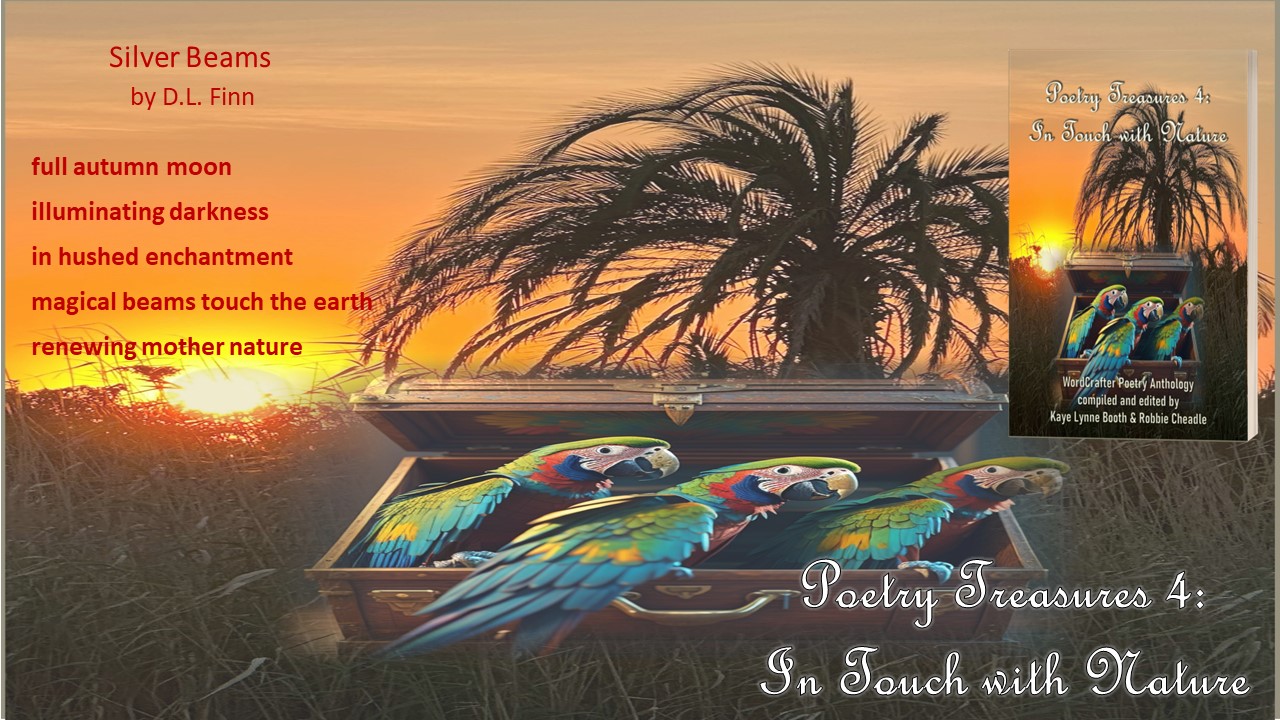
About Poetry Treasures 4: In Touch with Nature

Open the cover
and you will discover
Poetry Treasures
from the guests on
Robbie Cheadle’s 2023
“Treasuring Poetry”
blog series
on Writing to be Read.
Included are poetic gems from: Andrew McDowell, Robbie Cheadle, Patricia Furstenberg, Marcia Meara, Luanne Castle, D.L. Finn, Emily Gmitter, Kaye Lynne Booth, Selma Martin, Merril D. Smith, Frank Prem, and Colleen Chesebro.
Purchase Link: https://books2read.com/u/mlM5YA

____________________________________________
That wraps up today’s stop. Don’t forget to leave a comment and enter the giveaway for a free copy of this lovely poetry collection. Tomorrow will find us over at Colleen Chesebro, Author & Poet with a guest post by contributing poet, Merril D. Smith. Join us and don’t forget to leave a comment for another chance to win a free digital copy of Poetry Treasures 4: In Touch with Nature.
______________________________________
Book your WordCrafter Book Blog Tour today!
Share this:

February: Taking a look at nonfiction
Posted: February 25, 2019 Filed under: Biographies, Biography, Books, Commentary, Creative Nonfiction, His Name Was Michael, Memoir, Nature writing, Nonfiction, Self-Help, Travel, Writing, Writing to be Read | Tags: Biography, Creative Nonfiction, Diaries, How-to books, Journalism, Memoir, Nature Guides, Nonfiction, Self-Help, Travel Books, Travel Memoir, Writing to be Read Leave a comment
Our monthly theme for February on Writing to be Read was, you guessed it – nonfiction. So, what tipped you off? Was it the great interview I did with nature author Susan J. Tweit? Or maybe the nonfiction revues of How to become a Published Author and Letters of May? Or perhaps it was the “Chatting with the Pros” interview of nonfiction author Mark Shaw? Whatever it was that gave it away, I’m here to tell you that these few posts on nonfiction don’t even scratch the surface of what the genre of nonfiction encompasses.
There are many subgenres of nonfiction, just as there are many subgenres under each of the genres of fiction. When someone asks what type of book your fiction novel is, we are quick to catetgorize it as a paranormal mystery, a historical romance, or a science fiction thriller. For some reason, we don’t seem to think about nonfiction the same way we do fiction and when someone asks what type of book your memoir is, or your travel diary, or your self-help book, we tend to lump it in with all the rest in nonfiction. Why this is, I don’t know, but I find that it is the case, time and time again.
The fact is, not all nonfiction books are alike and there are many categories or subgenres that fall within the nonfiction realm. Mark Shaw writes biographies and creative nonfiction tales that are very different from the memoirs, illustrated travel books and nature guides of Susan J. Tweit. Other types of nonfiction that are hard to define are books like Mark Todd and Kym O’Connell Todd’s Wild West Ghosts, which chronicles their ghost hunting experiences and offers advice on how you can be a ghost hunter too. Or Hollywood Game Plan by Carole Kirshner, which is a how-to guide for anyone wanting to break into the screenwriting world. These books are all nonfiction, but they are all very different types of books.
According to wikipedia the genres of nonfiction are biographies, autobiographies, memoirs, commentaries, creative nonfiction, critiques, essays, owners manuals, journalism, personal narratives, reference books, self-help books, speeches, and text books. I would add to that spiritual texts, encyclopedias, documentaries, how-to books, cookbooks, diaries and anthologies such as the one found in Letters of May, which is a collection of writings and artwork illustrating the world of those afflicted with mental illness. I’m sure there are others, but as you can see the list is quite extensive.
Nonfiction books may or may not be aimed to entertain, but the primary purpose, no matter the type of nonfiction book, is to inform. This may account for the fact that my reviews of nonfiction books receive more views in general, than most of my fiction reviews. A fact that I found to be surprising when I uncovered it while looking over the data for this blog. My theory is that readers turn more quickly to books they may find useful than they do to those with entertainment as their sole purpose.

My reasons for interest in nonfiction and all it’s many forms stems from preparation for my journey to write my own memoir, telling the story of my son’s death and my life without him, His Name Was Michael. My bi-monthly blog series which will chronicle that writing process, “The Making of a Memoir“, came out with the first segment in February, too. It was a good month for it to come out, as it also fits in with the nonfiction theme. I hope you’ll join us again next month, when the theme will be science fiction and fantasy.
Be sure to join me next month when we will explore science fiction and fantasy, with guest author Kevin J. Anderson on “Chatting with the Pros” on March 18th, as well as a review of his Selected Stories: Science Fiction Volume 2, and Jordan Elizabeth’s Rogue Crystal.
Update: In Friday’s post I talked about the changes coming for Writing to be Read. One more change that I just recieved confirmation of, and I’m pleased to announce: Art Rosch will also be posting one movie review a month, on the forth Friday of the month, in “Art’s Visual Media Review”.
Like this post? Subscribe to Writing to be Read for e-mail notifications whenever new content is posted or follow WtbR on WordPress.
Share this:

Interview with nature author Susan J. Tweit
Posted: February 4, 2019 Filed under: Author Profile, Books, Interview, Memoir, Nature writing, Nonfiction, Teaching Writing, Uncategorized, Writing | Tags: Author Interview, Connections, Memoir, Nature Guides, Nature writing, Susan J. Tweit, Travel Books, Writing to be Read 6 Comments
My guest today is an author, nature lover and plant ecologist. Her books include memoirs, beautifully illustrated travel books, nature guides, and even children’s books, but they all have strong ties with nature. Her books reveal connections with nature and life that have not been pondered or may have been overlooked in our everyday lives. Her books have won the ForeWord Book of the Year, the Colorado Book Award, and she is a five time recipient of Colorado Author’s League Award. With a background in science and plant ecology, she expertly weaves her natural environment into her writings, illustrating how all things interact and connect. Let me introduce creative nonfiction author, Susan J. Tweit.
Kaye: You are a female author who champions the natural environment. Do you identify most as a feminist, a naturalist or an environmentalist?
Susan: All of the above. I grew up in a family of naturalists and scientists; restoring everyday nature is my way of leaving the world a better place. And I work in two fields where women are still second-class citizens in so many ways: science and writing. So am a feminist just be participating in those fields as a woman.
Kaye: On your website you claim that you taught yourself to write after you realized that you enjoyed the stories told by the data more than you did doing the research. How does one teach oneself to write?
Susan: I don’t know how other people teach themselves to write creatively, but for me, as a scientist trained to eschew personal opinions and emotions, and to be extremely parsimonious with descriptive adverbs and adjectives, I found my writing voice in reading the works of writers whose works I admire. I read Ann Zwinger and Terry Tempest Williams, Barry Lopez and Kim Stafford, Brenda Peterson and Linda Hogan, Leslie Marmon Silko and Denise Chávez, Robert Pyle and Gary Paul Nabhan, Sharman Apt Russell and Barbara Kingsolver, and so many others.
As I read, I thought about the mechanics of how each writer told their stories (whether fiction or essays), how they introduced subjects and characters, where they got personal and where they stepped back, how they described landscape and culture, how they used words and language… I tried out techniques and styles until I found my own voice, which has continued to evolve through twelve books and hundreds of essays, articles, and columns for newspapers and magazines.
Kaye: Connections are a common theme in many of your works. Can you talk a little about those?
Susan: As a plant ecologist, I am fascinated by the relationships and interrelationships that form community, whether the human community, or what I call “the community of the land,” the interwoven communities of species—from tiny microbes to gigantic redwood trees—that make life on Earth possible. Who loves who, who eats who, who sleeps with or pollinates who, who can’t stand who… All of those relationships weave the fabric of Life with a capital L. Without them we would not exist, and we have so much to learn about the connections that are vital to this planet. I just collaborated with science illustrator Samantha Peters on “Natural Partners,” a feature for WILDFLOWER Magazine on plants and the animals they rely on. It’s up on the internet here: https://www.wildflower.org/magazine/fauna/natural-partners (The print version took the cover of the magazine, and it’s really gorgeous!)
Kaye: Writing seems to be a way of life for you, and your love for nature is woven into almost everything you do. You have a background as a plant biologist and most of your books offer a perspective on nature and the environment, and you call your books love letters “to the earth and its living web of lives”. If you could convey one message to your readers, what would it be?
Susan: Get outside and get to know nature nearby. Learn even a handful of your neighbors in the world of plants and animals and you’ll never be bored. Nature is vital to our health and wellbeing—it’s the best antidote to stress I know of, the closest source of inspiration and renewal, and it doesn’t require a prescription or training. And it’s free!
Kaye: Besides writing and ecological restoration projects, what are your favorite things to do?
Susan: I’m an outdoors person, so I love taking long walks in the arroyo near my home, hiking with friends, and setting out on long road trips to see this amazing continent. At home, I tend a small garden of native wildflowers and other plants chosen to provide habitat for songbirds and pollinators, cook elaborate dinners for family and friends, and read. I’m an omnivorous reader, which leads into your next questions…
Kaye: You’ve written three memoirs about your life experiences. What makes an experience worthy to become a memoir?
Susan: Memoir is a way of distilling what our own lives and experiences have to offer others. What makes an experience worthy of memoir is partly whether we can find a way of telling the story that is compelling to others (that is, to a wider audience than our close friends and family!). It might be that we lived through a critical part of history, or our personal journey is exceptional in some way, or simply that we figure out how to relate our very ordinary story in a way that offers some universal wisdom about being human. Both of my published memoirs—Walking Nature Home; and Barren, Wild, and Worthless: Living in the Chihuahuan Desert—taught me about how to tell a story, how show the way we grow and change over time, and how to pick and choose telling detail. Each one presented different challenges, and the memoir I am working on now is challenging me in new ways. Telling my personal story may be my greatest learning experience as a writer!


Kaye: Would you tell us about your Write & Retreat Workshops?
Susan: They are an immersion in writing, in learning place and story, and in the inner work that is the source of our creativity. Each one includes hands-on writing and workshop time, as well as time to retreat and nurture our inner selves. Each one is set in some extraordinary place chosen to inspire us, with time spend exploring that place. I don’t have any W&R workshops planned this year, but next year I may offer one set near Yellowstone National Park, that place of wildness and wonders.
Kaye: You are a member of Story Circle Network, Women Writing the Westand Colorado Author’s League. How are these organizations beneficial to you as a writer?
Susan: I am also a member of Wyoming Writers. Belonging to at least one professional writing organization is critical to writing: they offer education, resources, and, most importantly. community. Writing is an inherently solitary activity: pulling words from deep within, honing them into stories, and then offering the work of our hearts to the world is perilous. Finding a community of fellow sufferers… uh, writers, is essential to maintaining our sanity, growing in the craft, and getting published.
Kaye: What is the one thing in your writing career that is the most unusual or unique thing you’ve done so far?
Susan: Besides leaving behind a paycheck, benefits, and job security to chase words and stories? Hmm… It’s hard to choose just one. Kayaking with sea turtles in the Sea of Cortez off Baja California? Learning about how to blow up dams to restore a river and its salmon run? Dancing with a Native American community to celebrate the return of those salmon? Watching a grizzly bear mom teach her twin cubs how to dig and eat spring-beauty bulbs in a meadow in Yellowstone National Park? Walking alone through some of the wildest country in the Lower 48 states, carrying all I needed on my back to listen to myself? Tending my husband and the love of my life through his death from brain cancer and then figuring out how to write how to survive loss? Seeing monarch butterflies return to a restored patch of urban nature? I’ve been fortunate to experience miracles and wonders all along the way.
Kaye: What are you working on now? What can readers expect in the future from Susan J. Tweit?
Susan: I’m working on The Climate Victory Garden, a book about how gardens can help grow The Green New Deal and slow climate change. It’s another chapter in my life-long quest to leave this world in better shape than I found it by restoring nature nearby and our connection to the green and living world.
Many thanks to Susan for sharing with us today. You can learn more about Susan J.Tweit and her work by visiting the following links:
Amazon Author page: https://www.amazon.com/Susan-J.-Tweit/e/B000AQ53RY/ref=sr_ntt_srch_lnk_1?qid=1547778739&sr=1-1
Website: http://susanjtweit.com/
Join us next Monday, when I’ll begin a new bi-monthly blog series, “His Name Was Michael”, which will chronicle the stages of writing a memoir as I work through them for my own memoir of the same name, telling the story of my son’s death and my own grief process. This first post will talk about the prewriting stage for memoir.
Like this post? Subscribe to Writing to be Read for e-mail notifications whenever new content is posted or follow WtbR on WordPress.



















Why do I do it?
Posted: June 22, 2021 | Author: kayelynnebooth | Filed under: Commentary, Nature writing, Photography, Writing Inspiration | Tags: Bears, Birds, Colorado, Flowers, Images, Inspiration, Mountains, Photography, Writing to be Read | 29 CommentsLiving in a rural area in the Colorado mountains provides a unique set of obstacles to be dealt with, including a forty-five mile commute, one way, on winding mountain roads which can be treacherous in winter weather conditions and clogged with tourist traffic in the summer that can turn a forty-five minute drive into and hour and a half. It can be nerve wrecking and even hair raising at times. And the wear and tear on my vehicles – proper maintenence and tires, etc… – due to all the mileage I put on them gets downright expensive!
I hate that commute and for several years now I’ve been asking myself why I do this live in this remote place. Three years ago, I hit black ice and rolled my car over on its side, totaling the car and raising my insurance, even though I had broken no traffic laws or violated the rules of the road. I hadn’t been driving too fast or being reckless. It was simply the road conditions that caused me to wreck. The cop almost landed on his derierre when he approached to issue me the ticket because the road was a sheer sheet of ice.
But it’s not just the commute. There are other unique difficulties that come with living off-grid, like hauling water and keeping generators and solar systems functioning, and chopping wood for winter fuel. Only in such remote locations does one have an internet outage during the writing conference that your hosting, causing you to have to stay at a hotel and miss one full day of events, as it happened during this year’s WordCrafter virtual writing conference. It can be tough when you don’t have the simple ammenities that many people take for granted.
Yesterday, as I was driving home from work, I saw something that reminded me of why I live where I live, in spite of the need to do that often treacherous and all too frustrating commute. As I turned off the highway and headed up the dirt road that I live off of, I came around a corner and saw a patch of brown, almost hidden in the meadow grasses below a heavily forested hill. At first I thought it might be a cow or perhaps a horse, as the folks who live just over the hill keep livestock, but it didn’t stand tall enough above the grasses to be of the equine or bovine persuasions. I slowed down to get a better look, and the sound of my car must have drawn the as yet unidentified animal’s attention, causing it to look up and allowing me a good look, as well.
I hit my brakes and then threw my car into reverse, backing to a spot off the road, where I had a fairly decent view of a large brown bear which was now watching me to see what I was up to. The bear watched me for a couple of minutes, as I dug in my computer case for my Kindle, the only device with a camera that I had available. Then, he must have decided I didn’t pose much of a threat and went back to whatever he had been doing in the grass before I came along. The grass still hid him partially, but I was able to snap several photos of him before he lost interest and decided to head back over the hill. I had a much better view as he ambled away, so I slid out of my car and walked to the back of the car to snap a few more shots. He looked back to see what I was doing, but didn’t seem to concerned, as he turned and continued on his way.
That’s why I do it. That is why I make the commute, and why I make lists and keep things stocked up, so I don’t end up making extra trips, and do all of the other things that are kind of a pain, but are necessary to accomodate my chosen lifestyle. That’s why I work so hard to grow a following and make money from my writing and publishing skills, so I won’t have to make that commute anymore.
Because living where I live, I get to see things like that big brown bear and many other kinds of wildlife that city dwellers miss out on. The bear I saw yesterday was only one of many wildlife sightings that living here has offered me. Many are just glimpses, such as the two foxes playing in a drainage pipe at the side of the road, or the bobcat running through the trees, but on a few occasions, I’ve even been afforded the opportunity to capture them in photos and created the wonderful images I’m sharing here today.
The flora and fauna surrounding my Colorado mountain home are what makes it all worth it. Beside road side wildlife, my mountain home offers opportunities to view and often, photograph many species of birds and plant life. Beautiful wild flowers and and magnificent bird photos inhabit my photo library, where the images of a small fraction of all the magnificent species to which I have been witness to, have been captured. Many encounters that I wasn’t able to capture through the lens have instead inspired poetry or found their way into stories that I’ve written, or other writings.
All of this serves to remind me of the reasons why I do what I do, and live where I live, strengthening my resolve to keep doing what I’m doing. My motto has always been “Endeavor to Perservere”, or keep on keeping on, and that’s just what I’m going to do, but now I remember why I’m doing it.
_________________________________________________________________________________________________________
Like this post? Let me know in the comments. You can be sure not to miss any of Writing to be Read’s great content by subscribing to e-mail or following on WordPress. If you found this content helpful or entertaining, please share.
Share this: