Read and Cook – Hotel Pastis: A Novel of Provence by Peter Mayle, and my new cake art and baking books series #ReadandCook #bookreview #cakeart
Posted: October 8, 2025 Filed under: Adventure, Book Review, Books, cooking, Creativity, Fiction, Nonfiction, Read and Cook, Recipes, Review, romance, Suspense | Tags: Baking, Cake Art, Fondant Art, Hotel Pastis, Peter Mayle, Read and Cook, Robbie Cheadle, Something Fancy, Writing to be Read 34 Comments
Hotel Pastis: A Novel of Provence by Peter Mayle

What Amazon says
A beguiling novel of romance, adventure, and tongue-in-cheek suspense set in the South of France, from the beloved, best-selling author of A Year in Provence.
Simon Shaw, a rumpled, fortyish English advertising executive, has decided to leave it all behind, and heads of to France to transform an abandoned police station in the Lubéron into a small but world-class hotel. On his side, Simon has a loyal majordomo and a French business partner who is as practical as she is ravishing. But he hasn’t counted on the malignant local journalist—or on the mauvaise types who have chosen the neighboring village as the site of their latest bank robbery. Slyly funny and overflowing with sensuous descriptions of the good life, Hotel Pastis is the literacy equivalent of a four-star restaurant.
My review
I read a few of Peter Mayle’s autobiographical books about life in Provence when I was in my twenties. I came across this novel a short while ago and was eager to revisit Provence, this time through Peter Mayle’s fiction. I was not disappointed. After a bit of a slow start, Peter Mayle’s typically humorous style of writing and his deep dive into the food and culture of Provence were very evident in this entertaining novel. What was new was his descriptions of life in the advertising industry in London.
I’m making an educated guess that this novel is set in the 70s in London as that is when the author worked in London as an advertising executive. The characters all smoke heavily which was quite interesting for me given that I’ve always worked in a no smoking inside buildings culture. I found the author’s descriptions of his work colleagues, spoiled wife and her equally over privileged friends, and super wealthy clients very entertaining. Of course, these scenes are depicted through a humorous lens, so the negative attributes of these people are all exaggerated but as someone who has always worked in corporate, it had the ring of truth. I could also relate to Simon’s exhaustion with this fast and fake lifestyle. It can be hard to feel sympathy for people caught up in this sort of all work with short intermissions of excessive play lifestyles because of all the money they have, but it is not a nice way to live your life. Having to work all the time and appease others and wine and dine them isn’t as glamorous as it appears on the outside. This is evident from the general wreckage you see in such people’s personal lives including broken marriages, alcoholism, and drug addiction. I really hoped that Simon would find a better way of living that brought him more personal happiness.
There is a romance between Simon and a fascinating woman from Provence, a butler who is very competent and savvy and equally weary of Simon’s (and thus his own) life in the London fast lane, as well as a ring of local petty criminals who are planning the heist of their lives.
This book is not a classic and does not contain intense and serious messages about life, relationships, and saving the world. This is a slice of escapism and is light and enjoyable like pavlova. If this is the sort of book you are looking for, then you will enjoy Hotel Pastis.
Purchase Hotel Pastis: A Novel of Provence from Amazon US here: https://www.amazon.com/gp/product/0679751114
Cake art and other confectionary related delights
I have wanted to publish a book containing my favourite baking recipes and cake and other confectionary art for some years. I have finally gotten around to it and the first book in my new series, Something Fancy: A Winter Wonderland Celebration book 1 is now available for pre-order on Amazon here: https://www.amazon.com/Something-Wonderland-Celebration-Celebrating-Confectionary-ebook/dp/B0FTX21BXL
This book isn’t just about cake art and baking, it also includes some history about the origin of Christmas cakes in a number of different countries and the origin of gingerbread and gingerbread houses in Europe and other places. It also includes several of my baking related poems and poets written specifically for various cake creations.

Blurb
Robbie’s cake and fondant creations are full of imagination and enchantment as demonstrated by her gingerbread bakery, populated by three mince pie figurines, and her Ice cream Rainbow Fairies Christmas Cake, decorated with seven fondant fairy figurines for each colour of the rainbow.
This book is intended as a celebration of Christmas in poetry, cake art, and gingerbread constructions and includes several of Robbie’s delicious Christmas recipes as well as design ideas for Christmas themed confectionaries. Bite sized smatterings of historical information relating to various culinary delights are also included.
Robbie Cheadle is a poet, writer, and artist. Over the past twenty years, she has created art cakes, gingerbread constructions, and fondant figurines for a variety of purposes including as illustrations for the Sir Chocolate children’s book series she wrote with her son, Michael Cheadle.
These are examples of the type of cake art featured in this book:


The gallery sets out my Ice cream rainbow fairy tiered Christmas cake with two close up pictures of the details on this cake.

Gingerbread houses, from small and easy …

to large and complex …

Advice and assembly instructions are included in the book.
About Robbie Cheadle

Robbie also has two novels and a collection of short stories published under the name of Roberta Eaton Cheadle and has horror, paranormal, and fantasy short stories featured in several anthologies under this name.
You can find Robbie Cheadle’s artwork, fondant and cake artwork, and all her books on her website here: https://www.robbiecheadle.co.za/
Find Robbie Cheadle
Blog https://wordpress.com/home/robbiesinspiration.wordpress.com
Bluesky https://bsky.app/profile/robbiecheadle.bsky.social
YouTube https://www.youtube.com/channel/UCVyFo_OJLPqFa9ZhHnCfHUA
Goodreads https://www.goodreads.com/author/show/15584446.Robbie_Cheadle
___________________________________________
Like this post? Are you a fan of this blog series? Did you know you can sponsor your favorite blog series or even a single post with an advertisement for your book? Stop by the WtbR Sponsor Page and let me advertise your book, or you can make a donation to Writing to be Read for as little as a cup of coffee, If you’d like to show your support for this author and WordCrafter Press.
__________________________________________
This segment of “Read and Cook with Robbie Cheadle” is sponsored by the Midnight Anthology Series and WordCrafter Press.

Discover more from Writing to be Read
Subscribe to get the latest posts sent to your email.
Share this:

Mind Fields: How Humble I Am
Posted: May 30, 2025 Filed under: Creativity, Mind Fields, Reflections, Self-Discovery | Tags: Arthur Rosch, Artistic Talent, Mind Fields, Reflections, Writing to be Read 1 Comment
In spite of my flamboyant reputation, I must admit that am innately modest and humble. I am, of course, joking. Having reached an age where I have experienced numerous great THUDS from life, I don’t have the conceit anymore to come out and tell everyone how great I am. Maybe that’s a problem. I know who I am. I’m a great artist. Unfortunately there’s no way to prove this assertion. Most great artists know they’re great. No one can talk them out of that notion.
For every great artist there’s another hundred million who think they are great artists. But they aren’t. How does one tell the difference? Damned if I know. Having a large audience doesn’t make one an artist. Nor does having a small audience. I would guess that one of the biggest tips that one is in the presence of mediocre art is the amount of sentimentality contained in the art itself. I recognize myself as a great artist by my ability to connect with the deepest regions of creative inquiry. You can take that or leave it. That just means that I received a gift from God and I was astute enough to treasure and protect it. That’s what talent is: god’s gift to you.
My writing tongue speaks as in a conversation with a friend. My music tongue sings as if playing with the birds in our tree. Making art is a process of extracting Truth from the sloppy ores of earthly life. Art is finding meaning in Existence and putting it into a form that communicates. When art becomes dishonest it stops being art. The truthful exposure of yourself is essential to obey the guiding spirit of art. most of the time art will contain an element of beauty regardless of how dark the subject matter.
As an artist I have greatness. As a human being not so much. I’ve been a pathetic human being for decades. These days less pathetic; I’ve changed a lot by doing the work of deep psychothereapy . It’s often the case that an artist is so focused on the art that he or she forgets how to behave. That’s how I used to be.
Awareness of myself as an artist came to me at fifteen. I was in love with a pink blonde girl who was a sex addict. She was’nt a sex addict with me which became the topic of extensive wheedling conversation. She did one good thing for me. She helped me turn my suffering into art. From that point forward I have never deviated from my core identity.
Art never stops. The practice of one’s craft never stops. The practice is your companion through life. Your instrument, your paint brush, the limbs of your body. These things you train every day. The quest for Art resembles a combination of athletic and priestly discipline. Thecalling of art requires much study.
It has been often said that it takes Genius to see Genius. That may be the reason so many genii remain invisible, like the spirits who inhabit the hollows.
Genius is lonely. I am always out there in the crazy-sphere, where my mind occupies itself with stupid things.
I admire people who are unique and know it. I admire people who retain their consideration for others in spite of their talents. Talent may buy you a hamburger but only character will help you digest it.
About Arthur Rosch
Arthur Rosch is a novelist, musician, photographer and poet. His works are funny, memorable and often compelling. One reviewer said “He’s wicked and feisty, but when he gets you by the guts, he never lets go.” Listeners to his music have compared him to Frank Zappa, Tom Waits, Randy Newman or Mose Allison. These comparisons are flattering but deceptive. Rosch is a stylist, a complete original. His material ranges from sly wit to gripping political commentary.
Arthur was born in the heart of Illinois and grew up in the western suburbs of St. Louis. In his teens he discovered his creative potential while hoping to please a girl. Though she left the scene, Arthur’s creativity stayed behind. In his early twenties he moved to San Francisco and took part in the thriving arts scene. His first literary sale was to Playboy Magazine. The piece went on to receive Playboy’s “Best Story of the Year” award. Arthur also has writing credits in Exquisite Corpse, Shutterbug, eDigital, and Cat Fancy Magazine. He has written five novels, a memoir and a large collection of poetry. His autobiographical novel, Confessions Of An Honest Man won the Honorable Mention award from Writer’s Digest in 2016.

More of his work can be found at www.artrosch.com
Photos at https://500px.com/p/artsdigiphoto?view=photos
__________________________________________
Did you know you can sponsor your favorite blog series or even a single post with an advertisement for your book? Stop by the WtbR Sponsor Page and let me advertise your book, or you can make a donation to Writing to be Read for as little as a cup of coffee, If you’d like to show your support for this author and WordCrafter Press.
___________________________________________
This segment of “Mind Fields” is sponsored by the Roberta Writes blog site, where you can find the poetry, photos, videos, and book reviews by Robbie Cheadle and so much more.
Share this:

Book Reviews: Lines by Leon & The Inyan Beacon
Posted: December 30, 2023 Filed under: Book Review, Books, Creativity, Fiction, Flash Fiction, Poetry, Review, Short Fiction, Stories | Tags: Book Review, Dan Antion, Drawing, Flash Fiction, Leon Stevens, Lines by Leon, Poetry, Scieince Fiction, Short Fiction, Teagan Riordain Geneviene, The Inyan Beacon, Writing to be Read 6 Comments
About Lines By Leon
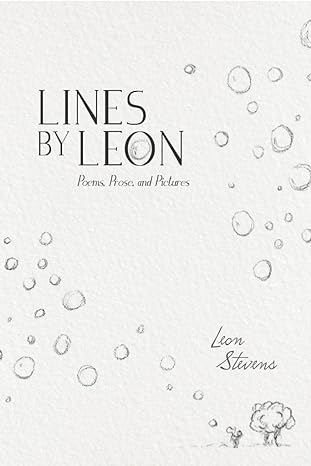
Lines by Leon is an eclectic mix of poetry, prose, and short stories that address the subjects of loss, struggle, human behavior, and environment in both humorous and thought-provoking ways. The author invites his readers to laugh, think, cry, and meditate on the wide variety of topics. Scattered throughout the book are sketches of various subjects, many that relate to the poems and stories they illustrate; others speak for themselves.
Purchase Link: https://www.amazon.com/Lines-Leon-Poems-Prose-Pictures-ebook/dp/B0BQCPP5WW
My Review of Lines By Leon
Lines by Leon, by Leon Stevens is an entertaining collection of creativity that showcases the authors talents in prose, poetr and drawing. The poems are lighthearted and positive, although I did feel a bit of sadness when reading “The Sock”. The drawings are well done, the sketches are amusing, and all offer the reader something to think about in a new or unique way.
It’s brief, but entertaining. One can’t help but smile. I give Lines by Leon four quills.

____________________________________________
About The Inyan Beacon
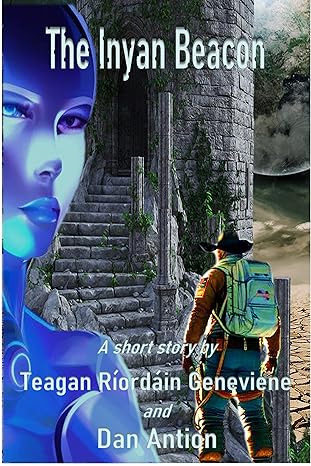
Part science fiction, part spaghetti Western, part speculative fiction, The Inyan Beacon is a short story set in the distant future. Earth’s moon, now called Maka, after a failed terraforming attempt, is the site of a lone stone tower. Tatanka (Tank) Cody, descendant of Buffalo Bill Cody, and his synth companion, Compass are determined to get inside the tower. Although they might not find what Tank is so sure will be there.
Purchase Link: https://www.amazon.com/Inyan-Beacon-Teagan-R%C3%ADord%C3%A1in-Geneviene-ebook/dp/B0C3Z7G2C6/
My Review of The Inyan Beacon
The Inyan Beacon, by Teagan Riordan Geneviene and Dan Antion, is a brief tale that feels like a small piece in a much bigger puzzle. Teagan jumps right into the story, but it takes a moment for the reader to orient. Once there, it is easy to emmerse oneself into the story, but before you know it the tale has come to its conclusion. I think I would have preferred to know what they were looking for a bit sooner to give me a better sense of purpose for the characters. I applaud Geneviene and Antion for providing this story with a beginning middle and end, making it a complete story; something many shorts fail to do.
It caught my interest, but was too short. I wasn’t ready to stop, and would have been willing to follow the characters through to the next adventure. I guess I wanted more. I give The Inyan Beacon four quills.
____________________________________________
Kaye Lynne Booth does honest book reviews on Writing to be Read in exchange for ARCs. Have a book you’d like reviewed? You can request a review here.
Share this:

The 2023 Cripple Creek Ice Festival
Posted: March 13, 2023 Filed under: Adventure, Creativity, Events | Tags: Cripple Creek Ice Festival 2023, Events, Ice sculptures, Kaye Lynne Booth, Writing to be Read 4 Comments
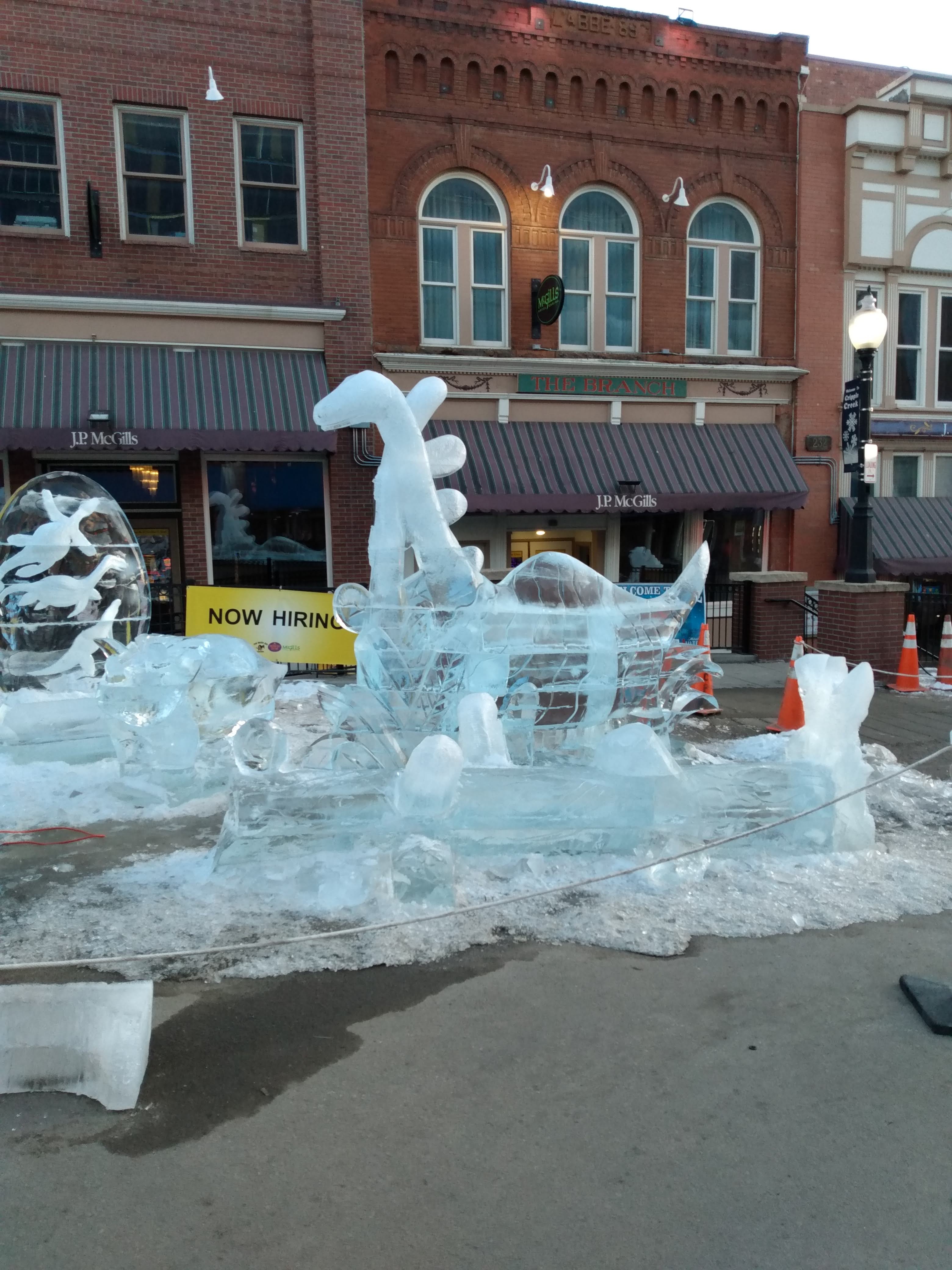
The Cripple Creek Ice Festival is an annual tradition, but for the past two years it has been canceled due to Covid. So, when I heard that they were holding the Ice Fest this year, you can bet that I made sure to attend. The Ice Festival is open to the public and admission is free. Ice sculptures are lined up and down Bennett Street, along with street vendors, who provide plenty of food and refreshments for all. Visitors walk up or down the street, appraising the sculptures and stop in at the main tent to place their votes for the sculpture they think is best. Past year’s themes include Under the Sea, Mythological Wonderland, Old West, Mountain Wonderland, and Story Time. The first year that I attended was 2015, with the Story Time theme. I also had the pleasure of attending in 2016 with the Old West theme. You can see those ice sculptures here.
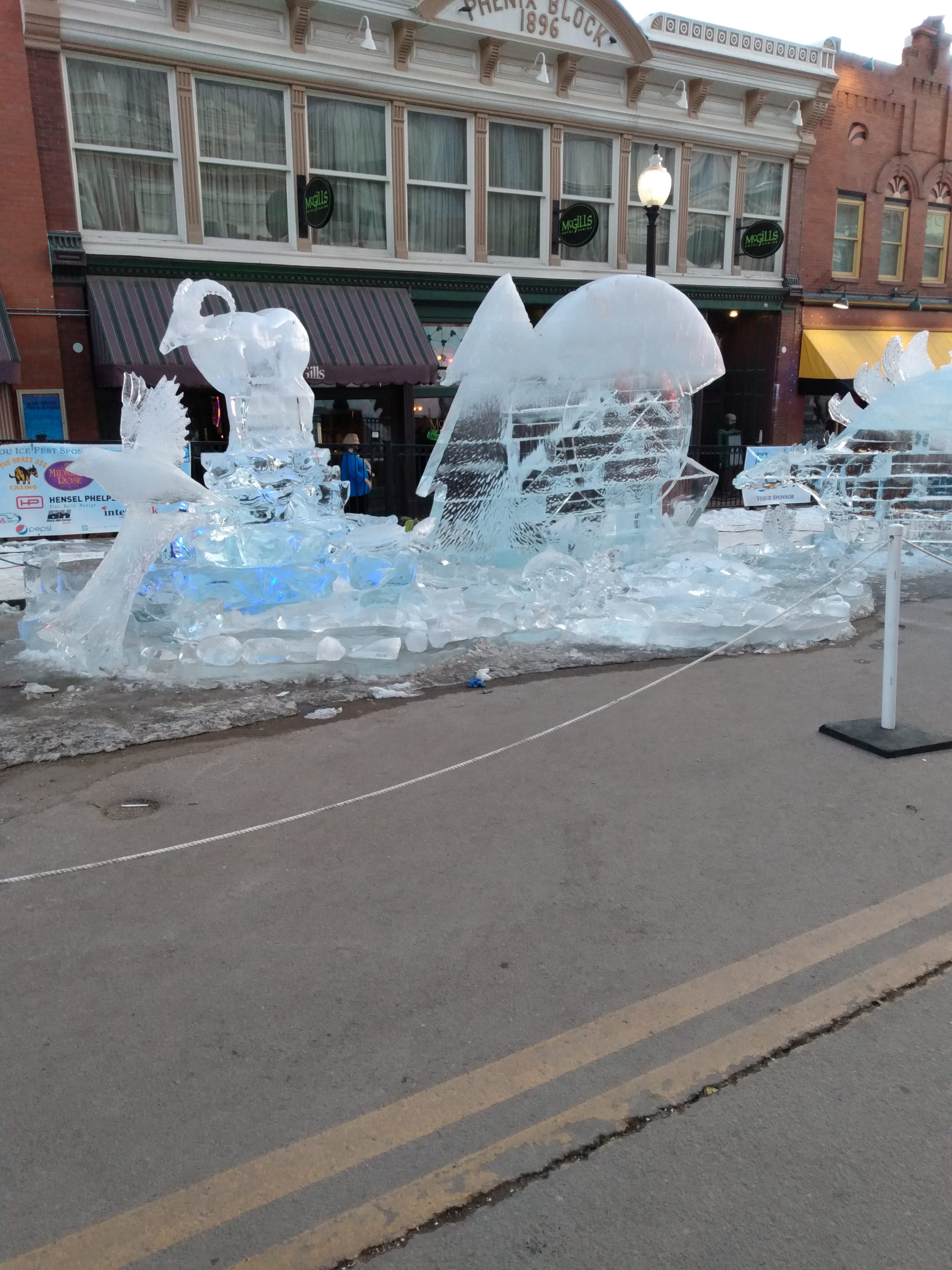
This year, the shape each sculpture took was the carver’s choice, so there was a wide variety of sculptures. For the 2023 Cripple Creek Ice Festival, (February 18-26), I attended on both the first Sunday and the final Sunday. On Day 2 of the festivities, only select sculptures were complete, as the chisel and chain saw weilding ice carvers work on their masterpieces all week long, so visitors are sure to catch them in action. Many large blocks of uncut ice lined the street, waiting for the carver’sto work their magic and turn them into spectacular works of art.


Even on the final day, there were still carvers demonstrating their talents. The way they carve the ice and shape it into their own visions is amazing.

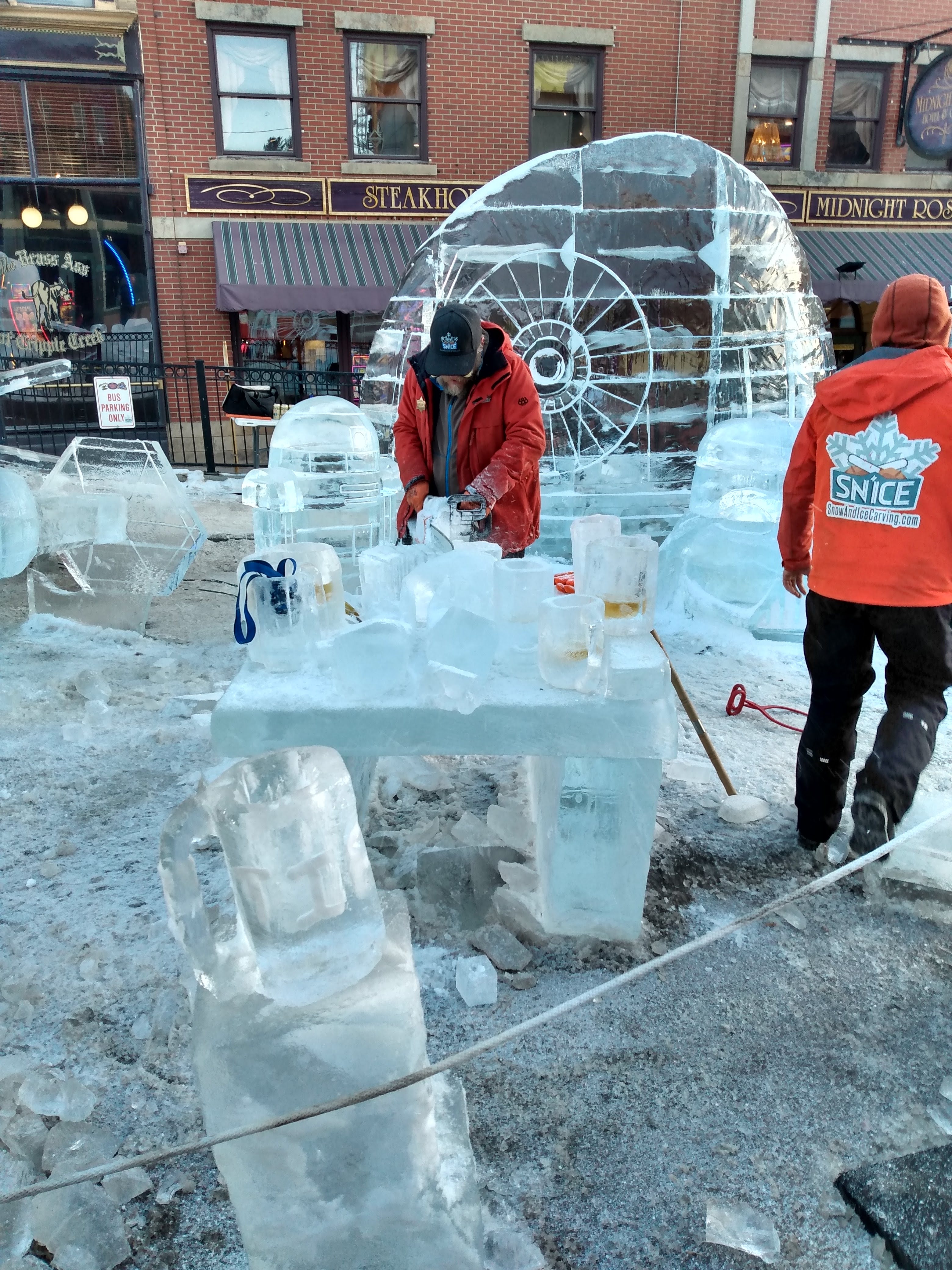

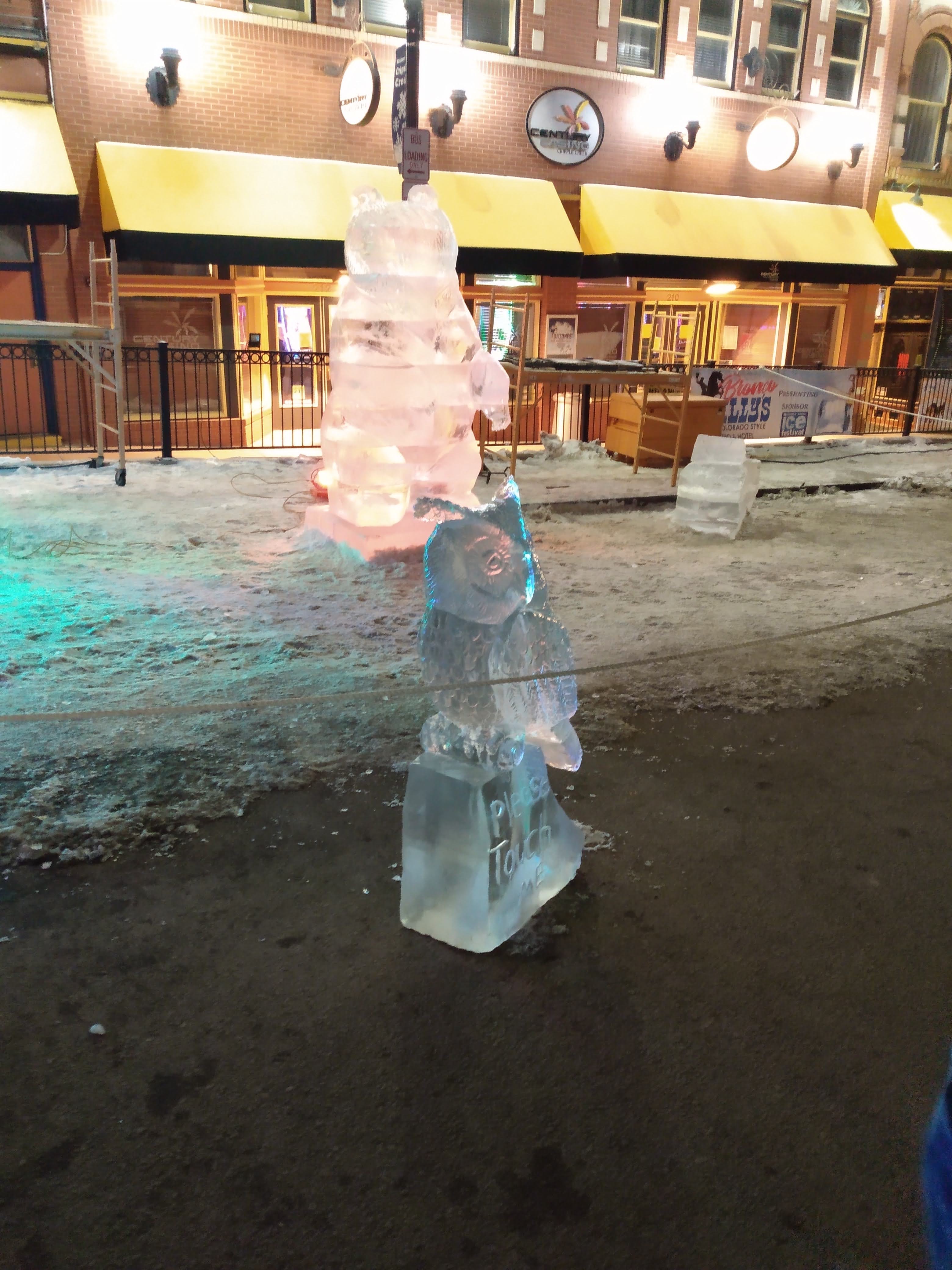
Through their talented efforts, for two weeks out of the year, Bennett Street in Cripple Creek turns into a fabulously creative winter wonderland. Since the theme was carver’s choice, the sculptures took on a wide variety of shapes and sizes.


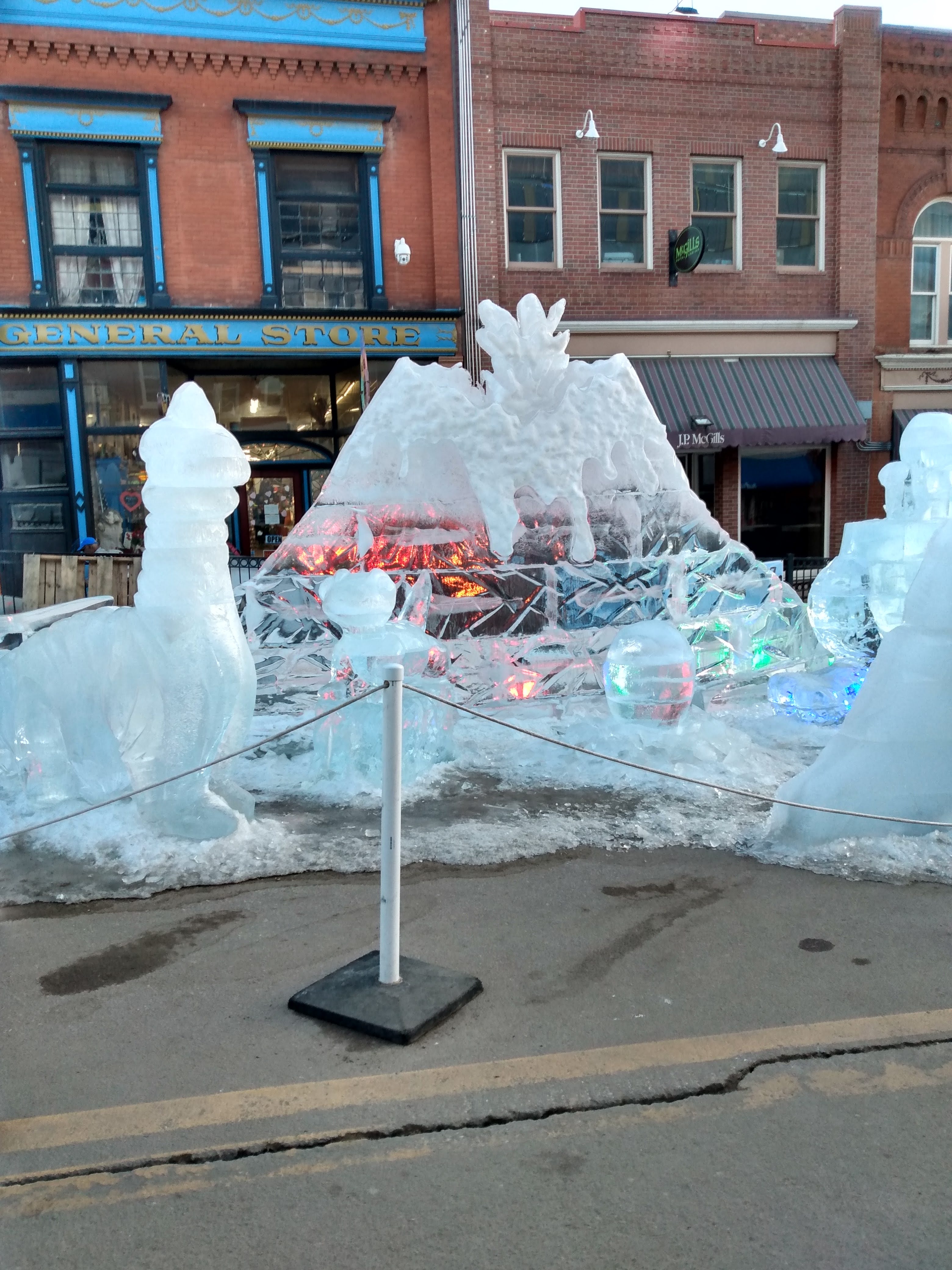




Although beautiful during the day, the addition of color lighting them up at night has unique effects.
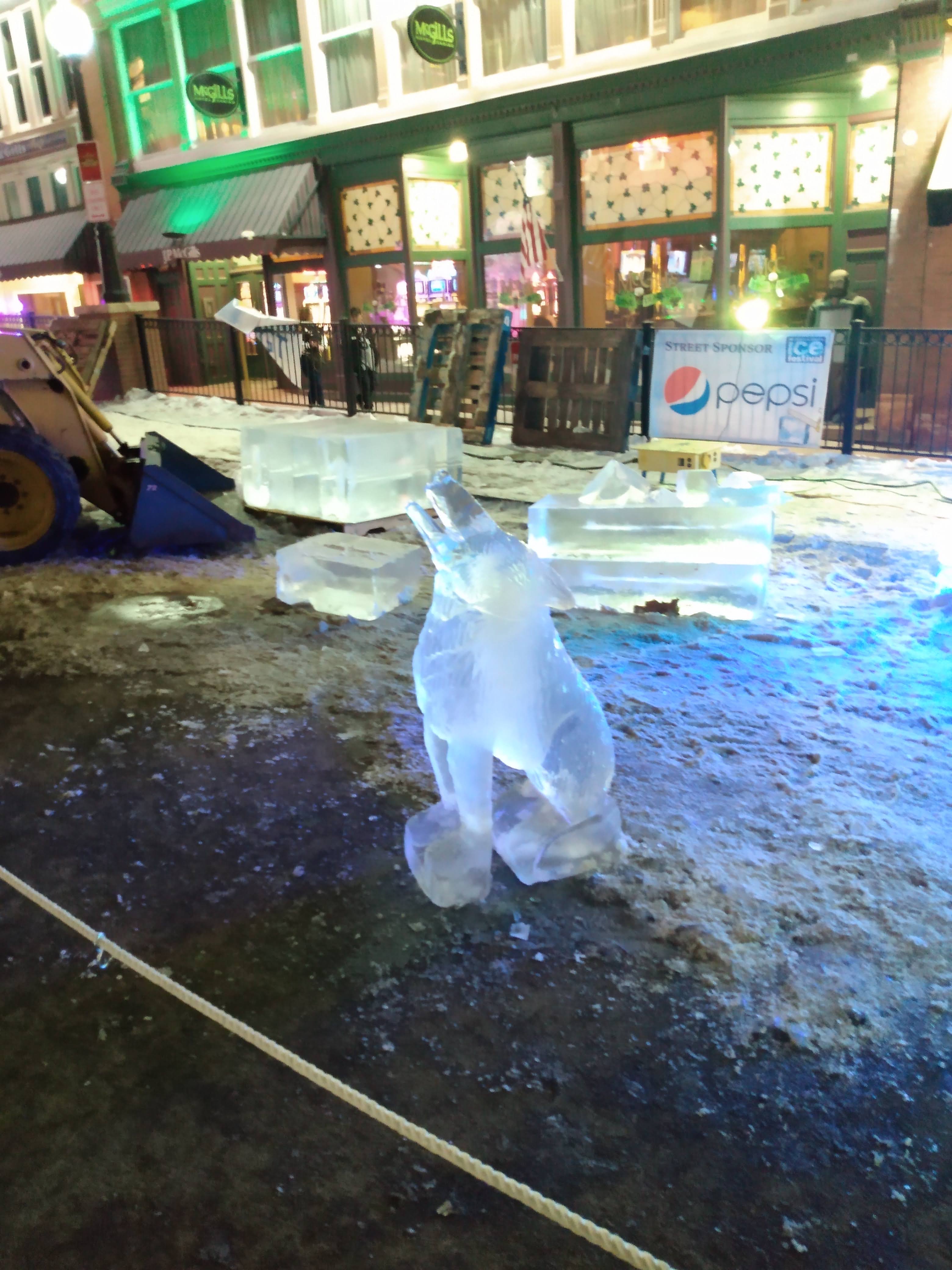

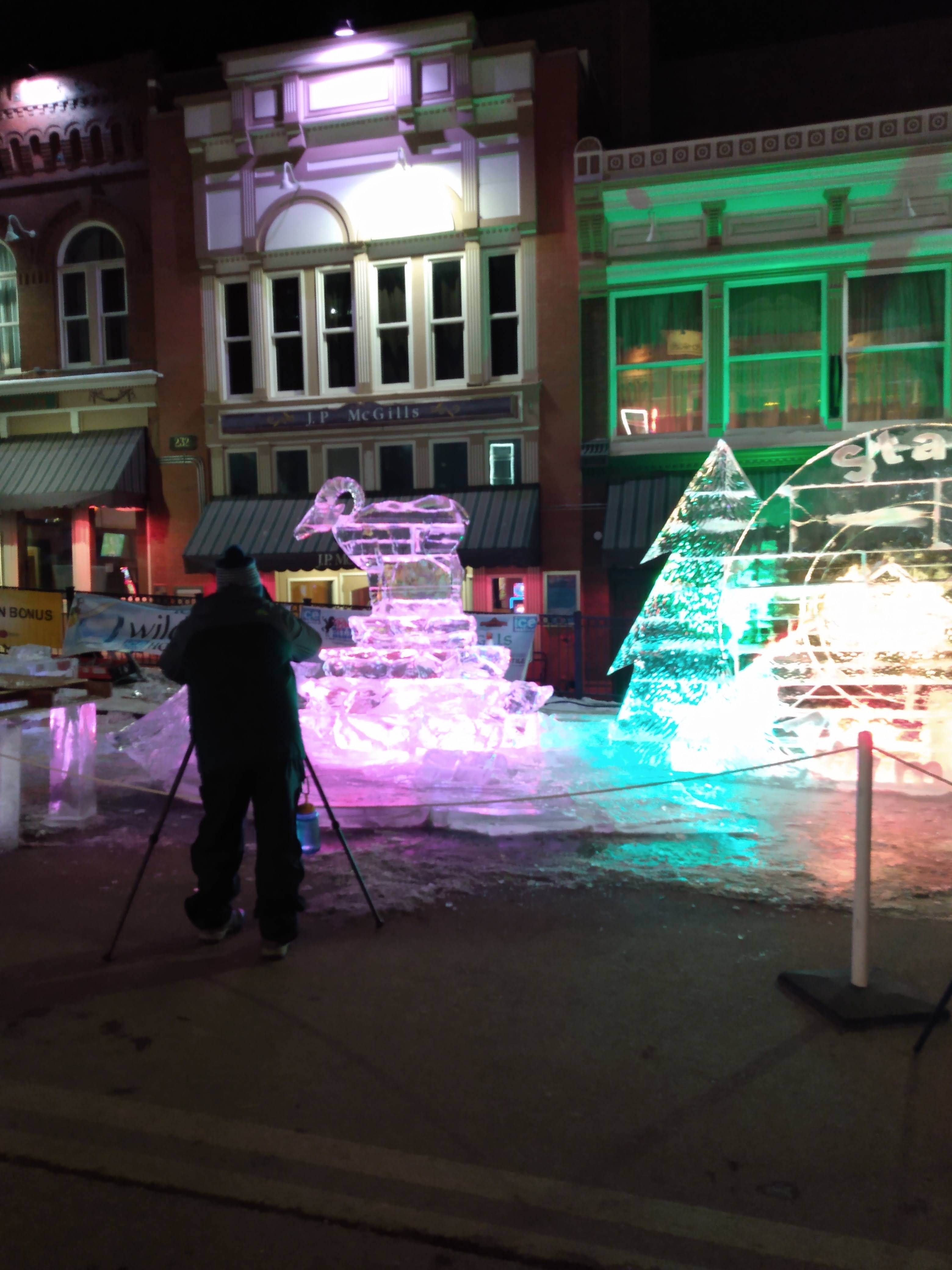


References
What You Need to Know About the Cripple Creek Ice Festival. Pike’s Peak Region Attractions. Retrieved from https://www.pikes-peak.com/cripple-creek-ice-festival/
About the Author

For Kaye Lynne Booth, writing is a passion. Kaye Lynne is an author with published short fiction and poetry, both online and in print, including her short story collection, Last Call and Other Short Fiction; and her paranormal mystery novella, Hidden Secrets. Kaye holds a dual M.F.A. degree in Creative Writing with emphasis in genre fiction and screenwriting, and an M.A. in publishing. Kaye Lynne is the founder of WordCrafter Quality Writing & Author Services and WordCrafter Press. She also maintains an authors’ blog and website, Writing to be Read, where she publishes content of interest in the literary world.
______________________________________________________________
Want exclusive content? Join Kaye Lynne Booth & WordCrafter Press Readers’ Group for WordCrafter Press book & event news, including the awesome releases of author Kaye Lynne Booth. She won’t flood your inbox, she NEVER sells her list, and you might get a freebie occasionally. Get a free digital copy of her short story collection, Last Call and Other Short Fiction, just for joining.
Share this:

Words to Live By – Inspiration, Legacy, and Beatles Music
Posted: January 5, 2022 Filed under: Commentary, Creativity, Opinion, Words to Live By, Writing | Tags: Inspiration, Jeff Bowles, music, The Beatles, Words to Live By, Writing to be Read 3 Comments
The first Wednesday of the month, writer Jeff Bowles muses on life, creativity, and our collective destinies as makers of cool stuff. You’re a writer, but have you ever thought about how or why? Here are some words to live by.
Paperback Writer
Over the holidays, I watched the new Beatles documentary released on Disney+, The Beatles: Get Back. I’m a huge fan of the group and always have been. I realize there are non-Beatles fans out there, but I have to admit, I’ve always been mystified by their lack of enthusiasm. To me and millions of other Beatlemanics, the band is a historical landmark, having written and recorded music that changed pop culture for generations to come.
This blog entry is about inspiration and legacy. I liked to write stories as a kid, but really, I wanted to be a rock star. This would’ve been in the mid-90s. At the time, many potential role models existed for me and every other outcast kid who picked up a guitar. I wasn’t into Nirvana or Linkin Park at that age, didn’t appreciate Red Hot Chili Peppers or Green Day. I loved The Beatles, plus lots of other groups from the 60s and 70s. Never mind that my older brother and mom began spoon-feeding me this stuff at a very early age, or the fact that I looked up to my brother and enjoyed liking the things he thought were cool. The Beatles were special, supernatural even. I believed that then and I believe it now.
But the truth is, I haven’t been feeling particularly inspired lately. Not even Christmas cheered me up. In fact, it only made me feel worse. This Get Back documentary, it’s exhaustive (and a little exhausting). Only a mega Beatles nerd could’ve pieced it together. Peter Jackson (director and co-writer of The Lord of the Rings trilogy) happens to have been that nerd. The film is almost eight hours in length, split over three episodes, focusing on just one month or so in the lives of the famous foursome.
The great thing about it is that we really get to see The Beatles’ creative process up close. Lots of labor and missteps, mistakes and dead ends. Critics have said this proves they weren’t as legendary as fans have always claimed. To me, it makes them more human, which is a comfort, because it proves anyone anywhere can muster enough talent and drive to produce work of honest significance.
Inspiration is great, but it’s not nearly as effective as perspiration. When I was learning to play and sing and write songs, John Lennon was my idol. I wanted to be him, and man did all the other kids in school think I was strange. I remember looking up at the stars one night when I was ten years old and whispering to the heavens,
“I want to be the greatest rock star ever.”
Or something to that effect. As it turned out, I lived a small (very small) portion of that dream. Played music with people all the way through my teens and early twenties. Lots of tiny coffee house gigs, open mic nights, bars, private celebrations. When I was twenty-one, I met the woman I would one day marry, and eventually I found I wanted different things out of life. Writing short stories and novels, the pursuit of some kind of career in this field, it replaced my desire to make music almost entirely. I grew dedicated to the craft and learned a hell of a lot. For the most part, writing has made me happy. I’m glad I took the years necessary to get good at it.
But I wouldn’t have found that dedication, that fire in my heart, if I weren’t already intimately familiar with it. There is an electric feeling that occurs inside the body and mind of a musician caught in the flow of her or his own creativity. The Beatles clearly knew that feeling well. It’s potent and wonderful, thrilling and powerful.
I came to learn that writing is a slower burn. Tons of work up front, and then maybe (maybe) a bit of adulation months or years later. But it still holds moments of intense creative gratification. No matter who you are, how popular or famous or legendary, this process, this mental birthing experience, it can be difficult and frustrating. John Lennon, Paul McCartney, George Harrison, and Ringo Starr were all wonderful musicians. They had nothing to prove to anyone, yet they still worked themselves to the bone to make stuff that simply had no equal.
So here’s my question for all of you: how dedicated are you to what you love? What thrills you and gets you excited for writing or anything else in life? Maybe it’s a bit unfashionable to admit that music recorded some sixty years ago makes me feel ready to take on the world, but it does. Especially when I get to see it up close, visceral, all the creative battles, coming to the logical and favorable conclusion of work that stands the test of time.
Next time you’re feeling down in the dumps and not at all creative, head back to the source—your personal wellspring of inspiration—and see if it won’t refill your cup a little. Pick up a guitar, or a pencil or paintbrush or a media powerhouse of a computer, or maybe just watch a good film about one of your favorite things on earth. All hail the makers of cool stuff. Be they Beatles or bestsellers or nobodies in particular.
Peace and love to you this new year. May it bring you everything you need, and maybe a few of the things you want, too. Until next time.
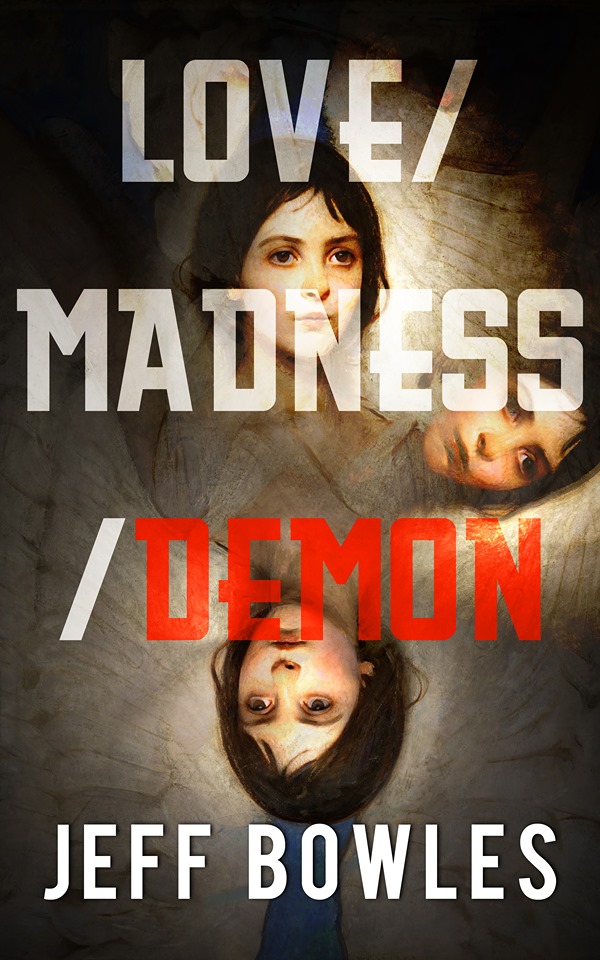
Jeff Bowles is a science fiction and horror writer from the mountains of Colorado. The best of his outrageous and imaginative work can be found in God’s Body: Book One – The Fall, Godling and Other Paint Stories, Fear and Loathing in Las Cruces, and Brave New Multiverse. He has published work in magazines and anthologies like PodCastle, Tales from the Canyons of the Damned, the Threepenny Review, and Dark Moon Digest. Jeff earned his Master of Fine Arts degree in creative writing at Western State Colorado University. He currently lives in the high-altitude Pikes Peak region, where he dreams strange dreams and spends far too much time under the stars. Jeff’s new novel, Love/Madness/Demon, is available on Amazon now!
Check out Jeff Bowles Central on YouTube – Movies – Video Games – Music – So Much More!
Want to be sure not to miss any of “Words To Live By” segments? Subscribe to Writing to be Read for e-mail notifications whenever new content is posted or follow WtbR on WordPress. If you found it useful or entertaining, please share.
Share this:

A Challenge and a Review: Dead of Winter
Posted: December 24, 2021 Filed under: Book Review, Creativity, Epic Fantasy, Fantasy, Poetry, Reader Challenge | Tags: Book Review, Dead of Winter, Fantasy, Poetry, Reader Challenge, Teagan Riordain Geneviene, Writing to be Read 9 Comments
The Challenge
This post is a response to a challenge issued on Teagan Riordain Geneviene’s blog, where she challenges readers to create a piece of art in the medium of your choice, inspired by her book, Dead of Winter: Journey 1: Forlorn Peak.
Recently, I’ve been dabbling in Japanese and English syllabic poetry, and I knew that I wanted to create a poem for this challenge. The image and poetry above is my response to Teagan’s challenge. It is a Shadorma poem, an form of syllabic poetry which may have originated in Spain, comprised of a sestet, or six-line poem with a syllabic count of 3-5-3-3-7-5 (Word Craft: Prose & Poetry, by Colleen M. Chesebro). Although no where have I found that Shadorma can appear with images to add meaning, like the Japanese Haiga poetry, I’ve found nothing that says it can’t, so I have featured mine with the image above.
They both create a feeling like what I felt after reading Dead of Winter, so might actually serve as a different type of book review. I think the poem could easily stand alone, so maybe that’s okay.

Buy Link: https://www.amazon.com/dp/B08RBBVRGX?tag=relinks-20
My Review
Dead of Winter: Journey 1: Forlorn Peak, by Teagan Riordain Geneviene is a brief little tale that sets the stage in a world where strict control prevents the protagonist, Emlyn, from revealing her gift of seeing and communicating with the dead. In this short tale, Emlyn receives a warning of what’s to come in the rest of the series. “Winter is coming…”
__________________________________________________________________________________________________
Like this post? Let me know in the comments. You can be sure not to miss any of Writing to be Read’s great content by subscribing to e-mail or following on WordPress. If you found this content helpful or entertaining, please share.
Share this:

Growing bookworms – The importance of day dreaming
Posted: November 10, 2021 Filed under: Creativity, Growing Bookworms, Inspirational, Parenting | Tags: Children, Creativity, Daydreaming, Growing Bookworms, Imagination, Parenting, Writing to be Read 67 Comments
When I was a little girl, I loved to day dream. I was one of those kids the teacher is always calling back from dream world. The recall to reality was always a little negative in my recollection. “Stop daydreaming, and concentrate on your maths/history/geography – fill in the blank.”
As I’ve grown older, I’ve realised the benefits of day dreaming and mental downtime. When my children were younger, I used to use the driving time into the office every day to day dream. It was a time for me to let my mind wander and relax. I discovered that poems would often pop into my head, more or less fully formed during this time. The inspiration would be something I saw on the way to work. For example, my poem “The Beggar’s Child” was inspired by a mother and baby I used to see standing on the curb everyday. I looked at that little boy, strapped to his mother’s back in the traditional African way, and wondered what he thought of the cars driving past and the indifference of the drivers to his plight.
About a year before the first lockdown, I started listening to audiobooks in the car, instead of day dreaming. I quickly discovered that my poetic output dropped dramatically with my new routine. That led to my having to make a choice between using my time in the car to listen to classic books or to day dream and produce poetry. I chose audio books.
The idea that the lack of day dreaming time was limiting my creativity stayed with me and I was most interested to learn that that day dreaming is considered to be good for children. Yes, you read correctly, day dreaming is beneficial for children and for adults.
Day dreams teach children to be calm and peaceful and to develop empathy and better emotional learning for consolidation of their learning experiences.

According to many psychologists, zoning out in your own internal world is good and helps you to plan for the future, generate ideas, regulate emotion, and spur creativity.
I have always felt that day dreaming, which I’ve always termed watching the clouds, is an essential part of the inventive process. The mind must wander and explore in order to be able to make the great leaps of logic and imagination required to invent something completely new. It pleases me greatly that recent research supports my view that day dreaming is an essential part of mental processing, reasoning, and learning.
These are some of the identified benefits of day dreaming:
- Enhanced critical thinking and intelligence – One of the main regions of the brain utilised when we day dream is the region associated with complex problem solving. Critical thinking capabilities are essential for successful learning;
- Motivation or achievement of ‘dreams’ – Living our dreams through day dreaming is an enabler of achieving our personal goals and objectives.
- Increased confidence – Imagining ourselves playing different roles in life and achieving certain objectives, like passing examinations, gives us more confidence when the real situation presents itself.
- Increased insight – The light bulb moments we have are often a result of our processing and organising information differently during day dreaming sessions.
- Increased ability to cope – Imagining ourselves in a different situation when our real one is emotionally draining or difficult, gives us an increased mental ability to cope with our reality.
- Better mental agility – Day dreaming enables us to smoothly shift mental gears in the face of unexpected situations or unanticipated events.
- Increased creativity – Day dreaming provides for increased creativity as our mind finds ways of entertaining us free from outside stimulation.
- Increased concentration – Mental downtime gives our brains time to process information and enables it to develop and concentrate better during periods of focus.
I must admit, that I have always innately know the above and I encouraged my children to day dream. Sadly, most kids fill all their free time with visual media like television and computers and I wonder what that will mean for innovation and progression in the future.
About Robbie Cheadle

Robbie Cheadle is a South African children’s author and poet with 9 children’s books and 2 poetry books.
The 7 Sir Chocolate children’s picture books, co-authored by Robbie and Michael Cheadle, are written in sweet, short rhymes which are easy for young children to follow and are illustrated with pictures of delicious cakes and cake decorations. Each book also includes simple recipes or biscuit art directions which children can make under adult supervision.
Robbie has also published 2 books for older children which incorporate recipes that are relevant to the storylines.
Robbie has 2 adult novels in the paranormal historical and supernatural fantasy genres published under the name Roberta Eaton Cheadle. She also has short stories in the horror and paranormal genre and poems included in several anthologies.
Robbie writes a monthly series for https://writingtoberead.com called Growing Bookworms. This series discusses different topics relating to the benefits of reading to children.
Robbie has a blog, https://robbiesinspiration.wordpress.com/ where she shares book reviews, recipes, author interviews, and poetry.
Find Robbie Cheadle
Blog: https://www.robbiecheadle.co.za/
Blog: robbiesinspiration.wordpress.com
Twitter: BakeandWrite
Instagram: Robbie Cheadle – Instagram
Facebook: Sir Chocolate Books
______________________________________________________________________________________________
Want to be sure not to miss any of Robbie’s “Growing Bookworms” segments? Subscribe to Writing to be Read for e-mail notifications whenever new content is posted or follow WtbR on WordPress. If you found it interesting or entertaining, please share.
Share this:

Words to Live By – Where Lie Your Roots?
Posted: March 3, 2021 Filed under: Comic books, Commentary, Creativity, Fiction, Words to Live By, Writing, Writing Inspiration | Tags: Creativity, Inspiration, Jeff Bowles, Words to Live By, Writing to be Read Leave a comment
The first Wednesday of every month, writer Jeff Bowles muses on life, creativity, and our collective destinies as makers of cool stuff. You’re a writer, but have you ever thought about how or why? Here are some words to live by.
Where Lie Your Roots?
It’s been a slow week for me out here on the Colorado prairie. Not planning to announce any upcoming book or music releases, no urge to get out of the house and see the world again. I assume it’s right where I left it. Such a long time ago! Do they still have fast food out there? Do children still laugh? Asking for a friend.
I did finish the rough draft of a new book the other day. I’ve been working on it for three and a half months, so it was gratifying to finally type THE END. About 70,000 words in total, and guess what else? I wrote it without any preparation, no outline or notes or character sheets or research conducted the hard way. And I like how it’s turned out. Kind of proud of myself, actually. I think it would’ve been a very different book if I’d had no clue how good stories are put together. My family gave that to me, the freedom to ponder and learn and express, regardless of whether or not they figured it would, quote unquote, “Get me somewhere”.
This is at the heart of Words to Live By for this month. Where lie your creative roots? Reaching deep into the nutrient-rich soil, I hope. Have you been making time for inspiration? Have you lately nurtured those people and circumstances essential to your own creative growth? I believe every one of us has common mythic imaginations. Joseph Campbell spoke about it all the time, and so for that matter did Carl Jung. If not for that thick, tangled, extra-nerdy root system of mine, I doubt I’d have had the confidence to improvise a whole book. Think I’m going to call it Emily Greer’s Resurrection Mixtape, which sounds dumb until you realize what it’s about. I’ve documented my writing habits elsewhere on Writing to be Read, but because I developed Schizoaffective Disorder about five or six years ago, I’ve had to lighten my daily workload considerably. For me there’s a fine line between healthy production and the kind of overproduction that only exhausts and triggers me.
Have you ever met a writer who’s lost his or her ability to be a fan of stuff? Like they broke that button a long time ago and never bothered to have it repaired? I’d hate always feeling that way. As long as they keep making movies for nerds, I’ll doubtless keep paying to see them. It was something we always did together, my family and I, the magic of a darkened movie theater, popcorn, candy, soda; complete and total escape into stories bigger than the side of our house! I started borrowing amazing science fiction novels from my brother, started singing for the other kids on the playground, developing that taste for performance. By the time I got to college, I was hooked. My biggest leap forward at that time was to write a full screenplay for one of my theater classes.
“This isn’t bad, Jeff,” my instructor told me near the end of the semester. “You’ve got a knack for writing. You ought to continue developing it.”
So I did. I worked hard, studied hard, and yes, that did include watching movies and TV shows many people at the time considered junk. I knew this stuff was cool then and I’m certain of it now. There are a lot of cultural touchstones to keep track of when you work in genre fiction. I’m a nerd, which means I’m already full of useless trivia. But what about you? In what ways have your experiences with storytelling shaped what you do and the way you do it?
I get much of my writing style from comics. Big surprise there. Comic books are dynamic, bombastic, colorful. They’re also short, which is perfect for a mind like mine. From the likes of Marvel and DC, I learned the value of punch-you-in-the-gut storytelling. Can’t say I took personal instruction at the feet of masters, but just read some of my work and tell me you don’t see far more super than man.
Heh, that’s a good one, more super than man. Going to have to remember that.
Because I write relatively little each morning, I end up with a lot of free time on my hands. I’m also a bit of a homebody, which has only become more pronounced in the days of COVID. What do I do all day long if not to write? Because honestly, ten years ago I’d work for hours on end and never bat an eye. I read comics, of course, and I watch movies I’ve seen a million times before. I’m a huge fan who also writes and occasionally gets paid for what I create. The point is not to elevate my tastes above anyone else’s. I do like some pretty awesome stuff, but that’s subjective. I’d rather you elevate yours over mine. What catches your imagination most? What gets you excited to be creative? Watch Captain America or Batman for the umpteenth time and pretend you’re immune to feeling bored, frustrated, disagreeable. How deep do your roots go?
The things I love charge me up and make my work possible. Do you feel the same about the stuff you love? If there were no Avengers, no Justice League, no Star Wars, I might not have ever become a writer. Thank god I did. It’s been one hell of a fun life so far. 😊
I’ll be back next month with another Words to Live By. Until then, everybody!
Jeff Bowles is a science fiction and horror writer from the mountains of Colorado. The best of his outrageous and imaginative work can be found in God’s Body: Book One – The Fall, Godling and Other Paint Stories, Fear and Loathing in Las Cruces, and Brave New Multiverse. He has published work in magazines and anthologies like PodCastle, Tales from the Canyons of the Damned, the Threepenny Review, and Dark Moon Digest. Jeff earned his Master of Fine Arts degree in creative writing at Western State Colorado University. He currently lives in the high-altitude Pikes Peak region, where he dreams strange dreams and spends far too much time under the stars. Jeff’s new novel, Love/Madness/Demon, is available on Amazon now!
Check out Jeff Bowles Central on YouTube – Movies – Video Games – Music – So Much More!
Share this:

Words to Live By – Losing My Mind (in Real Life)
Posted: February 3, 2021 Filed under: Commentary, Creativity, Mental Health, Opinion, Self-Help, Words to Live By, Writing, Writing Life | Tags: Mental Health, Mental Illness, Words to Live By, Writing Life, Writing to be Read 3 CommentsThe first Wednesday of every month, writer Jeff Bowles muses on life, creativity, and our collective destinies as makers of cool stuff. You’re a writer, but have you ever thought about how or why? Here are some words to live by.
Losing My Mind (in Real Life)
At three-thirty in the morning, I’m screaming at demons. There’s something inside me, something over which I have very little control, and it’s been at my throat for months. Somehow I’ve convinced myself the voice in my head belongs to a friend from graduate school, that she’s speaking to me telepathically over a great distance. She’s crueler than the person I remember, always mocking and deceiving me, but I don’t do the simple mental math. The voice tells me all sorts of things, and this is the first time I’ve ever been crazy, so I don’t necessarily understand I’m not supposed to listen.
Though I sleep dismally, I call her the very next morning. The real person I mean. I say crazy things, most of which I don’t remember now. A few days later, something even worse happens. An incident with the car in our driveway. My wife, she gets hurt. The voice told me she was trying to kill me, and I believed every word, so I attempted to flee the house and she ended up with six fractured ribs. God, some days are made in Hell. If I close my eyes, even five years later, it’s an easy vision to conjure, and it lays me low every time. This happened, it was real, and I was crazy, crazy, crazy, an animal, a lunatic, someone completely undeserving of justice or fairness or something simple and clean like compassion.
I made a mess of my life, ended up in jail, in court, on a psychiatric ward, and I have had to cope with a version of myself from that time I cannot excuse, someone vulgar and unhinged, someone barely hanging on. I won’t go into details that are still too painful to write in blunt, unadulterated language. The pressures of life had gotten to me, an unexpected barrage of one thing after another, as life is known to dish out. Unexpected health issues, loss of a job, unable to pay the mortgage. No, I’d never heard voices before, but that doesn’t mean I’m worthy of forgiveness. My loved ones keep telling me I should finally let go, be kind to myself on this front, realize people make mistakes, that these things can and do happen and that none of it makes me a bad or dangerous person. I find it difficult to believe what they say. Scratch that, I find it impossible. It’s a miracle no one was killed.
Many prominent creative voices throughout history have commented on the clear and seemingly causal link between mental illness and creative genius, but not every dork with a science fiction and fantasy fetish and a couple of short story sales goes full tilt into lunacy. It’s not in my nature to describe myself in lofty terms. It’s not in my nature to think of myself very fondly at all, and that’s perhaps where dark things like this take root. Whatever creative abilities I’ve been granted and have spent years honing seem to have come at a cost. I knew I had depression at a very young age, but schizophrenia, I didn’t even know what that was.
It’s like this: you can’t trust your thoughts, your senses, your worldly experience. You will hear voices and smell phantom aromas and see things that aren’t there. You’ll think delusional thoughts every once in a while, strange ruminations and lines of logic that make perfect sense at the time they occur. If you’re lucky, medication will help, and counseling will teach you skills you can lean on that boil down to keeping it real, keeping it present, leaning on others if you’re having a truly difficult time distinguishing fantasy from reality. Don’t listen when you think you hear your friend from school. Don’t listen when you think you hear your friend from school. Don’t listen when you think you hear your friend from school.
There were nights I was so terrified I couldn’t imagine surviving till morning. These voices, they torture you in all sorts of creative and intimate ways. They make fun of you in the toilet, in the shower, when you’re dressing in the morning. They con you into driving recklessly in city traffic, convince you your counseling appointment has been canceled, and that in fact, you don’t really need counseling anyway. At some point, the ruse couldn’t sustain, and I finally realized I wasn’t speaking with my friend. Sensibly, tardy as usual, I asked to whom or what I was in fact speaking, in my head, in the room, just out of sight.
It said it wanted to be called Dave. Just Dave. And the more my wife and I used the name as shorthand, the more it seemed appropriate. Dave, like some faceless person who could be anyone or anything at any time. Dave, a personality that might be normal or might be abnormal, just depended on the day. And now when I write, even a simple essay like this one, I feel as though Dave is guiding my fingers over my laptop keyboard.
I can feel him looking out my eyes sometimes. He wiggles my toes and fidgets when I’m barely paying attention. He’s in me, he is me, yet they say he’s not the conscious, aware me. If my id expresses itself thusly, what the hell is wrong with me? Is it any wonder the book I wrote about that insane, scary time depicts Dave as a full-stop demon? Not a biproduct of janky biochemistry or a brain or emotional disorder, but rather something separate and inhuman? Took me two years to write that book. I still can’t stand to read a single word of it.
I wasn’t myself. It must be a constant reminder, or the truth is the person I am today, the person I’ve always believed myself to be, he’s a lie. And this is something I can’t accept. You must take action when your own wounding wounds others. It’s a teaching moment, a failing you can catch like a falling aspen leaf. It was a shot across the bow, an opportunity to reorient myself, look at my life and everything I’ve created and done not as the end-all-be-all, but as a small component of who I am in full. Each and every time Dave speaks to me, I can silently rebuke or ignore him and remind myself what real humility and humanity look like.
They look like the patients at the psych hospital who’d just survived suicide attempts and psychotic episodes. How gentle and caring they seemed. Not like me, strapped to a hospital bed, screaming my head off, trying to cut my wrists in a pretty useless fashion, thinking the Velcro ties would do the trick. Humility and humanity look like the caregivers—yes, even the guards at the county jail—who could’ve condemned me but instead took pity on me, tried to protect and treat me.
Even five years later, I awake sometimes from nightmares. He’s always there, but thankfully, so am I. Watchful, careful, repentant. Honestly, not at all interested in returning to that place ever again. I could’ve lost so much. It all could’ve ended so much worse. My blessings, I do my best to count them, but I know I could do far more. Recovery is a long process, or at least it can be, and it’s a bumpier ride than most people give it credit for being. But I have to go through it. It’s an imperative. Being better to people, hoping one day to learn to be better to myself. Leave the creative stuff aside. In fact, leave everything aside that is surface-level and cheap. Maybe it’s what I came here to do. Maybe it’s what we all came here to do.
If you or anyone you know is suffering severe mental health issues right now, I urge you to seek help. Especially in the middle of this pandemic, it’s a huge issue for many, and we owe it to ourselves, our friends, and our family to treat it with respect. There’s hope, there’s survival, and there is recovery. I’m proof of that. We all deserve to be the best versions of ourselves. All of us. I pray and hope for the best life has to offer, and I pray and hope the same for you as well. Safety, happiness, generosity, and love. Sanity most of all, my friends. Until next month.
Jeff Bowles is a science fiction and horror writer from the mountains of Colorado. The best of his outrageous and imaginative work can be found in God’s Body: Book One – The Fall, Godling and Other Paint Stories, Fear and Loathing in Las Cruces, and Brave New Multiverse. He has published work in magazines and anthologies like PodCastle, Tales from the Canyons of the Damned, the Threepenny Review, and Dark Moon Digest. Jeff earned his Master of Fine Arts degree in creative writing at Western State Colorado University. He currently lives in the high-altitude Pikes Peak region, where he dreams strange dreams and spends far too much time under the stars. Jeff’s new novel, Love/Madness/Demon, is available on Amazon now!
Check out Jeff Bowles Central on YouTube – Movies – Video Games – Music – So Much More!
Want to be sure not to miss any of Jeff’s “Words to Live By” segments? Subscribe to Writing to be Read for e-mail notifications whenever new content is posted or follow WtbR on WordPress. If you found this useful or just entertaining, please share.




















Mind Fields: The Highwayman Of Failed Dreams
Posted: December 16, 2022 | Author: artrosch | Filed under: Commentary, Creativity, Mind Fields, Opinion | Tags: Aging, Arthur Rosch, Depression, Mind Fields, Social Commentary, Writing to be Read | 1 CommentNote: I wrote this piece ten years ago. Things have changed. I’m doing much better than I would have expected when I wrote this essay. Here it is in all its misery.
Lately I’ve been waiting for a heart attack to drop me in my tracks. It isn’t that I have heart disease. I just turned seventy and I’m waiting for my official Hypochondriac’s License to be delivered in the mail. I think that every little twinge in my body is an incipient cancer. I’m waiting for the stroke that will paralyze my speech centers and put me in a wheel chair. I’m old, and I’m terrified. My imagination runs wild as I fantasize every possible affliction. I feel as though something awful is lurking just around the bend. It’ s like a giant boot in a Monty Python skit, it’s waiting for me to walk under it so it can go SPLAT! and squish me to a gooey puddle.
This is called “catastrophizing”. It’s a feature of depression. When I wake up early in the morning I’m churning with anxiety and my mind boils with fears of the worst things that can happen to me. Life is hard and I’m like a child: I can’t reconcile myself to the level of difficulty that life has thrown in my path. I’m inadequate. I’ve been broken since childhood. I want my mommy. I want to feel safe. I feel vulnerable, lonely, unsupported and bereft of family and community.
Now that I’ve introduced you to some of the fun features of depression, I will make an observation. Depression is extremely common. So is despair, but that’s different than depression. Despair is an emotion. Depression is a disease. It can kill you.
When I turned sixty five I was waylaid by the highwayman of failed dreams. It was too late (I felt) to rebuild my life. It was too late to develop an audience for my writing. To say that I was disappointed is too mild. I was heartbroken. I had worked my butt off but the world had changed and suddenly everyone was a writer. Five million self published books were elbowing my fine works into oblivion. I couldn’t gain traction. In spite of great reviews and an award from Writer’s Digest, I couldn’t even give away my books.
I have become almost proud of my obscurity. When I say “I couldn’t give away my books” I feel a weird yet heroic conceit. If my books were shit I would still feel proud, but my books are not shit; they’re damned good. They are compelling. One reviewer called them “important”.
There’s no reason you should care about me. You don’t know me. If you’re still reading it’s because I’ve touched a nerve. You may share some of these feelings and I’ve roused your curiosity. “Oh, does someone else feel overwhelmed the way I do?”
Yes. I would love to hear from you. Leave a comment, respond on Medium and Facebook, talk to me! What we lack is connection and mutual support. I’m looking to connect. I’m not looking for a dialogue about depression. I’m looking for truth. I want to know how you really feel and are maybe too ashamed to admit it.
It’s important to consider the state of the world when we contemplate our emotional pain.
The world is sick. The planet is reeling with toxic conditions. These things affect us personally, they have impact on our health and our moods. Seeing the faces of certain politicians rouses me to anger and nausea.
Every human being comes into the world with a set of parents and a third parent that is the culture in which he or she lives. The information that programs the infant child is transmitted by the parents and the culture. If it’s good information chances are that the human will live a good life. If the information is flawed there may be problems.
Let’s start with the culture, this culture, American culture. Every child born in America inherits an inner blueprint that guides in the construction of a personality. A Self. The weird thing about this blueprint is that it shows a structure that lacks a foundation. There’s no bottom on this diagram. It starts on the first floor.
If I had lived a more fulfilling life I might not be so catastrophic. My life, however, has been one of incredible effort and little reward. I have been endlessly creating works of music, literature, photography…that no one cares about. It’s good that I’m not prone to self pity. (Sound of sardonic laughter in the background.)
I don’t have any significant heart disease. My blood pressure’s running high but that’s because I’m terrified. It’s a vicious circle. Terror increases the BP and the BP increases my chances of stroke and heart disease. You can’t win.
Depression can stop you in your tracks. It is epidemic, it’s the most dangerous disease of the human race. I know you don’t care about my problems. You care about YOUR problems, whatever they are. Health, money, relationships, all the basic stuff that won’t behave and won’t get organized in a sustainable way.
When I’m REALLY depressed I don’t want to live but suicide’s not an option. I have responsibilities to people. I feel like a prisoner in my life, in my body, and that’s a fact. It’s irresistible. I can’t even open my email because none of it is for me, it’s all spam and fills me with ennui. I’m socially isolated. I’m old. My friends and family are scattered and gone. If I had a family I’d probably tell them to get lost. You know how families are: when you have one you loathe most of the people in it, but when you don’t have a family you feel cut adrift from reality.
This is my screed from a moment of dangerous difficulty. I understand that obstacles are necessary to my development. I get that. I accept the fraught process of living. There’s little else I can do other than bow to the will of a higher intelligence within myself. I believe in that higher intelligence. I believe it is not only possible to know God but that God has designed our consciousness so our understanding progresses by increments towards that knowing.
__________________________
Arthur Rosch is a novelist, musician, photographer and poet. His works are funny, memorable and often compelling. One reviewer said “He’s wicked and feisty, but when he gets you by the guts, he never lets go.” Listeners to his music have compared him to Frank Zappa, Tom Waits, Randy Newman or Mose Allison. These comparisons are flattering but deceptive. Rosch is a stylist, a complete original. His material ranges from sly wit to gripping political commentary.
Arthur was born in the heart of Illinois and grew up in the western suburbs of St. Louis. In his teens he discovered his creative potential while hoping to please a girl. Though she left the scene, Arthur’s creativity stayed behind. In his early twenties he moved to San Francisco and took part in the thriving arts scene. His first literary sale was to Playboy Magazine. The piece went on to receive Playboy’s “Best Story of the Year” award. Arthur also has writing credits in Exquisite Corpse, Shutterbug, eDigital, and Cat Fancy Magazine. He has written five novels, a memoir and a large collection of poetry. His autobiographical novel, Confessions Of An Honest Man won the Honorable Mention award from Writer’s Digest in 2016.
More of his work can be found at www.artrosch.com
Photos at https://500px.com/p/artsdigiphoto?view=photos
______________________________________________________________________
Want to be sure not to miss any of Arthur’s “Mind Fields” segments? Subscribe to Writing to be Read for e-mail notifications whenever new content is posted or follow WtbR on WordPress. If you find it interesting or just entertaining, please share.
Share this: