Growing Bookworms – Meet children’s author and blogger, Norah Colvin, creator of Readilearn #childrensfiction #childrenseducation #Growingbookworms
Posted: April 12, 2023 Filed under: Children's Books, Growing Bookworms, Interview | Tags: Children's Books, Growing Bookworms, Let's Move, Nora Colvin, Robbie Cheadle, Wombat Digs In, Writing, Writing to be Read 127 Comments
Today, I am delighted to introduce you to children’s author, Norah Colvin. Norah is a retired teacher and runs a marvelous educational site called Readilearn which is packed with wonderful teaching aids and ideas for promoting learning among children. Welcome Norah!
I have read and enjoyed a few of your children’s pictures books. They comprise of delightful age appropriate stories and lovely illustrations. Is there any particular children’s book author whom you admire and consider to be a role model for your writing?
Robbie, thank you so much for inviting me here to talk about my books and favourite authors. There are so many authors whose work I love, it’s hard to know where to start, but I guess if I had to pick just one, I’d have to say Mem Fox.
Mem has written so many wonderful picture books that touch my heart. Each one is a gem. She is enormously prolific and writes in many different styles. Possum Magic, her first picture book, was published in 1983, too late for my son and a few years before my daughter was born. I fell in love with this book and Mem as soon as I read it. But I love so many others of her books too, especially Koala Lou (I can’t read it aloud with tearing up), and Whoever You are (same thing). For others of her books that I love, it’s best to just go to her website and check out her full list. I love them all!
One book of Mem’s that I found especially inspiring was her memoir Mem’s the Word. I had always wanted to be a published writer but had never been successful in having any of my submissions accepted. In the memoir (great name for a book about Mem, eh?) Mem revealed that she’d had her first book published when she was forty or almost forty. That gave me hope. I was not yet 40 at the time, only almost. Not only that, Possum Magic had been rejected nine times and had gone through many changes and edits before it was published. Possum had even started life’s journey as a mouse. I thought maybe there was hope for me yet. It took decades after that for me to have these little picture books published with Library For All, but I have been a published educational writer since the early 1990s (last century!)
Mem has also written a brilliant book for parents called Reading Magic. It is all about the importance of reading aloud to children and I just love it. Whenever I know someone who is becoming a parent for the first time, I gift them this book and one of Mem’s picture books as well, usually Ten Little Fingers and Ten Little Toes if I can find it, or Possum Magic. While I can talk (and write, which I often do) about the importance of talking with, reading to and playing with children, a message from Mem gives extra authority to the message. While we’re talking about Mem – although she is an Australian and was born here, she grew up in Africa, Zimbabwe, I think.
You can read more about Mem Fox on Norah’s blog here: https://norahcolvin.com/2015/09/25/a-celebration-of-australian-picture-books-mem-fox/
Where do you find inspiration for your children’s picture books?
This is a tough one to answer, though it should be easy, as stories are everywhere. One of my favourite sayings to children I was teaching, my own children and now my grandchildren is “There’s a story in that”. A story can arise from almost any situation, and be triggered by a thought, a word, a scent on a breeze, a sound. A story is taking a moment, a thought, and turning it into something magical that resonates with others. Of course, if I’d had more success with that latter part, maybe I’d have more stories published and would be more confident in answering this question. But I guess, in fact, children are my inspiration. I love spending time with young children. They are just the most amazing, joyful, full of wonder wonderful little humans with huge hearts. When I’m writing stories for or about children, I try to capture what it means to be a young child and release the six-year-old that still resides within me.
How do you go about ensuring the language and flow of ideas in your children’s books are appropriate for the target age group?
I hope the language and flow of ideas in my stories is appropriate for the young children in my target audience. I have spent a lot of time with young children. I was one once myself and am still a six-year-old at heart (see above). I was a teacher of 5 – 7 year-olds for almost 30 years, had two children of my own, and two grandchildren. A day never went by in the classroom or at home when I didn’t read at least one (often many more) stories to my children. I think all these things – talking with children, spending time with children, and reading stories and books to them (and to myself) – have helped me write in language that is age appropriate.
Do you include specific messages for young children in your picture books? What are your aims with these books?
I try to not be didactic in my stories but to allow messages of empowerment come through the events and character development, encouraging children to love themselves, to be confident, to be friendly towards and respectful to others, to be courageous and curious and try new things, and … I often consider my stories to be ‘a slice of life’, an incident that could occur in any family, an incident that children may identify with. I avoid the darker emotions and try for something lighter. There’s too much darkness. Let there be light, I say. Learning and life are meant to be fun after all.
Your books are part of the Library for All initiative. Could you please share a bit about the objectives of Library for All and why you are a participant in this project.
I’m so pleased you have asked about Library For All (LFA). It is Library for All that has published these first picture books of mine that you have mentioned. I am absolutely delighted and feel extremely honoured to be able to contribute to the Library For All collection. It is such an amazing organisation with a mission that is close to my heart – to make knowledge and books accessible to all equally. Authors and illustrators donate their stories and illustrations to LFA. It’s a great way to be able to support their work. I have fifteen books published with LFA. The first one to be published Wombat Digs was written in a workshop run by LFA with the aim of expanding their titles. I was lucky to have this story written and accepted in that workshop. Most of my stories are nonsense phonics stories written at the request of LFA. Two of the stories have been translated, one for Timor-Leste and one for Kiribati. I was so surprised to receive the one for Kiribati this week. I didn’t know it was being translated. How exciting. You can see all the titles on my Amazon author page. While I receive no income from sales, I’m delighted that the funds contribute to the good work of LFA.
You have a website, Readilearn, Digital Resources for Teachers. Please tell us a bit about your objectives with this website and how teachers and other caregivers can benefit from your digital resources.
Readilearn has been a labour of love. When I was teaching, as most teachers do, I spent many hours away from the classroom preparing lessons to not only encourage learning but to make learning fun. I was/am never in favour of handing out worksheets just to keep children busy. I’ve never considered that respectful of their intellect or a good use of time. I believe that children learn through trying things for themselves and through discussions with the teacher and each other.
When I left the classroom, I wanted to support teachers by doing some of the preparation for them, preparing lessons that were ready for them to teach, lessons that gave the children opportunities to interact with and discuss what they were learning. I wanted to make the lessons a bit more fun and meaningful than just filling out numerous worksheets filled with repetitive exercises. I also wanted to make it affordable so that teachers didn’t have to spend a lot of their hard-earned money (as most of us, especially early childhood teachers, do) on quality resources.
As most of my teaching days were spent working with 5 – 7-year olds, that’s the age group I’ve targeted. Teachers of children in that age group don’t have to scroll through oodles of resources to find something age appropriate. However, as I said, they are lessons ready for teachers to teach (including home-schooling parents). They are not designed for children to use on their own. It is the interactions and the discussions that are important. This is especially so for the interactive lessons which are accessed online. While there are some downloadable worksheets (many of them free), they usually provide follow-up support for the online lessons or provide other teaching ideas. Teaching is an amazing job. It has enormous rewards, but it has its challenges too. If I can make a teacher’s day a little easier and learning a little more fun and meaningful for the children, I’m happy.
Thank you, Norah, for being a wonderful guest and sharing all this amazing information about your writing and Readilearn.
My review of Wombat Digs In by Norah Colvin
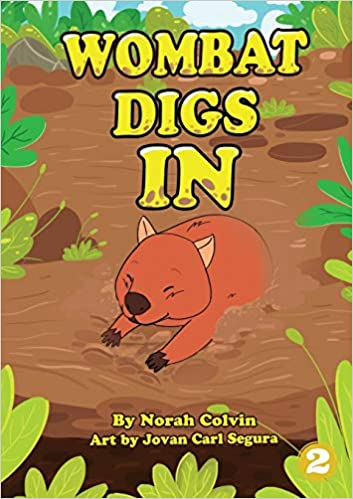
This is an adorable book for small children about a wombat who is struggling to keep up with some of the other animals including the kangaroos who can bounce, the possums who can climb, and the fruit bats who can fly. Wombat is feeling a little dejected, but when Baby Koala falls out of the tree, Wombat’s own special skill of digging comes to the forefront. This little book is illustrated with simple and bright pictures that small children will love.
Purchase link:
Amazon Au: https://www.amazon.com.au/gp/product/192596003X
Amazon US: https://www.amazon.com/Wombat-Digs-Norah-Colvin/dp/192596003X
My review of Let’s Move by Norah Colvin

This is a delightful little book for teaching very young children about animals and movement. The illustrations are adorable and I particularly liked the snails that slide and the snakes that slither.
Purchase link:
Amazon Au: https://www.amazon.com.au/gp/product/1925960064
Amazon US: https://www.amazon.com/Lets-Move-Norah-Colvin/dp/1925960064
About Norah Colvin
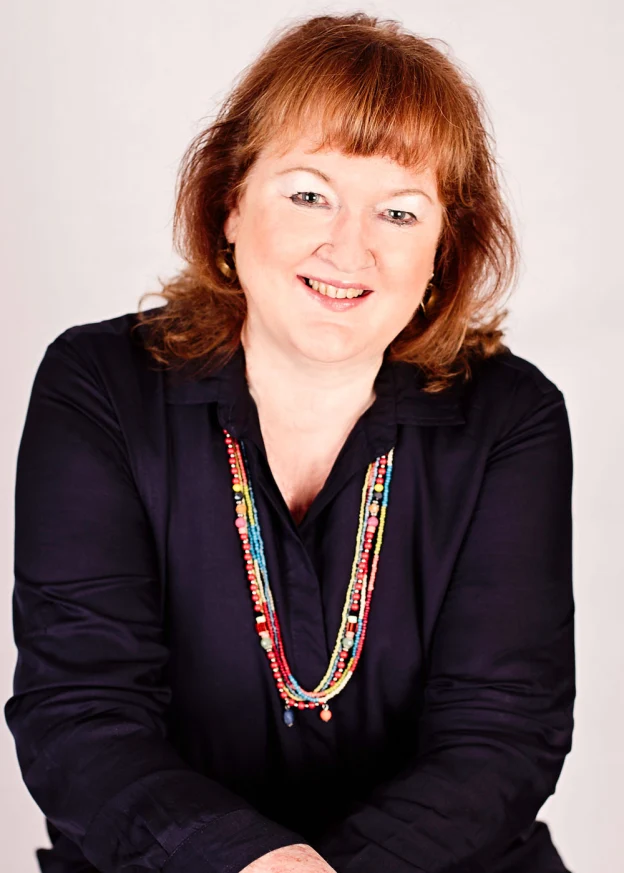
Norah Colvin is a passionate educator and writer.
She is a published educational writer and freelance author for publishers such as Jacaranda Wiley, Greygum Software, Blake Education, Pascal Press, MacMillan and ITC Publications.
She has two children’s books published with Library For All, a ballad included in the Share Your Story Tell ‘Em They’re Dreaming anthology and flash fiction in the Carrot Ranch Rough Writers Anthology Vol 1. She loves to write picture books manuscripts for the six-year-old in her own and others’ hearts.
She belongs to the following writers’ groups:
SCBWI
Queensland Writers Centre
Book Links
Write Links
Writing NSW
Creative Kids Tales
and other Facebook writing groups.
She blogs at www.NorahColvin.com and produces teaching resources for her educational website www.readilearn.com.au.
About Robbie Cheadle
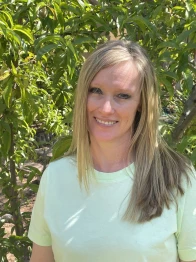
Award-winning, bestselling author, Robbie Cheadle, has published thirteen children’s book and two poetry books. Her work has also appeared in poetry and short story anthologies.
Robbie also has two novels published under the name of Roberta Eaton Cheadle and has horror, paranormal, and fantasy short stories featured in several anthologies under this name.
The ten Sir Chocolate children’s picture books, co-authored by Robbie and Michael Cheadle, are written in sweet, short rhymes which are easy for young children to follow and are illustrated with pictures of delicious cakes and cake decorations. Each book also includes simple recipes or biscuit art directions which children can make under adult supervision.
Robbie’s blog includes recipes, fondant and cake artwork, poetry, and book reviews. https://robbiesinspiration.wordpress.com/