Wrapping Up the WordCrafter “Northtown Angelus” Book Blog Tour
Posted: March 14, 2024 Filed under: Book Promotion, Book Review, Books, Crime, Fiction, Giveaways, Hard-Boiled Crime Fiction, Review, WordCrafter Book Blog Tours | Tags: Books, Crime Fiction, Hard-boiled fiction, Northtown Angelus, Raimo Jarvi Investigates, Robert White, WordCrafter Book Blog Tours 8 Comments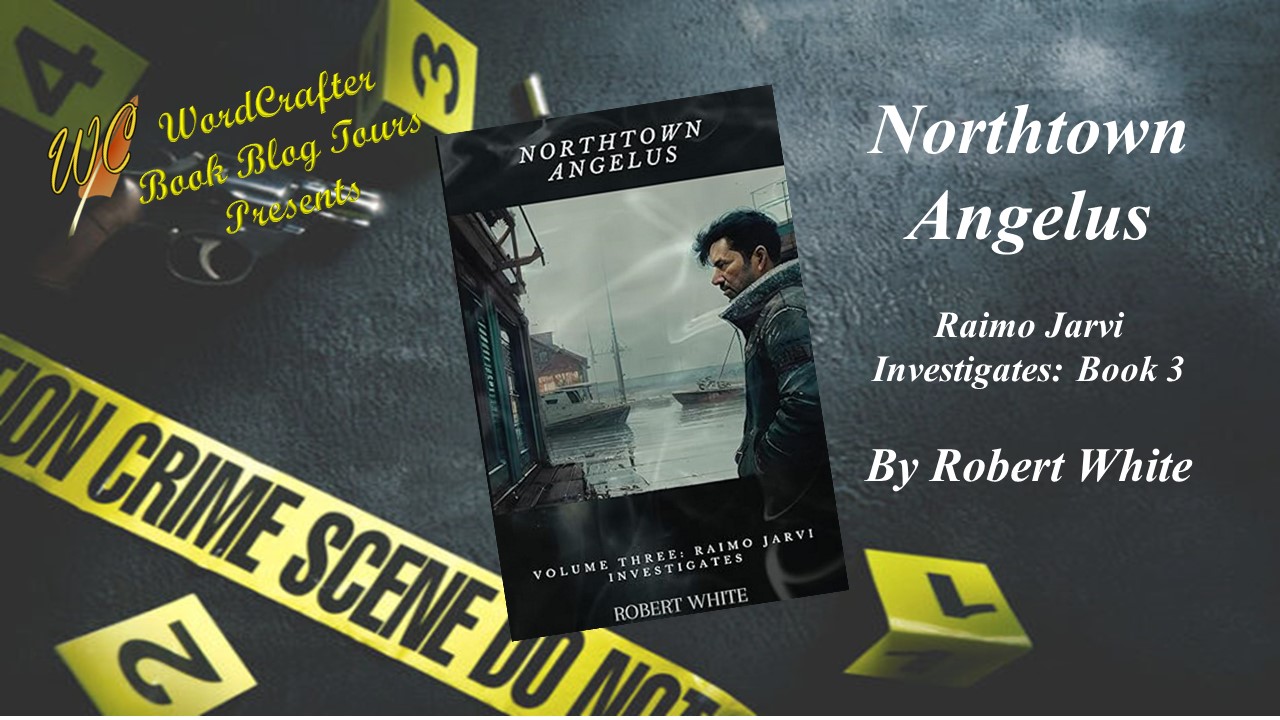
This is the last day of the WordCrafter “Northtown Angelus” Book Blog Tour. To wrap-up we have a double stop today, with my review of the book here, on Writing to be Read, and then on to Undawnted for a final guest post from the author, Robert White. But , let before we get started, let me offer a reminder to be sure and leave comments when you visit a stop to be entered in the giveaway below. You can click on the links in the schedule to go back and visit any stop you may have missed along the way. Undawnted does not accept comments, but you can leave your comments for the second stop on today’s tour here.
Giveaway
Each stop where you leave a a comment,
you get another chance to win one of five digital copies,
and one signed print copy of Northtown Angelus.
Tour Schedule
Mon. March 11 – Writing to be Read – Author Interview
Tues. March 12 – Robbie’s Inspiration – Guest Post
Wed. March 13 – Patty’s Worlds – Author Interview
Thurs. March 14 – Writing to be Read – Review/Undawnted – Guest Post
About Northtown Angelus

Johnny Dillon took his life. His wife Cora wants to know why. The Northtown cops don’t care; they closed the case as a suicide. The M.E. hasn’t got any answers for the discrepancies Ray Jarvi discovered in the autopsy report and from what Johnny’s wife told him about the days leading up to his decision to take his life.
This is the beginning of an investigation for private investigator Ray Jarvi, who follows a twisting path of corruption and vice in his rust-belt town on the shores of Lake Erie to help her find some resolution to the worst day in her life. Like a medieval play between warring devils and angels battling for a soul, he must deal with a variety of Northtowners who play one part or the other on his journey to find those answers. Getting past one obstacle only leads to another—and another. Before long, Jarvi does not know whom to trust. He realizes nothing in his town is what it appears to be and that there are some dangerous people who like it that way.
Purchase Link: https://www.amazon.com/Northtown-Angelus-Raimo-Jarvi-Investigates/dp/B0CRQ66L4Y
About Author Robert White
Robert T. White writes from Northeastern Ohio. He has published several crime, noir, hardboiled novels and genre stories in various magazines and anthologies. He’s been nominated for a Derringer. “Inside Man,” a crime story, was selected for Best American Mystery Stories 2019. His second hardboiled p.i. series (after the Thomas Haftmann mysteries begun in 2011 with Haftmann’s Rules) features Raimo Jarvi in Northtown Eclipse (Fahrenheit Press, 2018) and Northtown Blitz (2020). British website Murder, Mayhem & More cited When You Run with Wolves (rpt. 2018) as a finalist for Top Ten Crime Books of 2018 and Perfect Killer in 2019. “If I Let You Get Me” was selected for the Bouchercon 2019 anthology and The Russian Heist (Moonshine Cove, 2019), another crime thriller, was selected by Thriller Magazine as winner of its Best Novel category. “Out of Breath” and Other Stories is a mixed collection of mainstream and noir fiction (Red Giant Press, 2013).

My Review
Northtown Angelus, by Robert White, is book 3 in the Raimo Jarvi Investigates series. This story reads like a classic hardboiled crime fiction tale, complete with flawed P.I. protagonist and colorful inner city characters and setting. The writing style and lack of dialog tags was a little off-putting at first. It kind of grew on me though, and once I became emmersed in the story, I hardly noticed unless I got confused about who was speaking.
Dealing with less than desirable people and neighborhoods, is bound to give anyone a grim outlook on life. But for Ray Jarvi, a P.I. with an unfortunate history which left him scarred, inside and out, working those neighborhoods throws low lifes, drug dealers, and other criminal types in his path at every turn, has turned his outlook grim indeed. He’s learned not to expect too much from his fellow man. Ray is on a case to find out what really happened to man the cops wrote off as suicide, for the greiving widow, but finds himself in the middle of something even bigger. Ray doesn’t wait for things to happen, he pushes peoples buttons and makes things happen, always on the offensive. But when a friend and employee is brutally beaten while doing survellience for him, we see a softer side of Ray, as someone who really does give a damn, before donning his social armor once more and going back after the villians who are responsible.
Fast moving and hard hitting, Northtown Angelus is all that a hard-boiled crime novel should be. I give it four quills.

_________________________________________________________
Don’t forget to visit the second stop on today’s tour to hear more from author Robert White on Northtown Angelus and his Raimo Jarvis Investigates series. You can visit that stop here: Remember you can come back here to leave a comment for today’s entry in the giveaway.
___________________________________________
That wraps up the WordCrafter Northtown Angelus Book Blog Tour. Thank you all for joining us. Be sure to visit each stop through the schedule at the top of this post for more chances to win a copy of this hardboiled crime fiction novel. I hope you enjoyed meeting Robert White and learning more about Northtown Angelus.
_________________________________________________________
Book your WordCrafter Book Blog Tour today!
Share this:

Day 3 of the WordCrafter “Northtown Angelus” Book Blog Tour
Posted: March 13, 2024 Filed under: Author Interview, Books, Crime, Giveaways, Mystery, Pulp Fiction, WordCrafter Book Blog Tours | Tags: Crime Fiction, Giveaway, Hard-boiled fiction, Northtown Angelus, Robert White, WordCrafter Book Blog Tours 2 CommentsFor Day 3 of the WordCrafter Northtown Angelus Book Blog Tour we’re over at Patty’s Worlds, where Patty Fletcher interviews author Robert White. Join us, and leave a comment for a chance at a free copy of this hardboiled crime fiction novel.
Share this:

Welcome to the WordCrafter “Northtown Angelus” Book Blog Tour
Posted: March 11, 2024 Filed under: Author Interview, Book Promotion, Books, Fiction, Giveaways, Hard-Boiled Crime Fiction, WordCrafter Book Blog Tours | Tags: Crime Fiction, Hard-boiled fiction, Northtown Angelus, Raimo Jarvi Investigates, Robert White, WordCrafter Book Blog Tours 17 CommentsWelcome to the WordCrafter Northtown Angelus Book Blog Tour. We have a great tour planned with a generous giveaway, so let me tell you about that first.
Giveaway
Each stop where you leave a a comment,
you get another chance to win one of five digital copies,
and one signed print copy of Northtown Angelus.
Opening Day
Today is opening day, and we have a special interview with author Robert White, where we talk about what draws him to crime thrillers, and writing in general. Of course, he will also talk about Northtown Angelus, and if you pay attention, he might even reveal a few insider clues about the story.
Interview with author Robert White
Kaye: Please tell us a bit about your author journey and how you got into writing as a profession and a business?
Robert: I taught five sections of freshman composition at a regional branch campus, which meant I was steeped in marathon grading sessions during the week and throughout the weekend in my tiny office circling to/too homonyms. The desire to write was always there but not the time. In the two decades of writing I’ve enjoyed—strictly as hobby—I’ve made a few bucks, but I knew even as a fledgling English major that no one but a lucky or extraordinarily talented few make a living at it.
The immediate impetus was serendipity (not a word to use easily). A student of mine called down from the IT lab where he worked part-time. He said my computer was scheduled for an upgrade and I would lose all my unsaved files. I’d written a Haftmann ms. a decade earlier for fun and forgotten it. He sent it to me, I looked it over, updated it with cell phones and laptops, and sent it out to Grand Mal Press. Ryan Thomas, still the managing editor, published it in 2011. Ryan has since brought out nearly all the Haftmann novels and this last novel in the Northtown trilogy.
Kaye: What’s the most difficult thing about being an author for you?
Robert: Not a thing. I’ve been a stockboy in a grocery store, a factory worker, and a deckhand on the Great Lakes. I remember what hard work is. Sitting in my room, sipping coffee, and mulling over word choices is not it.
Kaye: What is the most rewarding thing about being an author for you?
Robert: Just having my foot in the door. When I was fifteen a girlfriend gave me a copy of William Styron’s Sophie Choice. I’d never read such beautiful prose before. To be a very junior member of that “club” is an honor in itself regardless of the boos I get on Amazon and elsewhere.
Kaye: What part of being an author was unexpected, something that you didn’t realize starting out?
Robert: That note of jaundiced humor that creeps into my narrative voice from time to time. Both my private eyes have it. I might have been influenced by Chandler’s Marlowe more than I realized, but my fictional landscapes veer toward the grim.
Kaye: You’ve received a few awards for your writing. The Russian Heist won Best Novel in Thriller Magazine. Your book, Betray Me Not, was selected by the Independent Alliance as a Truly Best Independent Book, and your story “Inside Man” was selected by Otto Penzler of Houghton Mifflin for Best Mystery Stories of 2019. How important have these awards been in propelling your author career forward?
Robert: Any distinction is a pleasure. I’m not immune to flattery. I do think I have a proper sense of humility about my own talent vis-à-vis the outstanding writers I admire intensely: Martin Cruz Smith, Thomas Harries, and David Lindsey.
Kaye: Regarding Thomas Haftmann, Private Eye: The Short Stories, The Midwest Review said, “Clearly, author Robb White is a master of the noir style mystery genre…”, and many of your works are noir, hardboiled crime fiction. What draws you to this genre?
Robert: I suspect there’s a glitch in my DNA molecule that absorbed something from my mother. She loved paperback mysteries, especially Agatha Christie. It didn’t stick all the way because I quit halfway through one Miss Marple book. Not my cup of tea, as they say.
I’m drawn to the genre because of its ambiguity, the half existence between knowledge and ignorance, truth and lies, good and evil—trite as that sounds. That’s real life, isn’t it? “Peering through a venetian blind,” as metaphor, is wonderfully apt.
Kaye: What other genres, if any do you write?
Robert: I dip my toe into the horror genre from time to time because psychological horror and crime are intricately related and there’s a slender passageway between them, easy to cross. But I’ve never gone beyond short stories.
Kaye: Northtown Angelus is volume 3 in the Raimo Jarvi Investigates series. For readers who may not have read books 1 & 2, please tell us, who is Ray Jarvi? What drives him? How did he end up as a P.I.? What makes him good at his job?
An outstanding critic in U.K. crime fiction is Rowena Hoseason, who said Ray is “broken.” She nailed it. He fights his past as a victim of a boyhood fire that scarred his face and isolated him in society thereafter. He’s driven by his refusal to stay locked away in a brooding isolation despite his physical appearance that keeps people away, although he did have one love affair that ended in tragedy, and he has a boyhood friendship with a deputy. A few minor figures in law enforcement pop up to help Ray out because he’s running on a shoestring budget and doesn’t have access to the best databases.
Kaye: Where did you get the inspiration for the Raimo Jarvi character?
Robert: I created Raimo Jarvi because Thomas Haftmann, my first series investigator, was set in stone. He was cast in the Spade-Marlowe mode and I couldn’t get him to “evolve” without denying the characteristics that made him. His surname is a play on “half-man,” and he wasn’t capable of aging gracefully, as flippant as that might sound. I needed a more self-effacing narrator akin to my own aging temperament.
Kaye: Please tell us a little about the first two books. Should the books for this series be read in order, or do they work as standalones?
Robert: I do think they’re standalones despite the fact a few characters and references follow from book to book. In Northtown Eclipse, Ray investigates a case involving his macho brother and some former classmates involved in a sordid catastrophe involving a female victim in the same sleazy resort town Haftmann has an office in. In Northtown Blitz, Raimo is again drawn back to the past of his painful high-school days. A woman asks him to investigate the death of her sister. The main suspect is her own brother-in-law, a prominent lawyer in Northtown.
Kaye: What is it about Northtown Angelus that would make crime thriller fans want to purchase this book? Tell us a little about the story within.
Robert: I believe fans of mystery aren’t locked into a niche that inhibits, say, a lover of big-city crime fiction from appreciating a small-town mystery about people who hide behind masks of middle-class respectability.
In Northtown Angelus, a recent widow asks Ray to investigate her husband’s death, which the cops have written off as suicide. As Ray peels the onion layers away, he meets a bevy of high and low characters involved. There are dark, ongoing secrets that no one wants exposed to the light.
Kaye: Tell us something about yourself that your readers would never guess.
Robert: I’m a skywatcher, not a real amateur star-gazer, but I drag the telescope out of the garage now and then to check out the celestial skies. What goes on in interstellar space is so remote from the mundane and our puny, temporal existence that it appeals strongly to me.
About Author Robert White
Robert T. White writes from Northeastern Ohio. He has published several crime, noir, hardboiled novels and genre stories in various magazines and anthologies. He’s been nominated for a Derringer. “Inside Man,” a crime story, was selected for Best American Mystery Stories 2019. His second hardboiled p.i. series (after the Thomas Haftmann mysteries begun in 2011 with Haftmann’s Rules) features Raimo Jarvi in Northtown Eclipse (Fahrenheit Press, 2018) and Northtown Blitz (2020). British website Murder, Mayhem & More cited When You Run with Wolves (rpt. 2018) as a finalist for Top Ten Crime Books of 2018 and Perfect Killer in 2019. “If I Let You Get Me” was selected for the Bouchercon 2019 anthology and The Russian Heist (Moonshine Cove, 2019), another crime thriller, was selected by Thriller Magazine as winner of its Best Novel category. “Out of Breath” and Other Stories is a mixed collection of mainstream and noir fiction (Red Giant Press, 2013).
About Northtown Angelus
Johnny Dillon took his life. His wife Cora wants to know why. The Northtown cops don’t care; they closed the case as a suicide. The M.E. hasn’t got any answers for the discrepancies Ray Jarvi discovered in the autopsy report and from what Johnny’s wife told him about the days leading up to his decision to take his life.
This is the beginning of an investigation for private investigator Ray Jarvi, who follows a twisting path of corruption and vice in his rust-belt town on the shores of Lake Erie to help her find some resolution to the worst day in her life. Like a medieval play between warring devils and angels battling for a soul, he must deal with a variety of Northtowners who play one part or the other on his journey to find those answers. Getting past one obstacle only leads to another—and another. Before long, Jarvi does not know whom to trust. He realizes nothing in his town is what it appears to be and that there are some dangerous people who like it that way.
Purchase Link: https://www.amazon.com/Northtown-Angelus-Raimo-Jarvi-Investigates/dp/B0CRQ66L4Y

About the Tour
We have a brief, but great tour planned with guest posts from the author, a second interview on Day 3. So you’ll hear a lot more from author Robert White and learn more about this thriller that takes after the classic hard-boiled crime novels. Day 4 will feature a double stop day with a guest post on Undawnted, and my review of Northtown Angelus.
Visit each day and leave a comment for more chances at one of five digital copies or a signed print copy of the book. You’ll find the tour schedule with links below, but remember the links won’t work until that day’s stop goes live. I hope you all will join us.
Tour Schedule
Day 1: Writing to be Read – Interview
Day 2: Robbie’s Inspiration – Guest Post
Day 3: Patty’s Worlds – Interview
Day 4: Undawnted – Guest Post/ Writing to be Read – Book review
________________________________________________________
Book your WordCrafter Book Blog Tour today!
Share this:

July: On the hunt for crime fiction
Posted: July 23, 2019 Filed under: Books, Crime, Fiction, Hard-Boiled Crime Fiction, Noir, Pulp Fiction, Suspense, Tension, Writing | Tags: Awesome Tales #10, Crime Fiction, Crime Novels, Hard-boiled fiction, Jenifer Ruff, Jim Nesbitt, Michael Pool, Noir, Noir crime fiction, Pulp Fiction, Quintin Peterson, Rose City, The Numbers Killer, Writing to be Read 2 Comments
The crime fiction genre covers a lot of ground. By definition, crime fiction involves mystery to be solved, usually who the killer is, or a quest to figure out some type of diabolical plot. Crime fiction stories involve pretty high stakes, and therefore a lot of suspense. Often there is a ticking clock to ratchet the tension even higher. And of course, there is always a crime of some sort to be solved, or prevented; some sort of wrong to be righted.
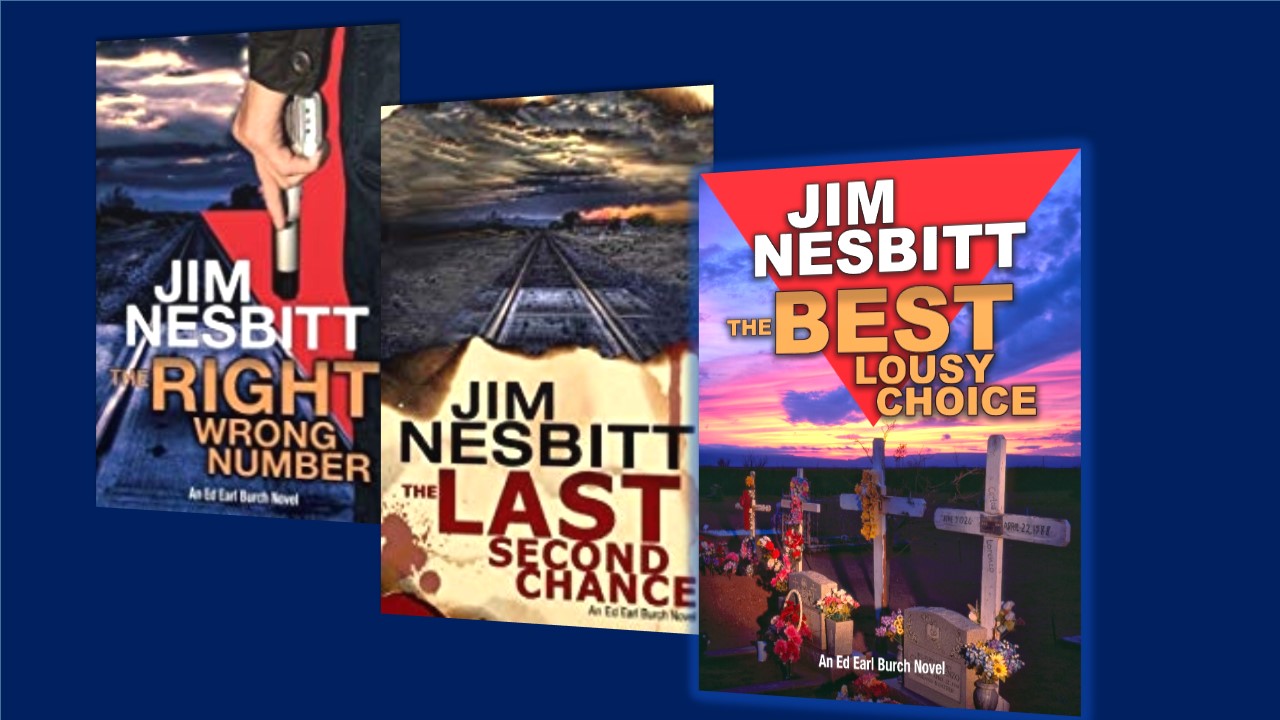
Crime fiction is a broad term which includes many sub-genres, which focus on the investigation of a crime and the apprehension of a suspect, either by law enforcement agents, as in The Numbers Killer, by my “Chatting with the Pros” author guest, Jenifer Ruff or by a tough guy P.I., as in hardboiled crime fiction such as Jim Nesbitt writes, with his tough guy P.I., Ed Earl Burch in The Best Lousy Choice and the two previous books in that series.
Hardboiled heroes are memorable. Who doesn’t know of Sam Spade or Mike Hammer and their cynical tough-guy images? They are usually down on their luck, or at least between clients. They are often heavily flawed, often self-destructive, but a ladies man none-the-less, with a love them and leave them attitude and the snappy dialog of the 1920’s. Hardboiled fiction was birthed by Carrolle John Daly and Dashielle Hammett in the 20’s, and carried on by authors such as Raymond Chandler and Mickey Spillane.
In noir crime fiction, the protagonist is usually an extremely flawed, average guy. He’s usually down and out, or perhaps on a downward spiral in a situation that seems bleak and hopeless. He’s a self-destructive hero, who ends up going against all odds to fight corruption and injustice, not because it is his job, but for strictly personal motivations, which are usually not in his own best interests. An excellent example of this is found in Rose City, by Michael Pool (See my interview with Michael next Monday, the 29th).
And of course, the classic crime fiction is pulp, such as Quintin Peterson writes in Awesome Tales #10 . From pulp, we get our classic heroes and fiendish evil villains. It’s from pulp that comic book super heroes and super villains arose, which is yet, another sub-genre of crime fiction, which has expanded with a life of its own to super colossal proportions.
We went on a hunt for crime fiction, and we found quite a bit. I learned a lot and I hope you did to. Now, I’m looking forward to August in a quest for mysteries and mystery authors. My “Chatting with the Pros” guest will be New York Times bestselling author, Gilly Macmillan. I’ll also be interviewing mystery author Gerald Darnell. And I’ll be reviewing a mystery anthology, Death Among Us, as well as a search and rescue mystery, Murder on the Horizon, by M.L. Rowland, and a paranormal cozy, Broomsticks and Burials, by Lilly Webb. I hope you’ll join me.
Like this post? Let me know in the comments. You can be sure not to miss any of Writing to be Read’s great content by subscribe to e-mail or following on WordPress.
Share this:

Interview with hardboiled crime fiction author Jim Nesbitt
Posted: July 8, 2019 Filed under: Books, Crime, Fiction, Hard-Boiled Crime Fiction, Writing | Tags: Author Interview, Crime Fiction, Ed Earl Burch, Hard-boiled fiction, Jim Nesbitt, The Best Lousy Choice, Writing to be Read 3 Comments
My guest today has a background in hard hitting journalism and he writes hard-boiled crime fiction in the tradition of Dashiel Hammet, and other famed crime writers. I’m pleased to be interviewing him because he represents a great literary tradition in genre. Please help me welcome, crime fiction novelist Jim Nesbitt.
Kaye: Your writing is classified as hard-boiled fiction, but you have your own style. Can you tell me a little about your style of hard-boiled fiction?
Jim: I’ve always thought of hard-boiled crime fiction as a distinctly American art form. Rooted in realism, cynicism, violence, corruption and a dark view of the American dream, it’s also a tremendously flexible genre. It’s best practitioners — from the founding fathers, Dashiell Hammett and Raymond Chandler, through Ross Macdonald, James Ellroy and the late and vastly underappreciated James Crumley — use it as a vehicle to comment on contemporary American life and politics, music, culture, the warped psychology of the hardened criminal and the suburban housewife, the tortured dance between men and women and anything else that strikes their fancy. When I decided to try my hand at fiction, I knew it would be hard-boiled crime fiction because it matches my outlook on life and my experience as a journalist as well as the freedom I saw in the books of the very best writers, not that I’m close to being in their class.
As for my style, it’s the result of years of working as a journalist who came up through the ranks at a time when long-format stories that used the narrative style and tradecraft of fiction were the rage, what I learned from reading Hammett, Chandler, Crumley, Ellroy, James Lee Burke and others and the genetics of coming from a long line of hillbilly storytellers. Every writer hopes to develop a unique voice, free from template and artifice. Few do. I write the way I talk — which is a curious mixture of film noir patter and cowboyspeak, with a little Tex-Mex thrown in. No surprise there since I spent quite a few years knocking around the West and the border between Texas and Mexico, used to own horses and am steeped in the dark movies of the 40s and 50s.
I’m also a strong believer in driving a story through snappy and hard-bitten dialogue, sharply defined characters with depth and lots of backstory and such a keen sense of place that it becomes a character unto itself. I spent a lot of time knocking around the West and the West Texas border country and my books are shot through with scenes based on what I saw out there. More than one reviewer has said my books have the soul of a classic Western, with hard-boiled and noirish trappings, and I tend to agree with them. Although they’re set in the late-80s and early 90s, they’re as much contemporary Westerns as they are hard-boiled crime novels.
Kaye: Tell me a little about your main character. Who is Ed Earl Burch?
Jim: Ed Earl’s a bit of an Everyman, a guy who has been knocked around by life. He’s a defrocked Dallas vice and homicide detective, tossed off the force for being a little too willing to beat the hell out of or shoot suspects and for being a terminal smartass who doesn’t know when to shut up. The brass also blames him for the death of his partner, which trebles the guilt he already feels.
Losing his badge robs Ed Earl of his sense of purpose and higher calling and takes away a job he’s really good at — chasing down killers. He’s a manhunter at heart, but without his badge, he retreats into a corner defined by the path from his apartment, to his ratty office and his favorite saloon, chasing down financial fugitives from the savings-and-loan bust of the mid-80s and taking on divorce cases he loathes because he’s in hock to his eyeballs.
What he isn’t is super-smart, like Sam Spade or Philip Marlowe. He’s tough and shrewd, but dogged more than brilliant. He’s no square-jawed Jack Reacher or other action hero one step removed from a comic book or graphic novel. He’s bearded, balding and has a belly. He’s got wrecked knees, a wounded liver and an empty bank account. He’s an anti-hero who sometimes forgets to live by his personal code — and a bit of a burnout.
In THE BEST LOUSY CHOICE, he starts out as an emotional wreck, plagued by nightmares from his last misadventure captured in THE LAST SECOND CHANCE, where he was almost killed by a psychotic drug lord who believed in Aztec heart sacrifice and had Ed Earl trussed up on a stone altar to carve out his heart. He’s self-medicating with bourbon and Percodan, but finds out that when he’s working, he steadies up and the old cop reflexes return. When he gets asked to look into a suspicious barn fire that killed a prominent West Texas rancher, he leaps at the chance to be a manhunter again, unburdened by the rules and laws he had to live by as a cop. He pays a terrible price both physically and emotionally to do a job he was born to do — as he does in my other books.
Kaye: You were a journalist chasing all kinds of stories. How much of your true life experiences have found their way into your stories?
Jim: I kind of tipped my hand with my answer to your first question. The scenes in my books are based on what I saw and experienced as a journalist knocking around this great country, particularly the South, the West and West Texas. Chances are, if I’m writing about it, I’ve been there. I fell in love with the stark, harsh and beautiful land of what they call the Trans-Pecos and I used that to create a keen sense of place in all my books. It’s the perfect setting for bloody tales of revenge and redemption. During my years as a journalist, I also met cops, prosecutors, crooks and a few killers so they went into the creative pot. So did my marital misadventures, my taste for bourbon, my love of great saloons and my preference for Colt 1911 semi-automatics.
Kaye: You were a journalist for a good part of your life, and now you are an author, so it seems as if writing is a way of life for you. When did you first know that you wanted to become an author?
Jim: I come from a long line of hillbilly storytellers and remember listening to the stories my uncles, aunts, parents and grandparents told about family, friends and life experiences. As a kid, I always had my nose in a book and started writing my own little stories. When I was in eighth grade, my English teacher, Mary Bailey, took my aside and told me I was a writer. She even called my dad in to tell him the same thing and to encourage me to be a writer. That impressed dad and me, although I took a long intermediate step as a journalist before trying my hand at novels. Call it an apprenticeship that lasted decades.
Kaye: What is the biggest challenge for you in writing crime fiction?
Jim: I still have a demanding day job, so finding the time to write is my biggest challenge. I’m also an older writer and don’t have quite as much energy as I did twenty or twenty-five years ago — can’t stay up until the small hours writing a novel, then turn around and put in a ten to twelve hour day at the office. Have to pace myself and carve out big blocks of time during the weekends to write Ed Earl books.
Kaye: What’s something most readers would never guess about you?
Jim: That I’m an introvert at heart and inherently shy. I’m a big guy with presence and a bit of a showboat in a crowd, but that covers up my introverted innards.
Kaye: Besides writing, what are your favorite things to do?
Jim: Taking long trips on back roads to nowhere with my wife in our 1972 Cutlass Supreme ragtop and smoking a cigar and sipping bourbon while reading a good book.
Kaye: Which author, dead or alive, would you love to have lunch with? Why?
Jim: The late, great James Crumley. I learned a lot about writing through reading his books — DANCING BEAR, BORDERSNAKES, THE WRONG CASE. He taught me to let it rip with frank descriptions of violence, sex, drugs and other forms of wretched excess. His characters, particularly Milo Milodragovitch, are deeply flawed anti-heroes, just like Ed Earl. He was also a man with a taste for deep whiskeys and red meat, so I think a liquid lunch with a porterhouse side dish would be a helluva lot of fun and would teach me a thing or two about writing.
Kaye: How do you build suspense in your stories?
Jim: I really don’t worry too much about building suspense. I think that’s a natural byproduct of driving the story at a relentless pace through dialogue, character and lots of action. I want the reader to think: How is Ed Earl gonna get out of this mess? Who is this new bad hombre and what kind of pain is he going to rain down on ol’ Ed Earl?
Kaye: You’re working on the next Ed Earl Burch novel, The Best Lousy Choice. What can you tell me about that story?
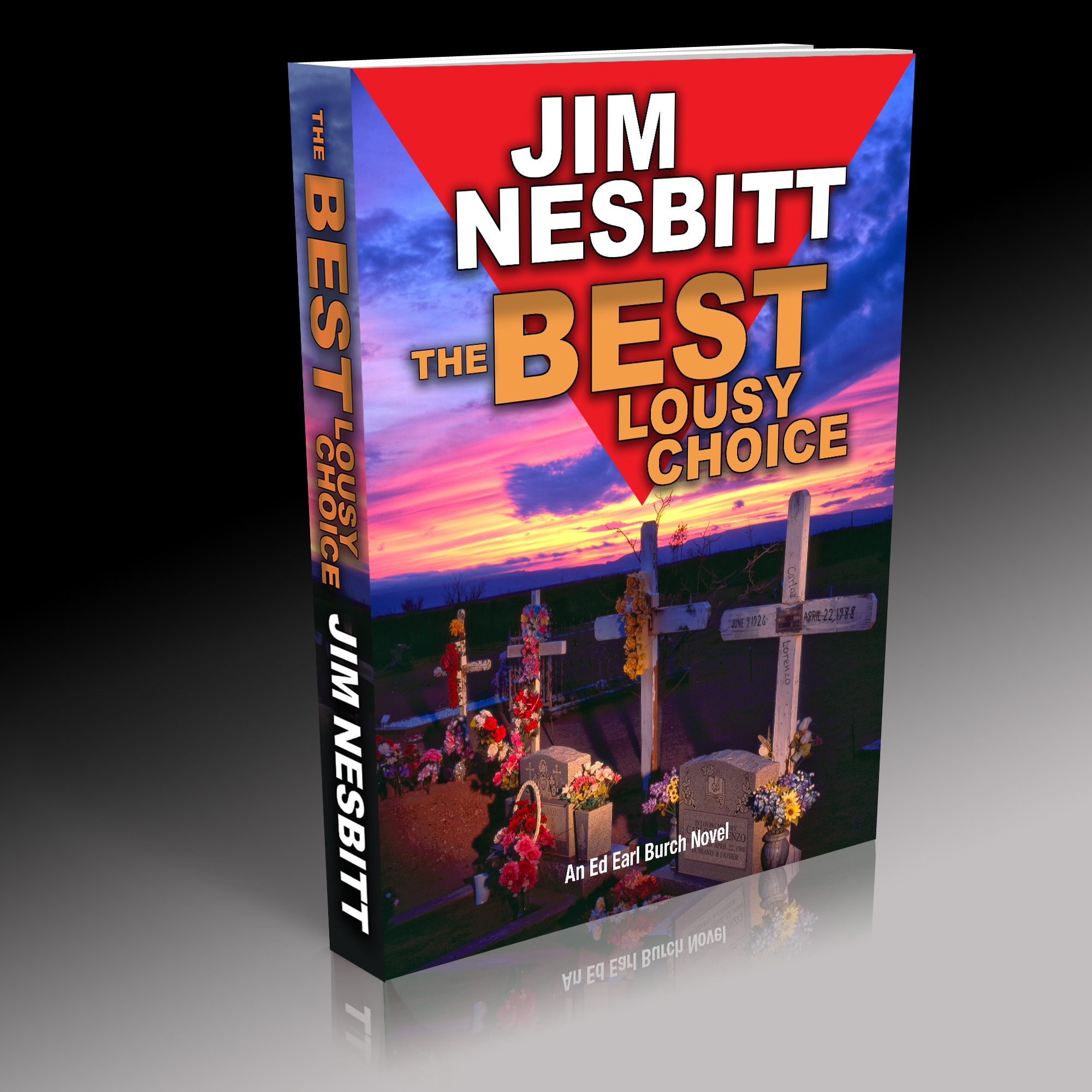 Jim: Dallas private eye Ed Earl Burch is an emotional wreck, living on the edge of madness, hosing down the nightmares of his last case with bourbon and Percodan, dreading the next onslaught of demons that haunt his days and nights, including a one-eyed dead man who still wants to carve out his heart and eat it.
Burch is also a walking contradiction. Steady and relentless when working a case. Tormented and unbalanced when idle. He’s deeply in debt to a shyster lawyer who forces him to take the type of case he loathes — divorce work, peephole creeping to get dirt on a wayward husband.
Work with no honor. Work that reminds him of how far he’s fallen since he lost the gold shield of a Dallas homicide detective. Work in the stark, harsh badlands of West Texas, the border country where he almost got killed and his nightmares began.
What he longs for is the clarity and sense of purpose he had when he carried that gold shield and chased killers for a living. The adrenaline spike of the showdown. Smoke ‘em or cuff ‘em. Justice served — by his .45 or a judge and jury.
When a rich rancher and war hero is killed in a suspicious barn fire, the rancher’s outlaw cousin hires Burch to investigate a death the county sheriff is reluctant to touch.
Seems a lot of folks had reason for wanting the rancher dead — the local narco who has the sheriff on his payroll; some ruthless Houston developers who want the rancher’s land; maybe his own daughter. Maybe the outlaw cousin who hired Burch.
Thrilled to be a manhunter again, Burch ignores these red flags, forgetting something he once knew by heart.
Be careful what you wish for. You just might get it. And it might just get you killed.
But it’s the best lousy choice Ed Earl Burch is ever going to get.
I want to thank Jim for being my guest here and sharing with us. He has shed some light on what hard-boiled fiction is all about and obviously loves his craft. You can learn more about Jim Nesbitt and his books at the links below.
https://jimnesbittbooks.com Website
https://www.amazon.com/author/jimnesbitt Amazon author page
https://www.facebook.com/edearlburchbooks Facebook author page
https://www.goodreads.com/author/show/14971688.Jim_Nesbitt Goodreads author page
https://books.apple.com/us/book/the-best-lousy-choice/id1468993353 Apple Books E-Book
https://www.kobo.com/us/en/ebook/the-best-lousy-choice Kobo E-Book
https://www.barnesandnoble.com/w/books/1132276790?ean=2940161430828 Barnes & Noble Nook E-Book
https://spottedmule.wordpress.com/ Blog
Like this post? Let me know in the comments. You can be sure not to miss any of Writing to be Read’s great content by subscribe to e-mail or following on WordPress.
https://twitter.com/EdEarlBurch?lang=en Twitter author page