Day 4 of the WordCrafter “Poetry Treasures 6: Seasons” Book Blog Tour
Posted: April 23, 2026 Filed under: Anthology, Blog Tour, Book Release, Books, Giveaways, Poetry, WordCrafter Book Blog Tours | Tags: Joy Neal Kidney, Poetry Anthology, Poetry Treasures 6: Seasons, WordCrafter Book Blog Tours, WordCrafter Press, Yvette Prior 3 Comments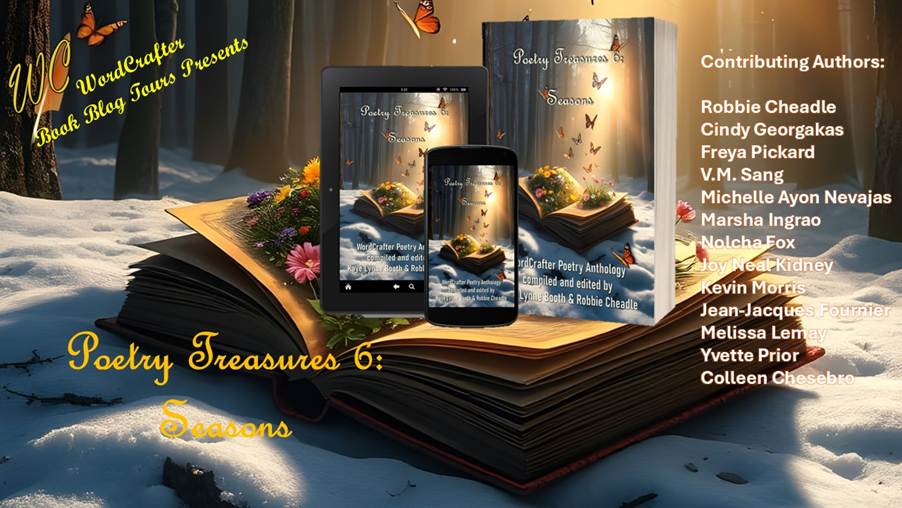
We’re over at Robbie’s Inspiration for Day 4 of the WordCrafter Poetry Treasures 6: Seasons Book Blog Tour with contributor guests Joy Neal Kidney and Yvette Prior. Join us in celebrating the release of this wonderful poetry anthology and enter the giveaway for a chance for a free digital copy.
Share this:

Day 3 of the WordCrafter “Poetry Treasures 6: Seasons” Book Blog Tour
Posted: April 22, 2026 Filed under: Anthology, Blog Tour, Book Release, Books, Giveaways, Poetry, Poetry Readings, WordCrafter Book Blog Tours | Tags: Freya Pickard, Poetry, Poetry Anthology, Poetry Treasures 6: Seasons, V.M. Sang, WordCrafter Book Blog Tours, WordCrafter Press 1 CommentDay 3 of the WordCrafter “Poetry Treasures 6: Seasons” Book Blog Tour finds us over at Joy Neal Kidney’s blog site with fun facts and a poetry reading by V.M. Sang, and an introduction to Freya Pickard. Join us in celebrating the release of this amazing poetry anthology and enter the giveaway for a chance at a free digital copy of the book.
Day 3 of the WordCrafter “Poetry Treasures 6: Seasons” Book Blog Tour – Joy Neal Kidney
Share this:

In Touch with Nature – The magnificent male leopard
Posted: April 22, 2026 Filed under: Animals, In Touch With Nature, Nature, Photography, Poetry, Wildlife | Tags: #InTouchWithNature, #RobbieCheadle, In Touch With Nature, Leopards, Robbie Cheadle, South Africa, Writing to be Read 47 Comments
Characteristics of male leopards
Leopards are powerful big cats and are closely related to lions, tigers, and jaguars.
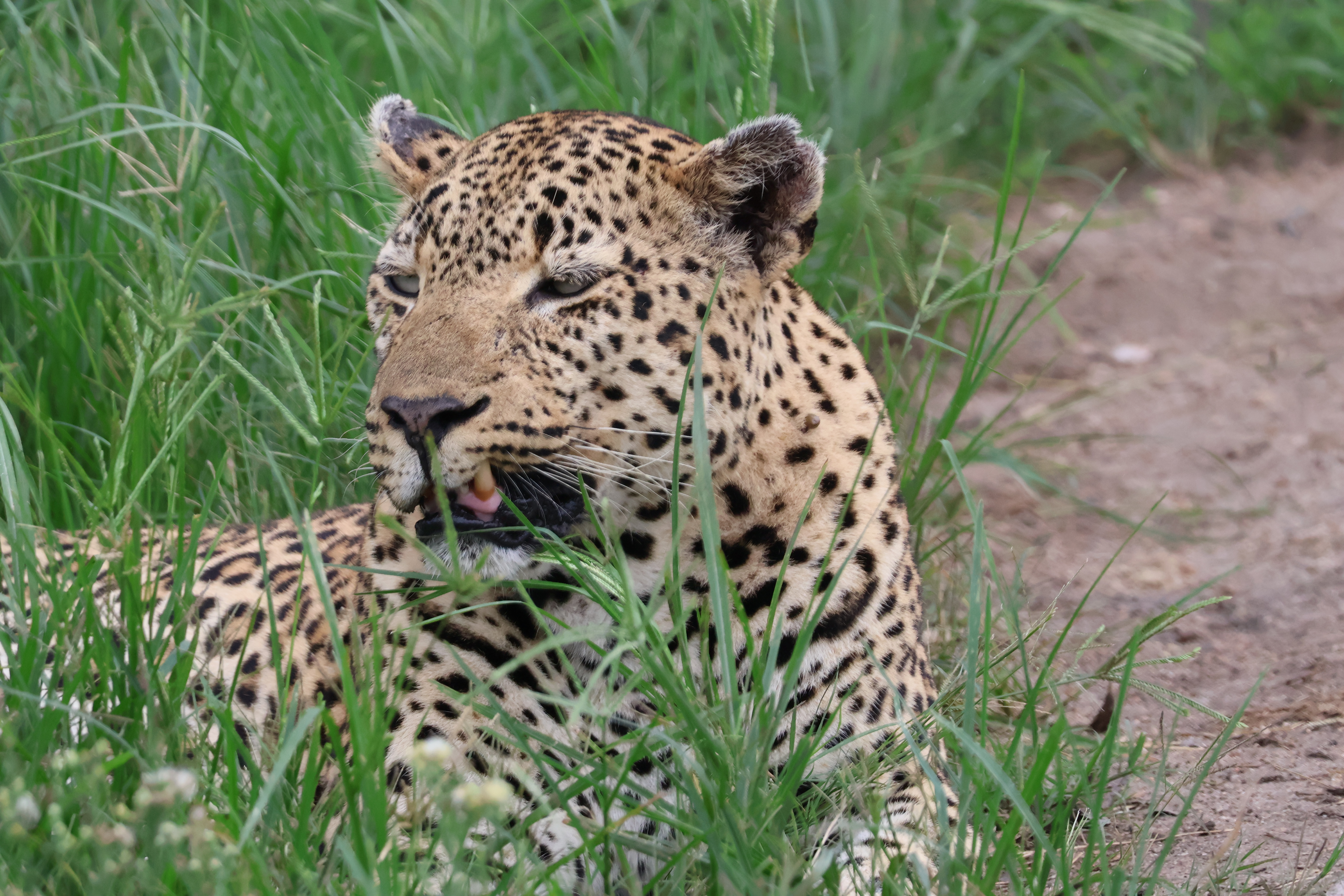
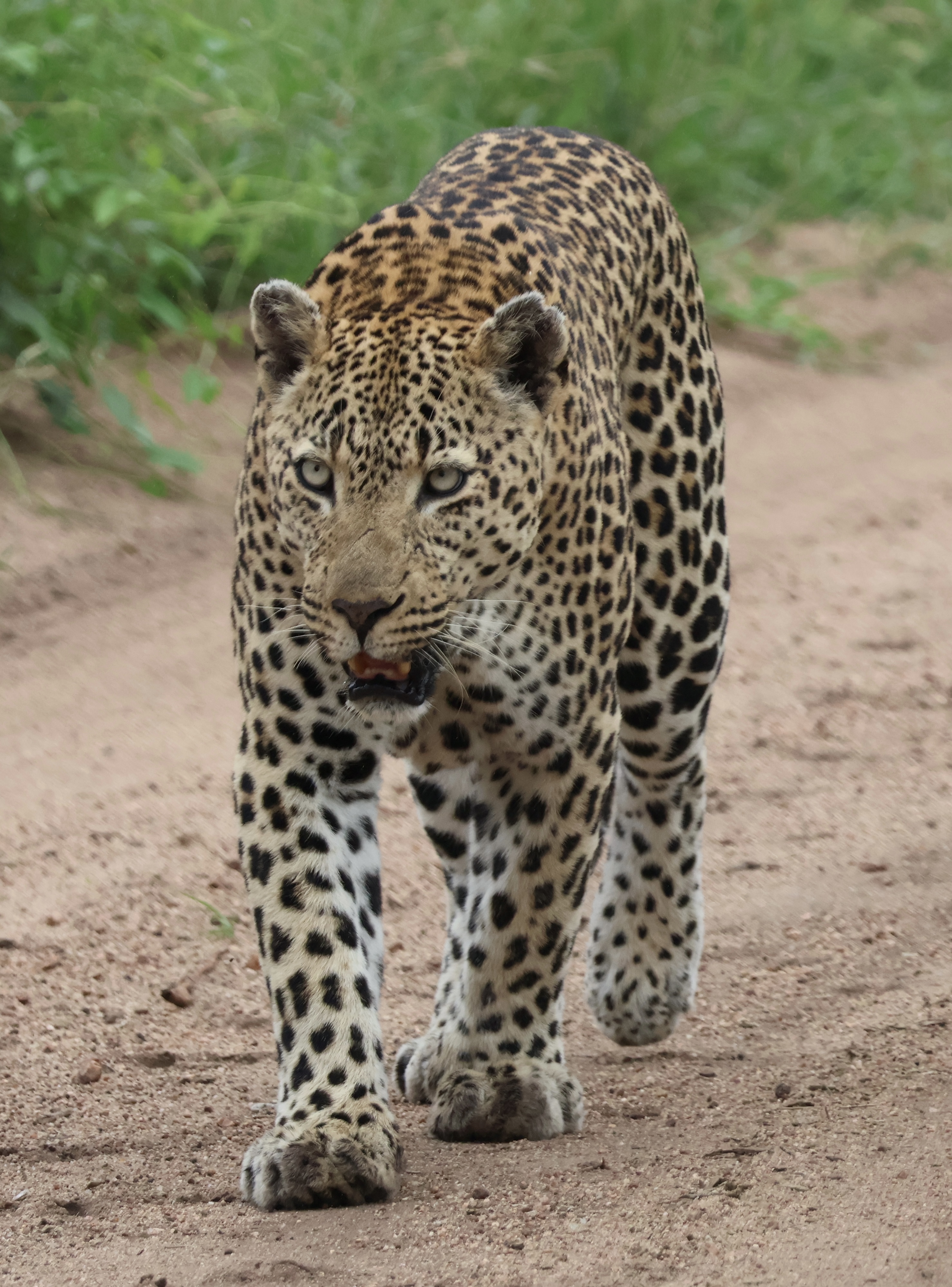
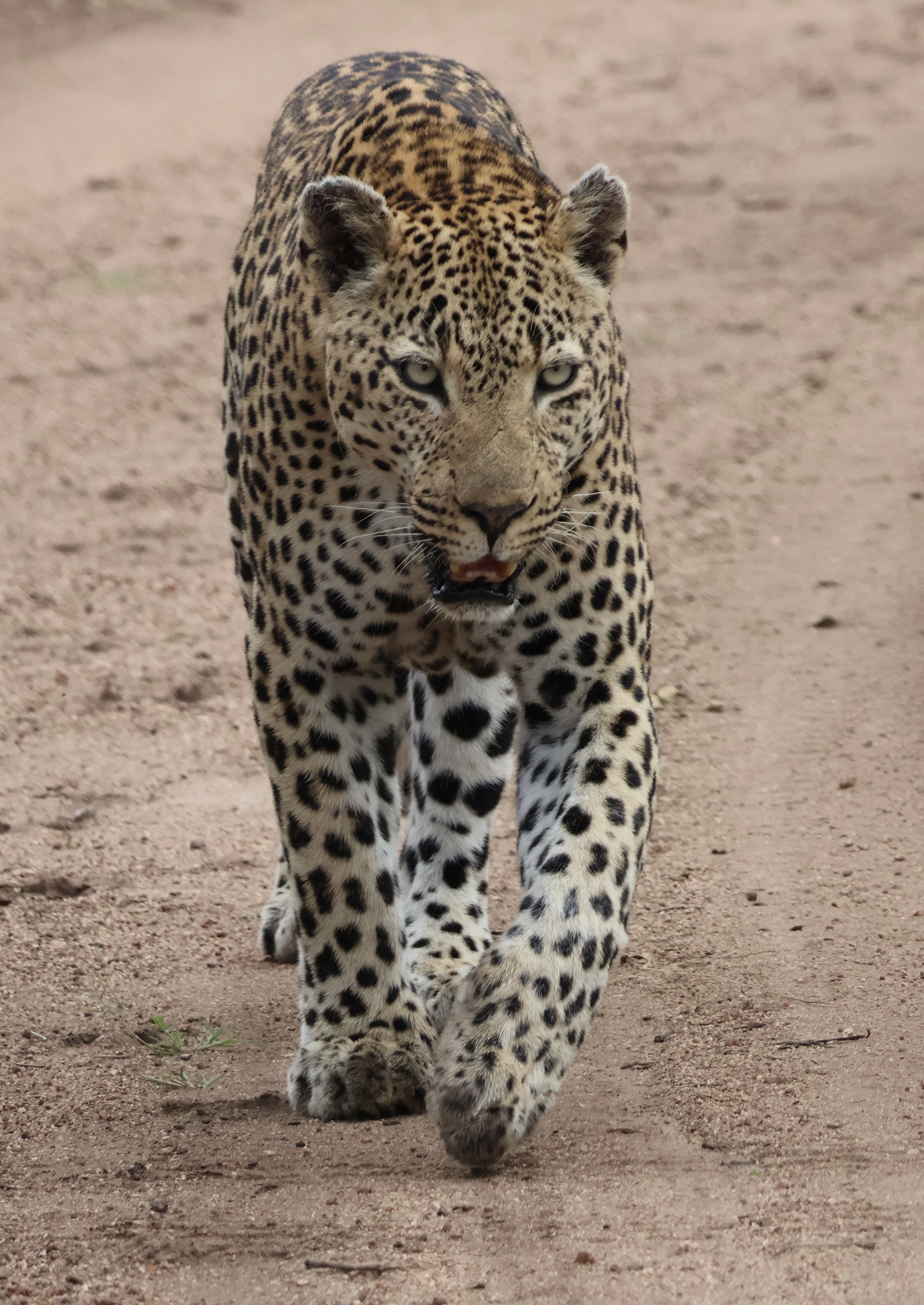
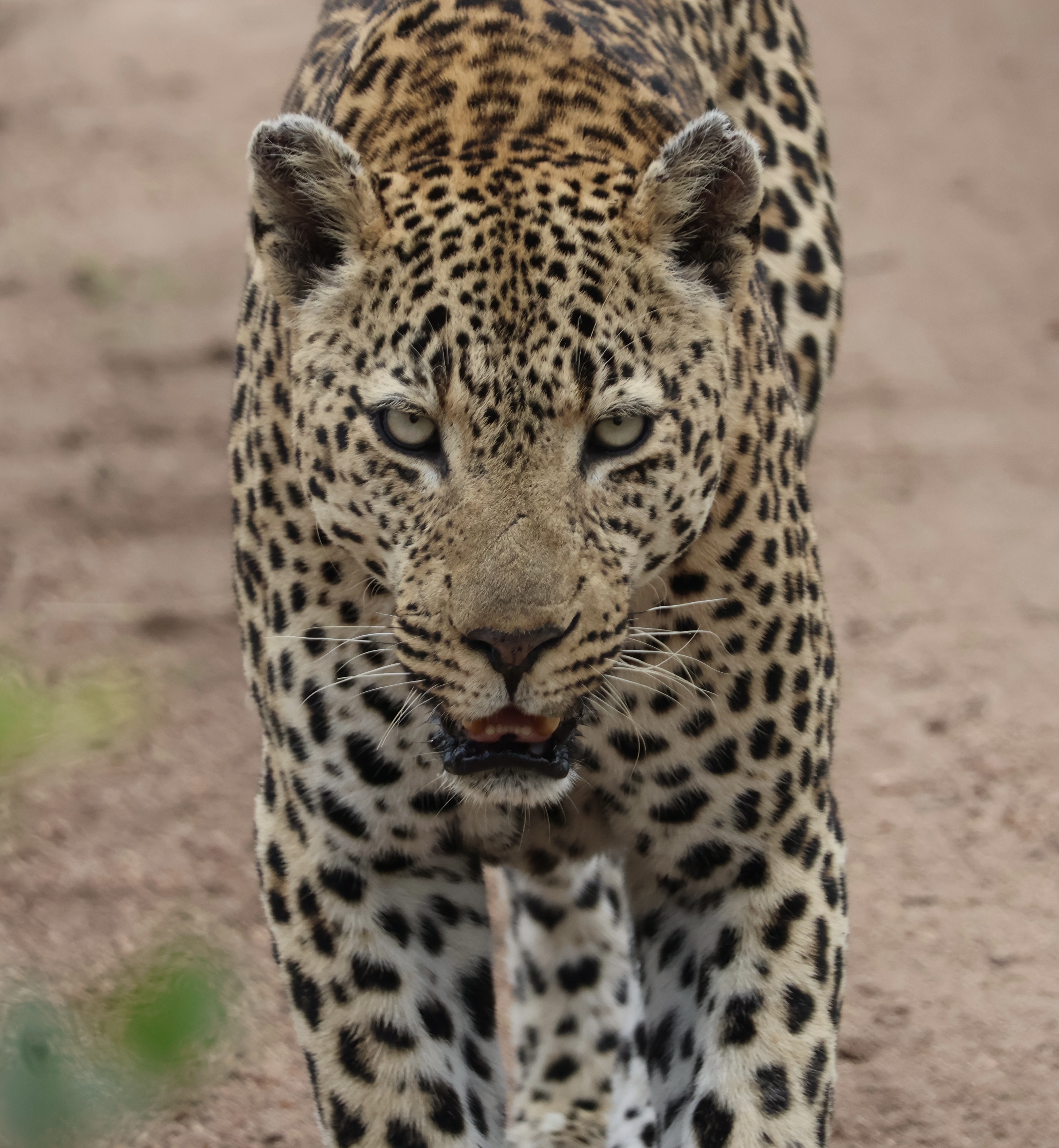
The easiest way to tell the difference between a male and a female leopard is its size. Adult males typically weigh between sixty and seventy-five kilograms and are significantly larger and broader than females.
Male leopards establish large territories covering between thirty and one hundred kilometres and have a distinctive dewlap (loose skin under the neck). The heads of male leopards are broader and larger than the heads of females. The footprints of the males are also typically larger with a more rounded outer edge to the rear pad.
Males are solitary, coming together with females for only six or seven days to mate. The territory of a single males may overlap with those of several females.
Young male leopards leave their mothers to become independent at around eighteen to twenty four months of age. Males stay with their mothers longer than females in order to fully master hunting and territorial skills before leaving to live on their own. Male leopards become dominant at between four to six years of age and usually have to fight other males for control of territory.
In South Africa, leopards generally inhabit the same areas as lions and hyenas and compete with them for food.
Male leopards live for between ten and fifteen years, provided they survive their early, vulnerable years.
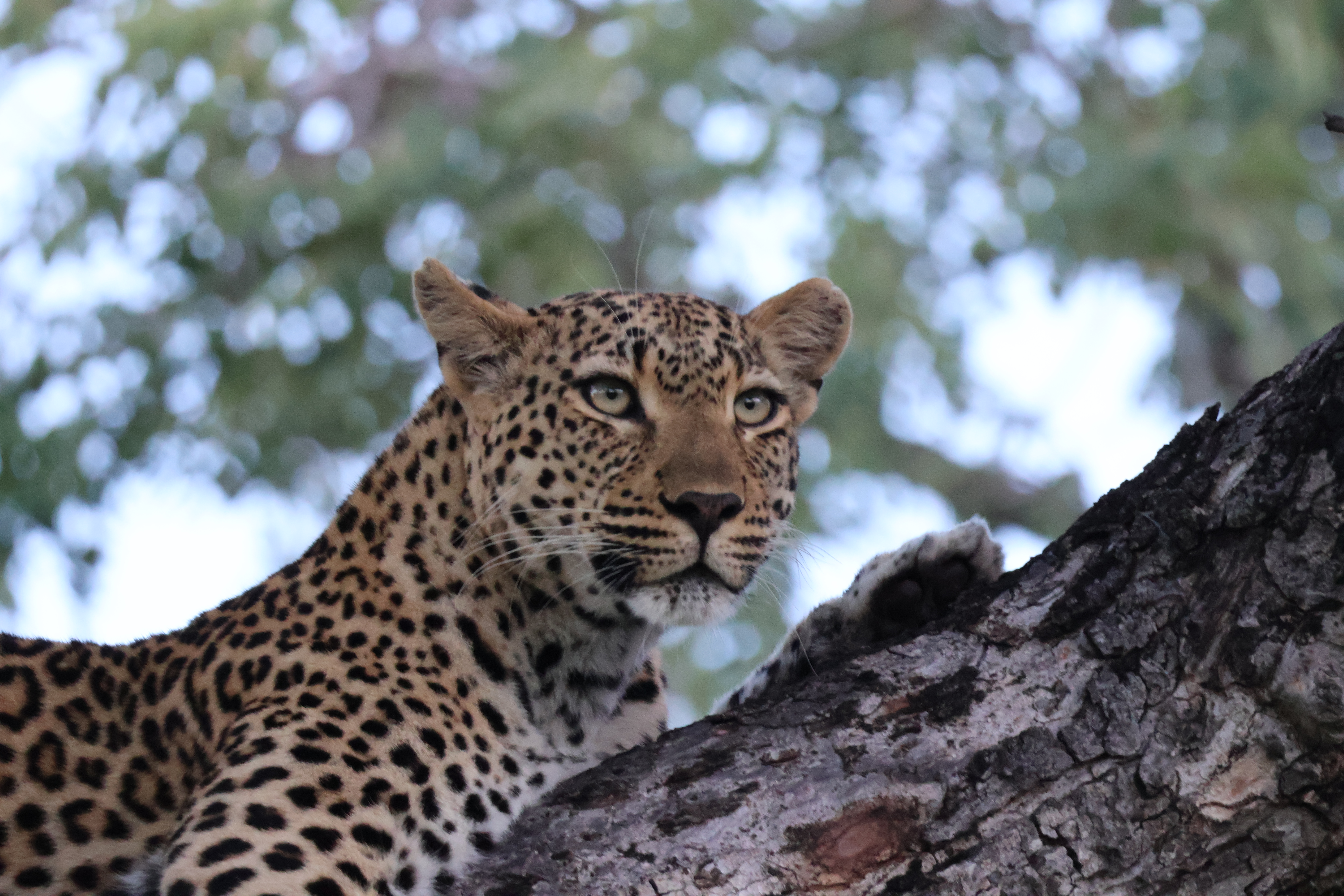
Slide the bar below to see the male (first picture) and the female (second picture) leopards.
Gallery
The gallery below sets out some of the photographs I took of a male leopard.
Picture captions: The pictures in the gallery above are of a female leopard. Her kill had fallen from the tree and she was picking at the remains. She then went up the tree and was resting on a branch and cleaning herself just like a house cat. The last picture is a dead baby zebra in a tree. It was dragged up there by a leopard which then left it to go and get a drink of water. It was a very tiny zebra so a little sad but leopards have to eat.
Into the Light: Leopard – artwork
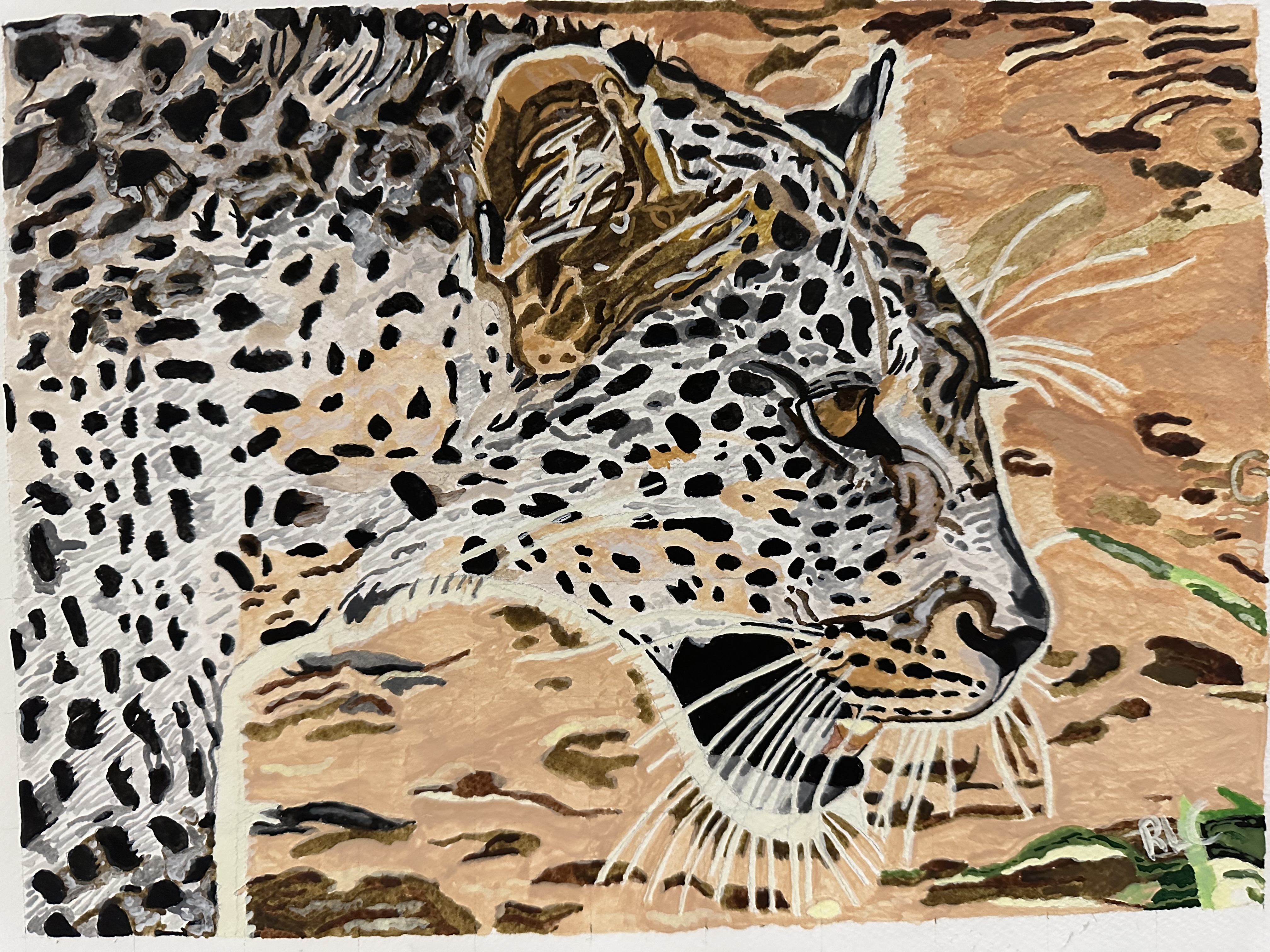
Picture caption: Into the Light: Leopard in watercolours. An original artwork by Robbie Cheadle.
Exotic Pets (Double Ennead)
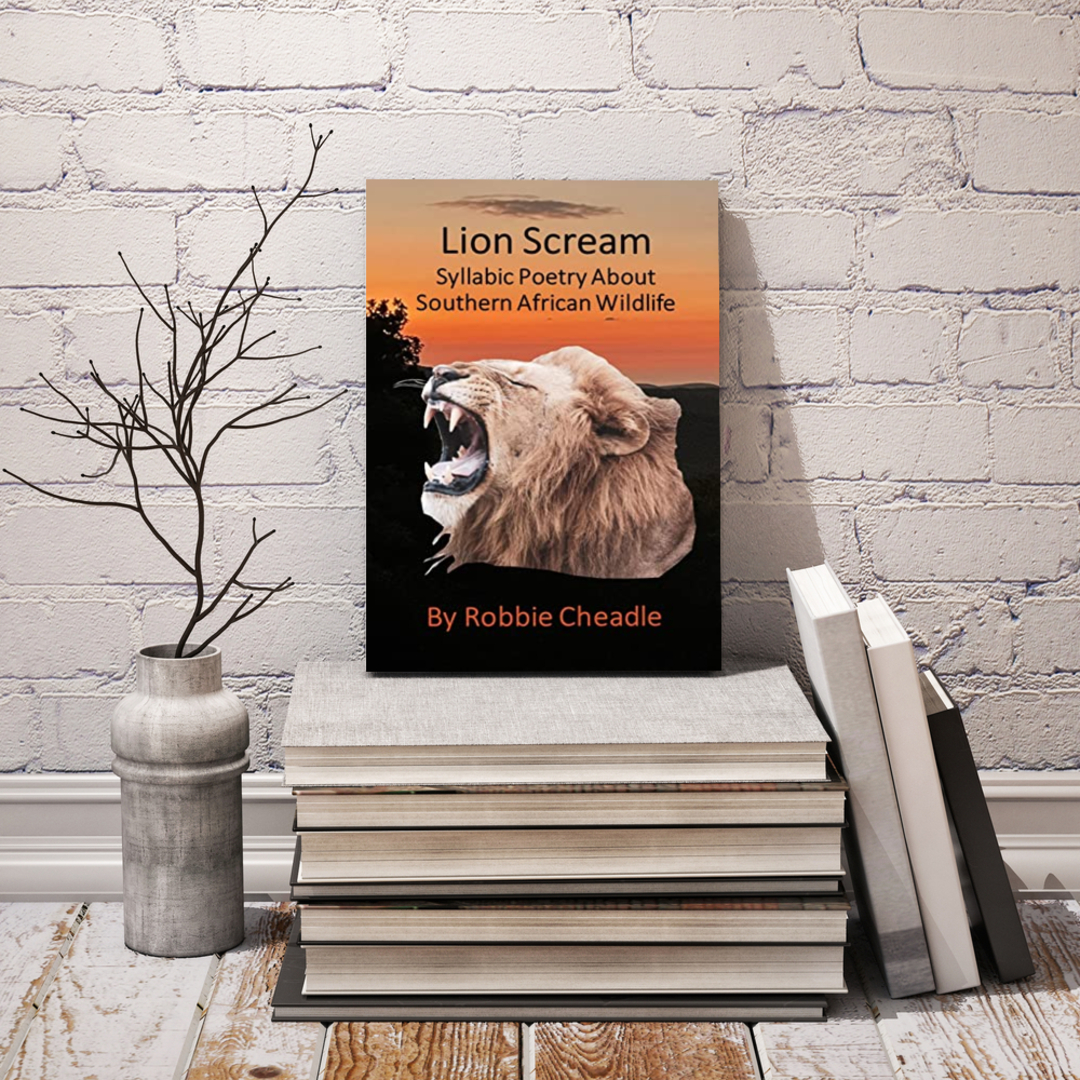
The poem below is extracted from my book ‘Lion Scream‘.
Bought as exotic pets
We are rescue cubs
Our owner didn’t know we could never be tamed
Our play is boisterous
We chew everything
***
Just over three months old
We have all our spots
And our denim-blue eyes have turned bright yellow
Play fighting each other
Teaches hunting skills
***
Everything is brand new
Exciting to us
A spider in its web, an experience
For our sister, who snaps,
And tries to eat it
About Roberta Eaton Cheadle

Roberta Eaton Cheadle, is a South African writer and poet specialising in historical, paranormal, and horror novels and short stories. She is an avid reader in these genres and her writing has been influenced by famous authors including Bram Stoker, Edgar Allan Poe, Amor Towles, Stephen Crane, Enrich Maria Remarque, George Orwell, Stephen King, and Colleen McCullough.
Roberta has two published novels and a collection of short stories and has horror, paranormal, and fantasy short stories included in several anthologies. She is also a contributor to the Ask the Authors 2022 (WordCrafter Writing Reference series).
Roberta is also the author and illustrator of seventeen children’s books, illustrator to a further three children’s books, and the author and illustrator of four poetry books published under the name of Robbie Cheadle, and has poems and short stories featured in several anthologies under this name.
Roberta’s blog features discussions about classic books, book reviews, poetry, and photography. https://roberta-writes.com/.
Find Roberta Eaton Cheadle
Blog: https://wordpress.com/view/robertawrites235681907.wordpress.com
Bluesky: https://bsky.app/profile/robbiecheadle.bsky.social
Facebook: https://www.facebook.com/robertawrites
Amazon: https://www.amazon.com/Roberta-Eaton-Cheadle/e/B08RSNJQZ5
___________________________________________
Like this post? Are you a fan of this blog series? Did you know you can sponsor your favorite blog series or even a single post with an advertisement for your book? Stop by the WtbR Sponsor Page and let me advertise your book, or you can make a donation to Writing to be Read for as little as a cup of coffee, If you’d like to show your support for this author and WordCrafter Press.
__________________________________________
This segment of “In Touch with Nature” is sponsored by the Midnight Anthology Series and WordCrafter Press.

Midnight Roost: Weird and Creepy Stories: 20 authors bring your nightmares to life in 23 stories of ghosts, paranormal phenomenon and the horror from the dark crevasses of their minds. Stories of stalkers, both human and supernatural, possession and occult rituals, alien visitations of the strange kind, and ghostly tales that will give you goosebumps. These are the tales that will make you fear the dark. Read them at the Midnight Roost… if you dare. https://www.amazon.com/Midnight-Roost-Kaye-Lynne-Booth-ebook/dp/B0CL6FPLVJ
Midnight Garden: Where Dark Tales Grow: 17 authors bring you 21 magnificent dark tales. Stories of magic, monsters and mayhem. Tales of murder and madness which will make your skin crawl. These are the tales that explore your darkest fears. Read them in the Midnight Garden… if you dare. https://www.amazon.com/Midnight-Garden-Where-Tales-Anthology-ebook/dp/B0DJNDQJD3
Midnight Oil: Stories to Fuel Your Nightmares: 14 authors bring you 16 dark tales that explore your deepest fears. These are the stories which nightmares are made of. Tales of monsters, mayhem, and madness which will make you shiver in the dark. Read them while you burn the Midnight Oil… if you dare. https://books2read.com/Midnight-Oil
Share this:

Day 2 of the WordCrafter “Poetry Treasures 6: Seasons” Book Blog Tour
Posted: April 21, 2026 Filed under: Anthology, Blog Tour, Book Release, Book Review, Books, Giveaways, Poetry, Poetry Readings, Review, WordCrafter Book Blog Tours, WordCrafter Press | Tags: Colleen Chesebro, Dragons Rule, Jean-Jacques Fournier, Poetry Treasures 6: Seasons, V.M. Sang, WordCrafter Book Blog Tours, WordCrafter Press 4 CommentsIt’s Day 2 of the WordCrafter Poetry Treasures 6: Seasons Book Blog Tour, and we’re over at Dragons Rule with host and contributor V.M. Sang and contributor guests, Jean-Jacques Fournier and Colleen Chesebro. Join us in celebrating the release of this fabulous poetry anthology and get to know the contributors with fun facts, guest posts, poetry readings and reviews of their works. Leave a comment for a chance at a free digital copy of Seasons in our Giveaway.
Share this:

Opening Day of the WordCrafter “Poetry Treasures 6: Seasons” Book Blog Tour
Posted: April 20, 2026 Filed under: Anthology, Blog Tour, Book Release, Books, Giveaways, Poetry, Poetry Readings, WordCrafter Book Blog Tours, WordCrafter Press | Tags: Cindy Georgakas, Hotel by Masticadores, Kevin Morris, Masticadores Phillipines, Michelle Ayon Navajas, Poetry, Poetry by Mich, Poetry Treasures 6: Seasons, WordCrafter Book Blog Tours 8 CommentsJoin us for the opening day of the WordCrafter “Poetry Treasures 6: Seasons” Book Blog Tour with host Michelle Ayon Navajas and contributors Cindy Georgakas and Kevin Morris over on Poetry by Mich at the link below. Or you can catch it on Hotel by Masticadores and Masticadores Phillipines, where we have fun facts about each contributor and a reading by Cindy of her poem, “Dreaming of Summer”.
Help us celebrate the release of this fabulous poetry anthology, volume 6 of the Poetry Treasures Anthology Series, and get in on the free giveaway just by leaving a comment.
Share this:

Celebrating National Poetry Month with Poetry Sales
Posted: April 7, 2026 Filed under: Anthology, Book Sales, Collection, Poetry, WordCrafter Press | Tags: #Poetrycommunity, Arthur Rosch, Behind Closed Doors, Book Sale, Feral Tenderness, Kaye Lynne Booth, Poetry Sale, Poetry Treasures Series, PoetryCollections, Robbie Cheadle, WordCrafter Press 6 Comments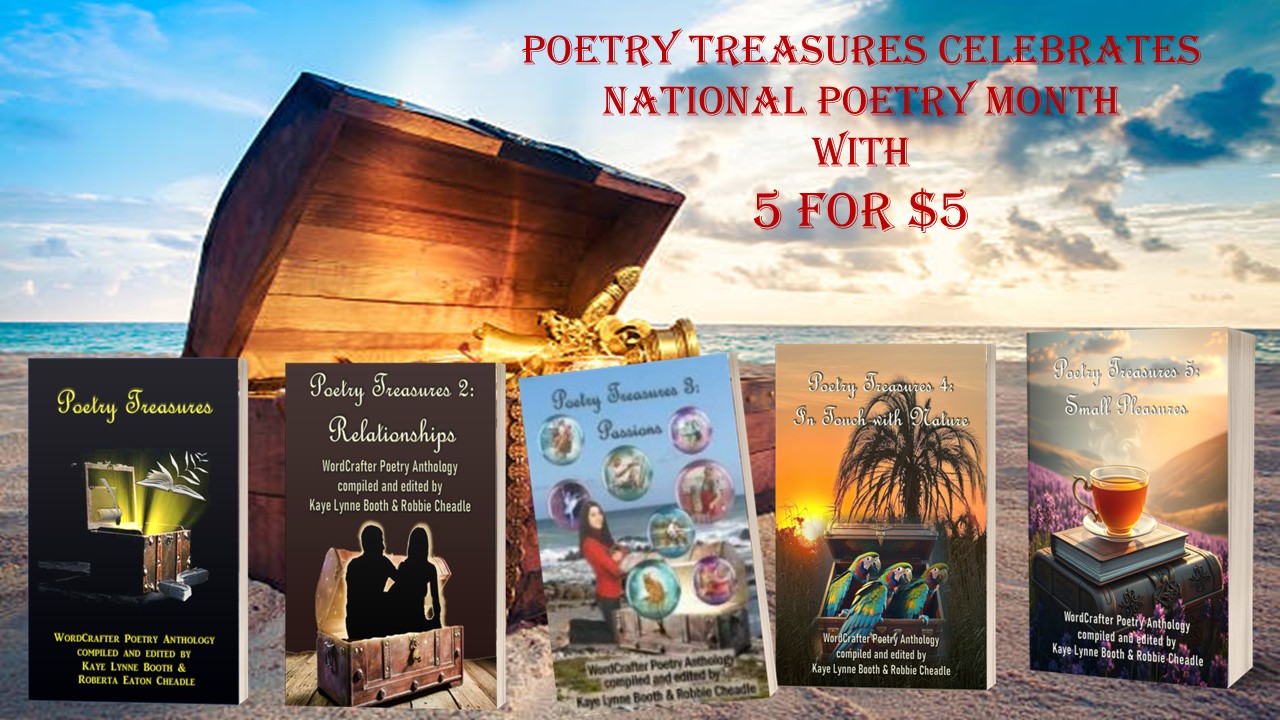
Exclusive on WordCrafter Press during the month of April.
Purchase the 5 for $5 bundle on the Poetry Treasures Series page.
In celebration of National Poetry Month, WordCrafter Press is offering the first five Poetry Treasures volumes for $5 only at the link above. And I’ve dropped the price on all individual WordCrafter poetry collections all month, as well.
All WordCrafter Poetry Collections – $1 off
Small Wonders: Reflective Poems, by Kaye Lynne Booth – $2.99
Behind Closed Doors: A Collection of Unusual Poems, by Robbie Cheadle – $2.99
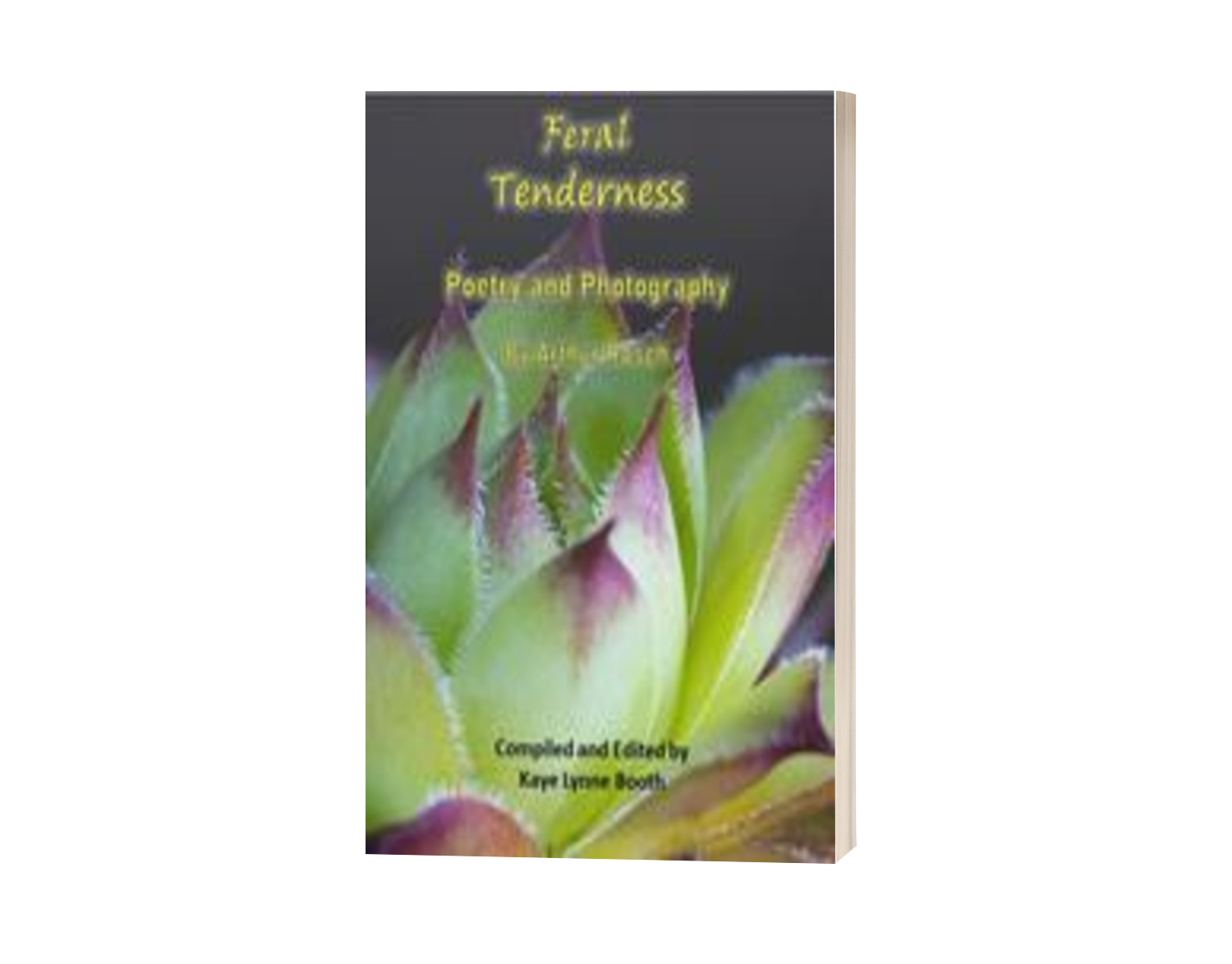
Feral Tenderness: Poetry and Photography, by Arthur Rosch – $2.99
Grab your copies while you can!
Share this:

WordCrafter News: April Release – National Poetry Month, Release of “Poetry Treasures 6”, Winners of the “Double Visions” Giveaway & Approaching Submission Deadline
Posted: March 30, 2026 Filed under: Blog Tour, Book Release, Book Sales, Books, Collection, Giveaways, Nature, Poetry, Treasuring Poetry, WordCrafter Book Blog Tours, WordCrafter News, WordCrafter Press, Writing Contest | Tags: Call for submissions, Deadline, Giveaway Winners, Midnight Madness, Poetry, Poetry Treasures 6: Seasons, The Rock Star & The Outlaw 2 Double Visions, WordCrafter News, WordCrafter Press 16 Comments
WordCrafter Celebrates National Poetry Month
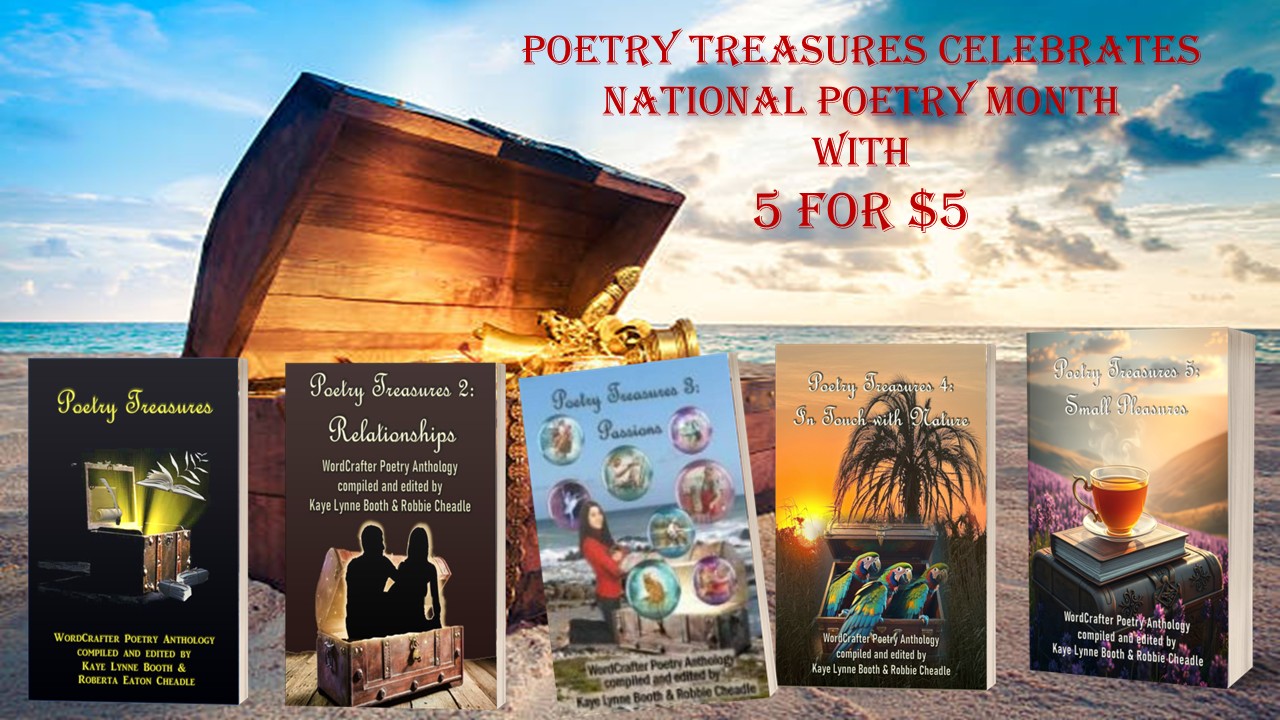
Only on WordCrafter Press during the month of April. Purchase the 5 for $5 bundle on the Poetry Treasures Series page.
In celebration of National Poetry Month, WordCrafter Press is offering the first five Poetry Treasures volumes for $5 only at the link above. And I’ve dropped the price on all individual WordCrafter poetry collections all month, as well.
All WordCrafter Poetry Collections – $1 off
Small Wonders: Reflective Poems, by Kaye Lynne Booth – $2.99
Behind Closed Doors: A Collection of Unusual Poems, by Robbie Cheadle – $2.99
Feral Tenderness: Poetry and Photography, by Arthur Rosch – $2.99
Grab your copies while you can!
New Release: Poetry Treasures 6: Seasons
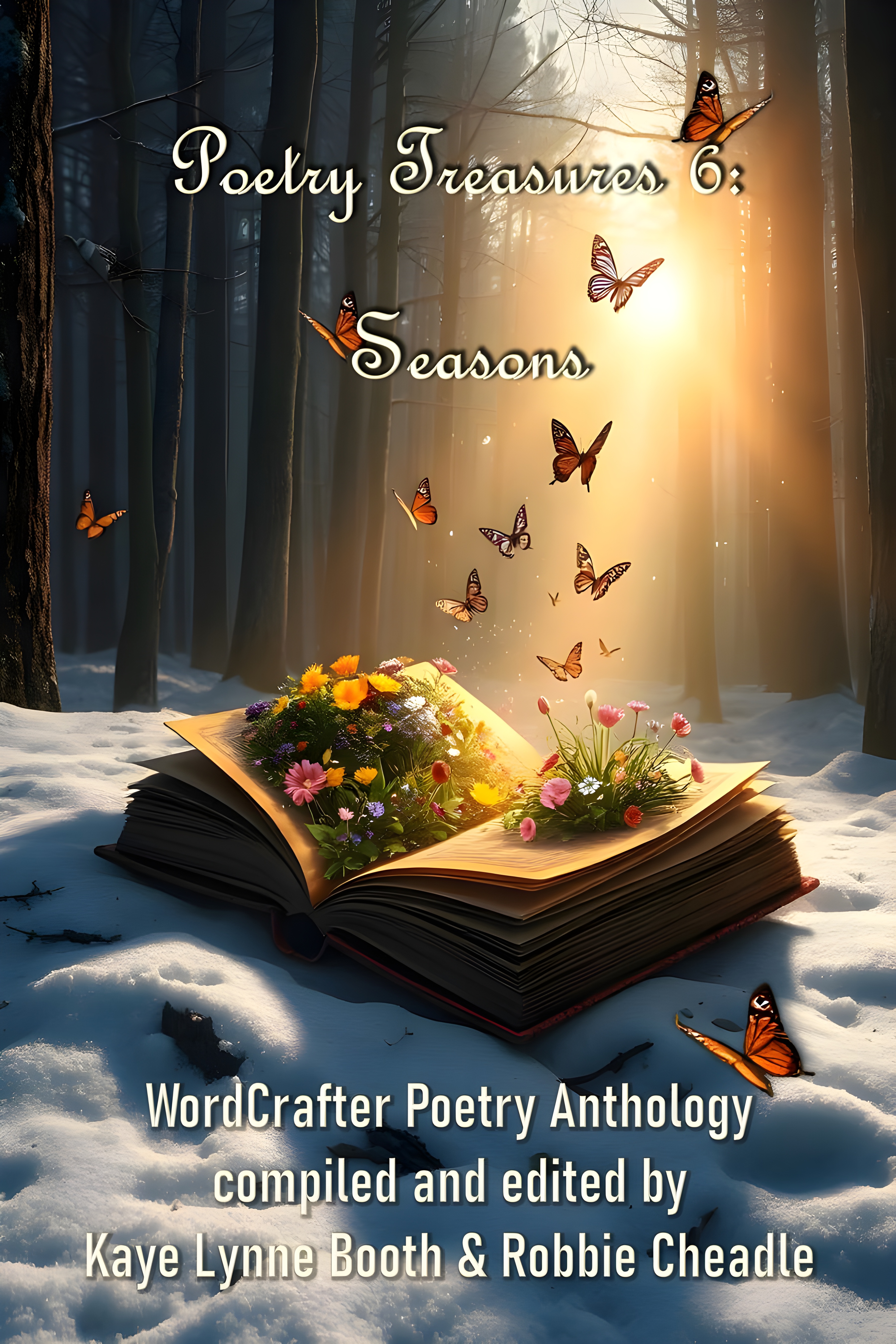
Poetry Treasures 6: Seasons will be released April 21st.
This year’s volume will include works by Robbie Cheadle, Cindy Georgakas, Freya Pickard, V.M. Sang, Michelle Ayon Navajas, Marsha Ingrao, Nolcha Fox, Joy Neal Kidney, Kevin Morris, Jean-Jacques Fournier, Melissa Lemay, and Colleen Chesebro.
Winners of the WordCrafter Double Visions Book Blog Tour Giveaway
We had a great tour last week and met the $500 Kickstarter goal with a couple of days to spare. A big thank you goes out to Michelle Ayon Navajas, Kay Castenada, and Carla Johnson-Hicks for doing such a wonderful job of hosting.
Now it’s time to announce the winners of the Double Visions Giveaway. Each time someone commented on one of the tour stops, they were entered into the giveaway for a chance at one of three digital copies and one signed print copy of The Rock Star & The Outlaw 2: Double Visions. So, I put all the names in my trusty hat and randomly drew out four names. (Yep, I really do pull them out of my hat.)
And the winners are…
(Drumroll please)
- Robbie Cheadle (Book Places)
- Selma Martin (Masticadores Phillipines)
- Joni Caggiano (Hotel by Masticadores)
- Cindy Georgakas (Hotel by Masticadores) – Signed Print Copy
Congratulations to the winners!
If you are on the list above and haven’t heard from me yet, please contact me at kayebooth(at)yahoo.com to collect your copy of The Rock Star & The Outlaw 2: Double Visions.
Reminder: Submissions Deadline Approaching
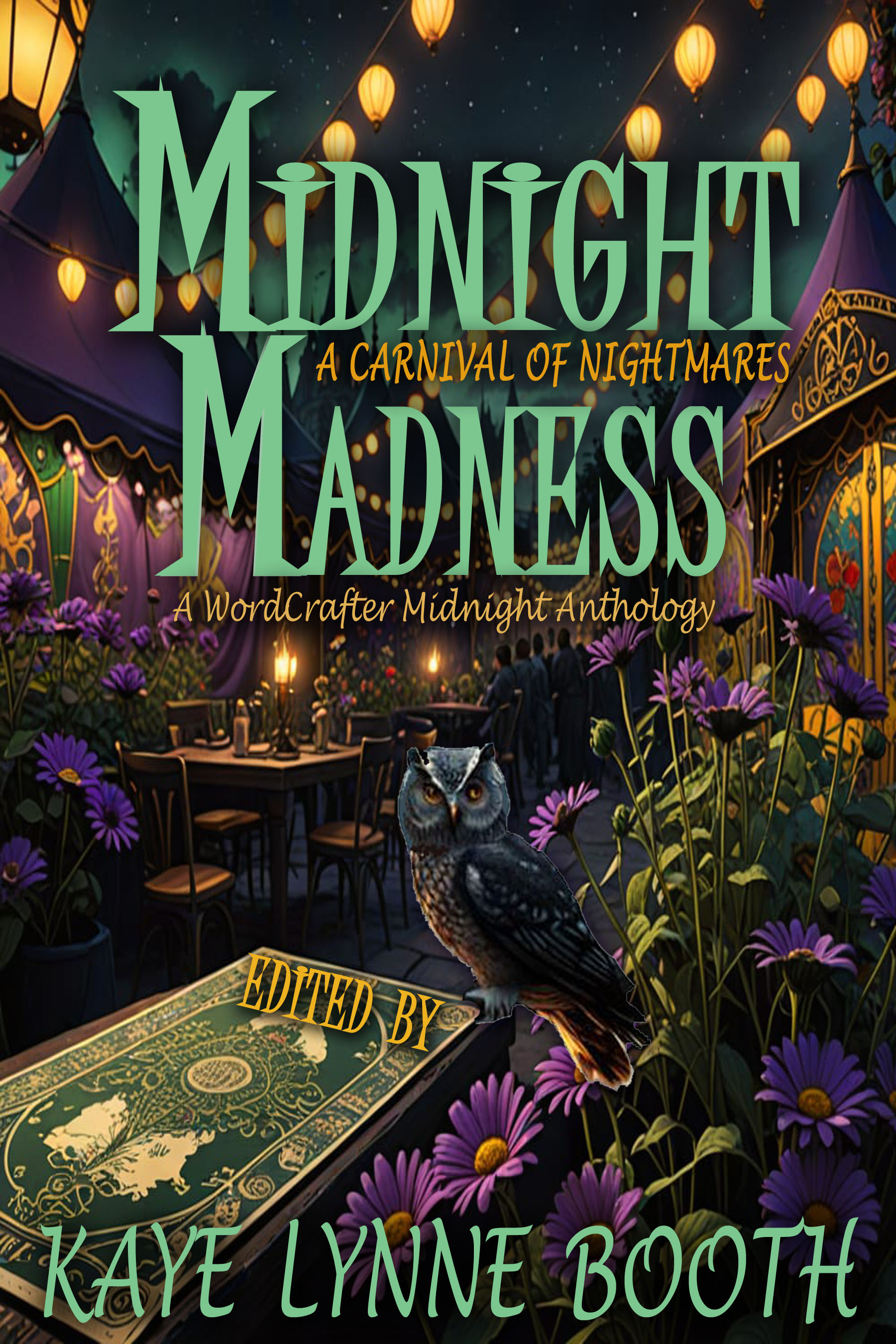
April 30th is the deadline for the 2026 WordCrafter Dark Fiction Contest.
Don’t let it sneak up on you. Get those submissions in now.
You can find submission guidelines here.
Kickstarter for The Rock Star & The Outlaw 2: Double Visions Fully Funded!
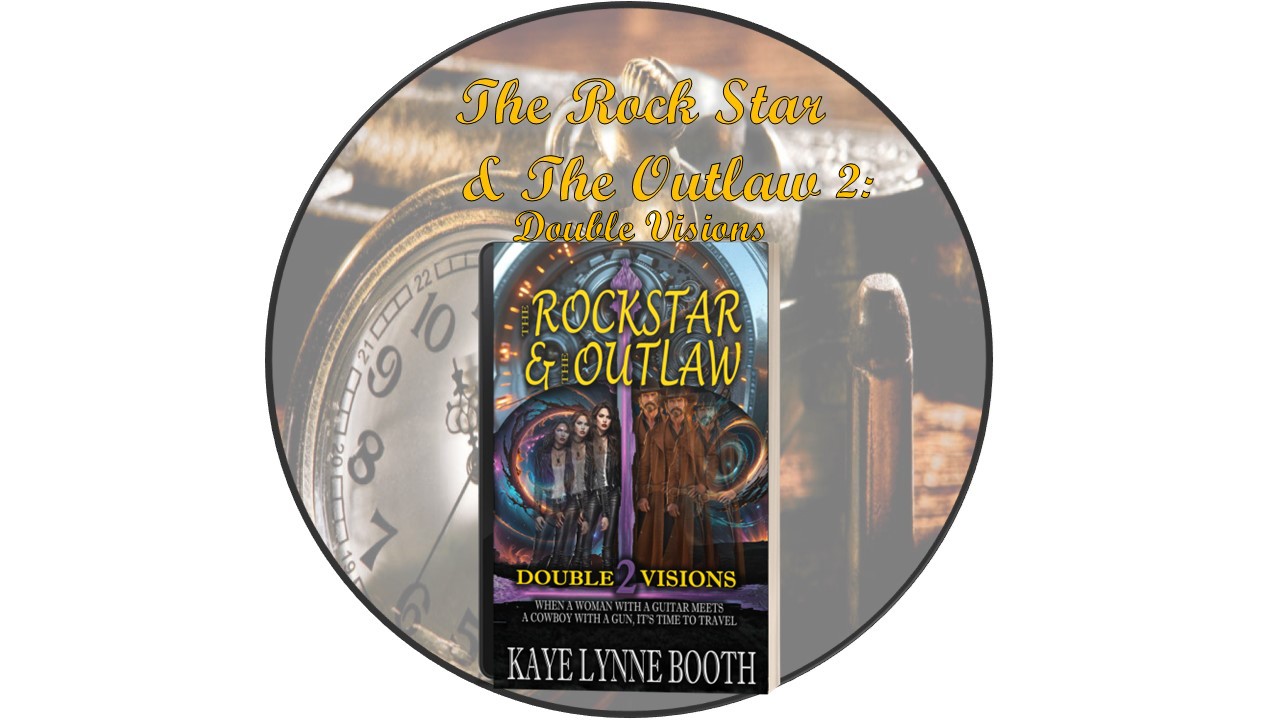
Maybe
About Kaye Lynne Booth
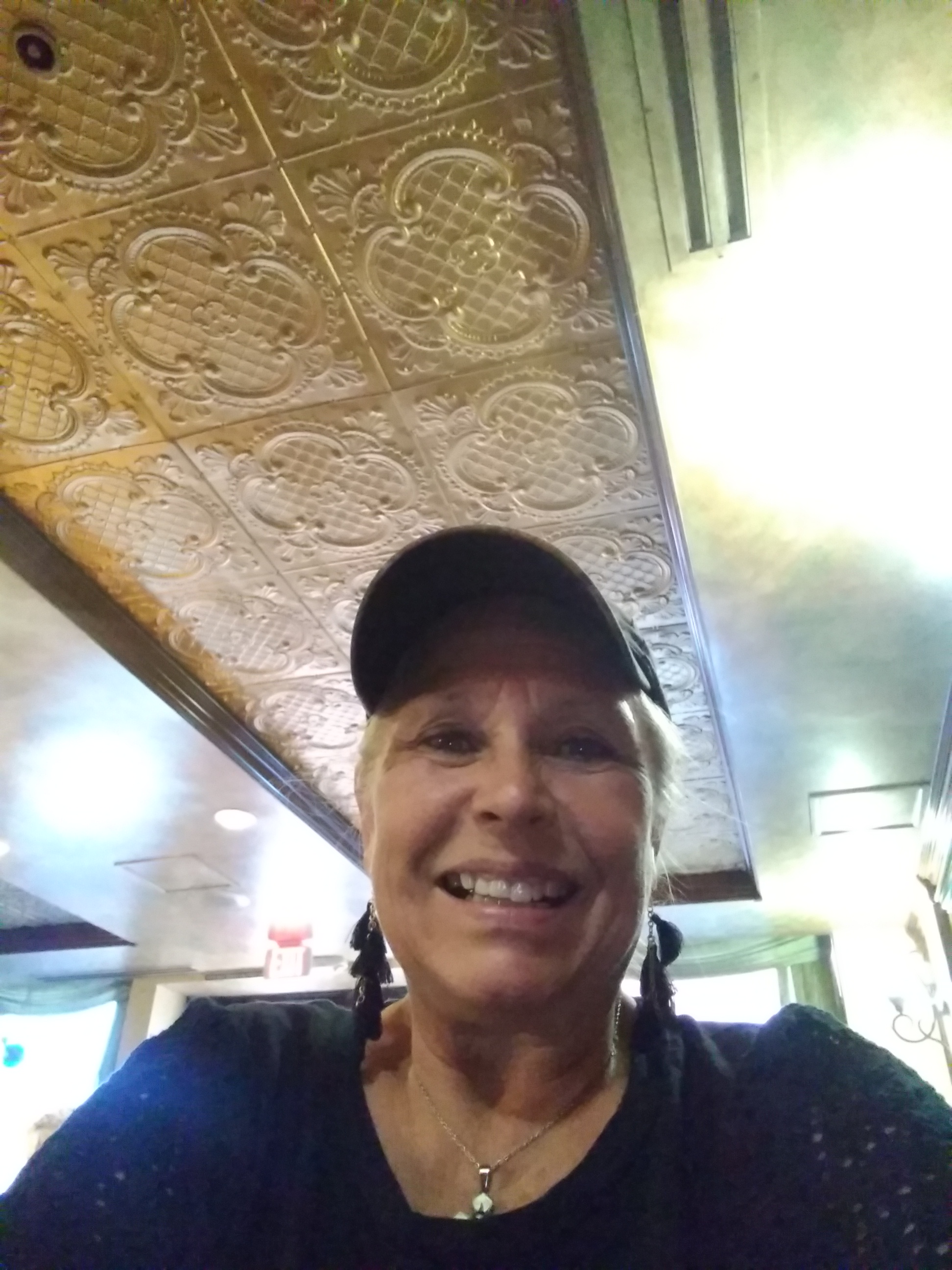
For Kaye Lynne Booth, writing is a passion. Kaye Lynne is an author with published short fiction and poetry, both online and in print, including her short story collection, Last Call and Other Short Fiction; and her paranormal mystery novella, Hidden Secrets; Books 1 & 2 of her Women in the West adventure series, Delilah and Sarah, and Book 1 in her Time-Travel Adventure series, The Rock Star & The Outlaw, as well as her poetry collection, Small Wonders.
Kaye holds a dual M.F.A. degree in Creative Writing with emphasis in genre fiction and screenwriting, and an M.A. in publishing. Kaye Lynne is the founder of WordCrafter Quality Writing & Author Services and WordCrafter Press, where she edits and publishes two short fiction anthologies and one poetry anthology every year amidst her many writing projects. She also maintains an authors’ blog and website, Writing to be Read, where she publishes content of interest in the literary world.
______________________________________
Did you know you can sponsor your favorite blog series or even a single post with an advertisement for your book? Stop by the WtbR Sponsor Page and let me advertise your book, or you can make a donation to Writing to be Read for as little as a cup of coffee, If you’d like to show your support for this author and WordCrafter Press.
_____________________________________
This post sponsored by WordCrafter Quality Writing & Author Services.
Whether it’s editing, publishing, or promotion that you need, WordCrafter Quality Writing & Author Services can help at a price you can afford.
Stop by and see what we have to offer today: https://writingtoberead.com/readings-for-writers/wordcrafter-quality-writing-author-services/
Share this:

In Touch with Nature – Leopards
Posted: March 25, 2026 Filed under: Animals, In Touch With Nature, Nature, Photography, Poetry, Wildlife | Tags: #InTouchWithNature, #RobbieCheadle, In Touch With Nature, Leopards, Robbie Cheadle, South Africa, Writing to be Read 78 CommentsIntroduction and fun facts
Leopards are my husband’s favourite animal. They are very difficult to see in the wild because they are nocturnal, they are rare, and they are solitary. The best game reserve in South Africa to see leopards is Sabi Sands and this is where we went for our wedding anniversary last year to finally get good sightings of leopards.
We were at the reserve for 48 hours and went on 4 game drives during that time. We had two wonderful sightings of leopards. The first was of a mother and her juvenile youngster. The second was of the father.
Here are a few initial facts about leopards:
- Most leopards are light coloured and have dark spots called rosettes on their fur. There are also black leopards which also have spots, but the spots are hard to see against their dark fur. Black leopards are called melanistic leopards;
- Leopards are found in Sub-Saharan Africa, Northeast Africa, Central Asia, India, and China;
- Unlike lions, leopards are extremely solitary animals and they mark their territory with scratches, urine, and feces to warn other leopards to stay away;
- The only time you’ll see two adult leopards together in a single territory is if they are a male and female looking to mate;
- Leopards can achieve a running speed to nearly 60 kilometers per hour and can leap up to 6 meters forward;
- Leopards make a wide variety of sounds from coughing to growling. Leopards also purr when they are happy;
- Leopards carry their prey into trees to eat. Leopards eat a wide variety of animals from monkeys to rodents to birds to antelopes. Leopards also eat cheetah cubs;
- Leopards have very long tails to help them balance when climbing, running or changing direction;
- Leopards have specially adapted retinas that enable them to hunt in the pitch black of the jungle; and
- The English name ‘leopard’ emans ‘spotted lion’ in Latin.
Gallery and You tube videos
The gallery below sets out some of the photographs I took of a female leopard.
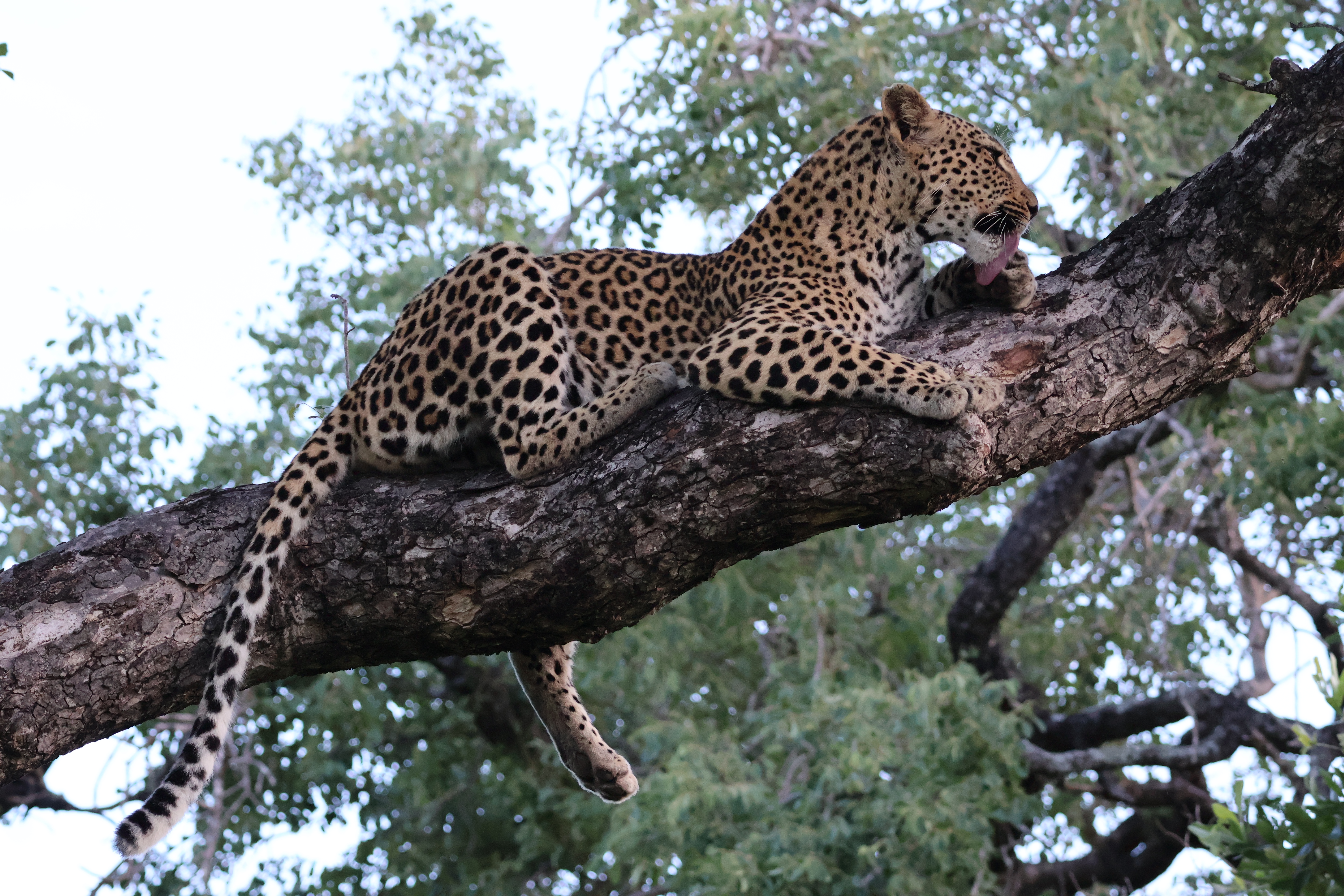
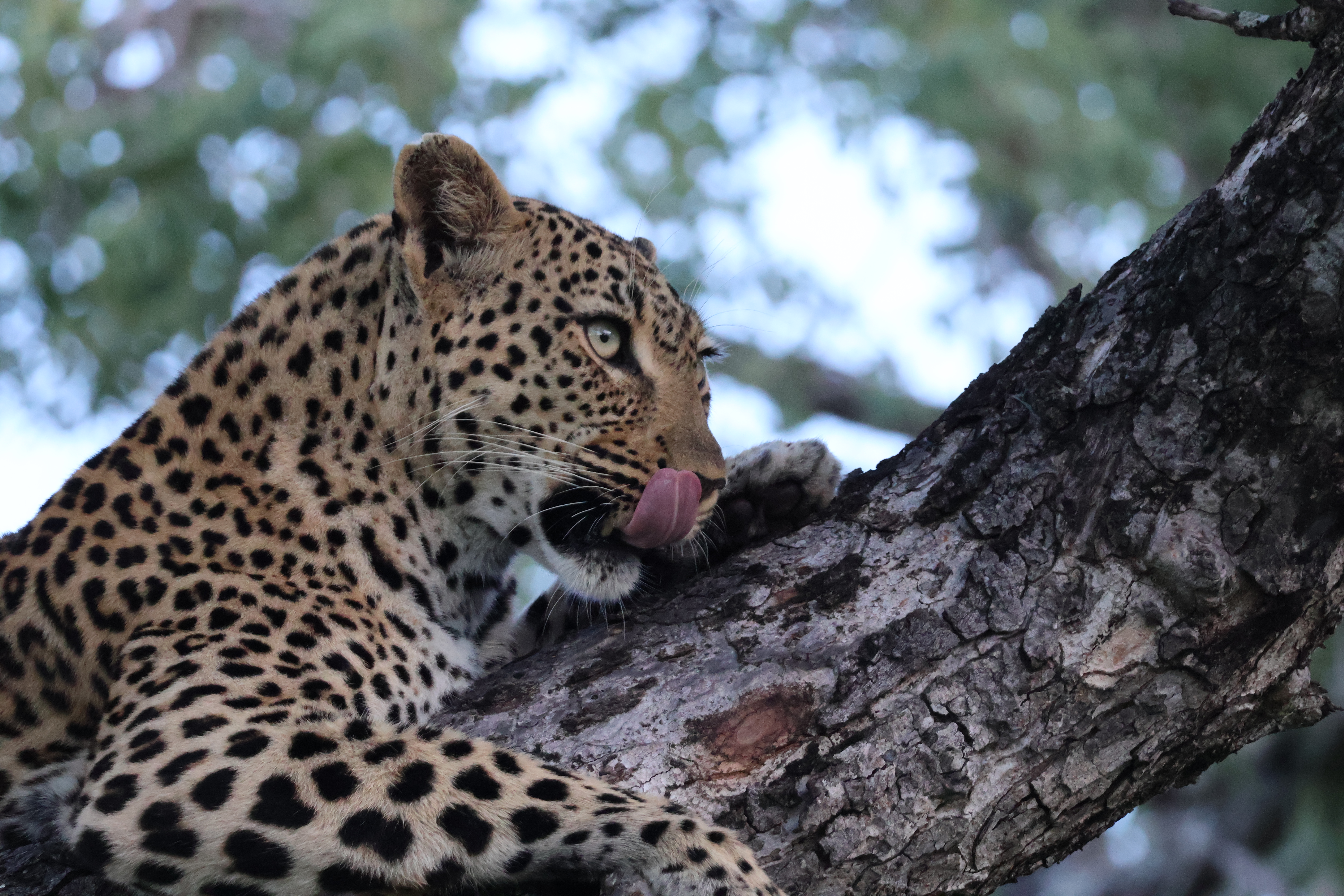
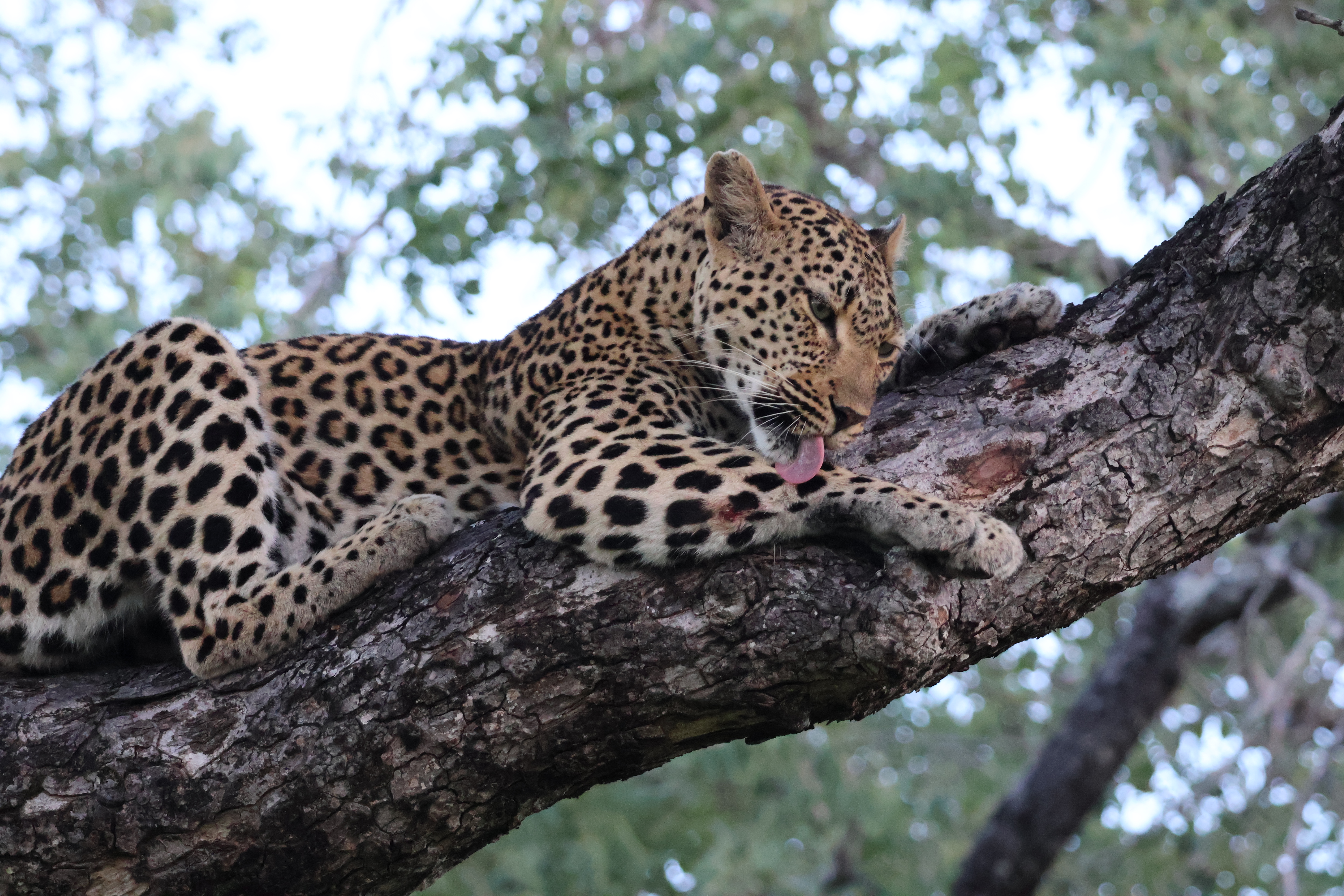
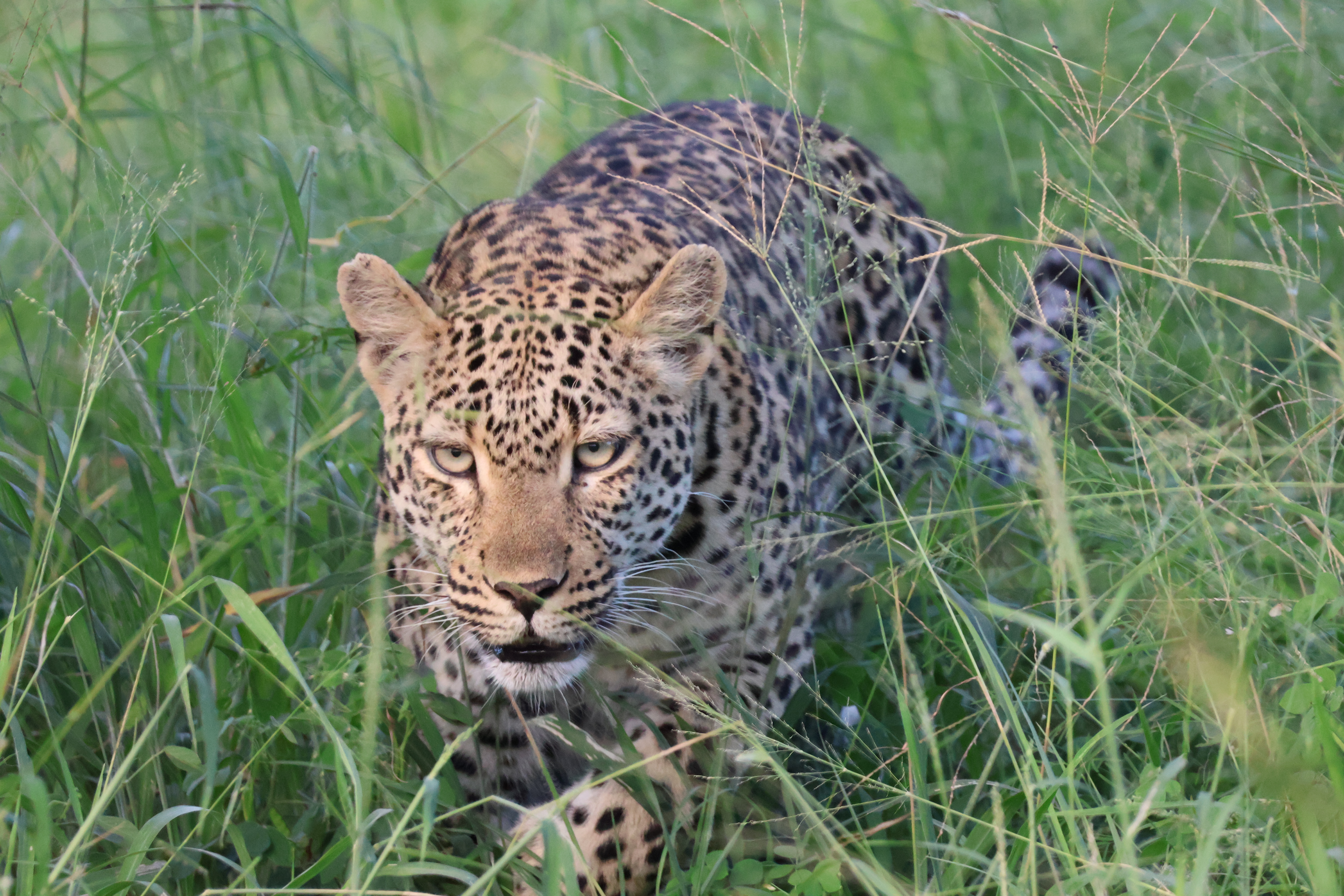
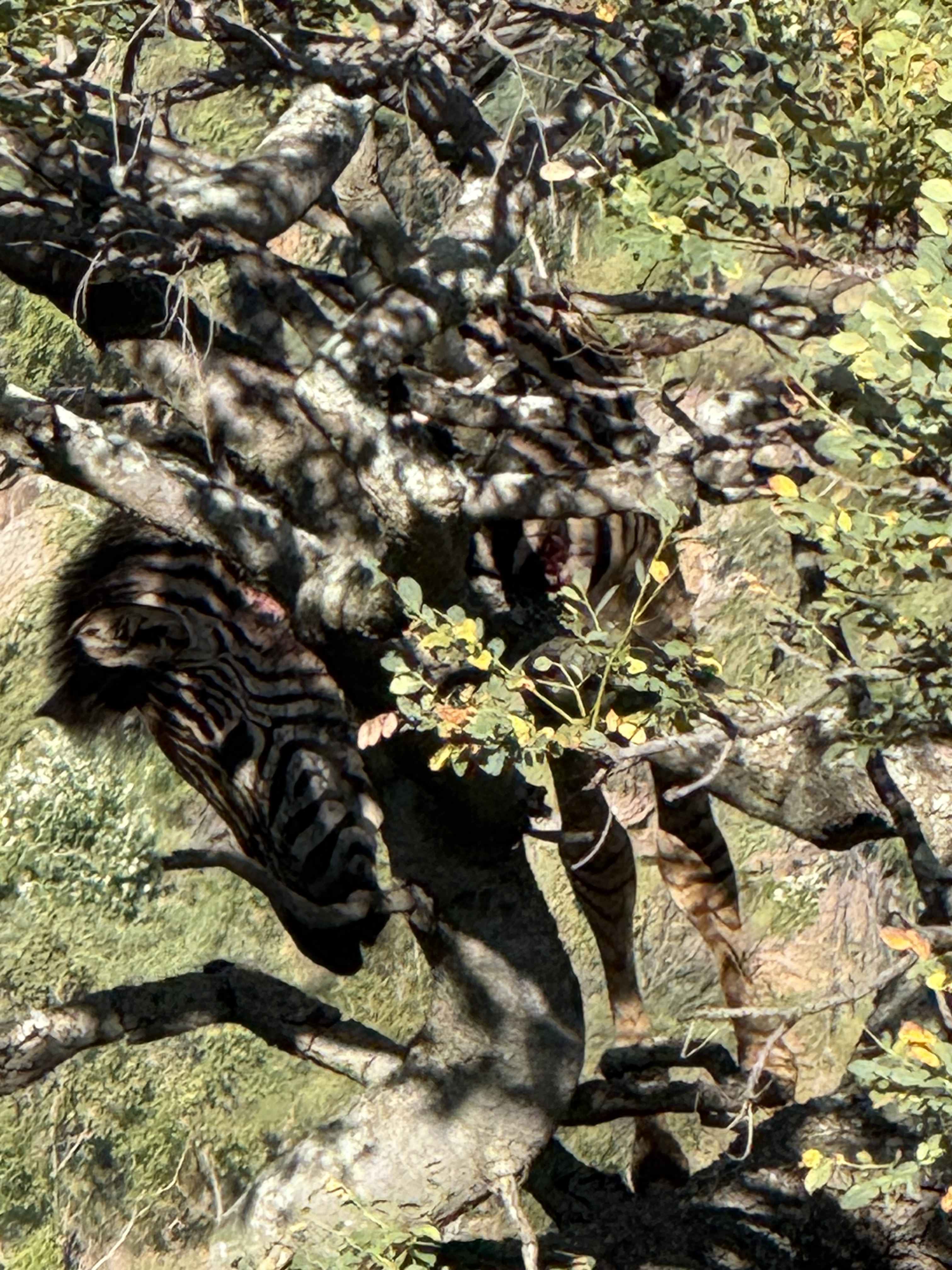
Picture captions: The pictures in the gallery above are of a female leopard. Her kill had fallen from the tree and she was picking at the remains. She then went up the tree and was resting on a branch and cleaning herself just like a house cat. The last picture is a dead baby zebra in a tree. It was dragged up there by a leopard which then left it to go and get a drink of water. It was a very tiny zebra so a little sad but leopards have to eat.
This is my You tube video of the leopard nibbling on its kill:
This is my You tube video of the female leopard grooming herself in the tree:
Leopard in a Tree – artwork
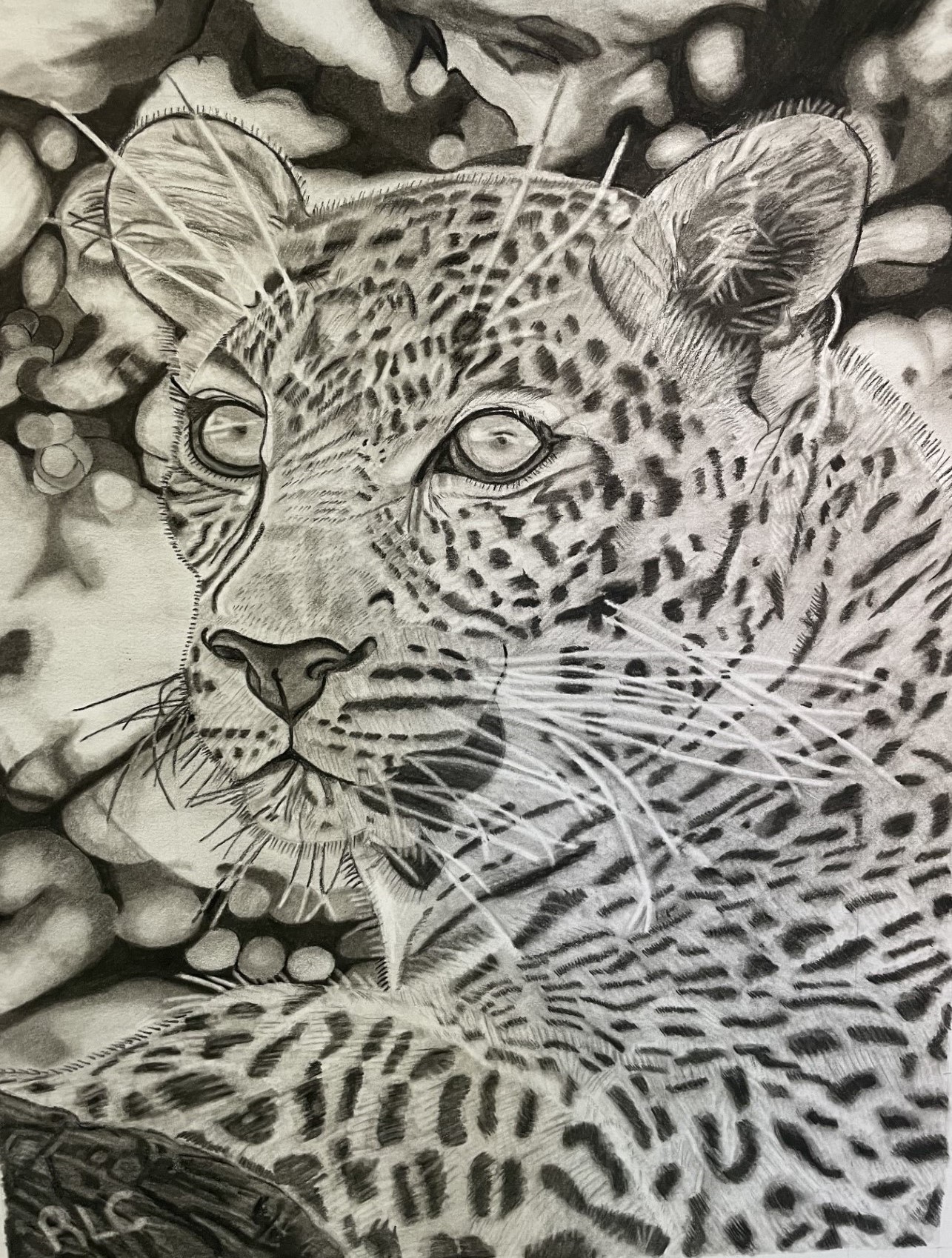
Picture caption: Leopard in a Tree – original charcoal artwork by Robbie Cheadle.
The Watcher (freestyle)
Dear Ranger
I am sorry
I didn’t oblige you
And make an appearance
For your paying guests.
You can’t blame me
For being wary
Of people.
After all
The guest farm
Right next door
Allows canned hunting
By wealthy tourists.
The lions are bred
And raised by hand
In captivity
Then,
Their caregivers
Release them
Into a caged enclosure
To be hunted down
As trophies.
BANG! BANG! BANG!
Leopards are not spared
This barbaric treatment
Although fewer of us
Are murdered this way
Our dead heads removed
To grace the walls
Mouths gaping open
In a humiliated grimace
Called a fierce pose
By the false hunters.
Run off our traditional land
By grasping humans
Who have the right
To life and liberty,
Freedom from slavery
And torture,
Freedom of opinion
And expression,
The right to work
And to education.
What about me?
Here in the reserve
I’m relatively safe
Provided I don’t follow
My natural instincts
To travel and
Stay within the fences
Built by you
I know you’re a good one
But frankly,
It still grates me.
Then you bring
Truckloads of visitors
Who chatter
Point
And gawk
While rattling chip packets
And taking photographs.
SNAP! RATTLE! SNAP!
Nothing is sacrosanct,
You invade
Every part
Of my life
… Eating
… Sleeping
… Mating
My babies
Fodder
For prattling spectators
Hooing and cooing
Making fools of themselves.
And so, I hide
Deep within
The long grass
Or up high
In a tree,
Dreaming away
The long, quiet days.
Sometimes
I shake a whisker
Or twitch an ear
Sending the viewers
Into a frenzy
Hopefully anticipating
A leopard sighting
I lie
And grin
Thinking
And now
Who’s watching
Who?
From
The Leopard in the tree
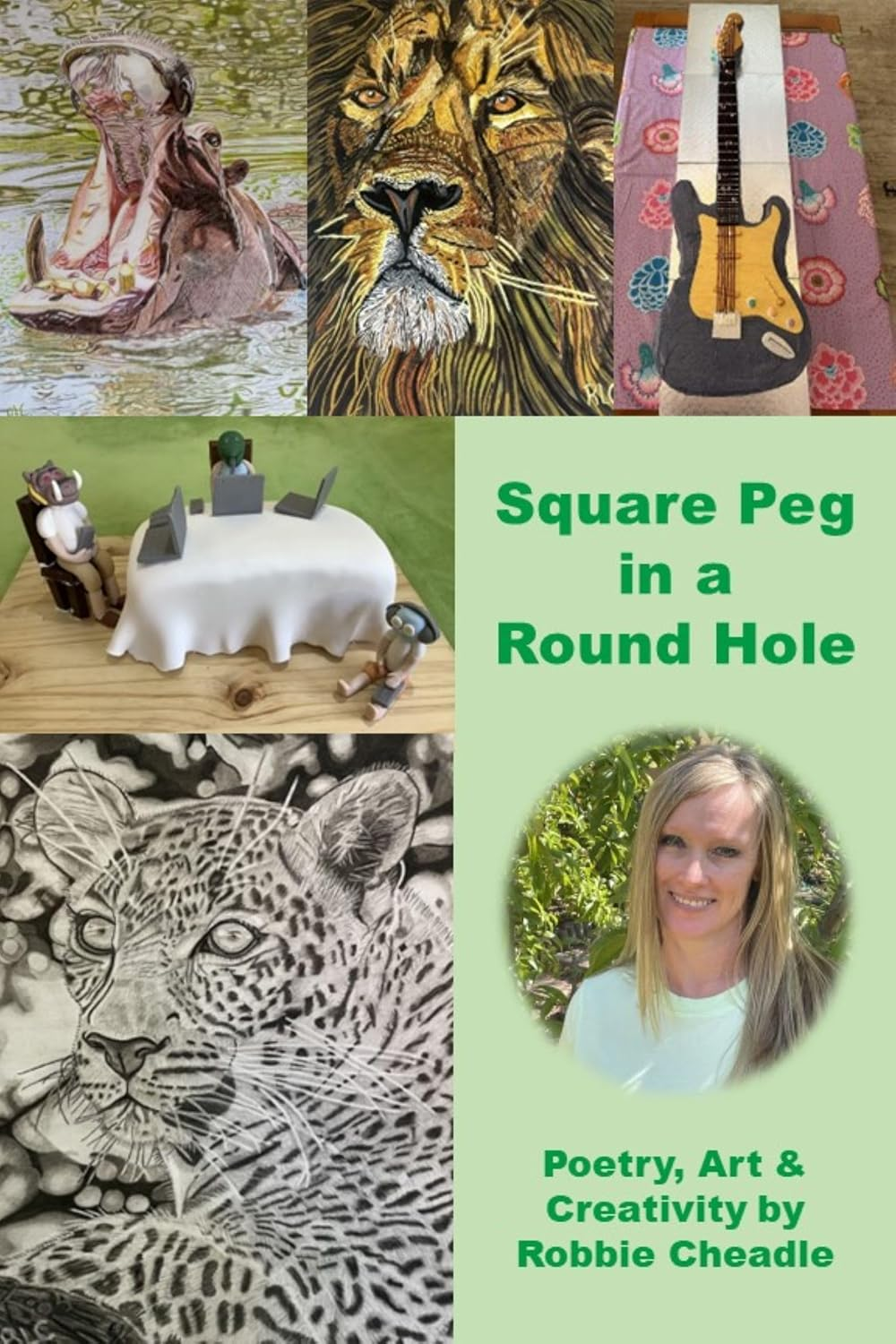
The artwork and poem above are extracted from my poetry collection, Square Peg in a Round Hole available from Amazon here: https://www.amazon.com/Square-Peg-Round-Hole-Creativity-ebook/dp/B0CW1H3SQV
About Roberta Eaton Cheadle
Roberta Eaton Cheadle, is a South African writer and poet specialising in historical, paranormal, and horror novels and short stories. She is an avid reader in these genres and her writing has been influenced by famous authors including Bram Stoker, Edgar Allan Poe, Amor Towles, Stephen Crane, Enrich Maria Remarque, George Orwell, Stephen King, and Colleen McCullough.
Roberta has two published novels and a collection of short stories and has horror, paranormal, and fantasy short stories included in several anthologies. She is also a contributor to the Ask the Authors 2022 (WordCrafter Writing Reference series).
Roberta is also the author and illustrator of seventeen children’s books, illustrator to a further three children’s books, and the author and illustrator of four poetry books published under the name of Robbie Cheadle, and has poems and short stories featured in several anthologies under this name.
Roberta’s blog features discussions about classic books, book reviews, poetry, and photography. https://roberta-writes.com/.
Find Roberta Eaton Cheadle
Blog: https://wordpress.com/view/robertawrites235681907.wordpress.com
Bluesky: https://bsky.app/profile/robbiecheadle.bsky.social
Facebook: https://www.facebook.com/robertawrites
Amazon: https://www.amazon.com/Roberta-Eaton-Cheadle/e/B08RSNJQZ5
___________________________________________
Like this post? Are you a fan of this blog series? Did you know you can sponsor your favorite blog series or even a single post with an advertisement for your book? Stop by the WtbR Sponsor Page and let me advertise your book, or you can make a donation to Writing to be Read for as little as a cup of coffee, If you’d like to show your support for this author and WordCrafter Press.
__________________________________________
This segment of “In Touch with Nature” is sponsored by the Midnight Anthology Series and WordCrafter Press.
Midnight Roost: Weird and Creepy Stories: 20 authors bring your nightmares to life in 23 stories of ghosts, paranormal phenomenon and the horror from the dark crevasses of their minds. Stories of stalkers, both human and supernatural, possession and occult rituals, alien visitations of the strange kind, and ghostly tales that will give you goosebumps. These are the tales that will make you fear the dark. Read them at the Midnight Roost… if you dare. https://www.amazon.com/Midnight-Roost-Kaye-Lynne-Booth-ebook/dp/B0CL6FPLVJ
Midnight Garden: Where Dark Tales Grow: 17 authors bring you 21 magnificent dark tales. Stories of magic, monsters and mayhem. Tales of murder and madness which will make your skin crawl. These are the tales that explore your darkest fears. Read them in the Midnight Garden… if you dare. https://www.amazon.com/Midnight-Garden-Where-Tales-Anthology-ebook/dp/B0DJNDQJD3
Midnight Oil: Stories to Fuel Your Nightmares: 14 authors bring you 16 dark tales that explore your deepest fears. These are the stories which nightmares are made of. Tales of monsters, mayhem, and madness which will make you shiver in the dark. Read them while you burn the Midnight Oil… if you dare. https://books2read.com/Midnight-Oil
Share this:

Treasuring Poetry – An introduction to the poetry of Lindsey Martin-Bowen and a review
Posted: March 18, 2026 Filed under: Book Review, Collection, Interview, Poetry, Review, Treasuring Poetry | Tags: #poetry, #RobbieCheadle, #TreasuringPoetry, Book Review, Interview, Lindsey Martin-Bowen, Treasuring Poetry, Where Water Meets the Rock, Writing to be Read 25 Comments
Today, I am delighted to host talented poet Lindsey Martin-Bowen as my March Treasuring Poetry guest. Lindsey is a fellow contributor to Writing to be Read and you can read her latest post here: https://writingtoberead.com/2026/03/04/lindseys-writing-practice-out-of-this-world-writing-exercise/
Interview with Lindsey Martin-Bowen
My poetry journey: How I became a poet
I must admit as a child, I wrote more stories than poetry. And the poems I wrote then were sentimental and trite. (During grade school (from third or fourth through sixth grade), I compiled annual Christmas books containing “Christmas” stories I wrote—but each year, the manuscript also included a Christmas poem (or one about winter) and a Christmas tale from Readers Digest (which influenced me to compose Christmas books). I also illustrated the books with colored pencils the first year and I gradually moved to water color illustrations (which I sometimes marked with felt-tip pens). My sixth-grade teacher (Mrs. Ferguson) introduced us to Robert Frost and Carl Sandburg, whom I liked, but I liked Emily Dickson the best when I attended elementary school—and I still consider her one of my favorites today. (Unfortunately, at the time, I was too naive to pickup on her style (and skills).
Being the nerd I was in high school, I opted to take a journalism classl. There, for the Christmas issue (of our high-school newspaper), I wrote a humorous Christmas poem from the staff, which I illustrated with an ink sketch of Santa , his gift-filled sleigh (which included B/W head-shot photos of each new-staff member )
and eight reindeer flying through skies above my sketches of Victorian two-stories. (Even then, I preferred old homes to the contemporary ranch styles where most my classmates and I lived.)
Also in high school, I continued writing in my diary, which I used to create short stories (from events in that diary). And I submitted those stories in English classes when a teacher requested them. But my poems were overly sentimental and personal. And basically about teen angst. (For example, one was entitled “Alone.”)
In fact, during my senior year in high school, my English composition teacher enjoyed my short stories and offered encouraging comments. I wouldn’t have shared my poetry, but she’d asked to see it. So I submitted the dreary poems I’d written (mainly centering on unrequited love). She read them and returned them without comment. I mean—absolutely NO comments. No encouragement. So I figured I was no better poet than I’d been a violinist. Sigh.
Thus, my true poetry journey did not take flight until my sophomore year at the University of Missouri-Kansas City, when fellow student Robert (“Bob”) Haynes and I became close friends. Even then, he was an excellent poet—and he boosted me along the journey to poet-hood. He shared not only his poems, but pointed out many contemporary experts who’d been gaining attention in the early 1970s, , such as W.S. Merwin, Galway Kinnell (both born the same year as my father: 1927), Lawrence Ferlinghetti, and Alan Ginsburg, popular in the late 1960s.-and who gave a reading at UMKC. Bob also introduced me to surrealists Kenneth Patchen and Kenneth Koch, who inspired my frenzies, (which I didn’t write until fifty years later.) I discovered James Tate, who I’d include as a “surrealist,”too. Shortly thereafter I enrolled in the university’s poetry writing classes taught by professors Dan Jaffe and David Ray, who introduced me to an array of well-known contemporary poets, including Diane Wakoski (whom Dan Jaffe brought to UMKC to give a reading), James Dickey, Etheridge Knight, Denise Levertov, John Berryman, David Ignatow, Randall Jarrell, William Stafford, Robert Lowell, Thomas Merton, Later, I also started reading Adrienne Rich, Denise Low, and Mary Oliver.
And, I did improve—enough that my senior year, Dan Jaffe asked me to read a few of my poems at a poetry reading on the UMKC campus for the public. He also published two of my poems in an anthology he compiled, one that included many professional poets.
Favorite poem by another poet
O my goodness—I’ve read so many poets and poems, this one is a tough question. Along with the previous set of poets I mentioned, I’ve always admired Emily Dickinson’s style and work, along with William Butler Yeats (especially his “The Second Coming.” And T.S. Eliot: His “Wasteland” is remarkable, but far too long to include here. And the sounds in that poem make it come alive so much that it’s best to listen to a recording of it. Even his “The Love Song of J. Alfred Prufrock” is a bit long to include. Thus, I’ll share Yeates’s “The Second Coming,” which not only inspired one of my poems that I’ll share later, but also remains relevant to our current world situation (a century later).
The Second Coming
Turning and turning in the widening gyre
The falcon cannot hear the falconer;
Things fall apart; the center cannot hold;
Mere anarchy is loosed upon the world,
The blood-dimmed tide is loosed, and everywhere
The ceremony of innocence is drowned;
The best lack all conviction, while the worst
Are full of passionate intensity.
Surely some revelation is at hand;
Surely the Second Coming is at hand.
The second Coming! Hardly are those words out
When a vast image out of Spiritus Mundi*
Troubles my sight: somewhere in sands of the desert
A shape with lion body and the head of a man,
A gaze blank and pitiless as the sun,
Is moving its slow thighs, while all about it
Reel shadows of the indignant desert birds.
The darkness drops again; but now I know
That twenty centuries of stony sleep
Were vexed to nightmare by a rocking cradle,
And what rough beast , its hour come round at last,
Slouches toward Bethlehem to be born?
1920-1921
Favorite style of poetry and why
Although I love my surreal frenzies, I also like other forms of poetry, including sonnets, when they come “naturally.” (The two times I’d written sonnets but didn’t realize it until I re-examined them, tweaked them here and there, and voila! I’d written two sonnets without trying—the best for me). Those two appeared n my second published poetry book (the first full collection) Standing on the Edge of the World (Washburn University/Woodley Press 2008).
I’ve also fallen in love with the Japanese tanka form. (Haiku doesn’t allow enough syllables for my poems. 😉 ) Thus, I created a section of tankas in my last collection, CASHING CHECKS with Jim Morrison (redbat books 2023). More about that later.
Moreover, I generally write in “free verse” with sounds and rhythms and internal rhymes (not at the end of a line), that flow so smoothly, the rhyme doesn’t “hiccup” or stop the reader. Why is this usually my favorite form? As I’ve mentioned in a number of my bios, “poetry is my way of singing.” Thus, in most poems I write, I strive to use sound so they have somewhat the same effect that a song does.
Favourite poem of my own
O so many poems—so little time. I cannot name one favorite poem. But three of them come to mind. First, here’s my response to “The Second Coming,” which I wrote in response to the violence occuring in Ferguson, Missouri:
Re-reading “The Second Coming’ by W.B.Yeats
after Ferguson, Missouri\
No one listens anymore. No one works
in tandem. No horses pull this cart.
Now trembling, it falls apart.
The center hub’s blown, exploded.
Rioting in city squares—rioting along beaches.
Is this anarchy—or something more?
The blood of victims rushes onto shores.
Innocents no more, their lungs fill
till they can’t speak—can’t breathe.
Their passions now sneseles, uneasy—
bringing the strange revelation:
the Second coming lies on the horizon.
It’s the day, it’s the day—
O yes, it’s the holy day—
it’s the Day of the Dead.
A wide-winged beast rises above—
eyes black and gleaming, onyx
glistening through bone.
O Momma, Momma,
come back, come back
again. The world’s too cold.
No lion-bodied beast alouches
toward Bethlehem. It’s a creature
with a jackal’s head, a jackal’s soul.
Where Water Meets the Rock, p. 30 (39 WEST PRESS 2017)
Two other poems I must also count as favorites, because they seemed to write themselves.
The words came to me without me planning them. It was if they suddenly appeared in my brain, and I had to scramble to pen them onto paper before they evaporated.
The first, I wrote during the months that revealed my father was not to stay much longer on this earth. (This was when the frenzies started coming to me. Many of the frenzies are absurd—but comical. This one’s more serious. (And I’ve included it in three of my books: It must be a favorite.)
It’s Never Like the Movies—
for my father
this dying, no background chords
rising to a crescendo,
no adagio of strings.
You watch these ants instead,
trickle across peonies
They disappear. And you
can’t keep your grip
on that granite wall of reason
but slip downstream
into some wild current
till you run aground .
There, you search
for the deserted place, a Holy Land,
where Ekijah met God.
Even if you’re hiking
the Appalachian Trail, up
Standing Indian Mountain,
you watch vultures circle
in and out of clouds festering
into some murky, yellow soup.
And when lightning hits,
Father Davis says Hail Marys—
and there, on the horizon,
you see wovoka whirl
in his dance of ghosts.
Standing on the Edge of the World, p. 85 (Washburn U/Woodley Press, 2008)
Inside Virgil’s Garage, p.52 (Chatterhouse Press, 2013)
The Book of Frenzies, p. 76 (Pierian Springs Press, 2022)
And “From the Emerald City to the Mountain of Quaff” is special to me because it came to me in pieces—often as I was awaking from sleep. At the time, it seemed to be one of the most imaginative poems I’ve written. Perhaps that’s why one of my former poetry professors, David Ray selected it to run in an anthology he assembled (Whirleybird Anthology of Kansas
City Poets, 2012).
From the Emerald City
to the Mountain of Quaff
(or This Must Be Kansas)
Go out and get that long face lost, you say,
Bury me in Jerusalem, I reply.
I want to be one of the first to rise,
like yeast on a rock in the desert,
among iron stones, hills filled with brass,
in a land of olive oil and honey—
wrapped in silver and gold,
where water eats fire
and fire drowns water, and the angel
of the presence outlasts them both.
Or, if poetry must be delirious and weird,
or even a prophetic frenzy,
then bury me in absurdia,
where the lemons bloom.
Inside Virgil’s Garage, p. 7 (Chatter House Press 2008)
Kansas City Voices (October 2007)
Whirlybird Anthology of Kansas City Poets, Whirlybird Press (2012).
The BOOK of FRENZIES, p. 66 (Pierian Springs Press 2022)
About CASHING CHECKS with JIM MORRISON
This book has a strange history. Although it resulted in being a sequel to CROSSING KANSAS with JIM MORRISON (Paladin Contemporaries 2016), it wasn’t exactly planned. I wrote the first collection in about six months. It was odd, too, because it took two years for me to write and revise the book’s initial poem entitled “Crossing Kansas with Jim Morrison, which, of course, became the book title. Yet—once that poem came together, I wrote the rest of the book within six months and entered it into the 2015-2016 QuillsEdge Chapbook Contest, Although it didn’t win, it was a finalist. Concurrently, Thorny Locust literary magazine ran three poems from the collection, and Amethyst Arsenic, another lit mag, took one more.
And the Jim Morrison poems kept coming to me. So I added them and others that fit into the collection, to make a complete book, which Paladin Contemporaries published that summer. On Amazon, the book made it to number 23 or so on the top 100 Poetry Books by Women list—and stayed there most of the following year. (Inside Virgil’s Garage was on that same list concurrently, but it didn’t rise as high Crossing Kansas w/JM did.
About two years later after Where Water Meets the Rock was published, I put together CASHING CHECKS, designed around the themesof actual money becoming obsolete. (Checks, along with credit cards, debit cards, and other contemporary methods of payment don’t include actual money, correct? It money going the way of the manual—or even electric typewriter?) That collection, of course, included other sectons centering around the tanka form and the frenzies. (At present three of my collectons include a section of “frenzies,” and of course, The BOOK of FRENZIES contains solely frenzies, some less zany than others).
In short, after accruing more Jim Morrison poems—I mean, Jim just wouldn’t hush, but kept popping words into my brain—I considered merging the new Jim Morrison poems with the CASHING CHECKS book.
When I submitted both versions to redbat books, both the publisher and her editor preferred the collection containing Jim Morrison. So that’s where we went with it.
What’s next?
What’s next? I’m now working on a manuscript, named for a 10-stanza poem (which can be set in five pages or in in ten, whichever works best) that’s appeared in three publications. I’ve been adding to it and hope to complete a full collection within a few months. The DARK HORSE WAITS in BOULDER, my fourth novel (third on Amazon) is scheduled to be released this spring—so that will precede the poetry book release. At present, I have one more poetry collection I’ve started but don’t see it going anywhere for a year or more. That one may be my last poetry collection, too. (Three more novels and one short story collections are ahead of that poetry collection.) And then, what may be my last novel—now in a VERY ROUGH state-of-being—just may allow the likely last poetry collection to supercede it .But who knows? Rock star archetype Jim Morrison may hop into one or the other manuscript and upset the entire scene.
My review of Where Water Meets the Rock
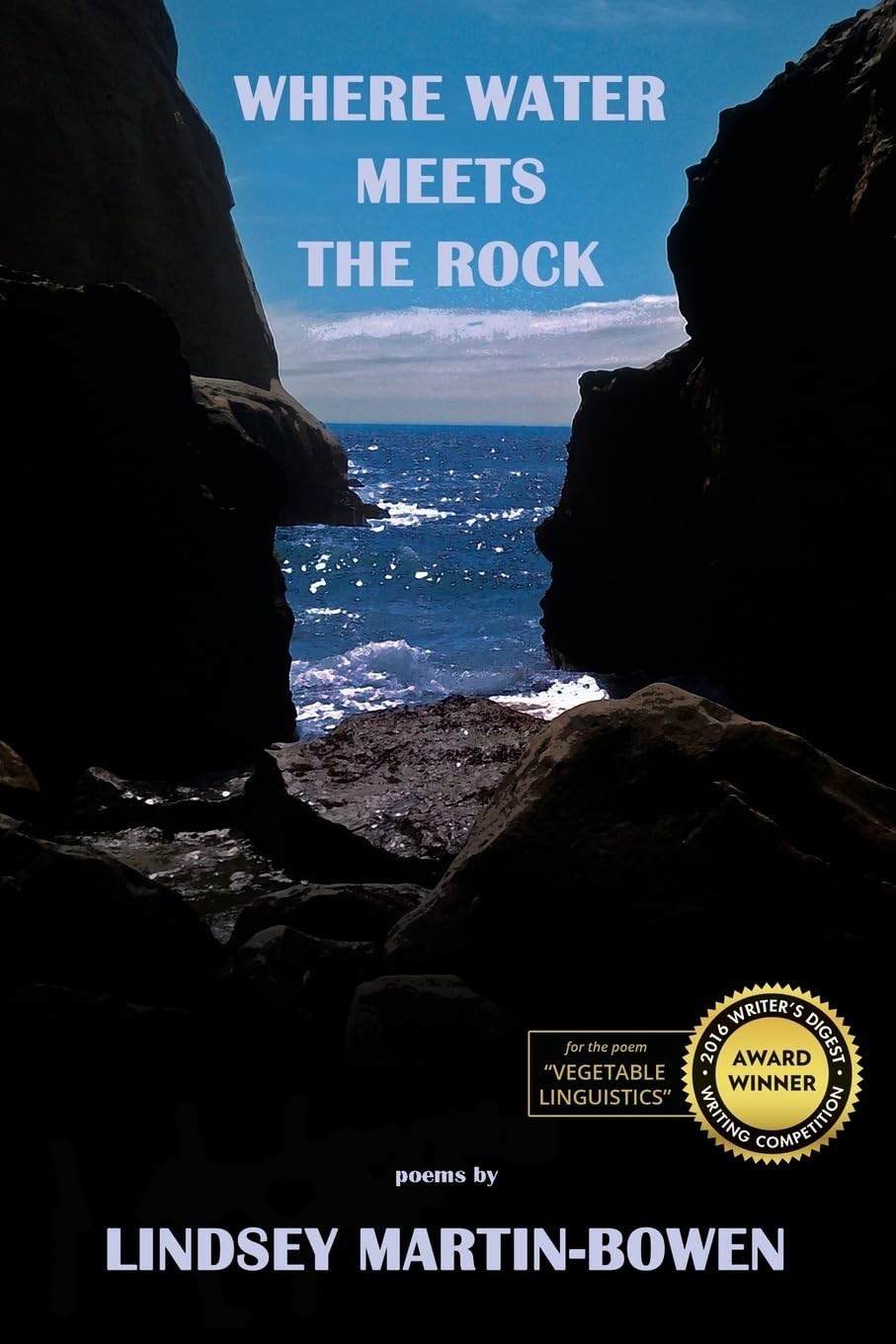
I enjoy reading poetry collections that include a common thread that links all the poems together. The common thread for this collection is loss and recuperation. This theme is relatable to everyone as we all suffer loss in various forms throughout our lives and we are forced to recuperate whether we want to or not.
The collection is divided into three sections: Erosion which explores the slow build up to loss; Frenzies which seeks to unravel the immediate chaos and emotion that follows loss; and On the Shore which delves into the slow path to acceptance and continuation.
The poems are unique and make use of various techniques to either exaggerate or bring out the humorous side of deep emotion and complex thought patterns relating to loss.
A poem that resonated strongly with me in Erosion is titled Psyche in the Suburbs. For me, this poem exposed the conflicting emotions of love, resentment, and self sacrifice that arise when caregiving for aging relatives.
This is the final stanza in this poem:
“Now, lavender scents fill the air,
sending me to the Aegean Sea.
When I step onto the asphalt,
I remember the bottled water.
I must go back. Without it,
the world will know her face
grows old. And she’ll blame me.”
Another poem in this section I especially related to is entitled My Bones are Glass. I have often thought this same thing when dealing with the elderly and aging. The poet includes an apology to Mark Strand, one of my favourite poets, so the style also worked very well for me.
Section 2: Frenzies, includes a lot of humour relating to people’s eccentricities and wants in their final moments. The poems also touch on the need for the observers to fulfil every desire and make the passing easier – perhaps to alleviate the guilt of survival. I enjoyed the poems although humour in poetry is not my personal favourite style. This section lifts the tension in death and loss and will appeal to most readers.
Section 3: On the Shore was very compelling for me. It explored inevitable change and endings coupled with new beginnings of a different sort. I reminded me that we move from one phase to another in our lives without even realising it until we look back and the end and beginning stand out in stark reality. The poem I enjoyed the most in this section was Two Mothers with Kids in Winchell’s. Perhaps because my children are now adults and have both finished school so I can understand and appreciate this poem through the lens of a soon to be empty nester.
This is one stanza in the poem that I strongly related to:
“The Winchell’s mothers nod, talk in buzzing hums,
eye their toddlers, who hop, slide on linoleum.
The kids scratch glass, balance on window ledges.
The pregnant one smooths seersucker. “Guys,” she says,
“They don’t like that here. Come, be quiet, Sit down.”
Like seatbelts, her words rein them in. I frown,
wonder how she renders her voice firm but not loud.”
As a mother who always worked, this stanza fills me with thoughts about what might have been had my own path taken me along a different path. What kind of mother would I have been had I not always been struggling to balance work and home demands. A writer who can introduce such reflections has to be great.
I highly recommend this compelling collection.
Where Water Meets the Rock is available from Amazon US here: https://www.amazon.com/Where-Water-Meets-Lindsey-Martin-Bowen/dp/1946358053
Lindsey Martin-Bowens Amazon Author page is here: https://www.amazon.com/stores/Lindsey-Martin-Bowen/author/B00JA31KW0
About Lindsey Martin-Bowen
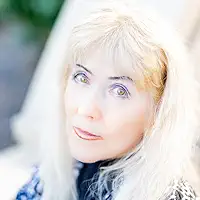
Lindsey Martin-Bowen’s CASHING CHECKS with Jim Morrison has just been released this fall (2023) by redbat books (a La Grande, Oregon publisher) as part of its Pacific Northwest Writers series. She serves as a Literary Consultant for Pierian Springs Press, which published The BOOK of FRENZIES in April 2022 (hardback copy in December 2022–BEFORE she became its Literary Consultant). She has taught Criminal Law and Procedure (online) at Blue Mountain Community College, Pendleton, Oregon since January 2019. Until August 2018, she taught writing, literature, and Criminal Law at MCC-Longview and taught literature and writing at the University of Missouri-Kansas City 18 years.
A Pulitzer-Prize nominee, her fourth full-length poetry collection, WHERE WATER MEETS THE ROCK (39 West Press 2017) contains “Vegetable Linguistics,” which received an Honorable Mention in the Non-rhyming Poetry category of Writers Digest’s 85th Annual Writing Competition (2016). Her third collection, CROSSING KANSAS with Jim Morrison, won the “It Looks Like a Million” Award for the 2017 Kansas Authors Club competition. The book is an expansion of her chapbook named a finalist in the 2015-2016 QuillsEdge Press Chapbook Contest. “Bonsai Tree Gone Awry” from INSIDE VIRGIL’S GARAGE (Chatter House Press 2013) was nominated for a Pushcart Prize. This collection was also runner-up in the 2015 Kansas Authors Club Nelson Poetry Book Award. Woodley Press (Washburn University) published her first full-length collection, STANDING ON THE EDGE OF THE WORLD, which McClatchy newspapers named one of the Ten Top Poetry Books of 2008. Paladin Contemporaries released her novels RAPTURE REDUX (2014), HAMBURGER HAVEN (2009) and CICADA GROVE (1992). Her work has appeared in NEW LETTERS, I-70 REVIEW, THORNY LOCUST, FLINT HILLS REVIEW, PORTER GULCH REVIEW, SILVER BIRCH PRESS, COAL CITY REVIEW, PHANTOM DRIFT, TITTYNOPE ZINE, BARE ROOT REVIEW, , AMETHYST ARSENIC, THE SAME, THE ENIGMATIST, ROCKHURST REVIEW, BLACK BEAR REVIEW, LITTLE BALKINS REVIEW, KANSAS CITY VOICES, LIP SERVICE, 21 anthologies, and others.
With Dennis Etzel, Jr., she edited GIMME YOUR LUNCH MONEY: Heartland Poets Speak out against Bullies (Paladin Contemporaries 2016). She holds an MA in English (creative writing emphasis) and a Juris Doctor degree.
Before focusing upon teaching and writing poetry and fiction, she served as a full-time journalist and magazine editor for THE LOUISVILLE TIMES, the Johnson County SUN, MODERN JEWELER Magazine, and THE NATIONAL PARALEGAL REPORTER. She also worked as a legal editor for the Office of Hearings and Appeals (USDI) in Washington, DC.
She has two brilliant children and contends with super Chihuahuas Chia Maria La Rue and Chico the Man, her canine companions. And often, she spars verbally with poet Carl Rhoden.
About Robbie Cheadle

South African author and illustrator, Robbie Cheadle, has written and illustrated sixteen children’s books, illustrated a further three children’s books, and written and illustrated three poetry books. Her work has also appeared in poetry and short story anthologies.
Robbie also has two novels and a collection of short stories published under the name of Roberta Eaton Cheadle and has horror, paranormal, and fantasy short stories featured in several anthologies under this name.
You can find Robbie Cheadle’s artwork, fondant and cake artwork, and all her books on her website here: https://www.robbiecheadle.co.za/
________________________
Did you know you can sponsor your favorite blog series or even a single post with an advertisement for your book? Stop by the WtbR Sponsor Page and let me advertise your book, or you can make a donation to Writing to be Read for as little as a cup of coffee, If you’d like to show your support for this author and WordCrafter Press.
__________________________
This segment of “Treasuring Poetry” is sponsored by WordCrafter Press and the Poetry Treasures series.
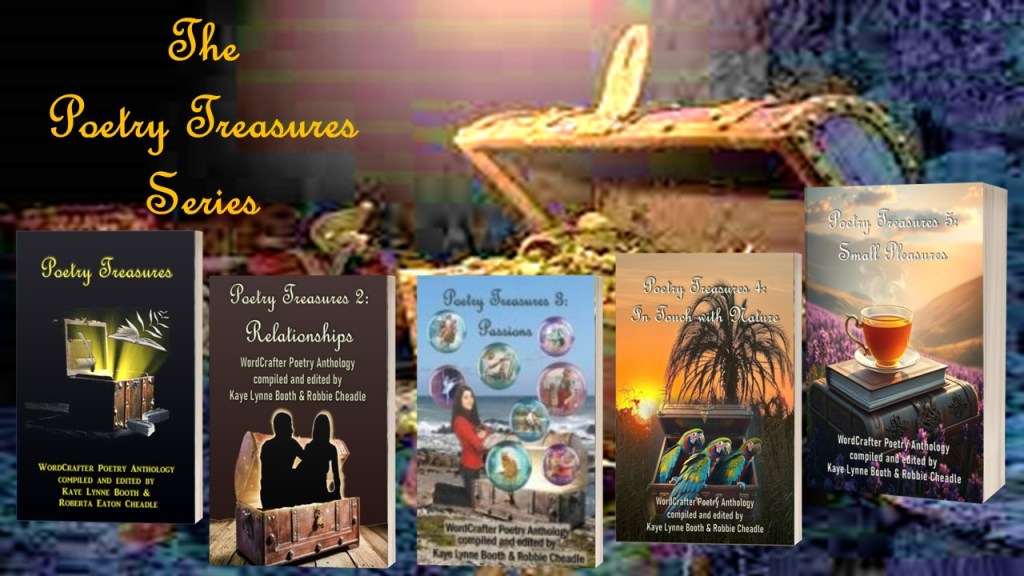
Get Your Copy Today!
Poetry Treasures: https://books2read.com/PoetryTreasures
Poetry Treasures 2: Relationships: https://books2read.com/PT2-Relationships
Poetry Treasures 3: Passions: https://books2read.com/u/b5qnBR
Poetry Treasures 4:In Touch With Nature: https://books2read.com/PT4-Nature
Poetry Treasures 5: Small Pleasures: https://books2read.com/PT5-SmallPleasures
Share this:

Mind Fields: Where Does Courage Come From?
Posted: February 27, 2026 Filed under: Mind Fields, Poetry | Tags: Arthur Rosch, Mind Fields, Poetry, Writing to be Read 1 Comment
Where Does Courage Come From?
I didn’t expect
to have to be this brave
to live in the world.
I had no idea.
I didn’t know what I would need,
how much strength it would take,
how deeply I would fail,
how inadequate I would feel.
I wasn’t ready.
I’m not ready now.
I look at ways out;
I look at death,
I look at drugs,
I use every excuse
to flee.
I do it every day.
I didn’t expect it
to be this hard.
My imagination was not prepared
to encompass the misery,
to behold the sheer strangeness
of what has happened,
what I can’t make un-happen.
I thought I would be protected.
I thought it would be pleasant, this life,
I thought it would be okay,
that I would have a good time,
be satisfied, get away free of entanglements,
leave a nice footprint
that could be seen clearly
down through time.
I am surprised by the mud,
appalled by the blood,
angry with god for letting this happen
to anyone, let alone people I know and love.
I didn’t expect to have to be this brave.
I didn’t think I had it in me;
I still don’t. But I persist
in spite of every difficulty.
I don’t really know why.
It’s not a matter of a foolish belief sustaining me.
My belief is not foolish. My belief is my survival.
There simply is nothing large enough,
other than God,
to hold the grand squalor,
the screaming birth,
the wriggling, enduring heart at the center
of this beleaguered world.
I have no strength, no courage,
I have nothing but strategies to avoid
agony, and they don’t always work.
I survive, for a time,
while the world survives
forever, stronger than
I can be, deeper than I can fulfill,
more powerful than my will,
defiant in the face
of my disappointment in myself.
The world and something loving that redeems
all torment,
survives.
About Arthur Rosch
Arthur Rosch is a novelist, musician, photographer and poet. His works are funny, memorable and often compelling. One reviewer said “He’s wicked and feisty, but when he gets you by the guts, he never lets go.” Listeners to his music have compared him to Frank Zappa, Tom Waits, Randy Newman or Mose Allison. These comparisons are flattering but deceptive. Rosch is a stylist, a complete original. His material ranges from sly wit to gripping political commentary.
Arthur was born in the heart of Illinois and grew up in the western suburbs of St. Louis. In his teens he discovered his creative potential while hoping to please a girl. Though she left the scene, Arthur’s creativity stayed behind. In his early twenties he moved to San Francisco and took part in the thriving arts scene. His first literary sale was to Playboy Magazine. The piece went on to receive Playboy’s “Best Story of the Year” award. Arthur also has writing credits in Exquisite Corpse, Shutterbug, eDigital, and Cat Fancy Magazine. He has written five novels, a memoir and a large collection of poetry. His autobiographical novel, Confessions Of An Honest Man won the Honorable Mention award from Writer’s Digest in 2016.

More of his work can be found at www.artrosch.com
Photos at https://500px.com/p/artsdigiphoto?view=photos
_________________________________________
Did you know you can sponsor your favorite blog series or even a single post with an advertisement for your book? Stop by the WtbR Sponsor Page and let me advertise your book, or you can make a donation to Writing to be Read for as little as a cup of coffee, If you’d like to show your support for this author and WordCrafter Press.
_______________________________________
This segment of “Mind Fields” is sponsored by the Roberta Writes blog site, where you can find the poetry, photos, videos, and book reviews by Robbie Cheadle and so much more.




















