Craft and Practice with Jeff Bowles – Characters in Need of Color
Posted: March 17, 2021 Filed under: Character Development, Craft and Practice, Fiction, Writing, Writing Tips | Tags: Character Development, Craft and Practice, Jeff Bowles, Writing, writing advice, Writing Tips, Writing to be Read 1 Comment
Each month, writer Jeff Bowles offers practical tips for improving, sharpening, and selling your writing. Welcome to your monthly discussion on Craft and Practice.
I’m a big fan of color. Maybe it’s the art lover in me, but I can’t stand boring compositions. A little passionate red, cool and withdrawn blue, yellow to energize, purple to pacify. My stories are always full of color. I design them that way so I don’t get bored in the telling. Attention span of a cocker spaniel, I assure you. I figure if I’m getting bored, my readers don’t stand a chance.
In this edition of Craft and Practice, we’ll look at colorful characters. Where do they come from? How can we more easily create them? Let’s assume you find them preferable to stock characters that are functional but not especially inspired. I’m here to tell you that you don’t need much in terms of preparation. Outlines, character sheets, written histories, throw them all out for the time being. The trick here is to open yourself up, to trust your instincts and your ability to create something sort of magical and unique to your abilities, to your point of view. It’s not so much that preparation can hamper our ideas or dampen our expression of them. This is true some of the time, but not always. It’s more that the tighter we constrict our creativity―that’s constrict rather than channel; one is suppressive by nature and the other is purposefully expressive―the more likely we are to produce wooden and inflexible components.
Your characters don’t want to be inflexible. Trust me on this. They long to be unpredictable, passionate, full of life. Some writers like to work with a net. Perfectly understandable. It’s cleaner and in some sense easier. But I’d like you to consider the possibility that extra work at the conclusion of a writing project is worth more in the long run than an equivalent amount of preparation. The final product is bound to be less like everyone else’s stories and more like your own, and that’s a win in my book.
Let’s run a brief exercise to illustrate the point. Character A asks Character B for something to drink. Character A doesn’t visit other people’s homes very often, so the request doesn’t seem rude or presumptuous. Character B is a friendly sort, charitable in all the ways it matters, and if it’s possible to provide hospitality and comfort to Character A, then that’s precisely what Character B will do. Outcome: Character A gets to drink. Huzzah!
Notice that in just a few brief character descriptions, I’ve told you everything you need to know in order to enjoy the scene. Do you care what Character A’s first car was? Not unless it has direct bearing on the scene at hand. Do you care if your protagonist prefers Pizza Hut to Domino’s? Not as such, because they’re not eating right now. They’re, you know, drinking. What if childhood trauma involving fruit punch makes them thirstier than the average beverage enthusiast? I mean, that may be pertinent information. Put it in and see how it reads. In this way, story serves character, not the other way around. These imaginary folks living rent-free in your head, they might change their spots entirely by the time you’ve written THE END. In fact, we sort of need them to. It’d be damn boring if they didn’t. I’m saying the desired effect is best achieved organically. Think about your standard rising action chart
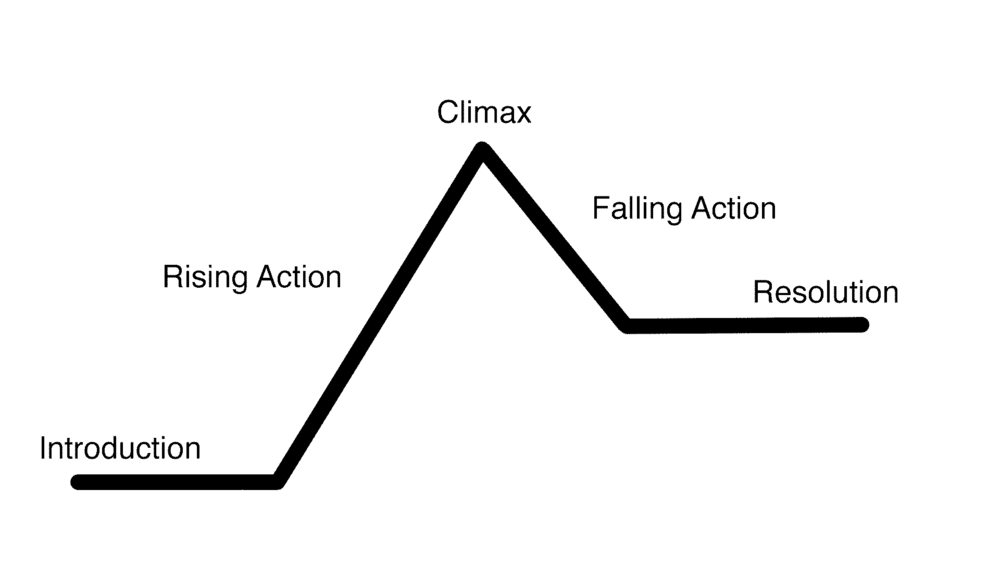
Notice the trajectory, one smooth line shot straight toward a conclusion. Don’t design your plot or your characters in this manner. Just don’t do it. Trust me, that line reads a whole lot better when it’s perforated, imbalanced, full of ups and downs, at last arriving at that ultimate destination. In real life, human beings do not proceed along a straight trajectory. Great actors know this. They understand innately to respond to moments as they come. One foot in front of the other, not all the feet all over the world all at once.
Imagine going onstage with a dozen pages of notes stapled to your forehead. This scene should be easier to perform because you have at your disposal so much background information. Right? Wrong? Yes? No? How’s your performance? Natural or constricted? I mean really, is that stuff helpful, or is it dead weight? A given scene tells me I should be afraid of snakes. The next one tells me I’m falling in love with someone who owns a lot of snakes. The core of my character remains, but the dictates of motivation, action, and reaction are all over the map. Am I in love with snakes and afraid of love? No, of course not. My name is Character A, and I’ve just been bitten by a rattler. See? No preplanning required.
Here’s another classic scenario for you to consider. You can night drive from Los Angeles to Las Vegas without ever seeing further ahead than the thirty feet of illumination provided by your headlights. The road is there, it promises to deposit you at your destination, but even it has no idea what will happen along the way. Maybe you don’t end up in Vegas at all. Maybe your characters have decided they’d rather go to Reno. Are you going to tell them no? They’ve already hit the ATM and booked serviceable lodging!
Thinking of your work in terms of performance is a good habit to cultivate. Just try it. Write a simple scene for which you’ve planned nothing. It’s not important where these characters have been, how much money they have, what their likes and dislikes are. All that matters is the spontaneous influencing the spontaneous. That’s the meaty part, the gold in the gold mine.
Fluff is a chore to read. If you don’t believe me, dig out one of your first serious pieces of writing and tell me how much of it is pertinent and how much ought to be nixed. I know, painful, right? Reminds me of the first piece of honest criticism I ever received, “I only have three problems with this story. The beginning, the middle, and the end.”
The good news about this craft is that there are a million and one ways to skin a cat. I’ll be back with more Craft and Practice next month. No cat-skinning required. See ya!
Jeff Bowles is a science fiction and horror writer from the mountains of Colorado. The best of his outrageous and imaginative work can be found in God’s Body: Book One – The Fall, Godling and Other Paint Stories, Fear and Loathing in Las Cruces, and Brave New Multiverse. He has published work in magazines and anthologies like PodCastle, Tales from the Canyons of the Damned, the Threepenny Review, and Dark Moon Digest. Jeff earned his Master of Fine Arts degree in creative writing at Western State Colorado University. He currently lives in the high-altitude Pikes Peak region, where he dreams strange dreams and spends far too much time under the stars. Jeff’s new novel, Love/Madness/Demon, is available on Amazon now!
Check out Jeff Bowles Central on YouTube – Movies – Video Games – Music – So Much More!
Want to be sure not to miss any of Craft and Practice with Jeff Bowles segments? Subscribe to Writing to be Read for e-mail notifications whenever new content is posted or follow WtbR on WordPress
Share this:

Jeff’s Movie Reviews – Coming 2 America
Posted: March 12, 2021 Filed under: Commentary, Film Review, Jeff's Movie Reviews, Movie Review, Movies, Opinion | Tags: Comedy, Coming2America, Eddy Murphy, Jeff's Movie Reviews, Writing to be Read 2 Comments
The Once and Future King?
by Jeff Bowles
So let’s say you’re a movie star who’s been part of the popular imagination for forty years. You’re given the opportunity to reprise a role that helped establish your legacy, and let’s be honest, the big parts aren’t exactly pouring in these days. Should you A). Disregard said opportunity, knowing full well it’s very difficult to capture lightning in a bottle, or B). Throw caution to the wind and have a great time making a follow-up to a movie successive generations know and love?
Eddie Murphy appears to have found himself in just such a situation, because when it came time to make a sequel to Coming to America, he didn’t hesitate. Without a doubt, he and the filmmakers would’ve preferred to debut this new movie in theaters, but that’s not an option during a global pandemic. Coming to America 2 (or is that Coming 2 America?) is available exclusively on the Amazon Prime Video streaming service. The original is widely considered one of the best comedies of the ‘80s. It’s sharp, aggressive, honest, romantic, and best of all, silly in all the right ways. A lot of time has passed since its release, yet it still holds up remarkably well. So why not give it a sequel? Why not take all these fan-favorite characters for another spin around the block?
Here’s why. Nostalgia is only as good as the material propping it up. If a film is going to devote most of its comedic resources to nailing the exact same jokes and situations as its predecessor, it’s got to work twice as hard to prove itself worthy of our time. Unfortunately, Coming 2 America proves nothing except the obvious: you can never go home again. Look, you walk into the barbershop and all the characters are played by Eddie Murphy and Arsenio Hall. Same joke as last time. Still funny, but not as funny as it used to be. Or maybe you go out to listen to a band with a terrible lead singer (also played by Eddie Murphy) and their ridiculous name, Sexual Chocolate, makes you smile. Same joke as last time. Still funny, but…

This pattern appears consistently throughout Coming 2 America’s runtime. Even the basic premise amounts to a variation on a well-established theme. This time around Prince Akeem (or rather, King Akeem) must travel to the US in order to meet his illegitimate son. Hijinks ensue, but um, why does it feel so exhausting? It’s like going to see your favorite band and hearing nothing but cover songs. Wesley Snipes, for instance, plays a pretty clear-eyed comedic version of a murderous warlord turned politician, but his presence does nothing to disrupt the flow of same-old, same-old. No sequel has ever ruined a great predecessor. People may say so, but rarely does the supposition hold water. This sequel, in fact, only makes you want to watch the original more. ‘Cause it was killer fun. You know, yay for that original!
A couple other potential pitfalls for audiences looking to recapture thirty-three-year-old magic: there’s no swearing. I mean none. No nudity either. Is that a problem in general? Nope, but the first movie had some serious edge to it, and this thing does not. In essence, it feels like a sequel to a totally different film. There’s also a serious lack of material shot on location. For a film that takes place in Africa and New York City, movie sets are uncommonly common. Incidentally, just a few days after its release, Coming 2 America quickly became the most streamed movie on any platform during the COVID-19 era. Go ahead and look it up, Amazon has a hit on their hands.
Realistically, though, they should’ve had to work just a bit harder to earn it. Watch this movie and see how quickly you forget about it. For my wife and me, the shelf life was two days, two whole days, and then it vanished like an errant spray of Soul Glo hair product in the wind.
Oh no, a callback to the original movie. See? They’ve even got me doing it now!
None of this is to suggest Coming 2 America is little more than a jaded corporate cash grab. Sincerely, the movie appears to have been made with the best of artistic intentions. Word on the street is Eddie Murphy now wants to make another entry in his Beverly Hills Cop franchise. Everything old is new again. Or is it the other way around? Let’s try Casablanca 2, or maybe Citizen Kane: Rosebud’s Revenge. Apocalypse Now, Now. Star Wars Episode … nope, never mind. They did that one already.
Jeff’s Movie Reviews gives Coming 2 America a Six out of Ten.
Jeff Bowles is a science fiction and horror writer from the mountains of Colorado. The best of his outrageous and imaginative work can be found in God’s Body: Book One – The Fall, Godling and Other Paint Stories, Fear and Loathing in Las Cruces, and Brave New Multiverse. He has published work in magazines and anthologies like PodCastle, Tales from the Canyons of the Damned, the Threepenny Review, and Dark Moon Digest. Jeff earned his Master of Fine Arts degree in creative writing at Western State Colorado University. He currently lives in the high-altitude Pikes Peak region, where he dreams strange dreams and spends far too much time under the stars. Jeff’s new novel, Love/Madness/Demon, is available on Amazon now!
Check out Jeff Bowles Central on YouTube – Movies – Video Games – Music – So Much More!
_____________________________________________________________________________________________________________________________
Want to be sure not to miss any of “Jeff’s Movie Reviews” segments? Subscribe to Writing to be Read for e-mail notifications whenever new content is posted or follow WtbR on WordPress. If you found it useful or entertaining, please share.
Share this:

Words to Live By – Where Lie Your Roots?
Posted: March 3, 2021 Filed under: Comic books, Commentary, Creativity, Fiction, Words to Live By, Writing, Writing Inspiration | Tags: Creativity, Inspiration, Jeff Bowles, Words to Live By, Writing to be Read Leave a comment
The first Wednesday of every month, writer Jeff Bowles muses on life, creativity, and our collective destinies as makers of cool stuff. You’re a writer, but have you ever thought about how or why? Here are some words to live by.
Where Lie Your Roots?
It’s been a slow week for me out here on the Colorado prairie. Not planning to announce any upcoming book or music releases, no urge to get out of the house and see the world again. I assume it’s right where I left it. Such a long time ago! Do they still have fast food out there? Do children still laugh? Asking for a friend.
I did finish the rough draft of a new book the other day. I’ve been working on it for three and a half months, so it was gratifying to finally type THE END. About 70,000 words in total, and guess what else? I wrote it without any preparation, no outline or notes or character sheets or research conducted the hard way. And I like how it’s turned out. Kind of proud of myself, actually. I think it would’ve been a very different book if I’d had no clue how good stories are put together. My family gave that to me, the freedom to ponder and learn and express, regardless of whether or not they figured it would, quote unquote, “Get me somewhere”.
This is at the heart of Words to Live By for this month. Where lie your creative roots? Reaching deep into the nutrient-rich soil, I hope. Have you been making time for inspiration? Have you lately nurtured those people and circumstances essential to your own creative growth? I believe every one of us has common mythic imaginations. Joseph Campbell spoke about it all the time, and so for that matter did Carl Jung. If not for that thick, tangled, extra-nerdy root system of mine, I doubt I’d have had the confidence to improvise a whole book. Think I’m going to call it Emily Greer’s Resurrection Mixtape, which sounds dumb until you realize what it’s about. I’ve documented my writing habits elsewhere on Writing to be Read, but because I developed Schizoaffective Disorder about five or six years ago, I’ve had to lighten my daily workload considerably. For me there’s a fine line between healthy production and the kind of overproduction that only exhausts and triggers me.
Have you ever met a writer who’s lost his or her ability to be a fan of stuff? Like they broke that button a long time ago and never bothered to have it repaired? I’d hate always feeling that way. As long as they keep making movies for nerds, I’ll doubtless keep paying to see them. It was something we always did together, my family and I, the magic of a darkened movie theater, popcorn, candy, soda; complete and total escape into stories bigger than the side of our house! I started borrowing amazing science fiction novels from my brother, started singing for the other kids on the playground, developing that taste for performance. By the time I got to college, I was hooked. My biggest leap forward at that time was to write a full screenplay for one of my theater classes.
“This isn’t bad, Jeff,” my instructor told me near the end of the semester. “You’ve got a knack for writing. You ought to continue developing it.”
So I did. I worked hard, studied hard, and yes, that did include watching movies and TV shows many people at the time considered junk. I knew this stuff was cool then and I’m certain of it now. There are a lot of cultural touchstones to keep track of when you work in genre fiction. I’m a nerd, which means I’m already full of useless trivia. But what about you? In what ways have your experiences with storytelling shaped what you do and the way you do it?
I get much of my writing style from comics. Big surprise there. Comic books are dynamic, bombastic, colorful. They’re also short, which is perfect for a mind like mine. From the likes of Marvel and DC, I learned the value of punch-you-in-the-gut storytelling. Can’t say I took personal instruction at the feet of masters, but just read some of my work and tell me you don’t see far more super than man.
Heh, that’s a good one, more super than man. Going to have to remember that.
Because I write relatively little each morning, I end up with a lot of free time on my hands. I’m also a bit of a homebody, which has only become more pronounced in the days of COVID. What do I do all day long if not to write? Because honestly, ten years ago I’d work for hours on end and never bat an eye. I read comics, of course, and I watch movies I’ve seen a million times before. I’m a huge fan who also writes and occasionally gets paid for what I create. The point is not to elevate my tastes above anyone else’s. I do like some pretty awesome stuff, but that’s subjective. I’d rather you elevate yours over mine. What catches your imagination most? What gets you excited to be creative? Watch Captain America or Batman for the umpteenth time and pretend you’re immune to feeling bored, frustrated, disagreeable. How deep do your roots go?
The things I love charge me up and make my work possible. Do you feel the same about the stuff you love? If there were no Avengers, no Justice League, no Star Wars, I might not have ever become a writer. Thank god I did. It’s been one hell of a fun life so far. 😊
I’ll be back next month with another Words to Live By. Until then, everybody!
Jeff Bowles is a science fiction and horror writer from the mountains of Colorado. The best of his outrageous and imaginative work can be found in God’s Body: Book One – The Fall, Godling and Other Paint Stories, Fear and Loathing in Las Cruces, and Brave New Multiverse. He has published work in magazines and anthologies like PodCastle, Tales from the Canyons of the Damned, the Threepenny Review, and Dark Moon Digest. Jeff earned his Master of Fine Arts degree in creative writing at Western State Colorado University. He currently lives in the high-altitude Pikes Peak region, where he dreams strange dreams and spends far too much time under the stars. Jeff’s new novel, Love/Madness/Demon, is available on Amazon now!
Check out Jeff Bowles Central on YouTube – Movies – Video Games – Music – So Much More!
Share this:

Jeff’s Game Reviews – The Medium
Posted: February 26, 2021 Filed under: Horror, Jeff's Game Reviews, Video Games | Tags: Jeff's Game Reviews, Medium, Video Games, Writing to be Read Leave a comment
Reviewed on Xbox Series X – Also available on Xbox One and Xbox Series S
Fear can be a tricky thing to nail down. From a storytelling perspective, it’s more complicated than basic jump scares and grotesque slight of hand. In order to really scare people you’ve got to get inside their heads, and that’s exactly what independent Polish game developer Bloober Team has tried to do in their latest Xbox exclusive, The Medium. The basic selling point is a new gaming mechanic in which the player is occasionally required to control their character in two different spiritual “realms” at the same time. It’s a cool idea, novel in the sense that dedicated gaming consoles have never been powerful enough to render this kind of thing before, but it’s also a little bit gimicky, and that’s hard to ignore.
Whether it’s the stunning and seriously disturbed environments found in the land of the dead, the screaming, groping, crying, ever-present monster who shamelessly plagues you wherever you go, or the expertly revealed mystery of the murder of one lively little dead girl, the game is seriously invested in freaking you out. Does it do its job? For the most part, but there’s not a whole lot of basic modern scare tactics in use here that we haven’t seen before. The game’s narrative is anything but perfectly realized, and certain technical shortcomings hurt the overall experience, but The Medium is more than the sum of its parts. This could’ve been a huge disaster. It’s not though, even if it is the brand new system’s first and only true exclusive. Watch our video review for a good look at the game in action:
Our hero, the eponymous medium of this ghost story, is a young woman named Marianne. We never really get the sense she’s super experienced at this gig, because contextually speaking, she seems to be using many of her incredible abilities for the first time. First time having an out of body experience, first time getting stalked by a giant, faceless, pan-dimensional demon with a serious skin fetish. I mean it, there’s this frightening and freakish dude who follows you around for the entire second half of the game. No attacking, shooting, bludgeoning, or stabbing for you. The only way to win is to keep running and hiding. Can’t we get a moment’s peace?!
More or less The Medium’s shortcomings boil down to this: the camera is locked off in old-school Resident Evil fashion, making navigation cumbersome and awkward. Additionally, puzzles and quests are never as smart as you want them to be. The much-touted split-screen mechanic of simultaneously dwelling in both the world of the living and the land of the dead is unique and visually striking, but it seems to be limited to the use of passing arbitrarily administrated spiritual barriers, blasting demon bat thingies with an electric shield bubble, and slicing through large sheets of skin with a bone straight-razor.
Ew, gross.
And yes, a terse and limited story about shame, fear, death, and rage is continuously hampered by narration that tells more than it shows. Truly, the dialogue and voice acting try to keep pace with bigger games of the genre, but they never quite get there. It’s kind of a shame, because there’s lots of scary concepts and dark emotional undertones percolating just below the surface. Moments of sheer terror be damned, Resident Evil and other genre master series are capable of nailing gameplay AND story, so what’s the deal here?
The one thing that truly elevates the overall experience is the atmosphere, which is rich, dense, and undeniably disturbing. It’s hard to imagine The Medium pushes the powerful new Xbox hardware to its limits, but the launch release is plagued by framerate issues and other graphical kinks, so push the Xbox it must. Even so, dense forests and a haunted Polish resort hotel are handled with style in both the material and ghost realms. You’ll have a good time playing this game, especially if you’re a horror nut, but doubts will continue to linger as to whether or not you’ll remember it once you put it down.
Jeff’s Game Reviews gives The Medium a final score of SEVEN out of TEN.
Jeff Bowles is a science fiction and horror writer from the mountains of Colorado. The best of his outrageous and imaginative work can be found in God’s Body: Book One – The Fall, Godling and Other Paint Stories, Fear and Loathing in Las Cruces, and Brave New Multiverse. He has published work in magazines and anthologies like PodCastle, Tales from the Canyons of the Damned, the Threepenny Review, and Dark Moon Digest. Jeff earned his Master of Fine Arts degree in creative writing at Western State Colorado University. He currently lives in the high-altitude Pikes Peak region, where he dreams strange dreams and spends far too much time under the stars. Jeff’s new novel, Love/Madness/Demon, is available on Amazon now!
Check out Jeff Bowles Central on YouTube – Movies – Video Games – Music – So Much More!
Share this:

Craft and Practice with Jeff Bowles – Throw Away Your Outlines FOREVER!
Posted: February 17, 2021 Filed under: Craft and Practice, Fiction, Writing, Writing Process, Writing Tips | Tags: Anime, Craft and Practice, Jeff Bowles, Outlines, Surprises, Writing to be Read 9 CommentsEach month, writer Jeff Bowles offers practical tips for improving, sharpening, and selling your writing. Welcome to your monthly discussion on Craft and Practice.
My wife recently showed me a new favorite anime series of hers that perfectly illustrates a point I’ve been making about storytelling for years. I didn’t used to like anime all that much, and I’m not sure how you feel about it (if you feel anything about it whatsoever), but like many writers from my part of the globe, I had a certain bias toward a more Westernized approach to storytelling. I didn’t much like the aesthetic of anime, the tropes or the style, but I also wasn’t seeing the big picture. Anime is often judged on its aesthetics, but it should be praised for a preference for bold storylines, creativity, color, imagination, a kind of libertine approach that is no-holds-barred, that exceeds and usually subverts audience expectations.
The truth is there are a million writing advice columns saying it’s a bad idea to head into a writing project without some kind of plan. Sometimes, especially in speculative fiction, copious amounts of planning are advised. Character sheets, outlines, beat sheets, world building tools, map making, story bibles, and a number of other idea-gathering methods are common, and for good reason, I suppose. But in the traditions that gave birth to a medium like anime, form follows function, structure often inhibits form. In other words, rigidity and an unwillingness to let stories guide themselves is at the heart of lots and lots AND LOTS of bad writing.
To produce an animated television show, of course, quite a bit of planning is required. Scripts have to be written, art must be created, there’s a need to hire actors and hold recording sessions, and then post production is always a long process. Large groups of very talented people make this stuff. The animation industry is a machine, one so well-oiled the product itself is viewed and loved all over the globe, regardless of culture or regional storytelling preferences. In contrast, someone who writes fiction or poetry or who dabbles in screenplay, stage production, or even video game writing, is very much a free agent. But I’d like to ask you to throw all that out the window for a moment, because I want to direct your attention toward something crucial. Storytelling can and perhaps should be artful in addition to being solid, confident, and competent. Storytelling, the best kinds of it anyway, should meet and then exceed audience expectations, and I know of one sure-fire way of doing that: be the author who surprises the author.
Surprise yourself. Anime is an interesting medium to study because it absolutely loves the element of surprise. I know that in the new show my wife introduced me to, every episode contains a wealth of sea changes that completely redirect the flow of the narrative, creating an experience audiences simply cannot predict from one half-our segment to the next. It’s an intense ride, one that has equivalents in Western storytelling. Stephen King, for instance, is famous for espousing a very seat-of-the-pants approach to writing novels. He’s struck by an interesting what-if scenario, starts writing an introductory scene, establishes some initial paradigms, a few working story dynamics, and then he’s off to the races for the next couple months, having no clue where he’ll end up or how he’ll get there.
It’s worth noting that story synthesis requires the introduction, development, and resolution of disparate elements. For example, if I tell you to write a first chapter including a gun, a nun, an assassin, and a vengeful widow, you’ve got four disparate elements that must follow that exact line: introduction, development, resolution. So let’s say the widow is on a quest to kill the assassin who took the life of her beloved, but her religious convictions lead her to a local church where she gets down on her knees and begs a nun to talk her out of committing the ultimate sin of murder.
Where does the story go in chapter two? Imagine the possibilities, reason out the next most likely scenario to occur, given what’s just happened in chapter one (have to use your reasoning, logical brain for this). Repeat that method throughout approximately thirty or forty chapters, and you’ve got yourself a book. Again, if the author of a great story is surprised while they’re in the process of telling it, the reader is likewise guaranteed a similar reaction. It doesn’t mean you’re a sloppy storyteller. It means you’re willing to take a leap of faith, play jazz a little bit, stretch your abilities and find out in an improvisational way what works and what does not.
As you come up with ideas in the moment, you’re likely to want to check them against a few basic questions: does this concept make sense in context? Would my characters really do this and why? How does this dynamic irrevocably change the narrative, and does it take the story in a direction I’m not prepared to go? Constant alterations, redirection, redactions, and tweaks will be required, and you may also find your finished rough draft is in need of serious inserts, deletions, and edits, but the benefits outweigh the grief. Stories that surprise, that don’t hold the audience’s hand, that respect the audience’s intelligence, that’s what can result.
To return to Stephen King for a moment, there is a preponderance of disappearing, reappearing elements in his stories. Some of his most famous novels set, break, and then reset paradigms constantly and consistently. In The Stand, for instance, notice how a story initially about a small group of disparate and scattered pandemic survivors becomes a tale of strong familial community and then a post-apocalyptic holy battle of good vs. evil. King wrote that book without any planning at all, and whenever he got stuck because, you know, he hadn’t planned anything, he simply did something drastic and unexpected to break paradigms he himself had set. Gathering all the pandemic survivors in Boulder, Colorado and setting them up with good lives isn’t enough. There has to be a traitor in their midst, and if a bomb suddenly goes off and kills some fairly important protagonists, what’s the difference? At least we get some more breathing room to play with that wicked story.
Anime also teaches us paradigms can be created and implemented with the intention of shattering them and reassembling and continuing a story on the fly. Just like, I’m afraid, too much outlining can turn an otherwise well-written book into a predictable mess. Decent surprises telegraphed and ruined, characters that behave irrationally because they were and are slaves to dense, inhibiting structure, it’s a bit of a nightmare. It must be noted that in the professional world, a writer isn’t always given the opportunity to create stories on the fly. Publishers and studio executives, game developers, whoever you’re writing for, they like to be sold on ideas before they see a finished product. Call it an insurance policy. But if by chance you don’t care too much about impressing or working for these folks, if you’re of a more independent disposition, I urge you to try a writing approach that eschews too much planning and allows for absolute spontaneity. You may just be thrilled with the results.
I’ll be back next month for another Craft and Practice. See ya, folks, and thanks for stopping by!
Jeff Bowles is a science fiction and horror writer from the mountains of Colorado. The best of his outrageous and imaginative work can be found in God’s Body: Book One – The Fall, Godling and Other Paint Stories, Fear and Loathing in Las Cruces, and Brave New Multiverse. He has published work in magazines and anthologies like PodCastle, Tales from the Canyons of the Damned, the Threepenny Review, and Dark Moon Digest. Jeff earned his Master of Fine Arts degree in creative writing at Western State Colorado University. He currently lives in the high-altitude Pikes Peak region, where he dreams strange dreams and spends far too much time under the stars. Jeff’s new novel, Love/Madness/Demon, is available on Amazon now!
Check out Jeff Bowles Central on YouTube – Movies – Video Games – Music – So Much More!
Want to be sure not to miss any of Craft and Practice with Jeff Bowles segments? Subscribe to Writing to be Read for e-mail notifications whenever new content is posted or follow WtbR on WordPress
Share this:

Words to Live By – Losing My Mind (in Real Life)
Posted: February 3, 2021 Filed under: Commentary, Creativity, Mental Health, Opinion, Self-Help, Words to Live By, Writing, Writing Life | Tags: Mental Health, Mental Illness, Words to Live By, Writing Life, Writing to be Read 3 CommentsThe first Wednesday of every month, writer Jeff Bowles muses on life, creativity, and our collective destinies as makers of cool stuff. You’re a writer, but have you ever thought about how or why? Here are some words to live by.
Losing My Mind (in Real Life)
At three-thirty in the morning, I’m screaming at demons. There’s something inside me, something over which I have very little control, and it’s been at my throat for months. Somehow I’ve convinced myself the voice in my head belongs to a friend from graduate school, that she’s speaking to me telepathically over a great distance. She’s crueler than the person I remember, always mocking and deceiving me, but I don’t do the simple mental math. The voice tells me all sorts of things, and this is the first time I’ve ever been crazy, so I don’t necessarily understand I’m not supposed to listen.
Though I sleep dismally, I call her the very next morning. The real person I mean. I say crazy things, most of which I don’t remember now. A few days later, something even worse happens. An incident with the car in our driveway. My wife, she gets hurt. The voice told me she was trying to kill me, and I believed every word, so I attempted to flee the house and she ended up with six fractured ribs. God, some days are made in Hell. If I close my eyes, even five years later, it’s an easy vision to conjure, and it lays me low every time. This happened, it was real, and I was crazy, crazy, crazy, an animal, a lunatic, someone completely undeserving of justice or fairness or something simple and clean like compassion.
I made a mess of my life, ended up in jail, in court, on a psychiatric ward, and I have had to cope with a version of myself from that time I cannot excuse, someone vulgar and unhinged, someone barely hanging on. I won’t go into details that are still too painful to write in blunt, unadulterated language. The pressures of life had gotten to me, an unexpected barrage of one thing after another, as life is known to dish out. Unexpected health issues, loss of a job, unable to pay the mortgage. No, I’d never heard voices before, but that doesn’t mean I’m worthy of forgiveness. My loved ones keep telling me I should finally let go, be kind to myself on this front, realize people make mistakes, that these things can and do happen and that none of it makes me a bad or dangerous person. I find it difficult to believe what they say. Scratch that, I find it impossible. It’s a miracle no one was killed.
Many prominent creative voices throughout history have commented on the clear and seemingly causal link between mental illness and creative genius, but not every dork with a science fiction and fantasy fetish and a couple of short story sales goes full tilt into lunacy. It’s not in my nature to describe myself in lofty terms. It’s not in my nature to think of myself very fondly at all, and that’s perhaps where dark things like this take root. Whatever creative abilities I’ve been granted and have spent years honing seem to have come at a cost. I knew I had depression at a very young age, but schizophrenia, I didn’t even know what that was.
It’s like this: you can’t trust your thoughts, your senses, your worldly experience. You will hear voices and smell phantom aromas and see things that aren’t there. You’ll think delusional thoughts every once in a while, strange ruminations and lines of logic that make perfect sense at the time they occur. If you’re lucky, medication will help, and counseling will teach you skills you can lean on that boil down to keeping it real, keeping it present, leaning on others if you’re having a truly difficult time distinguishing fantasy from reality. Don’t listen when you think you hear your friend from school. Don’t listen when you think you hear your friend from school. Don’t listen when you think you hear your friend from school.
There were nights I was so terrified I couldn’t imagine surviving till morning. These voices, they torture you in all sorts of creative and intimate ways. They make fun of you in the toilet, in the shower, when you’re dressing in the morning. They con you into driving recklessly in city traffic, convince you your counseling appointment has been canceled, and that in fact, you don’t really need counseling anyway. At some point, the ruse couldn’t sustain, and I finally realized I wasn’t speaking with my friend. Sensibly, tardy as usual, I asked to whom or what I was in fact speaking, in my head, in the room, just out of sight.
It said it wanted to be called Dave. Just Dave. And the more my wife and I used the name as shorthand, the more it seemed appropriate. Dave, like some faceless person who could be anyone or anything at any time. Dave, a personality that might be normal or might be abnormal, just depended on the day. And now when I write, even a simple essay like this one, I feel as though Dave is guiding my fingers over my laptop keyboard.
I can feel him looking out my eyes sometimes. He wiggles my toes and fidgets when I’m barely paying attention. He’s in me, he is me, yet they say he’s not the conscious, aware me. If my id expresses itself thusly, what the hell is wrong with me? Is it any wonder the book I wrote about that insane, scary time depicts Dave as a full-stop demon? Not a biproduct of janky biochemistry or a brain or emotional disorder, but rather something separate and inhuman? Took me two years to write that book. I still can’t stand to read a single word of it.
I wasn’t myself. It must be a constant reminder, or the truth is the person I am today, the person I’ve always believed myself to be, he’s a lie. And this is something I can’t accept. You must take action when your own wounding wounds others. It’s a teaching moment, a failing you can catch like a falling aspen leaf. It was a shot across the bow, an opportunity to reorient myself, look at my life and everything I’ve created and done not as the end-all-be-all, but as a small component of who I am in full. Each and every time Dave speaks to me, I can silently rebuke or ignore him and remind myself what real humility and humanity look like.
They look like the patients at the psych hospital who’d just survived suicide attempts and psychotic episodes. How gentle and caring they seemed. Not like me, strapped to a hospital bed, screaming my head off, trying to cut my wrists in a pretty useless fashion, thinking the Velcro ties would do the trick. Humility and humanity look like the caregivers—yes, even the guards at the county jail—who could’ve condemned me but instead took pity on me, tried to protect and treat me.
Even five years later, I awake sometimes from nightmares. He’s always there, but thankfully, so am I. Watchful, careful, repentant. Honestly, not at all interested in returning to that place ever again. I could’ve lost so much. It all could’ve ended so much worse. My blessings, I do my best to count them, but I know I could do far more. Recovery is a long process, or at least it can be, and it’s a bumpier ride than most people give it credit for being. But I have to go through it. It’s an imperative. Being better to people, hoping one day to learn to be better to myself. Leave the creative stuff aside. In fact, leave everything aside that is surface-level and cheap. Maybe it’s what I came here to do. Maybe it’s what we all came here to do.
If you or anyone you know is suffering severe mental health issues right now, I urge you to seek help. Especially in the middle of this pandemic, it’s a huge issue for many, and we owe it to ourselves, our friends, and our family to treat it with respect. There’s hope, there’s survival, and there is recovery. I’m proof of that. We all deserve to be the best versions of ourselves. All of us. I pray and hope for the best life has to offer, and I pray and hope the same for you as well. Safety, happiness, generosity, and love. Sanity most of all, my friends. Until next month.
Jeff Bowles is a science fiction and horror writer from the mountains of Colorado. The best of his outrageous and imaginative work can be found in God’s Body: Book One – The Fall, Godling and Other Paint Stories, Fear and Loathing in Las Cruces, and Brave New Multiverse. He has published work in magazines and anthologies like PodCastle, Tales from the Canyons of the Damned, the Threepenny Review, and Dark Moon Digest. Jeff earned his Master of Fine Arts degree in creative writing at Western State Colorado University. He currently lives in the high-altitude Pikes Peak region, where he dreams strange dreams and spends far too much time under the stars. Jeff’s new novel, Love/Madness/Demon, is available on Amazon now!
Check out Jeff Bowles Central on YouTube – Movies – Video Games – Music – So Much More!
Want to be sure not to miss any of Jeff’s “Words to Live By” segments? Subscribe to Writing to be Read for e-mail notifications whenever new content is posted or follow WtbR on WordPress. If you found this useful or just entertaining, please share.
Share this:

Jeff’s Movie Reviews – The Disney+ WandaVision Premiere
Posted: January 29, 2021 Filed under: Comic books, Comic Hero, Jeff's Movie Reviews, Movie Review, Movies, Super Hero, Super Villains, Visual Media | Tags: Comic book movies, Jeff's Movie Reviews, Marvel, Movie Review, WandaVision, Writing to be Read Leave a comment
Marvel Meets Dick Van Dyke
by Jeff Bowles
On January 15th, the video streaming service Disney+ premiered the first of its Marvel Studios television series, WandaVision. The show is tied into the larger Marvel Cinematic Universe, which for better or worse means it’s a more meaningful viewing experience if you’re familiar with a few of the newer Marvel movies, most notably Captain America: Civil War, Avengers: Infinity War, and Avengers: Endgame. By no means are the two premier episodes entirely dependent on those other films, because really, WandaVision is a Marvel production of a different color (or is that Technicolor?).
WandaVision is high-concept for a comic book adaptation. It’s a hybrid classic sitcom and superhero movie, though the first two episodes depend much more heavily on the sitcom tropes than on muscles and powers. It pays expert homage to old fifties and sixties shows like The Dick Van Dyke Show and I Dream of Jeannie, and it does so in a fairly clear-eyed fashion. Disney+ and Marvel Studios were wise to premier the first two episodes together, because at first blush, the series doesn’t seem to have much more going for it than being a classic American television pastiche.
It’s pretty clear by the end of episode two, however, that there’s something interesting and probably sinister happening underneath an otherwise slick and squeaky-clean black and white veneer. When last we saw Avengers Wanda Maximoff and The Vision, they were embroiled in the whole Infinity Saga thing. The mad Titan Thanos killed Vision to take the elemental stone locked inside his cranial matrix, and a bit later on (after some significant time travel shenanigans) Wanda helped the rest of the Marvel heroes take Thanos down for good. So what are the two of them doing here, living in I Love Lucy land? The show offers a few tantalizing hints, but so far, nothing super concrete.
As with most of the stuff Marvel commits to the screen, WandaVision is based on a couple different comic book source stories. I won’t and can’t spoil it for you, because the cinematic universe always diverges from the comics, and for good reason. But it will be intriguing to see how the series evolves from here. Lots of fun to be had with the concept, and I hope the show takes full advantage of every fun detail it’s set up so far.
The tone of WandaVision is pretty spot on, with a few notable exceptions. Sometimes jokes land in an authentic and genuine manner, and at other times they feel more synthetic than The Vision himself. For instance, in one sequence Vision accidently eats a piece of chewing gum, and it makes him act comically inebriated. For some reason. Again, sitcom logic. Paul Bettany, who plays the android Avenger, must enjoy the opportunity to put a new spin on this guy, because he really gives it everything he’s got. Marvel is taking a risk with this show, and that’s much appreciated. Other comic book movie franchises have gotten stale, but the MCU is proving once again it’s never willing to rest on its creative laurels. Superficially so, at least.
Ultimately, Bettany and co-star Elizabeth Olsen are really charming and comfortable together. Vision and Wanda Maximoff have a long and storied Marvel romance, so it’s fun watching this whole interesting take on superhero storytelling unfold. Some fans may find it slow and laborious. I mean, no big action scenes or sweeping and typically overly dramatic character moments? Really?
But this is good television if you ask me, Americana masquerading as Americana. Truth be told, it’s got more creative potential in its little finger than most comic movies released in the last quarter century had tucked away inside their entire utility belts. The shared universe model is both fundamentally flawed and incredibly successful because it discourages outsiders and incentives people willing to dig in and enjoy a much larger overarching narrative. It won’t be for everyone, but that’s how it’s always been with comics and comic book fans. The good news with WandaVision is that it’s likely to ensnare you if you let it, regardless of whether you can tell Iron Man from War Machine, Winter Soldier from The Falcon, Hulk from She-Hulk.
By the way, She-Hulk, Falcon and Winter Soldier, Loki, Ms. Marvel, and a whole host of other Marvel heroes are getting Disney+ shows in the months and years ahead. Brave new world, if you’re looking forward to it. Eventually you’ll need a Master’s degree to understand the whole complex storyline. Lucky for you, I proudly hold that exact degree.
Jeff’s Movie Reviews gives the premier of WandaVision an Eight out of Ten.
Jeff Bowles is a science fiction and horror writer from the mountains of Colorado. The best of his outrageous and imaginative work can be found in God’s Body: Book One – The Fall, Godling and Other Paint Stories, Fear and Loathing in Las Cruces, and Brave New Multiverse. He has published work in magazines and anthologies like PodCastle, Tales from the Canyons of the Damned, the Threepenny Review, and Dark Moon Digest. Jeff earned his Master of Fine Arts degree in creative writing at Western State Colorado University. He currently lives in the high-altitude Pikes Peak region, where he dreams strange dreams and spends far too much time under the stars. Jeff’s new novel, Love/Madness/Demon, is available on Amazon now!
Check out Jeff Bowles Central on YouTube – Movies – Video Games – Music – So Much More!
Want to be sure not to miss any of Jeff’s Movie Reviews? Subscribe to Writing to be Read for e-mail notifications whenever new content is posted or follow WtbR on WordPress
Share this:

Jeff’s Game Reviews – Hitman 3
Posted: January 22, 2021 Filed under: Jeff's Game Reviews, Review, Video Games | Tags: Jeff Bowles, Jeff's Game Reviews, Video Games, Writing to be Read 1 Comment
Reviewed on Xbox Series X – Also available on PS5, PS4, Xbox One, and PC
The thrill of the kill is everything in the Hitman series. Are you a master craftsman of death or just a sociopath for hire? Who cares? Finding almost limitless possibilities to achieve your objectives and wipe your targets off the map is every bit as fun now as it was when the original game debuted way back in 2000. A sharp reboot in 2016 and a great follow up two years later bring us up to this little gem of a next-gen title, Hitman 3. This series about creative and covert assassinations has been around a long time. So what’s changed?
Well, certainly not the production values, which are often glorious to behold. Played on the new Xbox Series X in stunning 4K HDR, the game’s graphical achievements are evident at almost every turn. Lighting effects are brilliant, environments are large and incredibly detailed, and character models are just advanced enough to ensure players the new gaming generation is off to a good start. Even the music is fantastic. Fully orchestrated and grand, just like a prime entertainment experience ought to be.
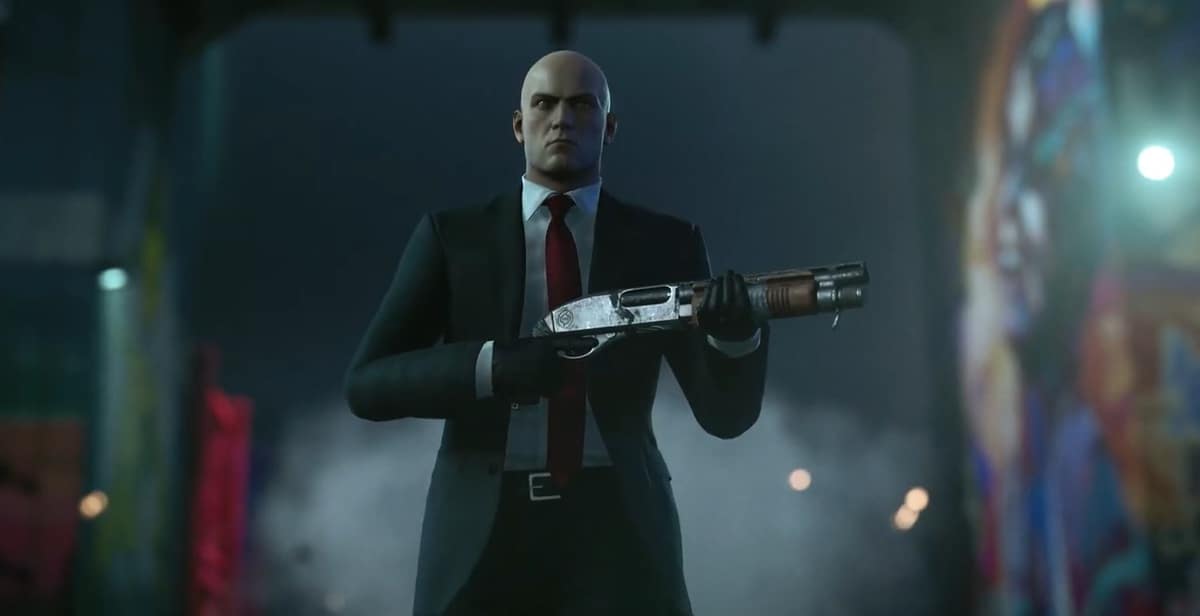
Your mission, should you choose to accept it, is to bring down the super-secret apparatus our bald-headed, barcoded protag, Agent 47, has spent an entire bloody career killing in the name of. It’s not crucial to have played the previous two entries in the series, but the campaign is well-written and well-acted, so you may want to go back and give the others a shot once you’ve cleared this one. Gameplay is essentially stealth-based, punctuated by moments of tense action, not unlike a good Bond or Bourne movie. Show up at a location, infiltrate, assassinate, get out. But the myriad ways to go about your grim work provide an impressive array of opportunities for fun and creativity. Sure, you can slink your way around, steal a disguise here, set up a killer trap there. Or you can be a bull in a China shop and bludgeon and murder your way to your targets. The choice as always is yours, but rest assured, you’ll never want for options.
Hitman 3 is a bit on the short side, with only six maps and therefore six overarching missions. But the replayability of the game is and should be a factor in your purchasing decision. Are you the sort to want to play huge missions again and again to get all the bloody nuance? Or is once and done enough for you? Developer IO Interactive is now working on a hotly anticipated 007 game, so you might want to get in your covert murder and espionage practice while you can.
The most accurate thing to say about Hitman 3 in relation to its predecessors is that its scope and scale are a tad more robust. Yes, only six maps, but those six maps are gorgeous, huge, and contain so many fun secrets and hidden nooks and crannies you’re crazy if you’re not at least a little bit interested in diving back in after you’ve finished the campaign. Sometimes boneheaded AI and the intense and frequent need to save your game make it feel old-fashioned, but the more time you spend with Hitman 3 the more you realize just how sophisticated it is.
It’s not what you do, it’s the way you do it, your ability to bring down mega-baddies with style and finesse. The game rewards you for not being seen, setting up kills in advance, clearing stages quickly, and so on. Very rarely does Hitman 3 hold your hand. Its main interest is in providing you a worthy sandbox, and it does so with flash and ingenuity.
I must admit that after early experiences with the Hitman franchise when I was a young adult, I haven’t been all that excited to play a new one in quite some time. I’m terrible when it comes to stealth gameplay. Really, just awful at it. Give me a machine gun and an open field to mow down any day. But Hitman 3 has made me rethink its prominence in the popular gaming imagination. It can be so rewarding to sit on top of a target for five or ten minutes, shadowing them like a pro, waiting for the perfect time to strike. Similarly, discovering alternate paths to my objectives, appropriating disguises and equipment, scaling walls and being an unseen agent of chaos, it all makes for an engrossing ride, one for which I’m glad I paid full admission.
This is a game for the meticulous, the completionists among us, and it’s incredibly rewarding on those levels. New players may find it tricky and challenging at first, but patience is a virtue. And so is a good garrot wire. Can’t leave that behind.
Jeff’s Game Reviews gives it an Eight out of Ten.
Jeff Bowles is a science fiction and horror writer from the mountains of Colorado. The best of his outrageous and imaginative work can be found in God’s Body: Book One – The Fall, Godling and Other Paint Stories, Fear and Loathing in Las Cruces, and Brave New Multiverse. He has published work in magazines and anthologies like PodCastle, Tales from the Canyons of the Damned, the Threepenny Review, and Dark Moon Digest. Jeff earned his Master of Fine Arts degree in creative writing at Western State Colorado University. He currently lives in the high-altitude Pikes Peak region, where he dreams strange dreams and spends far too much time under the stars. Jeff’s new novel, Love/Madness/Demon, is available on Amazon now!
Check out Jeff Bowles Central on YouTube – Movies – Video Games – Music – So Much More!
Share this:

Craft and Practice with Jeff Bowles – A Matter of Time
Posted: January 20, 2021 Filed under: Commentary, Craft and Practice, Writing, Writing Life, Writing Tips | Tags: Craft and Practice, Jeff Bowles, Writing, writing advice, Writing Life, Writing Tips, Writing to be Read Leave a commentEach month, writer Jeff Bowles offers practical tips for improving, sharpening, and selling your writing. Welcome to your monthly discussion on Craft and Practice.
I’d like to tell you there’s a magic bullet for the writer’s life, that one tip or trick or another will make you successful, skilled, well-known, or whatever else you’re looking for on your individual journey. If that were the case, we’d all be bestsellers and poet laureates, and yet somewhat mystifyingly so…
Why do some people strike out while others hit it big? Why does it seem like so many have to struggle more, or fail more, or publish less? I wish I knew. Then again, I wish it weren’t such a big deal. After all, personal dreams are a wonderful thing, but they don’t often hold up against cold hard reality. That the two sometimes become the same thing is an obvious miracle, but let’s not belabor the point. If you were here for mysticism instead of writing advice, I’d tell you to buy a good quartz crystal and an all-seeing eye pendant. The trick this month, the tip I’m offering, is simply to say that in most scenarios you’ll encounter in your creative career, patience will be a virtue. Because time is always the overriding factor. Always. And time can be a fickle thing.
Sometimes it looks like the long wait from a submission to an acceptance. Or even a rejection to a rewrite. It can also appear as years of struggle to produce a single wonderful piece of writing. If you’ve ever read an advice column that promised the moon, you know how disappointing and damaging unrealistic expectations can be. No matter what your goals are, sometimes accomplishment boils down to luck. That’s simply the nature of the beast. And luck doesn’t often spread evenly, as I’m sure you’ve discovered in your own life.
Then again, sometimes it’s all about the hard work, the sleepless nights. There are very, very few overnight sensations. I’ve seen individual writing dreams come true, up close and personal, and it only ever seems to occur after years and years of battling it out in the trenches. You can look at it in terms of struggle and strife, or you can adopt a more holistic point of view. What I’m suggesting here today is that the prime factor of your eventual success is a matter of time. That’s all.
Time.
Because no amount of talent, drive, dedication, or luck will ever disqualify or surmount one very important point: you have to get from here to there, from A to B. I think it’s important to have goals, especially when you’re just starting out, but you may realize at some point you don’t have as much control of the universe as you thought you did.
There will be periods of droughts and downpours, of veritable writing gluts and creative starvation. And what can you do about it? If you make enough professional allies and friends, you’ll most likely notice that some of them succeed more readily than others. Most people don’t have such fragile egos they can’t stand to see contemporaries and comrades doing better than them. Then again, we writers can be a sensitive and touchy bunch, and truly, it can hurt to watch other people get the things we want. I guess the real question is how much pleasure can we derive from work that doesn’t seem to be getting us anywhere. Placing no focus whatsoever on its perceived relative quality. How much do we enjoy doing what we do?
Because I urge you to enjoy it more. Perhaps easier said than done, but there’s great pleasure to be found in the moment-to-moment, the day-to-day. I want you to write like only you can write because only you can write that way. Make sense? I want to hear your individual voice, and I want you to recognize it deserves to be heard.
Time can be your friend as easily as it can be your enemy. I suppose what I’d really like to do is walk up to the next struggling, frustrated writer I see and tap them on the head, ask her or him what the big deal is. Don’t you know your success is only a matter of time? Because that’s the truth, isn’t it? Don’t worry so much about what will or won’t happen. Worry about this scene you’re writing, that sentence you’re tweaking. In other words, focus on what you can control and disregard the rest. Don’t sweat it, because honestly, what’s there to sweat?
The simplicity of my message might offend this writer, because how can I say their success is a matter of time when nothing good or great has happened for them yet? How can I be so casual about the fact they haven’t proved themselves? Writers love to prove themselves. I might direct them to the precepts of Quantum Law, which stipulate that while there is only one you in the here and now, the future holds limitless possibilities for who you’ll become and what you’ll do next. Playing with pretty big odds, actually. Forces quite beyond your ken. Keep your nose to the grindstone, work when you can work, play when it feels right to play, and try to develop a little bit of trust, a little faith in the process and in your ability to do what’s right for you, to be at the right place when and only when it’s the right time.
Cliché and sound advice seem like the same thing sometimes, so don’t fret when I indulge in a certain truism: it’s not about the destination, it’s about the journey. Fact is fact, my friends. It’s all just a matter of time. I’ll see you next month in Craft and Practice.
Jeff Bowles is a science fiction and horror writer from the mountains of Colorado. The best of his outrageous and imaginative work can be found in God’s Body: Book One – The Fall, Godling and Other Paint Stories, Fear and Loathing in Las Cruces, and Brave New Multiverse. He has published work in magazines and anthologies like PodCastle, Tales from the Canyons of the Damned, the Threepenny Review, and Dark Moon Digest. Jeff earned his Master of Fine Arts degree in creative writing at Western State Colorado University. He currently lives in the high-altitude Pikes Peak region, where he dreams strange dreams and spends far too much time under the stars. Jeff’s new novel, Love/Madness/Demon, is available on Amazon now!
Check out Jeff Bowles Central on YouTube – Movies – Video Games – Music – So Much More!
Want to be sure not to miss any of Craft and Practice with Jeff Bowles segments? Subscribe to Writing to be Read for e-mail notifications whenever new content is posted or follow WtbR on WordPress




















Words to Live By – For Dora
Posted: April 21, 2021 | Author: Jeff Bowles | Filed under: Commentary, Editorial, Opinion, Words to Live By, Writing, Writing Life | Tags: Grief, Jeff Bowles, Loss, Mourning, Words to Live By, Writing, Writing to be Read | 2 CommentsFor Dora
It’s been tough around the house this month. My mother-in-law passed away after a long battle with liver disease. She’d been having severe problems for months, but as my wife said a few nights ago, we always thought we had more time with her.
I haven’t felt like writing. Even typing up a blog post like this is draining. Writing is a bit of a safe haven for me. Easily tumbling down the rabbit hole, so to speak, laying aside my heartaches and disappointments, entering worlds of my own design, inhabiting people who don’t really exist.
Dora was a writer herself, and a voracious reader, too. I stayed with my wife and her family a lot in the days I was first starting to tinker with short stories. Because Dora was enthusiastic and willing, I often asked her to read my fist drafts. Her comments were always complimentary, because it wasn’t in her nature to poke holes in something her kids had poured their hearts and souls into.
Her kid, that’s what I was. The family has two daughters, and both were married within a year of each other. Dora never differentiated between the four of us, or at least, she tried her best not to. If everyone was gathering in the same place, it was about the kids and whether or not we’d eaten, her kids and how we were getting along in life, the importance of the kids’ enjoyment of holidays, birthdays, work promotions, collegiate successes.
I have no bad memories of her. Truly, anything contentious between us didn’t live long enough to become an issue. She was always patient and friendly with me. I loved reading her yearly Christmas poems, which she sent to the entire extended family. Never missed a year or an opportunity to fret over one or two words. I liked that about her, a certain willingness to own what she’d created. She never tried to publish anything professionally, but the rest of the family agrees she should have.
Marriage, as it turns out, can be one hell of a rollercoaster ride. My wife and I will be celebrating our twelfth anniversary in September. Most of our friends have been married a far shorter time, which means we can dispense wisdom without pretense. Our marriage has been anything but perfect. Thwarted expectations, mental health issues, a lost house, lost job, grad school, which was pretty tough for me, because I do tend to have a sensitive mindset, things can set me off easily.
I have guilt over whether Dora knew how much I appreciated her, because I doubt I ever communicated it properly. I know my wife and father-in-law are suffering, but the truth is they’re both stronger than I am. There’s been so much in the last year to cause us all grief and misery. No shame shaking your fist at the bumpy ride behind and ahead of us. There’s nowhere else for me to be, nothing else I’d rather be doing. Dora was a presence in this house, this family. She was a pillar, holding things up in that matronly way that looks easy but can’t possibly be effortless. Life will be different now. Better or worse, I don’t know, but different for sure.
I can help my wife by making calls, figuring out logistics, being a shoulder to cry on. I’m not perfect, but then neither was Dora. Sometimes I expect her still to be here, watching movies or making dinner, reading, chatting, clipping digital coupons. One of the last things she did for me was to read the first novel I self-published. She loved it, told my wife I was talented and that I was never to give up.
She would’ve said that regardless of whether she enjoyed reading it or not, but I believed her wholeheartedly anyway. That’s what she meant to me. I was proud to be one of her kids. I’m still proud.
I’ll see you next month in Words to Live By. In the meantime, give someone important a hug. If they’re not a hugger, hug them even harder. Tell them you have my permission.
Jeff Bowles is a science fiction and horror writer from the mountains of Colorado. The best of his outrageous and imaginative work can be found in God’s Body: Book One – The Fall, Godling and Other Paint Stories, Fear and Loathing in Las Cruces, and Brave New Multiverse. He has published work in magazines and anthologies like PodCastle, Tales from the Canyons of the Damned, the Threepenny Review, and Dark Moon Digest. Jeff earned his Master of Fine Arts degree in creative writing at Western State Colorado University. He currently lives in the high-altitude Pikes Peak region, where he dreams strange dreams and spends far too much time under the stars. Jeff’s new novel, Love/Madness/Demon, is available on Amazon now!
Check out Jeff Bowles Central on YouTube – Movies – Video Games – Music – So Much More!
Share this: