Weekly Writing Memo: Inciting your Story
Posted: July 6, 2016 Filed under: Uncategorized Leave a comment The inciting incident is the event in the story that causes the main conflict of your story to happen. Choosing the incident that starts your story is important because it is the foundation for all events that happen from that moment on. If you don’t write the inciting incident correctly, your story may not work or make sense. To know if your incident is working, ask yourself these questions:
Is it big enough?
The inciting incident has to be something big enough that it changes things for your character. It may seem small when it happens, but the event has to create a cascade of events for the rest of the story. Basically, the inciting incident is starting an avalanche, so it has to be powerful enough to get things moving.
An example of this which most people will know is in Lord of the Rings. The inciting incident for the trilogy can go all the way back to Bilbo Baggins finding the ring, or it could be considered to be when Bilbo leaves the ring to Frodo. It seems inconsequential, but it’s a major thing because of what the ring really is. Basically, because the ring is not just any ring, it’s THE ring, it’s a huge event that leads to the endless conflicts throughout the rest of the series.
Is it small enough?
While it’s important that the inciting incident is big enough that it can cause a huge series of events that will fill a story, it doesn’t need to be so big that it feels like the climax of the story. There are some stories that have huge inciting incidents, but the inciting incident should never be so big that it overshadows the rest of the story. There has to be somewhere for the story to build to. In most cases, the inciting incident is something small, that could almost seem inconsequential to the reader and the protagonist, but it has much bigger implications.
Returning to the Lord of the Rings example, when Bilbo leaves Frodo the ring it seems like such a small unimportant thing. It’s just a ring! But there is foreshadowing with the way characters interact with it that shows there could be something more about it.
Is it realistic?
Whatever your inciting incident is, it has to be something that is believable for your story. Being realistic and believable is, of course, subjective, but what matters is that it fits YOUR story. If the inciting incident doesn’t fit your world and your characters, it will feel like the author is forcing the story to go in the direction they want it to go; it’ll make the story feel unnatural.
If you worry about making something realistic, just remember that anything can be believable in a story if set up right. Sticking with the Lord of the Rings example, Bilbo finding the ring could be considered unbelievable, except that the ring is set up to have a sort of will of its own that makes people do things. This sets it up for every character who possesses the ring, or who is even in the same vicinity of it, to act in certain ways that can help move the plot forward. It works because it was set up that way from the beginning.
Does it matter?
The final thing to consider for your inciting incident, is whether it matters. If the inciting incident is something that changes nothing for your character, or the plot, then it is not really an inciting incident at all. As mentioned in the previous sections, it has to be something that is big enough to lead to future events. Beyond that, though, it has to be something that impacts the protagonist in a way that is significant enough to force them to act in some way. This is the incident that propels your protagonist to make some decision or change that leads them on the journey of the story. If the inciting incident isn’t something that does that, then it doesn’t matter to the story or the character and isn’t an inciting incident.
In Lord of the Rings, when Bilbo gives the ring to Frodo it matters immensely to Bilbo. He doesn’t want to give it up, and almost doesn’t. Frodo knows how much this ring means to Bilbo, so it matters greatly to Frodo when he is given it. He knows it’s something special, even if he doesn’t know what.
Final notes:
Whatever your inciting incident is for your story, as long as it fulfills the requirements above it should be a successful event to get your story started. The thing that matters most is that your event fits your story, and that it can be the first domino in a chain that causes future conflicts. Your entire story hinges on that first incident, so make sure it is solid before you get started writing or your entire story could falter.
Robin Conley offers great writing advice most Wednesdays on Writing to be Read. If you just can’t wait until next week to find out more, you can pop into her blog, Author the World, for more tips, or a weekly writing prompt.
Share this:

Weekly Writing Memo: Building a Story
Posted: June 29, 2016 Filed under: Fiction, Screenwriting, Stories, Uncategorized, Weekly Writing Memo, Writing, Writing Tips | Tags: Creative Fiction, Fiction, Writing, writing advice, Writing Process Leave a comment Stories are essentially a million little pieces intertwined in such a way that they relay a picture from the writer’s head into the mind of the reader. Specifically, every scene, and every story, is made up of a series of arcs (character arcs, plot arcs, genre arcs, etc) that combine to tell the story on various levels. In order for the arcs to work, they have to be carefully constructed and woven together so that they support each other and so the story forms a cohesive whole.
One of the most important parts of building a story is the construction. Each of the various arcs within the story have to start and end at the correct place, and have to be balanced with the other elements. If any arc or element is out of place, the entire story can falter or fail completely. There are dozens or more elements and arcs within a story to consider, but the main arcs I’m going to focus on are character, plot, and genre. These three are generally the core of every story, and if they’re right, the other elements are more likely to be right.
Character
The general rule in any story is that every character has to have an arc of their own, not just in the story as a whole, but in every single scene of the story. At the start of every scene, each character present should have two or more goals. The first goal is their overarching goal, and the second is their immediate goal. For example, in a scene where a man wants to get his daughter an ice cream, his first goal could be a larger goal that carries on throughout the story of trying to make his daughter happy, while his second goal is one that is the focus of the scene such as simply trying to buy an ice cream cone.
These goals are what drive each scene forward, and are what drive the character’s every action. A goal can change in the middle of the scene, but no matter what a character has to have a goal. The character arcs in every scene are generally caused by how they succeed or fail at achieving their goal. In the ice cream example, the character’s arc could be something like:
On the scene level: the character starts out hopeful that he will be able to buy the ice cream, he hits a peak in line when he is about to achieve his goal, but then when he gets to the front and finds out that they are out of the ice cream his daughter wants his hope disappears and he is in a much worse position than he started.
On the story level, this would be a minor arc in his larger development. This would be the arc where the father goes from trying to find his daughter’s happiness in material things to maybe looking deeper to find something more that can truly make her happy. The scene won’t resolve the problem, but it would be the first step of the father solving the problem and help him head toward the path where he will find the solution.
As shown above, by looking at and understanding the goals you can find the character’s arc of emotional and mental development in every scene, and in the story as a whole.
Plot
Each goal itself should be a part of the plot, and should have some form of arc as well. Some goals, like the larger story goals, will be made up of a bunch of mini-arcs, while the minor goals will just have a minor arc of their own. The goals make up the plot because they are what drive the action and create conflict within the story. They’re what the character wants and is constantly stopped from getting one way or another.
For each goal, there should be an arc of how it develops and changes throughout each scene and the story. Goals in general will be made up of some mix of the basic format of: conception of goal, plan to achieve the goal, enacting the plan, and failure or success. The outcome either leads to a new goal, or a new plan to achieve the new goal. Each arc of the plot can lead to new plots and goals depending on whether the character is successful or not, and whether the success/failure of the goal leads to new problems or new goals.
For example, in the ice cream story, the dad doesn’t get the ice cream so it leads to a new goal and new problem for the plot. He either has to find somewhere else to get the ice cream his daughter desperately wants, or he has to find a new way to make her happy.
Genre
Many people don’t consider that there are genre arcs within stories, but in there are almost always some form of genre arcs that happen in genre stories. For example, most romance stories involve some form of meeting of the potential couple, a period of interactions between the couple culminating in some form of acknowledgement of feelings, the breaking point where they are thrown apart, and then the reunion. This varies, of course, depending on the different types of romance stories, but being aware of the genre arc and knowing how to use them can help you create a certain flow within your story that readers find natural. It can also help you make sure your plots are working well for the genre you are using.
Even if you don’t go with a typical genre arc for your story, you should consider how the genre evolves throughout your story. For example, in horror there should be a general increase in the horror as the story develops, culminating in the final climactic moment toward the end of your story. If you don’t have an arc of the horror elements as well as the character and plot elements, then the horror part of your story could fall flat. So always consider the genre you are writing in, and think of how that influences your plot and character.
Whatever you are writing, there are many levels of story you are telling and each element should really have an arc of its own, even if it’s a minor one. Some arcs may not be super important or even that interesting, but it’s how they fit in with the other larger and more important elements that matter. Each element should be supporting the larger story as a whole. If you find a part of your story that isn’t doing its part to support the story, remove it. You’re building something where every part needs to do its job, so make every element count.
Robin Conley offers great writing advice most Wednesdays on Writing to be Read. If you just can’t wait until next week to find out more, you can pop into her blog, Author the World, for more tips, or a weekly writing prompt.
Share this:

Weekly Writing Memo: Where’s the Story?
Posted: June 22, 2016 Filed under: Uncategorized Leave a comment As I’ve touched on in previous posts both here and on Author the World, the setting you choose for your story can be pivotal to your story’s success. The setting of a story can have just as much impact on character and plot as an antagonist could, so it’s incredibly important to think carefully about where you set your story. The three biggest ways the setting can influence the story is through tone, character, and plot.
Tone
The tone of your story can help tell your audience how to interpret everything that happens. If your narrator has a flippant tone to how they tell the story, it can tell audiences not to take things too seriously. If the narrator has a serious, dark voice, it can tell audiences that the story will be dark. The setting is a major part of declaring the tone. Think of any story, movie or book, whichever comes to mind. Where is it set? What if you set it somewhere completely opposite? How would the story change?
A great example of this is the TV show Burn Notice. I heard somewhere that the original script had the show set in a city like Chicago (I can’t remember if this is the right city, but at the very least, it was similar to Chicago in tone). Imagine how that setting would change the story compared to where it actually was set, Miami. First off, visually it would be very different. Instead of the bright sunshine and beautiful beaches, you’d get the cold concrete and grayer tones that Chicago has to offer. Instead of brightly dressed citizens in sundresses and bikinis and laid-back suits, you’d get city folk bundled up against strong winds and even snow now and then.
The story taking place in such a bright sunshiny place creates a contrast between the serious spy drama with the laid-back atmosphere. It makes things more humorous, and allows the story to have some brightness in what is really a dark story if you think about it. If the story was set in Chicago as originally planned, then not only would the drama be more serious because the setting would be more serious, but the overall appearance of the show would be more serious.
Character
Setting is not only important for tone, but for character as well. If your character is a hardened detective in a small town, he’s going to be out of place and his tactics might not work. Of course, if that’s the point then that is a perfect set-up. If you want your detective to fit in, though, then you might reconsider where you place him. The setting has to highlight something about your character. Does it show how perfectly your character can navigate their world, or does it show how out of place they are? Whatever it is, make sure you’ve thought it through.
The other thing to consider is how the setting helps create your character into who they are. If this is a setting that your character has lived in for a while, then it will have an impact on their personality and past. If this is a setting they are new to, then remember to show how the setting your character has come from contrasts to the setting they are in now.
Plot
One of the final things to consider when choosing a setting is the plot. How does the setting you choose affect the plot? If you are writing a big spy thriller but you set it in a small town, it’s going to be hard to have the kind of espionage needed to really make a spy thriller succeed unless that small town has some sort of national secret to it. Similarly, if you’re looking for a big chase scenes with lots of chaos and people, you’re going to be hard pressed to find the right setting for it in a small town setting.
When choosing where to set your story ask yourself a few questions. What kind of people does this setting allow my protagonist to interact with? What kind of conflicts are inherent to this setting? What kinds of locations does this setting provide for me to work with? These three questions are all vital things to consider when choosing a location, so make sure to consider them carefully.
Final Notes
Ultimately, wherever you set your story will influence every other part of your story. If you’re ever doubting a choice, or if you want to check if your choice is a good one, try asking yourself what your story will look like if you set it in the complete opposite location. If your story doesn’t work at all in this location, then your original location is probably best. If the opposite location does work, then compare the two and see which one works better overall. Sometimes there will be more than one optimal setting for a story, but the important thing is that you’ve considered your options, and that you’ve chosen your setting carefully and with deliberate purpose.
Robin Conley offers great writing advice most Wednesdays on Writing to be Read. If you just can’t wait until next week to find out more, you can pop into her blog, Author the World, for more tips, or a weekly writing prompt.
Share this:

Writing Horror is Scary Business
Posted: June 20, 2016 Filed under: Uncategorized 1 Comment
For my summer semester, which will complete my additional screenwriting emphasis for my M.F.A. in Creative Writing, it was left up to me to decide what project I would like to work on, either feature film or television series. Since it is my final semester and I’ve already written both, it’s kind of a “whatever you want to do next” scenario. I’ve written a spec television script, for The Odd Couple, created an original television series, Unhappily Ever After, and written the pilot episode for it, as well as written two full features, one action, Across the Border, and one bio-pic, Bonnie. I’ve tried my hand at writing comedy with the television scripts, and I’ve delved into a couple of different genres in film. Now, I want to try my hand at horror. I’ve loved horror films since I was a kid. This summer, I want to write a monster in the house that will keep viewers awake until the wee hours of the morning.
If you’re writing a comedy, you write jokes and hope somebody laughs at them. But, how does one write scary? I think it is as much of a challenge as trying to make people laugh. The movie was pretty lame, but if you’ve read the book, The Blair Witch Project, you know that the story is actually pretty scary. When I read it, it left me with an eerie feeling that brought it back to the forefront of my thoughts for several days after. They had a good story, but they didn’t do it justice on the screen. That’s when I started thinking about how I might write a screenplay that would leave viewers with that same eerie feeling.

Robin Conley, who shares writing tips here, in her “Weekly Writing Memo”, did a three post series on writing horror on her own blog, Author the World. In her first post, The 3 Acts of Horror Stories, she talks about introducing the monster, increasing the threat, and the final face-off. No matter what kind of horror story you are writing, there must be some kind of monster, even if it’s the human kind, or the spectral kind. The bigger and meaner and scarier the monster is, the greater the threat for the characters. I definitely want a monster that will keep the tension ratcheted up and keep viewers on the edge of their seats.
In his book, Save the Cat Goes to the Movies, Blake Snyder points out that our monsters must be “evil” and the more that is at stake for our characters the scarier the monster must be. He suggests, “This is also why the tiny spiders in Arachnophobia, or the ones that can be dispatched with a baseball bat in Signs or die of the sniffles in War of the Worlds, are so unsatisfying.”1 And, I must admit, he’ got a point. Although I have always had a fear of spiders, in Arachnophobia it’s hard to be too worried about the characters, because this is a monster which can be easily escaped. The characters could get up and leave, or just step on the damn spiders, or buy a can of Raid™, for heaven’s sake.

I will definitely make my monster bigger than a spider. My monster will be of the supernatural, other worldly type, because they leave more to the imagination. Supernatural monsters can appear in many different forms, so you have open possibilities for making them really scary.
In her second post on writing horror, 4 Elements of Horror, Robin talks about how setting, senses, contrast, and imagination are important elements in horror, making your scarier by increasing tension and creating anticipation. It’s easy to see how the setting affects tone and sets expectations. A graveyard is definitely a scarier setting than a botanical garden. Although you could make a botanical garden scary by placing scary stuff within, a graveyard comes scary and you don’t have to anything to create a scary atmosphere and tone.
Blake Synder says, “the more cramped the space – the more isolated our heroes – the better.”2 That’s what the term he coined for this type of movie, Monster in the House, is all about. The characters must be trapped with the monster in some defined space, be it a house, or an island, or an isolated cabin in the woods. In The Shining, it’s a secluded hotel. In Cabin in the Woods, it’s, you guessed it, a cabin in the woods. In The Texas Chainsaw Massacre, it’s an area surrounding the house and extends to include the whole town. Going back to the example of Arachnophobia, if the characters can just get up and walk away from the monster, there isn’t much of a challenge.
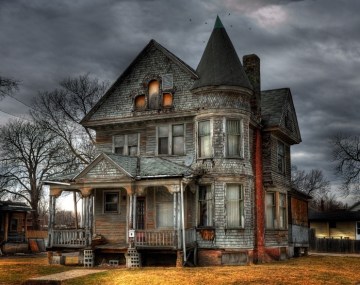
One of the scariest movies to me, when I was young, was Legend of Hill House, and later there was Amityville Horror and Rose Red. To me these were even scarier than the slasher movies, like Halloween or Scream. Since my monster is of the supernatural kind, it seems only natural that my setting would be a haunted house. In haunted house movies, the setting becomes a character, in fact it becomes your antagonist. It’s not easy to battle against a house, or a ghost in a house for that matter.
Robin also mentions using the senses to create tension. Screenwriting is a visual medium, and certainly characters can see things which are scary, but you can also use other senses to your advantage. It’s not hard to see how scary sounds could be worked in to your story, but there are also ways to work in the other senses, and is a good trick if you can pull it off. Obviously, you cannot make the audience smell the scent of freshly dug earth, but you can have a character comment on the odor and, thus clue the viewers into the fact that such a smell is present. Ditto with the sense of touch. If you are clever, there are ways to do this.
This will come in handy for me, because spectral monsters may not always be visible, but their presence can often be detected by a smell or odor that accompanies them. If you’ve ever walked through a room and detected the faint odor of perfume or pipe tobacco for just a moment, and then it was gone, you’ll know what I’m talking about. It’s as if someone just walked through the room, but when no one did, it’s kind of creepy. Feelings, such as chills or cold spots in a room are also known to often accompany specters.
Robin talks about balancing the horror elements, presentation and the stakes, in her third post, 3 More Elements of Horror. Not only do you need to have all the elements Robin mentions in her posts in a horror story, but you need to present them in a way that will give the audience the urge to hide their eyes, yet be unable to resist peeking through their fingers because even though it’s scary, they need to see what happens.
This is accomplished, I think, by having the right combination of horror elements and lulls in the storm, and by starting out small and building the tension and increasing the stakes in increments. At first, your characters may not take the threat seriously, but as more and more things happen and the severity of each event increases methodically, it forces them to eventually admit that something is amiss. You can even throw in some false alarms in the beginning to make it feel like there’s danger before there really is, but be cautious with this one. You want to build tension, but too many disappointments may cause viewers to lose interest before the real fun begins.

In her first post, Robin talks about having a death in the first act, perhaps as a catalyst to send your hero on his journey into the second act, where his normal life will be turned upside-down. She mentions that you want to do this in screenplays where the monster is of the serial killer kind and the threat needs to be established right up front, but I feel this puts the writer at a disadvantage, because there’s no bigger threat to build up to. Maybe this is an advantage of the supernatural monsters. There are so many little things you can do to build up tension and increase the threat little by little.
Blake Snyder also says that there must be some kind of sin, committed by at least one of the characters, which brings the monster down upon them. In a lot of horror movies, it is greed, a lust for money, which prompts them to go where they don’t belong or awakens the monster. In Friday the 13th, it is sex. The councilors were off doing the wild thing when Jason drowned, and the new councilors’ presence arouse his mother’s anger just by being at the camp. In Witchboard, the characters play around with the Ouija board and summon the monster, and in Nightmare on Elm Street, the kids get to pay for the sins of their parents. I plan to fall back on the good old dependable sins, greed and ambition, for my screenplay.
I don’t think you need a lot of blood and violence for a movie to be scary. I believe that if I play on the primal fears of my viewers, I can make a movie so scary, they’ll be wetting their pants. But I guess I won’t know until I write the darn thing, so I’d better get to work, and we’ll see if I can succeed in my goal to make a good old fashioned scary movie for modern times.
- Save the Cat Goes to the Movies. Synder, Blake. McNaughton & Gunn, Inc. 2007. p. 3
2. Save the Cat Goes to the Movies. Synder, Blake. McNaughton & Gunn, Inc. 2007. p. 3
Like this post? Subscribe to Writing to be Read for e-mail notifications whenever new content is posted.
Share this:

Batman V. Superman: Dawn of Exposition
Posted: June 17, 2016 Filed under: Uncategorized Leave a commentI know at this point a lot has been said about the movie Batman vs. Superman: Dawn of Justice, but as a writer I thought it might be interesting to look at some of the story issues I felt were a problem within the film. The three largest issues in the film, in my opinion, was the exposition, the protagonist/antagonist confusion, and the some of the transitions.
I shouldn’t really have to say this, but SPOILERS BELOW…
Exposition
This movie had an uphill battle as far as trimming exposition from the very start because there was a lot that needed to be set-up. They had to set up Batman’s new past, his vendetta against Superman, Superman’s hero worship in the public, Lex Luthor’s role in the world, Wonder Woman’s presence, and a ton of other minor elements as well. Almost all of these really big elements deserved a proper set up because they are major story parts that will potentially carry over into future stories, however, setting them up in one movie led to a very long build up in the film before the action started. The long exposition and set up in the film makes the story drag and hard to stay involved, no matter how many interesting elements there are.
Protagonist/Antagonist Confusion
Many stories have multiple protagonists without there being any sort of problem, but in this story the protagonists, and antagonists for that matter, are warring for the focus. Batman is originally set up as the protagonist of the film, with Superman as his antagonist. Then it switches to Superman as the protagonist with Batman as his antagonist. That wouldn’t be such a problem, except there is a bigger antagonist in the film – Lex Luthor.
So much focus is on Batman and Superman being at odds, that Lex Luthor’s plot line is shafted somewhat and pushed until later in the film. There are elements early on, of course, but the Lex Luthor plot feels week because he gets so little attention. He is also painted as the minor threat in a lot of ways, because both of the protagonists don’t even see him as a threat until very late in the film. If Lex’s plotline had been worked into the story a bit earlier, so his plan was clearer earlier (at least to the audience) then I think it would have helped balance out the conflicting antagonists. Audiences know who Lex is, most likely, so they know he’s the villain, but if he had been more involved in the feud between Batman and Superman, instead of just an opportunist about it, then it would have helped strengthened his plotline.
Transitions
The jumps back and forth between Batman and Superman’s plotlines were some of the main rough transitions in the film, however the ones where Bruce is getting a vision of some sort are the ones that really don’t work for me. Things transition into these visions and then it throws the viewer off balance as they try to figure out what is going on. It’s only clear once we come out that we’re in a vision or dream of some sort, but even then it’s not really explained. If you know some of the comic lore then you might understand what is happening, but without it there isn’t enough to set up the visions to explain why they’re happening, or what they mean. Which is really a shame.
Overall, the film is not a terrible one. There are a lot of great moments, and acting, and I’m excited to see what future films come from this. If the exposition had been more balanced and condensed in the beginning, and if Lex Luthor’s role had been better intertwined, I really think I would have loved this one. As it stands, though, I think it’s one I won’t watch again until I’m feeling like a Superhero marathon.
Share this:

Weekly Writing Memo: Going Through the Motions
Posted: June 15, 2016 Filed under: Fiction, Screenwriting, Uncategorized, Weekly Writing Memo, Writing, Writing Tips | Tags: Creative Fiction, creative process, Writing, writing advice, Writing Process 1 Comment Lately I’ve been coming across a lot of writing where the emotional connection has been lacking. If your audience isn’t invested or connecting with your story somehow, they will not want to stick around to finish it. There are a lot of ways your writing could lack an emotional connection, but the main one I find is when your characters or your plot aren’t ringing true to the audience. When it feels like the characters are just going through the motions of the story, rather than really living and breathing the story, then it starts to feel false. So how do you keep it feeling realistic so your audience is emotionally invested?
Actions and Words
One of the most important elements in a story to help it feel realistic is that your characters dialogue and their actions match up. To do this, make sure your character is behaving in a way that goes with their attitude and dialogue. If your character is angry, and is yelling, don’t have their body language be weak and cowering. If your character is shy and afraid, don’t have them adopting a dominant posture. These things are minor touches in your writing, but if your characters’ words aren’t backed up by their actions and body language, then their words won’t ring true and will make the audience feel as if something is off, even if they can’t put into words what exactly it is.
The exception, of course, is if the character is someone who says one thing and does another, or if your character is purposely behaving in a contradictory way because of anxiety, fear, or ulterior motives. In those cases, you still have to be consistent with that character and continue that behavior throughout the story. If they act irrationally when they’re afraid, then show the audience that and make them behave that way every time. If they are a perpetual liar, or manipulator, then again show that and make sure the audience understands the contradictions.
Sincerity
The second element that helps make your audience emotionally connect is to feel like your characters are behaving sincerely. I don’t mean they have to be telling the truth all the time or behaving kindly, they just have to be behaving true to who they (the characters) are. If a character isn’t behaving the way they would in reality, then the audience will pick up on that and feel like they’re being lied to and not connect with the story.
This comes down to one thing – you want your characters to be people, not actors. If it feels like they’re actors pretending to be someone, then it will create an unnecessary barrier between the story and your audience. You want your characters to always be themselves, and to behave in accordance to how they would naturally behave unless there is a significant reason for them not to.
Others
A lot of people think that the only characters the above stuff matters for is for the main characters, and maybe the secondary or even tertiary characters, but it’s more than that. Every single character in your story matters, and every single character should have a motive for their behavior that they drives their behavior. Without this, minor characters in stories will feel like placeholders and even disrupt the story.
If you have a ton of minor characters who just pass through the story without distinguishing them by giving them their motivations, it’ll be like placing a color photo on all gray background. While that can be pretty and help make the main photo pop, it’ll make the background uninteresting.
In a story, this kind of thing makes the story as a whole suffer because your character is living in this world, and if the world is boring and uninteresting, or unrealistic, then it’ll start to affect the main character. If you give your minor characters one thing, give them a motivation for being in the scene and every action they take. As long as they are clearly motivated, and stick true to these motivations, they’ll help give the scene more purpose and make the story more dynamic, which means it’ll be easier for your audience to get invested.
Share this:

Writing Comedy for the Screen is a Risky Proposition
Posted: June 13, 2016 Filed under: Uncategorized 1 Comment
You read that headline right. Writing comedy for the screen is a scary business in this day and age, when every time you open your mouth, or your characters’ mouths, you risk offending someone, somewhere. Seriously.
Last semester, for my original pilot series, I created a series that takes place in a backwards fairytale land, where the fairytales are all wrong, called Unhappily Ever After. My main character, Cassandra, who is stuck there, tries to fix the fairytales in hopes that by doing so, she will find a way to get home. In my pitch, I listed ideas for several more episodes to show my idea could be sustained for thirteen episodes, or at least one season. In the notes my instructor sent back, he pointed out that I could be in trouble with my idea for my second episode, where one of the things that must be fixed is that a prince falls for Cass’s geeky sidekick and she has to find a way to make him fall in love with his princess, so the story can end with its happily ever after.
My instructor felt that I would be portraying a gay relationship as something that “needed fixing”, and that it might be offensive, although it would be clear that the reason it was “wrong” in the episode wasn’t that they were gay or bi, but that the prince and princess must marry, because that’s the way the fairytale goes. It’s funny, but it’s not intended to make fun of gays, or saying anything negative about being gay.
The episode ideas I listed flowed from one episode to the next and this second episode was designed to follow off the story line from the pilot episode, picking up right where we left off the week before, and the third episode would pick up from the second episode. To change that one idea would be to change the entire series story line, and I didn’t want to change it. My response to him was that no matter what you say these days, someone will be offended.
And I meant it. It’s true.
Not long after that, I saw a t-shirt advertised on Facebook that said, “You find it offensive, but I just think it’s funny”, and I realized that shirt summarizes the whole problem. I grew up with blonde jokes, and I loved them. Does that mean I believe the stereotype about blondes being lower on the IQ? No. I like blonde jokes because I find them to be funny. Now days if I tell a blonde joke, it’s almost certain that somewhere out there, there will be a blonde who will be offended, and then watch out. And half of those who are offended are likely to be bleached blonde, but they’ll identify as blonde and be offended, just the same.
In the past, bigoted characters like Archie Bunker endured because he was funny. You didn’t have to agree with his character to laugh at his jokes. Archie’s humor may even have helped to break down many stereotypes and biased thinking, because the Archie Bunker character was so extreme, that the ridiculousness of the opinions he expressed was apparent. Today, they broadcast things on television that would make my grandparents cringe, but when it comes to humor, you have to walk a thin line, for fear of being offensive.
In Hollywood, we’re hearing cries for more diversity in the industry, but as a writer, I hesitate to create a diverse character, for fear that when I reference them, it will be politically incorrect, especially when the politically correct terms change from day to day. When I was growing up, those with darker coloring were called Negros. In my twenties, the term to use was black. Now, I think it’s African American, but it may have changed again and I just haven’t got the memo. I’ve never been much for political correctness anyway. Anyone who knows me will tell you that I’ve always been a bit of a rebel. According to my instructor, that needs to change or I won’t sell my script. The studios may not be willing to take a chance on something that might be offensive.
My point is that, no matter what term I use or how I portray my character, there’s no offense meant. It may be easier to write comedy for a stand-up routine than it is to write comedy for television, because stand-up comedians can poke fun at themselves and that’s okay. Nobody will be offended if a Jewish guy gets up on stage and jokes about what it was like to grow up in a Jewish household, or a Latino woman pokes fun at the Cinco de Mayo festival. If I go by that rule, I can only poke fun at poor white trash and starving artists.
The thing about writing for television though, is the audience can’t tell if the writer of the low rider joke is Latino, and therefore immune to public scrutiny. Where I might use it to my advantage is in writing diverse characters. When the Asian characters of Fresh Off the Boat fun at Asian culture, or the African American characters of Black-ish joke about being “brothers”, no one gets offended. It’s okay for Max and Caroline to make jokes about the female anatomy because they’re female, even though the persons writing the jokes may not be. We don’t see the writers, so it doesn’t matter. The humor is funny, so we give ourselves permission to laugh. The characters are joking about themselves, so it’s okay.
It seems to me the basic problem here, is we, as a society have become so over-sensitive about stereotypes, that we are now limited as to what it is acceptable to laugh at. For a culture that prides ourselves with open mindedness and acceptance of other cultures, it seems to me that we’re pretty uptight. In order to embrace our differences, don’t we have to be able to laugh at them, and ourselves?
I think, as writers, we have to realize something. No matter what you write or what your characters say, somebody somewhere is going to be offended. Unfortunately, the people in the business who make the decisions about which shows get made and which don’t need to realize this, too. Right now, they are all so afraid of offending, that they may be passing up shows, like mine, which may be genuinely funny. As a society, we need to lighten up and give ourselves permission to laugh again, at ourselves and at each other. We need to get our collective sense of humor back.
Share this:

Weekly Writing Memo: Parts of a Scene
Posted: June 8, 2016 Filed under: Fiction, Screenwriting, Uncategorized, Weekly Writing Memo, Writing, Writing Tips | Tags: Creative Fiction, Fiction, Screenwriting, Writing, writing advice, Writing Process Leave a comment Whether you’re writing a novel or a screenplay, you are going to be writing scenes for your story. The breakdown of a scene for each is essentially the same, and requires that three things happen.
The Setting
The first thing that has to be established in almost any scene is where it is taking place. Sometimes this can be as simple as establishing that it’s a mysterious unknown place, that’s fine, but some form of setting has to be established. Showing the setting helps ground the audience and helps them visualize what is happening.
To do this in a screenplay, you use the scene heading and then give a brief description of the location in a line or two. Find a succinct way to set the tone and layout of the scene without giving long descriptions. Also, make sure to mention any elements of the setting that are vital to the action of the scene. Don’t wait to mention there is a newspaper on a chair if a few lines down that newspaper is going to be used to slap someone!
This is true for fiction as well. It’s best to set up details that will come into play early on so that way when they are used, the audience feels they have been established instead of feeling like they were just thrown in when the writer needed them. Unlike in screenplays, fiction can let the setting unfold a little more naturally as the character interacts with it. You’ll still want to mention key elements as soon as you can for the best effect, but you can let some details come out more fluidly as the scene develops.
The Character
The second thing to establish in any scene is who the scene is about, and who the protagonist and antagonist of the scene is. In every scene there is one of each, even if one is an inanimate object or something. Every scene is driven forward by a character wanting something, and whatever is getting in the character’s way at that moment is the antagonist for the scene. There can also be an antagonist that is not present in the scene as well, but do consider who the antagonist within the scene is.
You’ll also want to find a way to introduce other characters that are present for the scene as early as possible. If a character is in the room while something is happening, and the audience isn’t aware of it, it can be startling when that character finally “appears” to the audience. It can also change a scene completely. So make sure to find a way to introduce each character within a scene so the audience knows who the players are.
The Conflict
Every scene is about one thing – someone wants something, and something (or someone) is stopping them from getting it. If this isn’t happening in your scene, then your scene has no conflict or tension and really needs to be reconsidered unless you have strong motivations for it.
The other key thing to remember for every scene is that every single character in the scene has a want, and their behavior is going to be driven by whatever that want is. You want some of those character desires to conflict to create tension. If the conflicts are the same (like two characters want a sandwich) then find a way to make the wants conflicting. For example, maybe they both want a sandwich, but they want the other character to make it for them. Or they both want a sandwich, but there is only enough bread for one.
If you know what your characters want, then you know how they will behave in a scene. You also know what you need to keep them from getting it for as long as you naturally can within the scene. Don’t let them get what they want easily, unless what they want isn’t really what they need! If it isn’t what they need, then the moment they get what they want, it’ll create new conflict. The point of every scene is to create tension and conflict, and to drive the story forward.
Final Notes
The final thing to consider when writing a scene is that you don’t want to spend a lot of time in the beginning setting up what your character is doing or trying to achieve. If you find yourself doing this, try jumping forward in the scene and seeing how it reads without the introduction.
For example, if a neighbor wants to borrow a cup of sugar, but the other neighbor wants someone to talk to, try this: Instead of showing Person 1 knocking on the door, show them already in Person 2’s kitchen and show Person 2 blabbering on about some subject that Person 1 cares nothing about. Maybe show Person 1 with an empty measuring cup in their hand and have them eyeing the cupboard.
Doing that tells us everything we need to know without going through the motions of the knocking on the door and asking for the sugar. It jumps straight to the conflict. And you almost always want to cut to the conflict when you can do so without the story suffering.
Robin Conley offers great writing advice most Wednesdays on Writing to be Read. If you just can’t wait until next week to find out more, you can pop into her blog, Author the World, for more tips, or a weekly writing prompt.
Share this:

Weekly Writing Memo: The Query Letter
Posted: June 1, 2016 Filed under: Fiction, Uncategorized, Weekly Writing Memo, Writing, Writing Tips | Tags: Writing, writing advice, Writing Process 1 Comment A query letter to an agent or a publisher is one of the basic things you should be able to write if you want to be a writer. Sooner or later, if you want to go the traditional publishing route you will have to send a query letter out to get your writing read. So what goes in a query?
Salutation:
To start your query letter, you’ll want to address it to a specific person instead of using something generic. So find out the editor of the publishing companies name, or who reads the queries. If you’re sending it to an agent, make sure you know the agent’s name. You don’t want to use a generic greeting like “to whom it may concern” because you want to show the person you are sending it to that you’ve done your research about them, and that you’ve chosen them specifically for a reason. By addressing the letter to a specific person, you’re saying I want you specifically to read this because you specifically are right for my story, instead of implying that the letter could go to anyone.
Introduction:
The introduction paragraph of your letter needs to have a few specific details in it. First, it should say why you are writing the person. Are you seeking representation, or publication? Second, it should tell them what you are writing them about, specifically the name of your novel or piece you’re trying to sell, what genre it is in, and a general idea of the word count. Finally, the introduction paragraph should include a line or two summary or description of your novel that gives the general feel of the novel. This should be some sort of hook about your novel and doesn’t have to tell the whole story or anything. The point is to show the person reading the query what type of novel it is in as short a way as possible.
Synopsis:
The second paragraph of your query should be a brief summary of your novel. It doesn’t have to tell everything, but it should touch on who your protagonist is, who the villain is, and what the core conflicts of the novel are. You want it to sound as narrative as possible. I like to think of it as the paragraph that would go on the back of the book – it’s meant to get people to want to read your story. The point of this section of the query is to give the person reading it a taste of what your novel is about, and to get them interested enough to want to read more. So don’t give everything away, but do give them the important details if you can.
Bio:
The final paragraph of your letter should tell a bit about yourself. Specifically, mention your experience as a writer, any publication history, and if you’re seeking representation you should mention what other genres or projects you may be working in. This section shouldn’t be too long, as you just want to give the letter a sample about you. End this section with a final “thank you” to the person who is reading your letter, and maybe something about looking forward to hearing from them.
Sign-Off:
Finally, end your letter with some sort of sign off. Some people like the classic “sincerely”, others prefer to use something less formal such as “best” or “thank you.” Whatever you use, make sure to sign your name. You can also add your contact information below your name, and if you attached anything to the letter you should include the words “Encl.” and whatever is attached after. Such as: “Encl. First three pages and synopsis.” That way the receiver knows what is coming with the query.
Final Notes:
The best way to get good at writing queries is to look up examples online of successful queries, and to practice. There are a lot of examples out there if you look. Just remember, always read what the person you are querying wants you to send, and do everything you can to stick to those guidelines. Not sticking to the guidelines is a very quick way to get yourself rejected if the query reader isn’t feeling generous.
Share this:

A Writer’s Life is No Bowl of Cherries
Posted: May 30, 2016 Filed under: Uncategorized 3 Comments
So, you want to be a writer.
This is something I’ve aspired to for years. With the emergence of the Internet, things shifted radically, and today, there are more opportunities for writers than ever before and submitting your work is often as simple as a few keystrokes and an attachment. This is good for me, the aspiring writer, right? Well… maybe. The thing is, as I look around today, as I browse social media sights and check out Facebook groups, I find I’m not the only one trying to take advantage of all the new and emerging possibilities out there. Everybody andtheir brother seems to be calling themselves a writer and they’re all trying to take advantage of the numerous ways which are now available to get their words into print. After completing a M.F.A. program in Creative Writing and learning a few things about the business, I have to ask myself, why? Why does anyone want to be a writer? Why do I want to be a writer?
It certainly isn’t because I think I’m going to become rich and famous from the crafting of words. Only a select few ever become a household name from their books, and if there’s one thing I learned while going through my graduate coursework, it’s how the world of traditional publishing works. If I’m ever lucky enough to have a publisher pick up one of my books, I’d better hope for one that gives an advance, and many don’t, because unless my work goes viral and sells a million copies, that’s probably all the money I will ever see from it. What I didn’t realize before I got my graduate degree was how the system really works. With enough royalties, a person could theoretically, live comfortably for years to come, but what a lot of people don’t realize, what I didn’t realize, was that you don’t see any royalties from your book until you have sold enough copies to pay off whatever advance you receive. That means your book must do really, really well in order for you to see any profit. So, the chances of getting rich from your writing through traditional publishing avenues are quite slim.
With the emergence of the Internet came the self-publishing boom. It started with vanity presses and P.O.D. publishers, like Lulu, and progressed with the birth of the e-book through Amazon and Smashwords, to name only two of the many e-publishers out there today. Amazon makes self-publishing in electronic format look very tempting, offering a much higher percentage of royalties than traditional publishers. Surely, if you’re making 70% on every book you sell, you have to come out better than the minute percentages traditional publishers offer, right? Not necessarily. I’ve asked several of the independent authors who I know, and most are making very little off their books. You see, the book has to sell before you can make any money of it, and with the market swarming with new titles and more coming out every day, independent publishing is a tough road to take. Independent authors can’t rely on their publisher to promote their work and develop marketing strategies for their book, because they don’t have one. They are writer, publisher and agent for their work. They must fill all these roles themselves, and it is both difficult and time consuming work to get the word out about your book. Certainly for some it pays off, but the majority of independent authors are lucky to sell even twenty copies.
Of course, part of the appeal of being a writer is the idea of being your own boss, making your own schedule, working from home in your pajamas if you choose. But, I believe most writers today, whether traditionally or independently published, live the life of the starving artist, scrambling for work, or for a publisher, or for an agent to get them a publisher. I certainly am. I try and try, shrugging off one rejection letter, or e-mail, after another, always holding out hope that the next one I open will be an acceptance. Occasionally, my perseverance pays off and I do get something published, an article or short story, or maybe a poem. But I still have to ask myself why I endeavor to persevere if not for the money?
I think many of us who strive to become writers do so because there exists a creative force within us that needs to be expressed, a story that must be told. We are creatives, and when an idea or image takes hold of us, there is no pushing it to the side until we pound it out on our keyboards, or scribble it out on a notepad, or a napkin, or whatever is at hand. The urge to create is a part of who we are. It’s as much a part of our beings as are our preferences in music or favorite foods. And a large part of the appeal of being a writer is the desire to share our creations with others. Why else would we keep pounding away at our keyboards, submitting our work in the face of repeated rejections, and laying our souls on the line?
I’m not saying it isn’t possible to make a living from your writing. Certainly there are authors out there who do. But, it isn’t the stereotypical write in your p.j.s, make your own schedule, and party until the early morning hours that we may have come to believe a writer’s life is. No, my friends. It is hard work. It is writing until you can’t see the words on the page, hustling to meet deadlines, selling yourself and your work at every opportunity, continuing to submit in the face of rejection, and searching your soul to make every word you put on the page ring true. That’s the life of a writer, and it’s no bowl of cherries, but it’s what we want more than anything, because the words must flow out of us onto the page. I say that’s why we write. What about you? Why do you write?
Like this post? Subscribe to Writing to be Read for e-mail notifications whenever new content is posted.