What’s a Nice Girl Like Me Doing Writing in a Genre Like This?
Posted: July 11, 2016 Filed under: Books, Fiction, Stories, Western, Writing | Tags: Delilah, I Had to Do It, Kaye Lynne Booth, Western, Writing 2 Comments
I recently sold I Had to Do It, a flash fiction story of the western flavor, to Zetetic: A Record of Unusual Inquiry. And of course, my regular readers know I’ve written a western novel, Delilah, as well, for which I’m diligently seeking a publisher at present. It might seem that I am leaning toward becoming a western writer, and I’ll admit, I do enjoy writing western.
But I’m an eclectic kind of gal by nature. My palate savors many cuisines, although I’m partial to Oriental and Latino foods. I listen to various genres of music, being heavy on the rock, but also enjoying metal, hip hop, country, pop, and even classical. I watch a wide range of movie genres, as well. On that same note, I read most of the genres, and seek opportunities to try genres that are new to me, but horror has always been my favorite. In fact, in 2012, when I began my M.F.A. in Creative Writing program at Western State Colorado University, western was one of the few genres which I hadn’t read.
In that first class, the first thing my instructor asked was, “In what genre do you usually write?” I considered the short stories I had written to date, many of which, I wasn’t sure what genre they fell into. The only experience I’d had with western was 850 words worth, I Had to Do It, and it hadn’t sold. But the idea was for us to write outside of our comfort zones, and western was the genre I was assigned for my first excerpt.
I’m not sure why I didn’t think I would like writing westerns. I’m a native of Colorado and proud of that, but I’ve never been a cowgirl per se. I enjoy western films. Clint Eastwood spaghetti westerns are the best, but Butch Cassidy and the Sundance Kid, and The Quick and the Dead are right up there, too. But as I said, I hadn’t really read much in the western genre. But then, I wrote the excerpt for Delilah. After that first semester, revising my excerpt according to the feedback from my instructor and my cohorts, I started thinking that I might not be too bad at writing in the western genre. Three years and several rewrites later, Delilah is a story I’m rather proud of. The rejections do sting a bit, but I’m confident that if I endeavor to persevere and keep submitting it, eventually it will land with the right publisher, and it will be accepted. And if not, well, there’s always independent publishing. Delilah is a good story, and it’s well written, and I want very much to be able to share it with the world. One way or another, I will get the book published.
And yes, there will probably be other westerns in my future. I seem to have a knack for it, at least, so I’ve been told. I already have an idea for a western romance, although romance is another genre I never thought I’d find myself writing. I guess we’ll see.
Like this post? Subscribe to Writing to be Read for e-mail notifications whenever new content is posted.
Share this:

Weekly Writing Memo: Building a Story
Posted: June 29, 2016 Filed under: Fiction, Screenwriting, Stories, Uncategorized, Weekly Writing Memo, Writing, Writing Tips | Tags: Creative Fiction, Fiction, Writing, writing advice, Writing Process Leave a comment Stories are essentially a million little pieces intertwined in such a way that they relay a picture from the writer’s head into the mind of the reader. Specifically, every scene, and every story, is made up of a series of arcs (character arcs, plot arcs, genre arcs, etc) that combine to tell the story on various levels. In order for the arcs to work, they have to be carefully constructed and woven together so that they support each other and so the story forms a cohesive whole.
One of the most important parts of building a story is the construction. Each of the various arcs within the story have to start and end at the correct place, and have to be balanced with the other elements. If any arc or element is out of place, the entire story can falter or fail completely. There are dozens or more elements and arcs within a story to consider, but the main arcs I’m going to focus on are character, plot, and genre. These three are generally the core of every story, and if they’re right, the other elements are more likely to be right.
Character
The general rule in any story is that every character has to have an arc of their own, not just in the story as a whole, but in every single scene of the story. At the start of every scene, each character present should have two or more goals. The first goal is their overarching goal, and the second is their immediate goal. For example, in a scene where a man wants to get his daughter an ice cream, his first goal could be a larger goal that carries on throughout the story of trying to make his daughter happy, while his second goal is one that is the focus of the scene such as simply trying to buy an ice cream cone.
These goals are what drive each scene forward, and are what drive the character’s every action. A goal can change in the middle of the scene, but no matter what a character has to have a goal. The character arcs in every scene are generally caused by how they succeed or fail at achieving their goal. In the ice cream example, the character’s arc could be something like:
On the scene level: the character starts out hopeful that he will be able to buy the ice cream, he hits a peak in line when he is about to achieve his goal, but then when he gets to the front and finds out that they are out of the ice cream his daughter wants his hope disappears and he is in a much worse position than he started.
On the story level, this would be a minor arc in his larger development. This would be the arc where the father goes from trying to find his daughter’s happiness in material things to maybe looking deeper to find something more that can truly make her happy. The scene won’t resolve the problem, but it would be the first step of the father solving the problem and help him head toward the path where he will find the solution.
As shown above, by looking at and understanding the goals you can find the character’s arc of emotional and mental development in every scene, and in the story as a whole.
Plot
Each goal itself should be a part of the plot, and should have some form of arc as well. Some goals, like the larger story goals, will be made up of a bunch of mini-arcs, while the minor goals will just have a minor arc of their own. The goals make up the plot because they are what drive the action and create conflict within the story. They’re what the character wants and is constantly stopped from getting one way or another.
For each goal, there should be an arc of how it develops and changes throughout each scene and the story. Goals in general will be made up of some mix of the basic format of: conception of goal, plan to achieve the goal, enacting the plan, and failure or success. The outcome either leads to a new goal, or a new plan to achieve the new goal. Each arc of the plot can lead to new plots and goals depending on whether the character is successful or not, and whether the success/failure of the goal leads to new problems or new goals.
For example, in the ice cream story, the dad doesn’t get the ice cream so it leads to a new goal and new problem for the plot. He either has to find somewhere else to get the ice cream his daughter desperately wants, or he has to find a new way to make her happy.
Genre
Many people don’t consider that there are genre arcs within stories, but in there are almost always some form of genre arcs that happen in genre stories. For example, most romance stories involve some form of meeting of the potential couple, a period of interactions between the couple culminating in some form of acknowledgement of feelings, the breaking point where they are thrown apart, and then the reunion. This varies, of course, depending on the different types of romance stories, but being aware of the genre arc and knowing how to use them can help you create a certain flow within your story that readers find natural. It can also help you make sure your plots are working well for the genre you are using.
Even if you don’t go with a typical genre arc for your story, you should consider how the genre evolves throughout your story. For example, in horror there should be a general increase in the horror as the story develops, culminating in the final climactic moment toward the end of your story. If you don’t have an arc of the horror elements as well as the character and plot elements, then the horror part of your story could fall flat. So always consider the genre you are writing in, and think of how that influences your plot and character.
Whatever you are writing, there are many levels of story you are telling and each element should really have an arc of its own, even if it’s a minor one. Some arcs may not be super important or even that interesting, but it’s how they fit in with the other larger and more important elements that matter. Each element should be supporting the larger story as a whole. If you find a part of your story that isn’t doing its part to support the story, remove it. You’re building something where every part needs to do its job, so make every element count.
Robin Conley offers great writing advice most Wednesdays on Writing to be Read. If you just can’t wait until next week to find out more, you can pop into her blog, Author the World, for more tips, or a weekly writing prompt.
Share this:

Chronology is full of surprises
Posted: June 24, 2016 Filed under: Book Review, Books, Fantasy, Fiction, Horror, Science Fiction, Speculative Fiction, Steampunk, Stories | Tags: Anthology, Book Review, Books, Creative Fiction, Fantasy, Fiction, horror, Review, Speculative Fiction, Steampunk, Writing 3 Comments
I’ve just had the pleasure of reviewing a new anthology of short fiction put out by Curiosity Quills Press. When asked if I’d like to review Chronology, I had the impression that it was a steampunk anthology, which is a genre I’m newly discovering. Some of the stories in this collection do have steampunk elements, such as Wind Up Hearts, the steampunk-ish romance that is sure to break readers’ hearts, by Bram Stoker Award finalist, Stan Swanson, or Flight of the Pegasus by Dr. Darin Kennedy. There’s also That Which is Hidden, a haunted steampunk-ish werewolf romance, by Julie Frost. But, I was pleasantly surprised to find the stories in Chronology to be a diverse mixture of speculative fiction.
Some are futuristic, leaning more toward science fiction, such as the apocalyptic Afterparty by Mark Woodring, Limited Liability, a futuristic outer space story by Matthew Graybosch or Gookie Visits Her Moma by G. Miki Hayden, an alternate universe science fiction story about a space bounty hunter whose current bounty takes her back to her home planet. Many others are more in the fantasy realm, such as Draconic King, by award winning author, James Wymore, or Yours Until the Ink Dries, a true faerie tale, as a young outcast girl discovers her true identity in her drawings, by Y.A. author Jordan Elizabeth. And then there are those stories that fall into the mythical realm, such as Strange Flesh, a well-crafted story of mythical creatures by Katie Young, or Wampus Cat, a tale of Appalachian legends come true by international bestselling author Scott Nicholson.
Still, others have a horror element or two, such as The Lair, a story of a cursed treasure hunt in jungle swamps, by best-selling independent author, Tony Healey, or Lava, a spectral love story by New York Times bestselling author, Piers Anthony, or In the Clutches of the Mummy Prince, by B.C. Johnson, which was not very scary. Also I had trouble relating with the main character in Johnson’s story, who wasn’t very likeable. There is also The Comeback, the weirdest zombie romance I’ve ever heard of, told from the zombie’s POV, by techno-thriller and MG fantasy author, Tara Tyler, and Inmate #85298, a chilling death row tale, by author and screenwriter, Andy Rausch.
Of course, there are also those stories that weren’t so easy to classify, including White Chapel, which sheds new light on the story of Jack the Ripper, by author, editor and podcast co-host, Andrew Buckley, or Signs Unseen, the story of a small town race war, by J.P. Moyahan, or Bait and Witch, a troublesome witch story by speculative fiction author, J.P. Sloan. There is also The Bull, by novelist and short story writer, J.R. Rain, which turns a Minotaur into a superhero, and The Unattended Life, a reminder to stop and smell the roses by J.E. Anckorn, and an intriguing airship romance, Above the Clouds, by Richard Roberts.
Yes, it is a big book, about 530 pages, but it is definitely a good read. In addition to the stories mentioned above there are the three I enjoyed the most, which I saved to tell you about in more detail. The following stories stuck out in my mind the most, but not in any particular order.
The Room Below, by novelist Wilbert Stanton is a horror story worthy of Lovecraft, or King. This story about a stay in a mental institution that puts One Flew Over the Cuckoo’s Nest to shame. It held my attention and kept me on the edge of my seat, and had a surprising, yet satisfying ending.
The Colorado King, by Nathan Yocum is a story in which survival is the name of the game as a father and daughter travel over post-apocalyptic badlands in search of kin and refuge, bringing with it some very hard lessons. This well-crafted tale grabs readers’ attention and doesn’t let go, yet it leaves readers feeling like there should be more, probably due to the fact that it is an excerpt. I’m guessing that it is from Yocum’s novel, The Zona.
And finally, Innocent Deception, by Matthew Cox is a well-crafted story which has a surprising reveal in its final pages. The daughter of a pharmaceutical company’s CEO is kidnapped and held for ransom, but the plan falls apart when the mother doesn’t want the kid back.
Overall, I give Chronology 3 Quills. 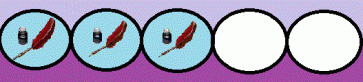
Kaye Lynne Booth does honest book reviews on Writing to be Read, and she never charges for them. Have a book you’d like reviewed? Contact Kaye at kayebooth(at)yahoo(dot)com.
Share this:

What Ever Happened to Heather Hummingbird?
Posted: March 25, 2016 Filed under: Children's Books, Stories, Writing | Tags: Children's Books, Ethan Eagle, Heather Hummingbird, Kaye Lynne Booth, Publishing, Writing 5 Comments
There are some of you who have been following my writing endeavors for some years. If you’re among that crowd, you’ll remember when I announced I had a publisher for one of the books in the My Backyard Friends series of children’s stories. I was very excited and proud to broadcast on the book’s progress at the time, but I haven’t mentioned Heather Hummingbird for quite a while now. It dawned on me the other day that there are many of you who were waiting for the release of the book. I even had a list of pre-orders in anticipation of it. You deserve an explanation as to what happened to Heather, so let me tell you what happened.
All through my limited writing career, I have done things on my own. A negative experience as an undergrad turned me away from a major in English that would have sent me down the path to becoming a writer the right way, and I got a major in Psychology, which I’ve never really found a use for instead. And when I first set out to be a writer, I failed miserably, because I couldn’t afford the submission process via snail mail, which is all there was back then. Yeah, I’m an old lady.
But the development of the Internet changed all that, opening up opportunities for writers that didn’t exist previously, and I began writing a series of children’s stories with animal and bird characters based on the creatures that visited the backyard of my Colorado mountain home on a daily basis. I met an illustrator online. She’d become a member of a social writing site, called Writer’s World, which I was administrator of. She offered me a very affordable deal to illustrate that first book, Heather Hummingbird Makes a New Friend, with beautiful handcrafted illustrations. I immediately fell in love with the cover illustration she produced, and down the road, she arranged for the publisher she worked for to offer me a contract.
Now you see why I was excited? I thought that was the best stroke of luck to ever hit me. I had a publisher fresh out of the gate. I was ecstatic. I spread the good news across all of my social networks, announcing to the world that Heather Hummingbird was coming. Little did I know, I had embarked on a nightmarish fiasco into the world of publishing.
When the publishing date the following year came and went, and nothing happened, they said it had been pushed back. And it was pushed back again and again for the next two years, each time I broadcast to my friends and readers the updated release date. But I wasn’t hearing anything from the publisher or the illustrator. She’d sent me three illustrations and the cover, but that was it. Nothing more was forthcoming, and no explanations.
If I wanted to know what was going on with my book, I had to contact them via e-mail and ask. They didn’t even tell me when the release dates were pushed back unless I wrote to inquire. In 2013, the release date passed, although all edits had been completed, my illustrator answered an inquiry, saying the date had been pushed back again and she was no longer able to illustrate by hand. She sent me a digitally illustrated cover and ask if this would be acceptable. I didn’t like this cover as much as the original, but I thought it would do, so I agreed to have her do the digital illustrations.
The next release date came and went, and when I inquired, the publisher sent back an email informing me I would be getting a different illustrator. I inquired as to the reason for this change, thinking perhaps my illustrator was no longer with the publishing house, but this was not the case. For some unknown reason they had decided to have someone else produce my illustrations, which I had already paid the original illustrator for.
At this point, I was more than slightly annoyed. I expressed my displeasure in the arrangement and the publisher got snotty and said she would release me from the contract. So, that is how it was resolved, and I’m still trying to collect my money from the original illustrator. It feels foolish to say that seven years since Heather started out on her venture, I’m stuck with two covers and three illustrated pages, none of which I can use, no illustrator and no publisher. But that’s it in a nut shell. I still don’t have a published book.
So, where is Heather now, and what lies in her future? Well, I shopped her around to a few publishers, to no avail. At Western State I was taught that you have to get back up on the horse, so after one rejection, I pulled up the manuscript and re-read it with fresh eyes, in order to revise before sending it out again. On that pass, something profound struck me. Heather Hummingbird Makes a New Friend, was not Heather’s story at all. It wasn’t Heather who learned a life lesson in this story, but rather, she was the teacher. So, I did the revisions, rewrote the synopsis, and changed the title to Ethan Eagle Makes a New Friend. After all, Ethan is the character that learns about friendship from Heather. Once that was done, I launched it into the submission process once more, so we’ll see.
There you have it. I don’t know how many are out there who even remember there was a Heather Hummingbird book, but at one time I had a whole list of pre-orders from people wanting the book. I am sorry that I wasn’t able to fill those orders, and I thank all of you for your support. If anything ever does come of Ethan and Heather, you, my readers, will be the first to know. Thanks for hanging in with me.
Share this:

Weekly Writing Memo: 3 Types of Plot
Posted: March 2, 2016 Filed under: Fiction, Stories, Uncategorized, Weekly Writing Memo, Writing, Writing Tips | Tags: Books, Creative Fiction, Fiction, Writing 4 CommentsIn previous posts we’ve talked about minor issues such as 5 ways to Increase Tension, as well as whether your characters need to be Likable or Relatable. In this post we’re going to focus on a larger concept of story—the three types of plot. Every story should really have multiple levels of plot going on, and in general there are three types of plot that should be in most stories for them to have depth, and enough content to be fulfilling.
- The Grand Plot
The Grand Plot is the larger plot that is the overarching conflict of the story. This can be anything, really, as long as it is grand enough to run the length of the story. In a series, it can be the larger plot that spans the series, or in a single movie or novel, it’s the larger plot that is the focus of that one story.
For example, if you look at The Hunger Games, the Grand Plot in the first book is whether Katniss Everdeen will survive the games. As a series, however, the Grand Plot is about the fall of the Capital and President Snow.
Essentially the Grand Plot has to be something that has enough conflict to sustain the entire film or novel. It can be made up of a bunch of smaller conflicts, such as Katniss having smaller battles to face during the games (other players, poison berries, beasts, etc), but it essentially boils down to one thing (in The Hunger Games, it is survival).
When choosing a Grand Plot for your story, ask yourself what kinds of problems your protagonist could run into while pursuing a solution to that plot. If you can only think of one or two, then it is probably not a good Grand Plot. Returning to The Hunger Games example, Katniss has to face Capital politics, she has to face her urge to sacrifice herself for Peeta, she faces other tributes, and dangerous wildlife, and more. Those are all minor conflicts that arise during her pursuit of the Grand Plot, so there is plenty of conflict. If, however, The Hunger Games was just about Katniss being locked in a room and having to survive with no external factors, there probably wouldn’t be enough conflict to sustain a story and there would need to be a different Grand Plot. The Grand Plot has to be a big enough goal for there to be an entire story (novel or film) written about it.
- The Personal Plot
While the Grand Plot is something that is the overarching plot for a larger story, the personal plot is a plotline that may or may not last the entire main story. It is something that has meaning for the protagonist in some way, and is often the motivator for the protagonist to pursue the Grand Plot.
For example, if you look at the first Die Hard movie. The Grand Plot is that Bruce Willis has to stop the terrorists who are holding his wife’s office building hostage. The Personal Plot, however is what motivates Bruce Willis to take action beyond his sense of justice—his desire to protect his wife. The movie Taken with Liam Neeson has a similar plot makeup. The Grand Plot of the movie is really taking down this trafficking ring, however the Personal Plot is Liam saving his daughter.
The Personal Plot usually links up with the Grand Plot in some way, and in general, once the protagonist pursues the Personal Plot, they end up going a step further and achieving the Grand Plot. For example, as a series, the Grand Plot in The Hunger Games is the destruction of President Snow and the Capital. The Personal Plot for the series is Katniss surviving and protecting those she cares about. On a smaller scale, in the first book the Grand Plot is Katniss surviving the games, while her Personal Plot is still protecting those she loves (Peeta and Prim).
The key to writing the Personal Plot is that it has to be the thing that makes your protagonist want to act. It is what makes the goal personal for your protagonist, and it is the thing that keeps them from giving up because they have a personal investment in succeeding. If Katniss didn’t want to protect those she loved, she could have just given up and died in the games, instead she HAD to survive in order to make sure Peeta made it.
The Grand Plot and the Personal Plot will most likely overlap, but the Grand Plot is always at least one step bigger than the Personal Plot. Like in Die Hard, saving his wife is the first step for Bruce, while saving everyone else is the next. In The Hunger Games, saving herself and those she loves is the first step for Katniss, and taking down the Capital and President Snow in order to save their society as whole is the next. By doing one thing (saving the one they love), the protagonist is spiraled into doing the bigger thing (saving everyone) because they realize that only saving the one they love is not enough.
- Secondary Plot
Secondary Plot are the little plot arcs that pop up while the protagonist is pursuing the Grand Plot. For example, in John Wick when the assassin chick is hired to kill him, she is a secondary plot—a small problem along the way to him achieving his goal. Often times these Secondary Plots involve a problem of a secondary character. In The Hunger Games, the Secondary Plot often comes from Peeta. When he is injured and ill during the games, Katniss having to figure out a way to help him is a Secondary Plot.
There can be many, many layers of Secondary Plot within a story, and it all depends on how many characters there are and how long it takes the protagonist to complete the Grand Plot. The simpler your Grand Plot is, the more Secondary Plot you will probably need. For example, The Lord of the Rings has a pretty simple Grand Plot—deliver the ring to Mordor and destroy it. Much of the rest of the story is all Secondary Plot that arises through the secondary characters.
For example, conflicts with people trying to steal the ring from Frodo, such as Boromir or Gollum, are all Secondary Plot. These Secondary Plots often are roadblocks for the protagonist on the way to solving the Grand Plot, because they force the protagonist to stop and solve another problem before they can continue on their journey to solving the big problem. Often times these Secondary Plots serve as learning moments for the protagonist so that they can learn what they need in order to succeed at the Grand Plot. When Boromir tries to steal the ring, Frodo learns that he has to go out on his own and cannot rely on the safety of the group to help him achieve his mission.
These kinds of moments are minor, but they are the things that continue to propel the protagonist into action and renew their vigor to achieve the Grand Plot. They can be anything from minor stepping stones on the road to the Grand Plot, to major side arcs for the story—such as Aragorn becoming King in Lord of the Rings.
When figuring out the Grand Plot for a story, always ask yourself: What kind of problems your protagonist will run into along the way? How will secondary and tertiary characters be effected? What will they need from the protagonist? What does your protagonist need to learn in order to succeed at the Grand Plot? Once you know these answers, you know what kinds of Secondary Plots to add to your story that will seem natural, as well as have purpose.
Final Notes:
The different layers of plot have different purpose, but they are all important in story. The Grand Plot is the big problem to be solved, so to speak. The Personal Plot is what motivates your protagonist to solve the big problem, and the Secondary Plot is the little conflicts that your protagonist has to overcome along the way and learn from. Without all three elements, your story can feel like it is light on depth and conflict.
The important thing is that all of the plot elements should tie together in some way and influence each other. Don’t have a random side plot where your character stops their big goal and goes to save a cat or something. Everything should be connected and serve a purpose, so whenever you have your character do something, make sure you have the larger plot in mind and can answer the question “what is the purpose of this?”
Later this week I’ll be doing a post on my blog (Author the World) about plotting specifically in Horror stories, so if you’re interested make sure to stop by and check it out.
Share this:

Weekly Writing Memo: 5 Ways to Increase Tension in Story
Posted: February 17, 2016 Filed under: Fiction, Stories, Uncategorized, Weekly Writing Memo, Writing, Writing Tips | Tags: Creative Fiction, Fiction, Writing 4 CommentsIn last week’s WWM we talked about how to use feedback to fix your story and the ways you can get the most from a critique. This week we’re focusing in on how to fix a lack of tension in a story, as it is one of the most common issues I come across when beta reading. Tension, by definition, involves two opposing forces holding something taut between them, such as two hands pulling ends of a rubber band in opposite directions.
In fiction, tension can be seen when the protagonist is facing an opposing force that is preventing him/her from getting what he/she wants. Essentially, tension in stories comes down to conflict. That conflict can come from three main places: the protagonist vs their own mental issues (self), the protagonist vs other characters (including animals), or the protagonist vs the setting. The conflict comes when the protagonist wants something, and the opposing force prevents them from getting it.
For example, when the opposing force is the protagonist’s self, then it could be something like anxiety or disease that prevents the protagonist from getting what they want such as in Girl, Interrupted. All of the characters in the institute want to be free and maybe even normal, but their individual mental issues prevent them from successfully reintegrating into society.
When there is a problem in tension a story can feel slow, boring, too easy, or even unbelievable. The method to fix it can vary depending on the story you’re writing, but there are several almost universal ways to fix tension in a story.
- Cut scenes with no conflict.
Anytime you have a scene where your protagonist gets everything they want, or is just going through the motions, then you have a scene where there is no conflict or tension. This may work out for the ending of a story, or even the beginning if the point is to show your protagonist before their world is upturned, but it doesn’t generally work in the middle. So if you don’t have an unfulfilled want, if there is no conflict, you could probably cut the scene out altogether.
- Figure out what your protagonist wants, and then refuse to give it to them.
What drives stories forward is a protagonist who is seeking something, and figuring out how to get it. Even in dialogue scenes your protagonist should have to work for what they want. Sometimes, even when your character gets what they want, it doesn’t solve their problem so it creates new wants and conflicts. This idea of what your protagonist wants should drive every scene of the story, and your protagonist struggling to get it should continue until the very end.
- Whenever possible, up the stakes for your protagonist.
A very common phrase you’ll her in writing is “what are the stakes?” The stakes are what your character is risking to get what they want, and a surefire way to increase tension in the story is to up the risk involved in your protagonist’s pursuits. Say he wants to buy a casino, but he has to put his life savings on the line in order to afford it. That’s a big thing, but it could be bigger if he was a family man with six kids to feed and care for. The more that is at risk for the protagonist, the more risk the pursuit of their want has, the more tension in the story.
- Add different layers of conflict.
You don’t have to use only one type of conflict at a time. By using variety you can add to the tension within the story without making your plot get unbelievable. For example, if you give your character an internal conflict – such as a fear of growing old – as well as an external conflict – his wife is leaving him – it creates two possible sources of tension. The internal one that affects everything the character does, and the external one that he has to solve. You don’t want to go crazy adding layers upon layers upon layers of conflict and drama, but you can use several layers to create more tension.
- Cue in the audience.
If you don’t want to add more conflict directly to your character’s story, you can add conflict by cuing in the audience to a conflict that is unknown to the protagonist. For example, if your character is afraid he’s going to lose his job you have a basic conflict. It works, and it is tense because something is at stake for the character.
However, if you wanted more conflict to the story you could show the audience that the company has already planned to fire everyone, including the protagonist. That could create more tension for the audience because they are waiting to see the protagonist’s reaction, as well as what he/she will do when faced with the news.
This method of tension is also often used in horror movies when the audience can see what the bad guy is doing while the protagonist cannot. It creates a sense of impending doom.
Final Notes:
They key to understanding tension is to remember that it doesn’t come from dangerous situations, though it can, but instead it comes from the audience seeing the protagonist not getting what they want and wondering how, or if, the protagonist will succeed in the end. So whenever you feel that your story may be going slow, or lacking tension, ask yourself what your protagonist wants, and find a way to refuse letting them have it.
Share this:

Weekly Writing Memo: Using Feedback to Improve Your Story
Posted: February 11, 2016 Filed under: Fiction, Stories, Uncategorized, Weekly Writing Memo, Writing, Writing Tips | Tags: Creative Fiction, Feedback, Fiction, Tips, Writing 3 Comments
In last week’s Weekly Writing Memo I discussed my method for giving feedback. This week, Kaye and I are teaming up to discuss what to do with feedback when you’re on the receiving end. We thought it’d be a great idea to do this one together so we could show two opinions for dealing with critiques.
As writers we tend to be very close to our writing and have trouble seeing it objectively; it’s important to get an outsider’s perspective to see how your writing is being read. That being said, hearing criticism of work you’ve put your heart into can be incredibly hard, but there are methods to dealing with it in a useful way.
What is your method for using a critique?
Robin: When I get a critique I basically have a four step process I go through.
- I read it start to finish. No stopping to vent or obsess, no tears, no anger. I just read. It’s important to take all the info in without letting yourself get too emotional about it. If you do get emotional, it’ll be harder to process whether the info is helpful.
- I walk away and let it sit. The initial response to feedback, especially bad feedback, can be overwhelming. Whatever emotions it brought up, I let them out for a bit and then give myself time to let them fade until I feel I can rationally return to the feedback and really look for the truth in it.
- Read it again, item by item, and consider, try, and analyze. Once I’ve cooled my heels some, I return to the notes and reread them, slowly this time going item-by-item. As I look at each comment, I HAVE to consider each item as being true. Then I look at my work and try to prove the feedback right or wrong. If I can’t prove it wrong in at least several ways, then there may be some partial truth, if not complete truth, to the critique. I do this extra for things I think are 100% wrong to make sure that I’m not just too close to the work.
- Use, refuse, revise, and ask questions. Finally, once I’ve considered everything, I go through and revise with what I want to use, and ignore what I’m “refusing”. I also will go back and ask the critic questions on any feedback I need clarity on once I’ve carefully considered it, that way I know what specifically I need to ask.
Kaye: I’m not nearly as methodical as Robin is. But then again, I’m kind of weird about my writing process. For starters, I ask for and await eagerly any feedback I can get. I look at any negative feedback as a window into things that can be improved, and there’s always room for improvement. Always.
So, my process goes more like this – I read through the whole thing, but I pull it up side-by-side with my manuscript, making changes to the original document as I go. If I come to a comment I don’t understand, don’t think I agree with, or I’m not quite sure what to do to fix it, I highlight the comment in the feedback, so I’ll know to go back to it later.
And I do go back to them, once I’ve done all the quick fixes I can. That’s when I take the time to ponder those I don’t understand or disagree with, and decide what I want to do about them. Some I work out clever ways to fix the problem, and some, I may not do anything about.
What do you do if you disagree with the feedback?
Robin: This one can be hard. If the feedback is something I think is completely wrong and I can’t understand it, then I ask questions. The important thing is to ask those questions in the least defensive, and least confrontational way possible. The person did you a favor giving you feedback, so don’t attack, ask for clarity.
For example, I’d ask: “Can you explain more about this specific comment and give me some examples of where you see that?” That way I can maybe get a better idea of what the critic is thinking, and where I need to be looking.
If the feedback is something I think will never be right, and I’m positive that I’ve considered it as many ways I can, then I ignore it. There really isn’t much else you can do. If you disagree, and you can’t see things from their perspective, then ultimately it’s your writing and you get to decide what feedback you use or don’t.
Kaye: I welcome feedback, but that doesn’t mean I agree with every comment I get. As writers, we often become attached to our creations, and sometimes it’s difficult to believe that others find flaw with our masterpieces. I’m no different. I pour my heart and soul into my writing. It’s not easy to separate myself from my work, but I think that’s what we have to do. Always remember that all criticism is about the writing and not the writer. We can’t take it personal, even though it may feel like our creations are a part of ourselves.
What do you use from the feedback?
Robin: I use feedback as a sounding board. I’m not looking for critiques to tell me HOW to fix it, I’m just looking for them to point me at what may or may not be wrong. In general, everyone who reads your work will probably have a different idea of how to fix something anyway, and many of the suggestions won’t be right for YOUR story because they’re suggestion how THEY would fix it. So I focus in on where the critique is pointing, or how they are interpreting things, and then I figure out how I would fix it in my own way.
For example, if someone says “This passage feels slow. I think it’s because this character is boring. I’d cut them.”
I would interpret that advice as meaning “something is wrong with this scene, it feels uninteresting.” Then I’d look at the scene and try to figure out where it goes wrong. Is the character really boring, or just inactive? Is the scene even necessary to the plot, or just filler? I look at the larger idea of the feedback, rather than the specifics. Sometimes I come to the same conclusion as the critique, and sometimes not.
Kaye: I believe there’s a grain of truth to everything. The trick is to pick it out. I always try to find those little granules when I disagree, because I’ve learned that most of the time, it’s there, and if I can find it and make appropriate changes, my story will be better for it. I choose my alpha readers carefully, and I’ve learned that their comments are usually pretty spot on.
Like Robin, I don’t always use their suggested fixes, but their comments let me know where I should be looking for something that’s off and then, I can determine for myself what it is that’s wrong and how I want to fix it. But again, my alpha readers often come up with some really good suggestions, and I use them whenever I can. Seldom do I totally discard a suggestion unless it’s obviously something the reader just doesn’t get. But if my reader isn’t getting it, then that tells me I’m doing something wrong or they would get it. Chances are, if my alpha reader doesn’t get it, my target audience won’t get it either.
What if you don’t know how to fix it?
Robin: A lot of times if someone gives me feedback that I don’t know how to fix, it’s because I don’t know what the real problem is. So, of course, I ask questions until I have a better understanding. Then I try to come up with a few possible solutions.
I will also sometimes talk with the critic about the changes I’m debating to get their perspective on whether it’ll fix things, or I’ll try the fix and then give it to someone else and see if I get the same critique. It’s really just a matter of trial and error if you can’t figure out a specific solution. After that, all you can do is take some time away from it and revise other things and hope when you come back with fresh eyes you’ll figure it out.
Kaye: It’s kind of funny, but I’ve learned a lot about fixing my fiction from my screenwriting classes. One thing I’ve learned is that if you can’t find a way to fix a problem, sometimes you have to look to see a change somewhere else in the writing that will fix the problem scene and make it all work. I guess you have to think outside the box, or beyond the page.
After looking at a problem from every angle, if I still can’t find a way to fix it, then I consult with the reader that pointed out the issue to see if they also have suggestions on how it might be fixed. If that doesn’t work, I can always throw it out to the members of my writers group and we can brainstorm it. Helpful suggestions seldom fail to materialize from these sessions.
Final Thoughts:
Kaye: To me, critiques are a writing tool, enlisting another set of eyes to see what I can’t because I’m too close to the work. When utilizing this tool, I try and take advantage of each and every comment that I can. After all, if I didn’t think they were intelligent and talented, I wouldn’t ask them to be my alpha readers. But the important thing to remember is not to take negative feedback personal, its about the writing, and being open to feedback is what makes your writing better.
Robin: Overall, the important thing for me when looking at critiques is to consider each element carefully and thoroughly. The whole point is to get an outsider’s perspective, so if I don’t consider it seriously, it’s a waste of everyone’s time. If I can fix what they see, I do, and if I can’t or think they’re wrong, I don’t. That being said, if multiple people say the same thing is wrong, then it’s most likely wrong and you need to do something about it, whether you like it or not.
Ultimately, remember the point of a critique is to tell you how your writing is being read, and whether the critic is wrong or right, someone somewhere will probably agree with them. So fix what you can, let go what you can’t, and do your best to be critical of your work no matter how much you love it.
Share this:

Weekly Writing Memo: Robin’s Guide to Critiquing
Posted: February 3, 2016 Filed under: Fiction, Stories, Weekly Writing Memo, Writing, Writing Tips | Tags: Critiques, Critiquing, Feedback, Fiction, Screenwriting, Weekly Writing Memo, Writing 3 Comments As Kaye mentioned in her blogpost “The 2016 Writing to Be Read,” I am Robin, I’m a writer, and I run the Author the World blog. I will be doing a “Weekly Writing Memo” on Wednesdays each week on Writing to Be Read that will consist of writing tips, tricks, and Q&As. So feel free to post questions in the comment section, tweet me, or e-mail me at: AuthorTheWorld (at) Gmail (dot) Com.
This week’s memo will deal with one of my specialties, critiquing. I spend a lot of time working as either a Beta or Alpha reader for people’s fiction and screenwriting, and honestly if I’m not writing myself it’s my next favorite thing to do.
Over the years between working with other writers and being in workshop settings, I’ve found that many people really struggle with giving critiques. When looking at a manuscript of any kind, it can be overwhelming to figure out where to start with feedback, to decide what is and isn’t important, and what is and isn’t helpful. So here is the way I approach feedback that seems to have the most success in helping other writers improve their work.
What Makes a Good Critique?
Before you can write a good critique, you have to know what one is. A good critique usually involves these five things:
- It’s detailed and says more than just “I liked it” or “I didn’t.”
- It’s objective, and minimizes the criticisms based on personal preference. (i.e., “I hate horror, so I don’t like this story.”)
- It doesn’t try to write the story for the author.
- It’s honest, but not mean.
- It’s about the writing, not the writer.
These are my goals I keep in mind when I do a critique. As long as every comment I make about the story connects to all of these things it’s a good note to make. With that in mind, here is how I go about giving a critique from first being asked, to the sending it back to the writer.
Ask What the Writer Expects.
In my experience, every writer has different expectations when they ask for a critique. Some really just want line edits. Others want you to tear their story apart. So the first thing I do whenever I offer to read for someone, is to ask how detailed they want me to be and what they are looking for.
Ask What Stage the Project is in.
I also ask what draft the project is in so I can get a feel for what stage the writing is at. A project in the first few drafts usually doesn’t need line edits yet because a lot will change along the way, so I focus on larger story issues (plot, character, tone, setting, etc). If it’s toward the final stage, then I will do line edits as well as larger issues.
This saves myself the trouble of marking things that may not be in the story later on, but also helps prevent shocking the writer. Early drafts will most likely have a lot of larger notes, as well as line notes if you do both at once, which can dismay a writer and overwhelm them.
Read Like it’s a Whodunit.
When reading for critiquing, you have to read like it’s a puzzle, not like it is entertainment. If you let yourself get sucked into the story, you stop paying attention to the faults. When I was little I used read those 2-minute Mystery books. The key to them is that you have to pay attention to every little detail and not get distracted.
I find that when I approach someone’s writing the same way, it helps me catch the little things—character mannerisms, minor plot details, foreshadowing, etc. Being able to catch these things early, lets me know what to expect in the story to come so I can make notes as to whether the story is meeting the expectations it is setting up or not.
The hardest part of critiquing, in my opinion, is staying in the critical mindset. It’s easy to get sucked into the characters, and the story, and to stop analyzing what is and isn’t working. By approaching the writing with the mindset that there is a puzzle to solve within it, it helps me keep analyzing it. At worst, if you feel yourself reading a lot and not analyzing, take a short break.
What to Mark?
The goal of an Alpha or Beta reader is to help the author see how an audience is reading the story, and to find issues the writer might be blind to. But how do you show this in comments? If you’re commenting on the line level, then of course you’re pointing out typos, grammar issues, and the like. If you’re commenting on content, then you have to put more thought into it.
Generally, I leave a comment when:
- I am confused by something in the text.
I write HOW I’m confused. Is it because the character said one thing but did another? Is it because there was no foreshadowing? Is it because the language is confusing? Etc. The key is to EXPLAIN what it is that leads to the confusion and not to simply write that you’re confused.
- I don’t believe something in the text.
I will write it’s unbelievable, but I will also write a line or two about WHY I don’t feel it is believable. Then I go an extra step and I tell the author HOW I think they could make me believe it. That way, if they want to stick with the idea, they know what it would take for me as a reader to believe. If I just think it isn’t ever believable, then I will offer 1 or 2 suggestions of similar things that I think would be believable not for the author to necessarily use, but to point them in the right direction.
- I have a question.
Whenever a question pops into my head, I will usually make a comment to let the author know that, as a reader, this is what I’m wondering at this moment. That way if the text is leading me in a direction the author may not want, they are aware of it. For example, if the text mentions a brother and builds up suspense around him, I may mention this, that way if the brother is not a character that comes back the author can minimize the attention on him so I, as a reader, don’t have that question pop up.
- I pause or feel bored.
Whenever you feel like stopping reading, ask yourself WHY. Are you bored? Is the passage slow? Is the character uninteresting? Has the plot not started? Etc. Then put a comment marking the passage and explaining WHY you are feeling that way. I also usually try to go back and pinpoint the moment the story stopped being interesting so I can mark it as well, and then I try to figure out which thread line (character, plot, setting, etc) it is that dropped out of the text so the writer knows what it is specifically that is missing. At the very least, though, always mark WHERE you feel bored and try to explain WHY.
- Something is missing.
A character is forgotten, a plotline is not finished, a setting is not described, etc. Whenever I feel like something is missing, I explain WHAT, I explain WHY it matters, and I pinpoint WHERE it first begins to be missing.
Ask Questions.
The other big thing to consider when commenting is how you are interpreting things vs. how the writer intended them. Whenever I think something I am commenting on could be something that is not what the writer intended, I make a note about that says something along the lines of:
“I’m interpreting this part this way, but I think you mean it this way. Here’s why I interpreted it the way I did and here’s what you should change if you mean it the other way.”
That way the author can see what and where there is a mix up.
Final Notes.
The key to all of the above is basically SPECIFICITY. Feedback is only helpful if you can be specific about what it is that you think is wrong. Ask yourself WHY do I feel this is wrong, HOW it is wrong, and WHERE it is wrong. Now sometimes you don’t know what is wrong or just can’t figure it out, but you do know something is wrong.
It’s perfectly valid to just leave that as a comment, but still try to give some specifics about what FEELS wrong. Tell them it feels slow, or boring (in kinder words if possible), but describe something so the author has an idea of where to look for the problem. At the very least, it’ll give them a specific passage to get a second opinion on.
The important thing to remember is that all feedback is opinion. Everyone can read the same story and come up with a different idea of what is wrong and how to fix it. So when you’re giving notes, try to keep things as objective as you can. If you know something you’re commenting on is just your preference, I always explicitly say that in the feedback and then explain WHY I prefer it that way. Then the author can decide if your preference is one they want to use or not.
Lastly, when you give feedback always expect that the writer may not use any of it. It seems like a defeatist thing to say, but writers (myself included) have their own idea of what works and what doesn’t and what they want in their story. Just know that in going through the process of analyzing the work and forcing yourself to think critically to explain how you feel about it, you are helping your own writing. Every time I give feedback, I feel like I can approach my own work more analytically, and like I am more prone to finding my own errors.
You won’t catch everything, no one can, but be honest, be specific, and remember it’s not about the writer it’s about the writing. Everything you comment should be about making the story better and helping the writer tell the story THEY want to tell, not what YOU think the story should be about. If you can keep that in mind your feedback will be helpful, it’s just up to the writer on whether they want to use it or not.
Share this:

The Power of Words
Posted: August 12, 2012 Filed under: Stories, Writing | Tags: Stories, Words, Writers, Writing Leave a comment Recently, I was told, “it’s all about the story”. If you believe that – and I do – that makes the writer’s job a very important one. It is the job of the writer to get the story out. More importantly, it is the writer’s job to tell the story the way that it wants to be told, and that is no small task. Without the right words, we don’t stand a chance.
English teachers and editors can tell you the rules. They can make sure that you have proper sentence structure and syntax; that your grammar and punctuation are correct in every way. But, writers know that the real trick is in knowing when the rules apply, and when it might be better to overlook them.
Writers are challenged with word choices every day, and it is a challenge to have to select just the right words. Writers must choose words that will state what we want to say in a clear or concise manner, while at the same time drawing readers in and compelling them to read on. Above and beyond that though, we are charged with the task of putting words to page that will stir emotion within readers – touching, inspiring, shocking, or tantalizing.
We are challenged to not only find the words, but also to put them in an order that will set the right tone and pace, and present a clear picture for the reader. The words we choose portray our characters and settings in a manner that allows readers to form a mental picture of what we are describing, thus bringing the reader into the story with us. Our words and the way we put them to the page also set the tone and mood, intensifying reader experience. The point is, that as writers we make choices every day that affect the shape of the story, as well as the outcome, and a gazillion events that occur as the plot unfolds. Without words, there is no story, and the writers are the ones that choose the words.
It is all about the story and often, stories just don’t care about the rules. For instance, to write realistic dialog that will be believable for the reader, you may not always have complete sentences. When we talk, we do not always use complete sentences, and dialog that is written in complete sentences may come out sounding very stiff and formal. Unless your characters are members of nobility during the seventeenth century, the dialog may not seem natural. Your dialog needs to fit your character.
I recently discovered what it’s like to have one of my characters speak to me, something I had heard of, but didn’t really understand. Now I do, and let me tell you, my character, a woman of the old west, did not speak in complete sentences. In fact, she did not even pronounce some of her words properly. Because her background and upbringing, that is the way she talks, and to portray her on the page in any other way, would be dishonest to my readers, and disrespectful of my character’s essence.
In addition to choosing the right words for our characters, we must choose words that our readers will comprehend and relate to; words that are right for the setting of the story; words that express the true character of our characters. We must sequence them so that the story moves at a pace that is fast enough to keep the reader’s attention, but not so fast that we leave them behind.
It is obvious that words are powerful. As it happens, words are the tools of the writer’s trade. Words are what gives us power. Just as the way a ruler welds his power determines whether he is loved or despised by his people, the way we weld ours determines whether we are good writers or bad, and whether anyone actually wants to read our writing. So, choose your words carefully and weld your power wisely.
Share this:

Who’s Best Friend? — A Two Way Street | The Real Owner
Posted: August 20, 2010 Filed under: Stories Leave a commentWho’s Best Friend? — A Two Way Street | The Real Owner.



















