Treasuring Poetry – Poet and editor of MasticadoresUSA, Barbara Harris Leonhard, talks about poetry and a review #poetrycommunity #bookreview
Posted: February 21, 2024 Filed under: Books, Collection, Poetry, Treasuring Poetry | Tags: Barbara Harris Leonhard, Memoir, Poetry, Robbie Cheadle, Three-Penny Memories, Treasuring Poetry, Writing to be Read 23 Comments
A huge welcome to Barbara Harris Leonard, editor of MasticardoresUSA, and talented poet, to Treasuring Poetry.
What is your favourite style of poetry to read i.e. haiku, ballad, epic, freestyle, etc?
I’ve studied different poetic forms but generally read freestyle poetry, especially Anne Sexton, Sylvia Plath, Elizabeth Bishop, and so many more. I also enjoy the more formal classic poetry and other modern poets like Frost, Sandburg, and others. A favorite poet of mine is Emily Dickinson. I’ve written poems in the manner of Dickinson. Overall, however, the majority of poems I have read and written have been free verse.
What is your favourite poem in your favourite style to read?
The first poem that comes to mind is Elizabeth Bishop’s poem “The Fish”. Here it is from poets.org. The description is exquisite, and the story is powerful. She catches a prize fish, admires him, and finds that the fish has been caught five prior times. After examining his wounds—the old hooks and broken fish-lines scabbed over in his mouth—she releases the fish. The imagery throughout the poem is stunning. The old fish is embattled and exhausted, not even resisting the catch. He represents something ancient and universal. He is more than a fish; he is history (“beard of wisdom”) and war as she describes his “weaponlike” lower lip and cutting gills. “The Fish” is a poem written with the skill I strive to have as a poet.
1911 –1979
I caught a tremendous fish
and held him beside the boat
half out of water, with my hook
fast in a corner of his mouth.
He didn’t fight.
He hadn’t fought at all.
He hung a grunting weight,
battered and venerable
and homely. Here and there
his brown skin hung in strips
like ancient wallpaper,
and its pattern of darker brown
was like wallpaper:
shapes like full-blown roses
stained and lost through age.
He was speckled with barnacles,
fine rosettes of lime,
and infested
with tiny white sea-lice,
and underneath two or three
rags of green weed hung down.
While his gills were breathing in
the terrible oxygen
—the frightening gills,
fresh and crisp with blood,
that can cut so badly—
I thought of the coarse white flesh
packed in like feathers,
the big bones and the little bones,
the dramatic reds and blacks
of his shiny entrails,
and the pink swim-bladder
like a big peony.
I looked into his eyes
which were far larger than mine
but shallower, and yellowed,
the irises backed and packed
with tarnished tinfoil
seen through the lenses
of old scratched isinglass.
They shifted a little, but not
to return my stare.
—It was more like the tipping
of an object toward the light.
I admired his sullen face,
the mechanism of his jaw,
and then I saw
that from his lower lip
—if you could call it a lip—
grim, wet, and weaponlike,
hung five old pieces of fish-line,
or four and a wire leader
with the swivel still attached,
with all their five big hooks
grown firmly in his mouth.
A green line, frayed at the end
where he broke it, two heavier lines,
and a fine black thread
still crimped from the strain and snap
when it broke and he got away.
Like medals with their ribbons
frayed and wavering,
a five-haired beard of wisdom
trailing from his aching jaw.
I stared and stared
and victory filled up
the little rented boat,
from the pool of bilge
where oil had spread a rainbow
around the rusted engine
to the bailer rusted orange,
the sun-cracked thwarts,
the oarlocks on their strings,
the gunnels—until everything
was rainbow, rainbow, rainbow!
And I let the fish go.
Copyright © 2011 by Elizabeth Bishop. Reprinted from Poems with the permission of Farrar, Straus and Giroux.
What is your favourite style of poetry to write? Why?
I like free style poetry, mainly narrative and persona poems. Sometimes poetic forms feel restrictive because mastering the form becomes more important than the message of the poem. However, I feel practicing with forms enables a poet to mature in many ways. As I’m writing free style, I use many poetic devices, such as alliteration, slant rhyme, assonance, meter, and others. With free style, for me, some challenges include where to place the line breaks and group the imagery into stanzas. How the poem is organized can affect the meaning. I like the potential for ambiguity in free verse poems.
In “The Fish”, the last three lines are ambiguous. What does “rainbow” refer to? Epiphany? Was the fish a Rainbow trout? Maybe both interpretations apply. But the em dash is important. It interrupts the description of the fish to state an insight “—until everything”. The line break allows the reader to recall everything that was just said and speculate on more things. The repetition of “rainbow” three times insists there is insight. Pay attention. Rainbows are multi-colored, much like the fish. Rainbows presents diversity, inclusivity, and friendship. It’s no wonder she freed the fish.
the gunnels—until everything
was rainbow, rainbow, rainbow!
And I let the fish go.
Formal poetry can also have ambiguity and surprise. It’s just that I feel I have more freedom to play with the lines and stanzas in free verse poems.
What is your favourite of your own poems in your favourite style?
In my book Three-Penny Memories: A Poetic Memoir, my poems are free style. I have several favorites, but “Marie Kondo Cleans My Purse at Starbucks” received recognition from Spillwords Press. It won Publication of the Month in Jan/Feb 2022. In this poem, I am carrying the grief from Mom’s decline due to Alzheimer’s and her death. I am burdened by the memories. Marie Kondo, who is famous for her books on how to declutter your house, offers to help clean my purse (let go of that which no longer serves me). As this poem is about healing from loss, it is in the last section of my book, “Echo”.
Marie Kondo Cleans My Purse at Starbucks
Konmari sees me at Starbucks,
my purse spilling over at the counter.
“May I help?”
She gathers me up
like I’m antique lace
washed too many times.
Before she begins, she whispers,
“Hello, the House,
I am safe. May I enter?”
She pokes through my purse,
pulling out the deck of cards
Mom once carried in her own purse.
A heavy bag of Mom’s pennies
to redeem for cash.
Her checkbook.
The messy old calendar
that listed her appointments
alongside my own.
The quilt she made me,
now falling apart. A cookbook
compiled in her own hand.
Konmari extracts other artifacts,
laying them gently on lined up tables.
People gather. My eyes bleed.
The extra-large pair of panties
Mom made me wear to Sunday school.
The wash, still not done.
A half-used bottle of Diethylstilbestrol,
she was prescribed to prevent spotting
when I was in vitro.
The tricycle she rode
around town at age three
because her mother never watched her.
My cancer scares, scattered
on the bottom of the purse
like cookie crumbs.
The scabs inflicted
by her compression stockings
I failed to wash one last time.
The clump of tissue
I miscarried, swaddled
in an inner pocket.
Her hysterectomy scar.
My hysterectomy scar.
Entwined on a spool.
My t-shaped uterus,
clenching a half-used packet
of Puffs Plus.
A dogeared photo of Mom.
A mirror reflecting
who I want to be.
Konmari has me
hold each item
one last time, saying,
“Thank you, tiny soul,
for sharing your life. I am
grateful.”
She teaches me
how to fold joy
three times.
How to throw out
what I can
no longer carry.
One strategy I appreciate about poetry, whether is is formal or free style, is the use of metaphor. In Bishops’s poem “The Fish”, the fish represents our history and ancient wisdom. Like the fish, we have all fought off death physically or spiritually. We are warriors who build muscle and bear wounds from our life battles. The fish holds our stories, and Bishop is masterful as she extends the metaphor to a universal level.
In my poem, I used the purse as a metaphor of my soul. In the book, Mom’s purse appears in several poems because her purse held her memories: her driver’s license (identity), her checkbook (finances), her comb (beauty), photos (family) and so on. Because I had to become Mom’s brain and hold her business along with mine, the purse took on significance as a brain, or a place to hold her life alongside my own. Grief work, for me, was a process of emptying the purse of all the attachments that no longer served me. And who could help declutter better than Marie Kondo? And revealing your wounds can be embarrassing, so why not do that at Starbucks? This choice gives a dream-like quality to the poem. It is surreal to carry your mother’s tricycle in your purse! Imagine all the nightmares of suddenly appearing naked on the first day of school or other important places. All my baggage is laid out on tables for everyone to see as though viewing a dead body. It’s no wonder “my eyes bleed”.
How do you promote your poetry and poetry books?
Connections sell books, so I’ve increased my online presence (Twitter/X, Mastodon, Linked-in, Instagram, Facebook, Threads, etc). I advertise my publications on social media. My position as Editor for MasticadoresUSA enables me to promote writers and get exposure. I also do interviews and readings online as well as readings, author showcases, and open mics in my hometown, Columbia, Missouri, and now other places in Missouri. I’ve gifted books to libraries. This past summer, 2023, Three-Penny Memories: A Poetic Memoir was chosen among other books for the summer reading program at our local library. My book sells on Amazon and is distributed everywhere, but I have also put it in independent bookstores in my hometown and in St. Louis, Missouri. I continue to publish poems mainly. I’ve started an account on Medium and am republishing poems there when the copyrights revert back to me. I sponsor Zoom poetry meetups and Zoom poetry critique sessions for the Columbia Writers Guild, a Chapter of the Missouri Writers Guild (https://ccmwg.org/ ) and The Garden of Neuro Institute (https://gardenofneuro.com/). I’ve developed relationships with other poets and have reviewed their books. I publish the reviews on MasticadoresUSA, my blog extraordinarysunshineweaver.blog, and Medium.
Thank you, Barbara, for being a wonderful guest.
My review of Three-Penny Memories: A Poetic Memoir by Barbara Harris Leonhard
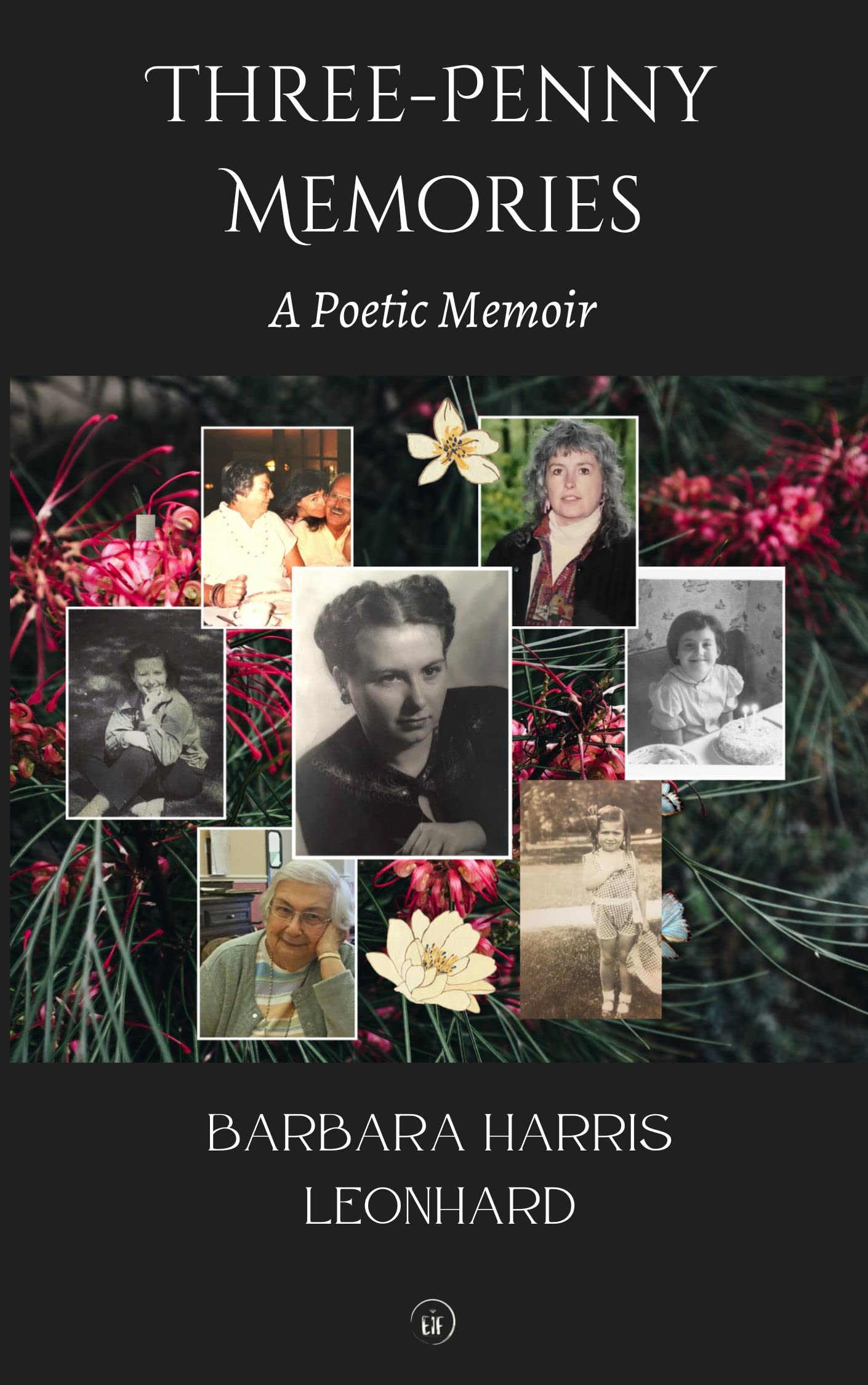
This collection of poems is a deep dive into the love between a mother and daughter. The collection takes the reader on a journey of the poet’s life and the development of the relationship with her mother. She covers her own life threatening illness and the subsequent incapacity and recovery process, as well as her later discovery of the poet’s inability to carry a child to term due to her mother’s ingestion of Diethylstilbestrol (DES) during her own pregnancy. How ironic that the poet’s mother took this drug to ensure the health of her own pregnancy and it resulted in childlessness for her own daughter. Life is full of bitter irony.
Throughout all the trials and tribulations of her life, the poet’s love for her mother burns like a flame, as does her mother’s love for her. And then came Alzheimer’s, the destroyer. The part of the book and the poet’s internal conflict and wrestle with her own feelings was close to my heart. Dementia and Alzheimer’s change people, turns them into someone you don’t know. Someone who doesn’t know you, someone who endlessly demands, complains, and makes bitter comments. In between, there are moments of normalcy and during those times, love returns in a rush, along with accompanying guilt for the conflicting emotions of the bad times.
This book captures the ebb and flow of human love and emotion exactly. It does not examine it, rather it describes and defines it.
A few stanzas from poems that stood out for me:
“One day says – out of nowhere –
shattering words out of her scattered mind
“You’re still childless? Don’t know why!
I dropped seven!”
From Mom’s DES Baby: The Hardest Pill to Swallow
“Mom, flat and detached
My fear. That she’s gone.
Now for good.”
From Fool’s Gold
“How will she manage
the mysterious passage?
This woman with no memories,
no way to find the path,
recall a friend, her mother,
recognise the welcoming
Angel of Death?”
From Departing from Gate 3
The collection is incredibly revealing and emotional, and exceptional read.
Purchase Three-Penny Memories: A Poetic Memoir by Barbara Harris Leonhard from Amazon US here: https://www.amazon.com/gp/product/B0BH99FS2T
About Barbara Harris Leonhard
I’m a retired Instructor of English as a Second Language. Although I have been writing since I was age 8, after retiring in 2017, I have had more time to devote to writing. My WordPress site is extraordinarysunshineweaver.blog. My work appears in online and print literary magazines, journals, and anthologies, and my poetry has won awards and recognition. My debut poetry collection, Three-Penny Memories: A Poetic Memoir (EIF (Experiments in Fiction, 2022), which is about my relationship with my mother, who suffered from Alzheimer’s, achieved best-seller status on Amazon. Also, on Spillwords, I was voted Author of the Month of October 2021, nominated Author of the Year for 2021, and recognized as a Spillwords Socialite of the Year in 2021. I enjoy bringing writers together and have been sponsoring open mics on Zoom. I live in the Midwest of the United States with my husband, Dierik, and our cat, Jasper. Dierik and I enjoy long drives to the wetlands to count the deer.
You can find out more about poet, Barbara Harris Leonhard, on her blog here: https://extraordinarysunshineweaver.blog/about/
About Robbie Cheadle
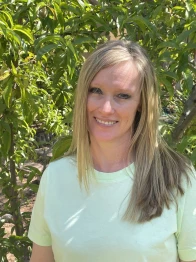
Award-winning, bestselling author, Robbie Cheadle, has published fourteen children’s books and two poetry books. Her work also features in several poetry and short story anthologies.
Robbie also has two novels published under the name of Roberta Eaton Cheadle and has horror, paranormal, and fantasy short stories featured in several anthologies under this name.
The eleven Sir Chocolate children’s picture books, co-authored by Robbie and Michael Cheadle, are written in sweet, short rhymes which are easy for young children to follow and are illustrated with pictures of delicious cakes and cake decorations. Each book also includes simple recipes or biscuit art directions which children can make under adult supervision.
Robbie and Michael Cheadle have recently launched a new series of children’s books called Southern African Safari Adventures. The first book, Neema the Misfit Giraffe is now available from Amazon.
Robbie’s blog includes recipes, fondant and cake artwork, poetry, and book reviews. https://robbiesinspiration.wordpress.com/




















