Chatting with New Blood: Svetlana Rodina
Posted: October 3, 2026 Filed under: Book Review, Books, Chatting with New Blood, Fiction, Interview, Literary, Review | Tags: Author Interview, Book Review, Chatting with New Blood, Kaye Lynne Booth, Literary Fiction, Little Red Riding Hood: Letters from the Wolf, Svetlana Rodina, Writing to be Read Leave a comment
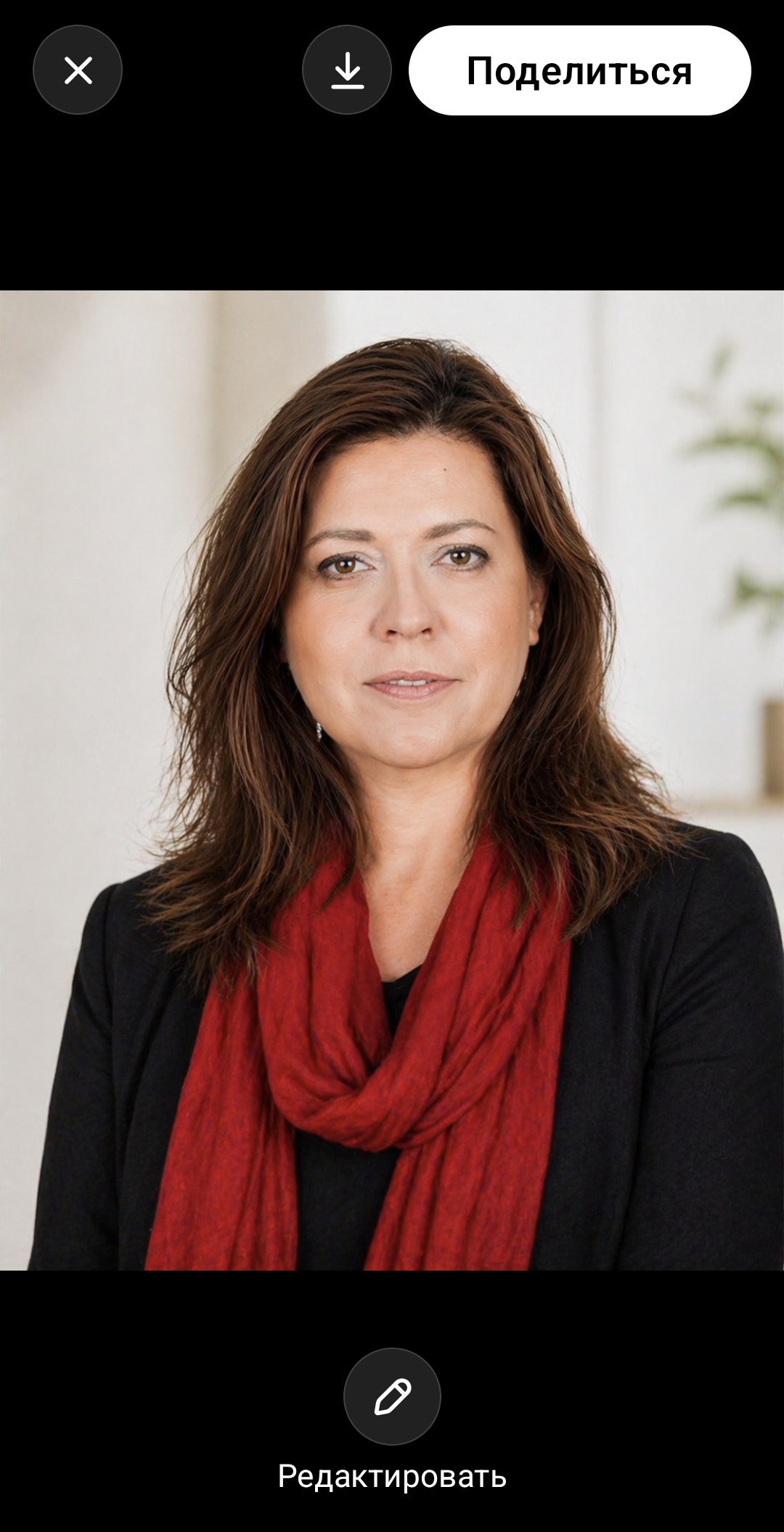
Introduction to Author Svetlana Rodina
Svetlana Rodina is an independent writer based in Buenos Aires. She writes contemporary women’s fiction that reimagines familiar fairy tales through the lives of modern adult women. Her novels explore family memory, identity, relationships, inherited stories, and the moment when familiar roles and expectations stop working. She’s especially interested in what remains when the fairy-tale script falls apart, and a woman has to decide for herself what comes next.
My Interview with Svetlana Rodina
Kaye: Please start by telling us about your author’s journey. What drives you to write?
Svetlana: I came to fiction relatively late. I trained as a translator and spent many years working in education, so my professional life was built around language, economics, and people rather than literary publishing. I began writing during a very difficult period in my life, when a psychologist suggested putting my thoughts into words. At first, that was all it was meant to be. I certainly did not expect it to become a novel. But as I continued, I discovered that fiction gave me a way to explore the questions that mattered most to me. What do we owe our parents? How much of a life is truly our own? Can a family lie sometimes be an act of love? What happens when, in midlife, you realize that the story you have been living was shaped long before you were old enough to question it? That is what keeps me writing now. I am drawn to the moment when an adult woman stops moving along the path laid out for her and begins to ask whether it is really hers.
Kaye: Red Riding Hood is your first literary work. What was your inspiration?
Svetlana: The emotional starting point was very personal. I found myself thinking about the stories families tell about themselves: who was good, who was guilty, who sacrificed everything, who abandoned whom. When the same version is repeated for years, it gradually stops sounding like an interpretation and starts sounding like fact.
That led me back to Little Red Riding Hood, one of the simplest stories we learn as children. There is a girl, a mother, a grandmother, a wolf, and a road through the forest. Everyone has an assigned role, and we know from the beginning whom the girl should fear.
Adulthood is rarely so convenient. I began wondering what would happen if Red Riding Hood were no longer a child but a fifty-three-year-old woman. What if the “wolf” were not necessarily the person she had been taught to fear? And what if the adults who gave her the map had themselves been frightened, mistaken, or hiding something? That question became the beginning of the novel.
Kaye: Can you give us a brief overview of the story?
Svetlana: Rose Hood is fifty-three and lives in Buenos Aires. For most of her life, she has believed that her father died when she was young, but photographs, letters, and family documents begin to contradict the story she has always known. She is forced to consider a much more unsettling possibility: perhaps her father did not die at all. Perhaps he disappeared.
At the same time, the person most likely to explain what happened, Rose’s mother, is losing her memory. Rose is therefore trying to reconstruct the past just as one of its last witnesses is gradually losing access to it.
There is a mystery at the center of the novel, but solving it is not the whole story. What interests me more is what Rose will do with the truth once she finds it, because discovering a family secret is one thing; deciding whether the next generation should inherit it is something else.
Kaye: What kind of things did you research to write this book?
Svetlana: The research covered several layers of the novel: Buenos Aires itself, migration, family archives, old photographs and documents, and the ways private histories survive through very ordinary objects. I became particularly interested in material traces of the past. A photograph without a date, a letter, a name written differently, or an archive card can suddenly alter the story a family has repeated for years. That became important to the structure of the book, because Rose never receives one convenient
explanation. She has to reconstruct what happened from fragments, and each fragment gives her only part of the picture. I wanted the reader to experience some of that uncertainty with her rather than simply being told the answer.
Kaye: What was the most interesting fact you turned up while researching to write Red Riding Hood?
Svetlana: The most important discovery was not really a historical fact but something I began to notice about the
way we look at the past. We judge previous generations with knowledge they never had. Looking backward, it is easy to say that
someone should have told the truth, should have stayed, or should have made a different decision, because we already know what followed. The person making that decision knew none of it. They might have been frightened, exhausted, in love, ashamed, dependent on someone, or simply unable to imagine the consequences.
Realizing this changed the way I wrote the characters. I became much less interested in deciding who was right and much more interested in understanding why each person could believe they were right at that particular moment. The past becomes considerably more complicated once you stop treating it as a solved case.
Kaye: The character of Rose is a strong female character. How much of Svetlana found its way into Rose?
Svetlana: Quite a lot, although Rose is not me. We share an age, a city, and some of the same inner questions. What passed from me into Rose was less biography than emotional experience. I understand very well what it means to live inside a family story and then begin to suspect that parts of it are missing, softened, or rearranged. I also know the feeling of looking back at your life and asking yourself which beliefs were really yours and which you accepted because they were handed to you early. I was never interested in making Rose “strong” in a simple way. She is not fearless. She hesitates, doubts herself, becomes angry, and sometimes wants certainty simply because uncertainty hurts. What matters to me is that she is able, in the end, to look again at the story on which she has built part of her life. That kind of courage interests me much more than heroics.
Kaye: We’ve all heard the advice “Write what you know.” You obviously took this to heart, placing your story in a setting you are familiar with. What literary devices did you employ to capture the atmosphere of Buenos Aires?
Svetlana: I deliberately avoided presenting Buenos Aires as a postcard. Beautiful cities in fiction sometimes seem to exist permanently at sunset, with everyone sitting at picturesque café tables. Living in a city is rather less cooperative than that.
I wanted Buenos Aires to appear through ordinary experience: streets, apartments, transport, weather, distances, errands, waiting, noise, and constant movement. Instead of stopping to explain the city, I let sensory and physical details accumulate around Rose as she moves through it. Contrast also became useful. Buenos Aires is enormous and continuously in motion, while Rose’s investigation becomes increasingly intimate, reduced to photographs, papers, rooms, conversations, and fragments of memory. Millions of people continue with an ordinary day outside while, inside one apartment, a woman’s understanding of her childhood may be changing completely. That tension made the city feel like more than a backdrop.
Kaye: Is there a message that you hope readers will walk away with after reading this book?
Svetlana: I distrust novels that behave like instruction manuals, so I would rather leave readers with a question than hand them a conclusion: How much of the story you tell about yourself was actually written by someone else? We inherit family versions of the past very early, and most of us live with them for years before we think to examine them. One of the things that matters to me in this book is that moment of re-examination, when a person begins to ask not only what happened, but also what she has been taught to believe about what happened.
The novel also touches on forgiveness, though not in any easy sense. Understanding why someone made a choice does not automatically make that choice right. But once we stop arranging people too neatly into heroes, victims, and villains, the past often becomes more human and more difficult at the same time.
Kaye: What was the biggest challenge for you when writing Red Riding Hood?
Svetlana: The hardest part was balancing the mystery with emotional realism. There is a genuine question at the heart of the book about what happened to Rose’s father, so naturally the reader expects answers. The difficulty is that Rose’s mother, who may possess the most important information, is losing her memory at exactly the moment Rose needs her. I did not want memory loss to function as a convenient plot device, and I did not want to reward the reader with a miraculous final confession in which every
uncertainty disappears neatly.
Family histories rarely work that way. My challenge was to reveal enough for Rose’s investigation to feel satisfying while allowing some uncertainty to remain. Eventually the more interesting question became not whether Rose could know absolutely everything, but whether she could live differently despite the things she might never know.
Kaye: What did you enjoy most about writing this book?
Svetlana: I loved constructing it from photographs, letters, documents, and contradictory recollections, and deciding when the reader should encounter each piece. In that sense, writing the novel sometimes felt like assembling an archive.
An object can appear early in the book and seem perfectly ordinary, then acquire an entirely different meaning once the reader knows more. That kind of construction was enormously enjoyable.
I also liked finding ways to echo Little Red Riding Hood without writing a literal retelling. The red hood, the wolf, the road, the mother’s warning, and the journey toward an older woman are still there, but mainly as psychological or structural echoes. I wanted readers to feel the old tale somewhere beneath the contemporary story without requiring a man dressed as a wolf to hide in a Buenos Aires apartment. Even family fiction has its limits.
Kaye: What inspired you to create a Buenos Aires coloring book? What were the challenges of that project?
Svetlana: The coloring book grew from another aspect of my fascination with Buenos Aires. While looking through archival photographs, I became interested in the older city that still seems to exist underneath the modern one.
Buildings disappear, streets change, vehicles and shop signs vanish, yet an old photograph can still feel unmistakably like Buenos Aires. The challenge was translating that atmosphere into black-and-white
illustrations that remained clear enough to color without losing the character of the original scenes.
Surprisingly, the process reminded me of writing. Both begin with far more information than you can use,
and eventually you have to decide which details actually carry the identity of the scene.
Kaye: Are there other projects on the horizon? What’s next for Svetlana Rodina?
Svetlana: Red Riding Hood turned out to be the beginning of a larger body of work. I am continuing to use familiar fairy tales as frameworks for contemporary adult stories, especially stories about women at the stage of life when the world often assumes the decisive chapters are already behind them.
What interests me, though, is precisely the opposite. Midlife can be the moment when the old explanations stop working, when long-accepted roles begin to feel strange, and when the questions a person avoided for years become impossible to ignore. So, the next books stay in the same territory as Red Riding Hood. They return to women looking again at the lives they have built, the stories they inherited, and the choices they may still be able to make.
Kaye: Where can readers who want to know more about you or about Red Riding Hood find you online?
Svetlana: Readers can find Red Riding Hood: The Letter from the Wolf and follow my work here:
Official website: https://svetlana-rodina.com
Payhip: https://payhip.com/b/6NgSW
Instagram: https://www.instagram.com/shapk_a2026/
Facebook: https://www.facebook.com/profile.php?id=61592242406213
I’m Svetlana Rodina, an independent writer based in Buenos Aires. I write contemporary psychological
and family fiction about memory, identity, inherited stories, and what happens when the roles we were
given stop fitting.
About Red Riding Hood: The Letter from the Wolf
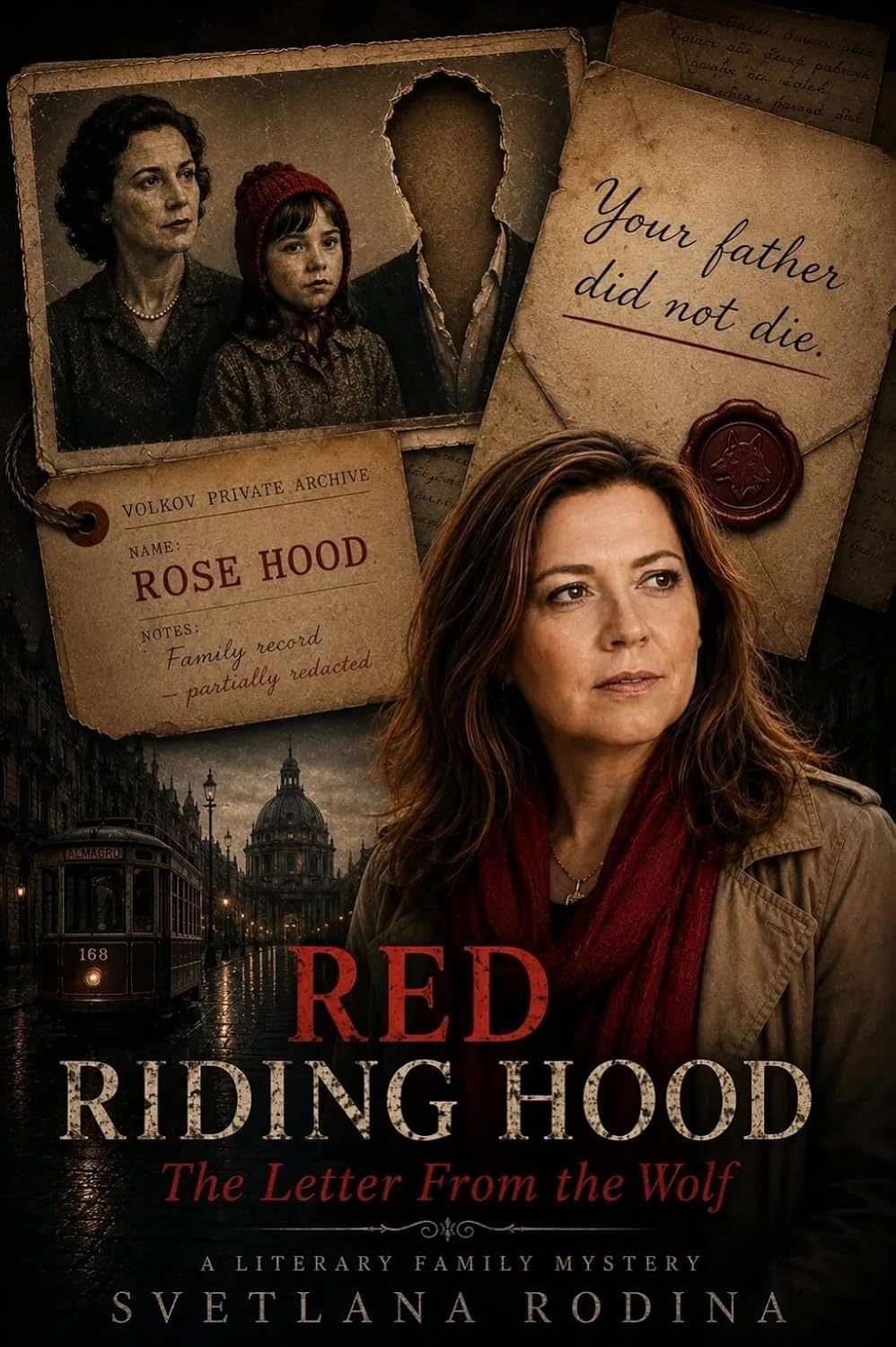
For readers of literary family mysteries, emotionally precise women’s fiction, and book club fiction.
Her father did not vanish. He was edited out.
At fifty-three, Rose Hood has become skilled at living beside loss: an ageing mother in Moscow, a grown son pulling away, a career quietly reducing her to “institutional memory”, and a city that keeps people company without offering comfort.
Then a worn parcel arrives at her Buenos Aires apartment: photographs, tram tickets, old receipts, and a file marked with her name. Inside is a version of her childhood that does not match the one she was taught to survive.
As Rose follows the trail through archives, railway stations, forgotten apartments and the neighbourhood where her father may have lived within reach, her mother begins to forget the only facts that might still matter. The family story is collapsing from both ends: the documents are speaking, and the witness is disappearing.
Dry, atmospheric and unsentimental, The Archive of Absence is a literary mystery about memory, family secrets, late-life reckoning, and the stories families rewrite in order to survive.
My Review of Red Riding Hood: The Letter from the Wolf
I received a digital copy of Red Riding Hood: The Letter from the Wolf, by Svetlana Rodina in exchange for an honest review. All opinions stated here are my own.
As I generally read genre fiction and cozy mysteries or thrillers are more my style, I wasn’t sure what to expect from this literary family mystery, but I was pleasantly surprised. Rose isn’t trying to solve a murder or stop a killer, but I was drawn in never-the-less. The mystery she needs to solve is one of absence. When a package arrives on her fifty-third birthday suggesting that her father’s absence from her childhood was not due to his death as she had believed, it sends her on an archival mission to unravel the truth. Why did her father disappear from her life? And if he wasn’t dead, why was she led to believe that he was? And who sent the mysterious package? As an archivist, Rose knows where to look for clues, and as she uncovers each piece to the puzzle, she isn’t always sure that she wants to learn the answers. The truth may too much to bear, which could change the way she views her whole life.
The writing style is very literary, with much of the dialog in two or three word sentences, and vague thoughts from inside the character’s head which allude to more, but the story grabbed me and sucked me in as easily as a genre story would. I felt it was well-crafted, unfolding in a natural procession of events, while her position as an archivist diminishes at work, and her friend, Lucia, betrays her out of love, bringing up the issue of forgiveness. Can she forgive her friend? Can she forgive her father? And should she?
An intriguing tale of mystery which spurs an investigation into the past. I give Red Riding Hood: The Letter from the Wolf five quills.

_____________________________________
About Kaye Lynne Booth
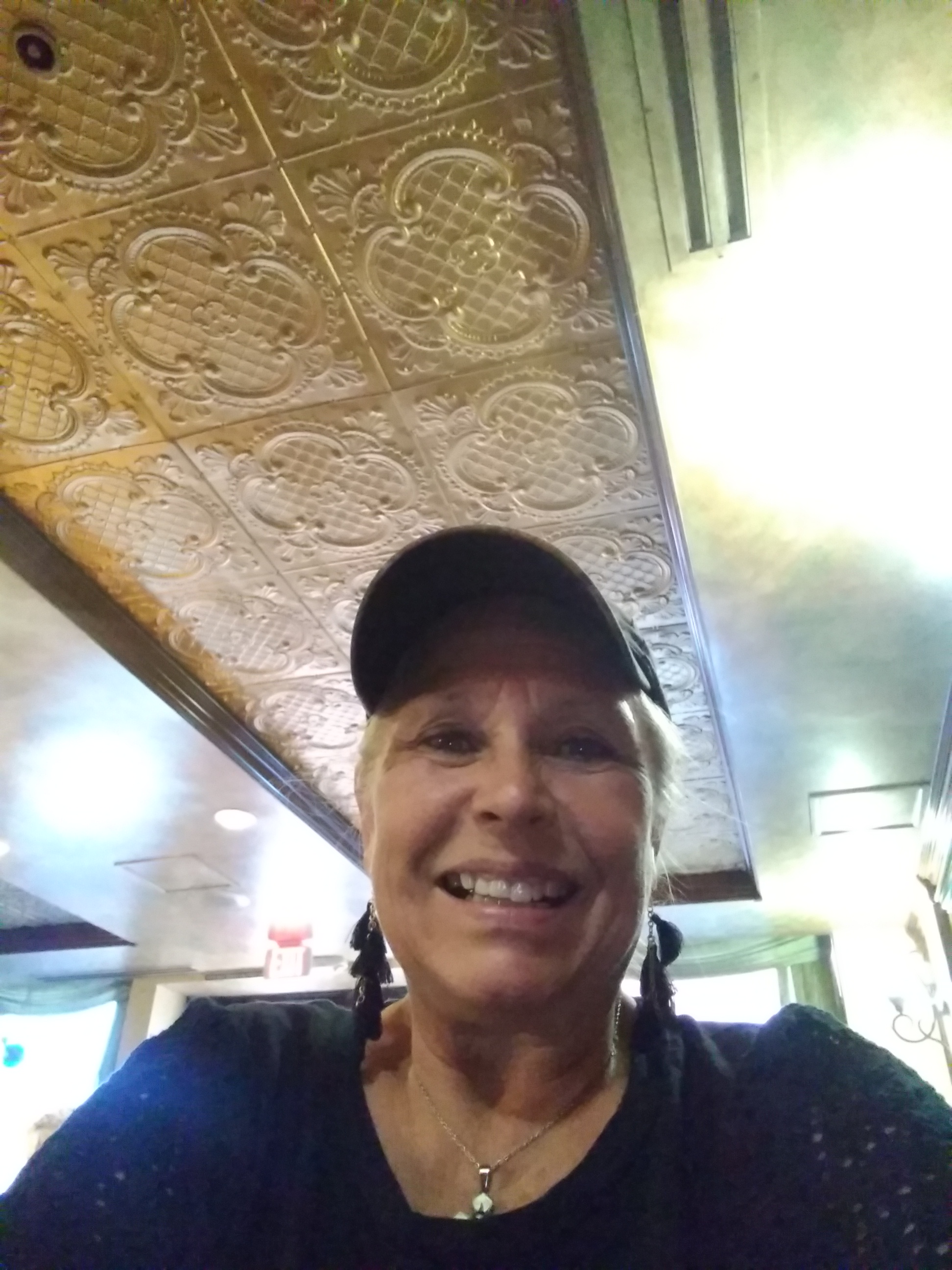
For Kaye Lynne Booth, writing is a passion. Kaye Lynne is an author with published short fiction and poetry, both online and in print, including her short story collection, Last Call and Other Short Fiction; and her paranormal mystery novella, Hidden Secrets; as well as her poetry collection, Small Wonders. Her novels include Books 1 & 2 of her Women in the West adventure series, Delilah and Sarah, and Books 1 & 2 in her Time-Travel Adventure series, The Rock Star & The Outlaw, and Double Visions.
Kaye holds a dual M.F.A. degree in Creative Writing with emphasis in genre fiction and screenwriting, and an M.A. in publishing. Kaye Lynne is the founder of WordCrafter Quality Writing & Author Services and WordCrafter Press, where she edits and publishes two short fiction anthologies and one poetry anthology every year amidst her many writing projects. She also maintains an authors’ blog and website, Writing to be Read, where she publishes content of interest in the literary world.
_______________________________________
Did you know you can sponsor your favorite blog series or even a single post with an advertisement for your book? Stop by the WtbR Sponsor Page and let me advertise your book, or you can make a donation to Writing to be Read for as little as a cup of coffee, If you’d like to show your support for this author and WordCrafter Press.
________________________________________
This segment of “Eye on Art” with Kaye Lynne Booth is sponsored by WordCrafter Press and the Narrating the Paranormal Anthology Series in the WordCrafter Spooky Special
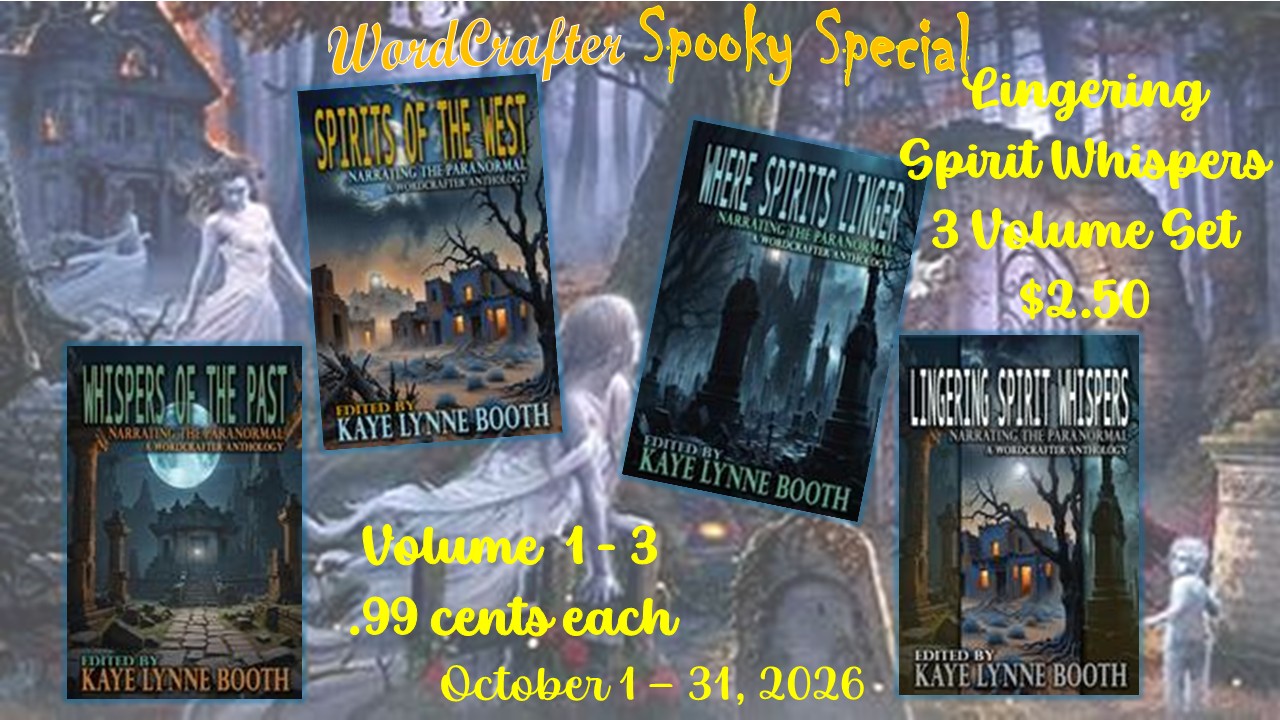
October 1 – 31, WordCrafter Press’ Narrating the Paranormal Series is on sale. Volumes 1-3 are only .99 cents each, or you can get all three volumes in volume four for only $2.50. Get your copies at the links below.
Volume 1 – Whispers of the Past: https://books2read.com/WhispersPast
Volume 2 – Spirits of the West: https://books2read.com/SpiritsoftheWest
Volume 3 – Where Spirits Linger: https://books2read.com/WhereSpiritsLinger1
Volume 4 – Lingering Spirits Whisper (3 in 1): https://books2read.com/LingeringSpiritWhispers



















