In Touch with Nature – Tailor Ants, Fire Ants, and Army Ants
Posted: June 24, 2026 Filed under: Animals, In Touch With Nature, Nature, Photography, Poetry, Wildlife | Tags: #armyants, #InTouchWithNature, #RobbieCheadle, #tailorants, In Touch With Nature, Robbie Cheadle, South Africa, Wildlife, Writing to be Read 78 Comments
Blogging friend, Barbara Harris Leonhard and editor of MasticadoresUSA, recently published a few of my micro poems that focused on tailor ants.
This is the first poem of three:
angry ants
fiercely protect nest
painful bite
You can read the other two poems here: https://masticadoresusa.wordpress.com/2026/06/08/a-trio-of-haiku-by-robbie-cheadle/
Several of the comments referred to fire ants that are found in the USA and, while tailor ants also inflict a nasty bite and are aggressive, they are not the same creatures. I decided to write this post and set out the differences between tailor ants and fire ants.
I’ve always been interested in army ants so I decided to include them in this post as well.
Primary differences between tailor ants, fire ants, and army ants
Nesting habits
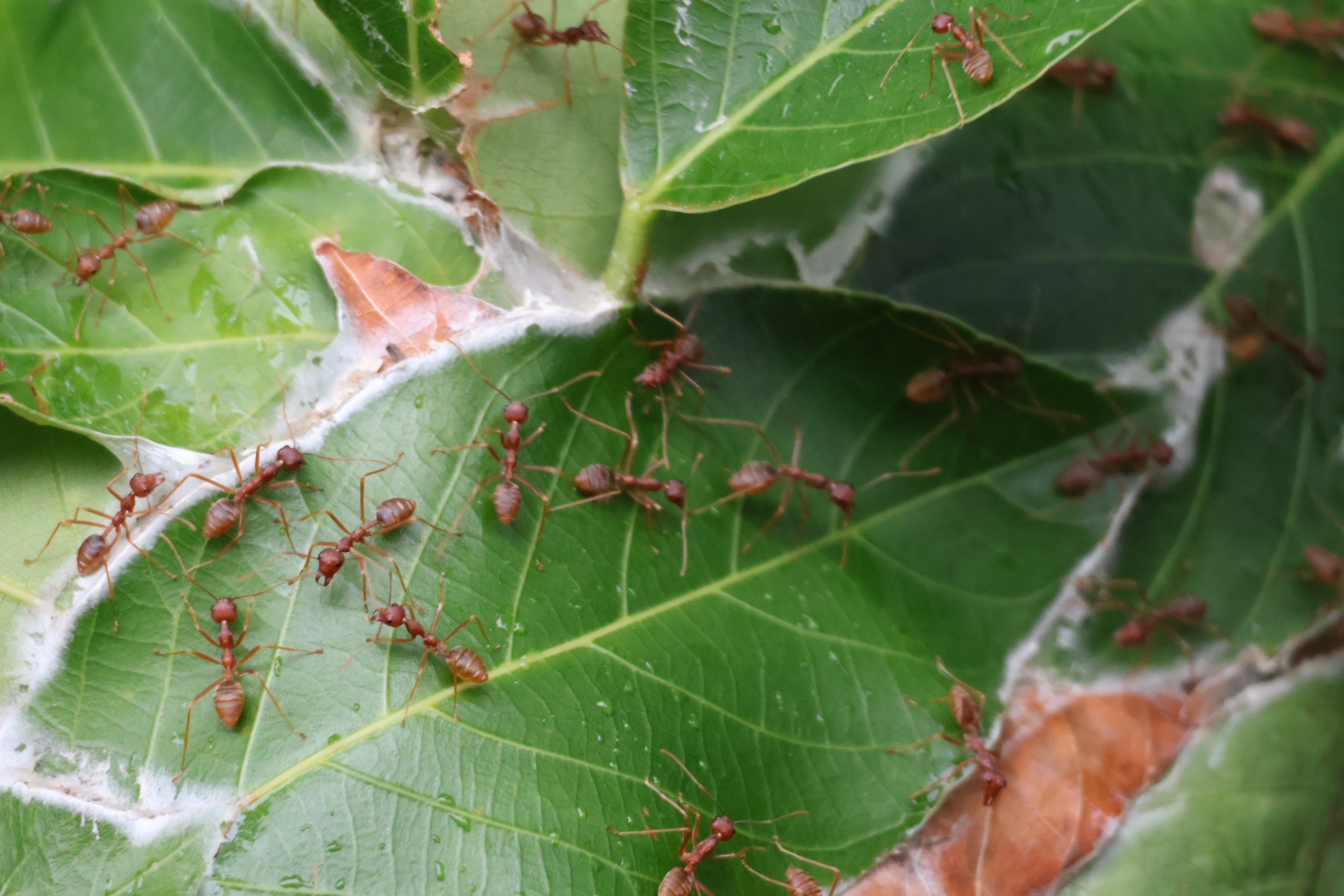
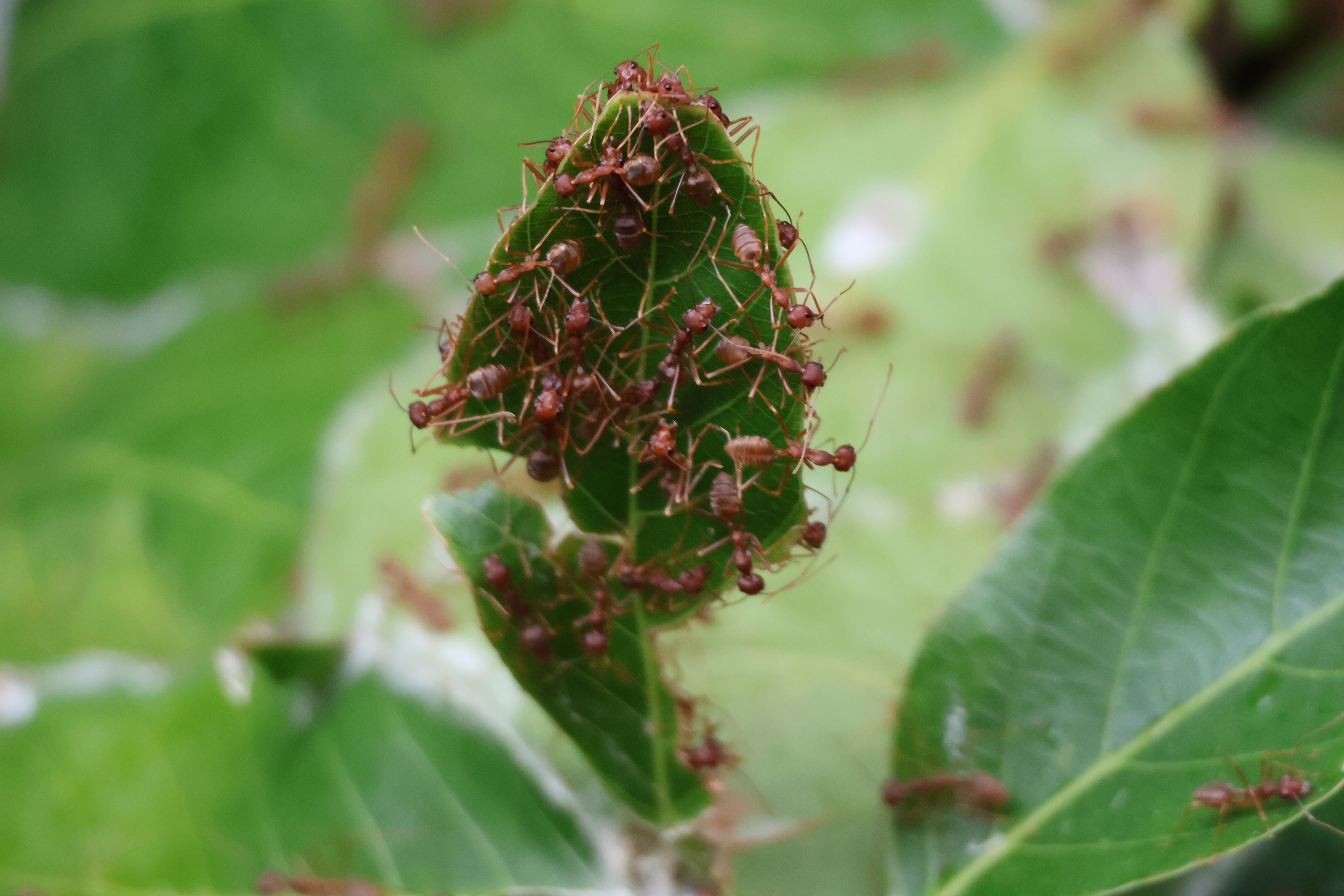
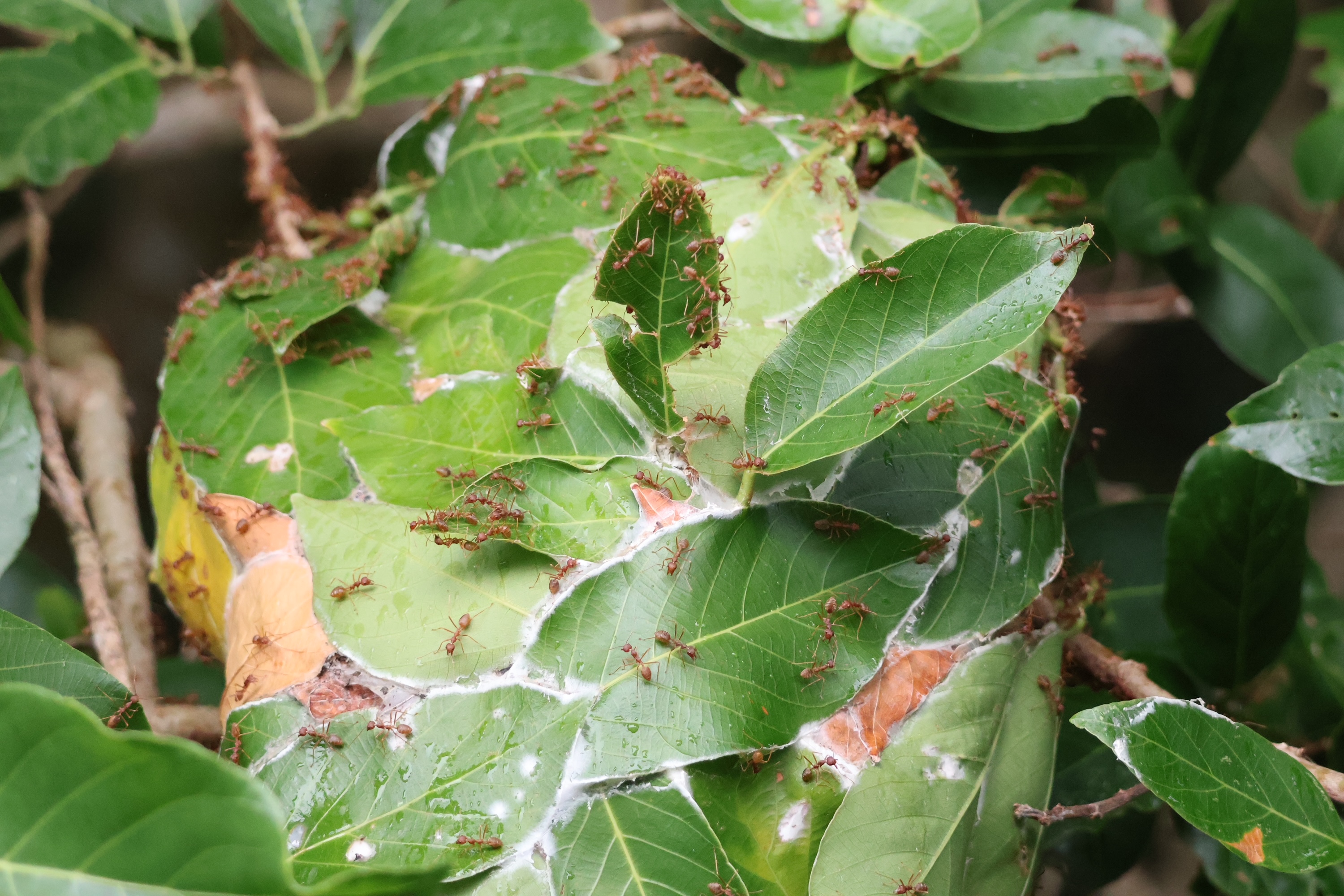
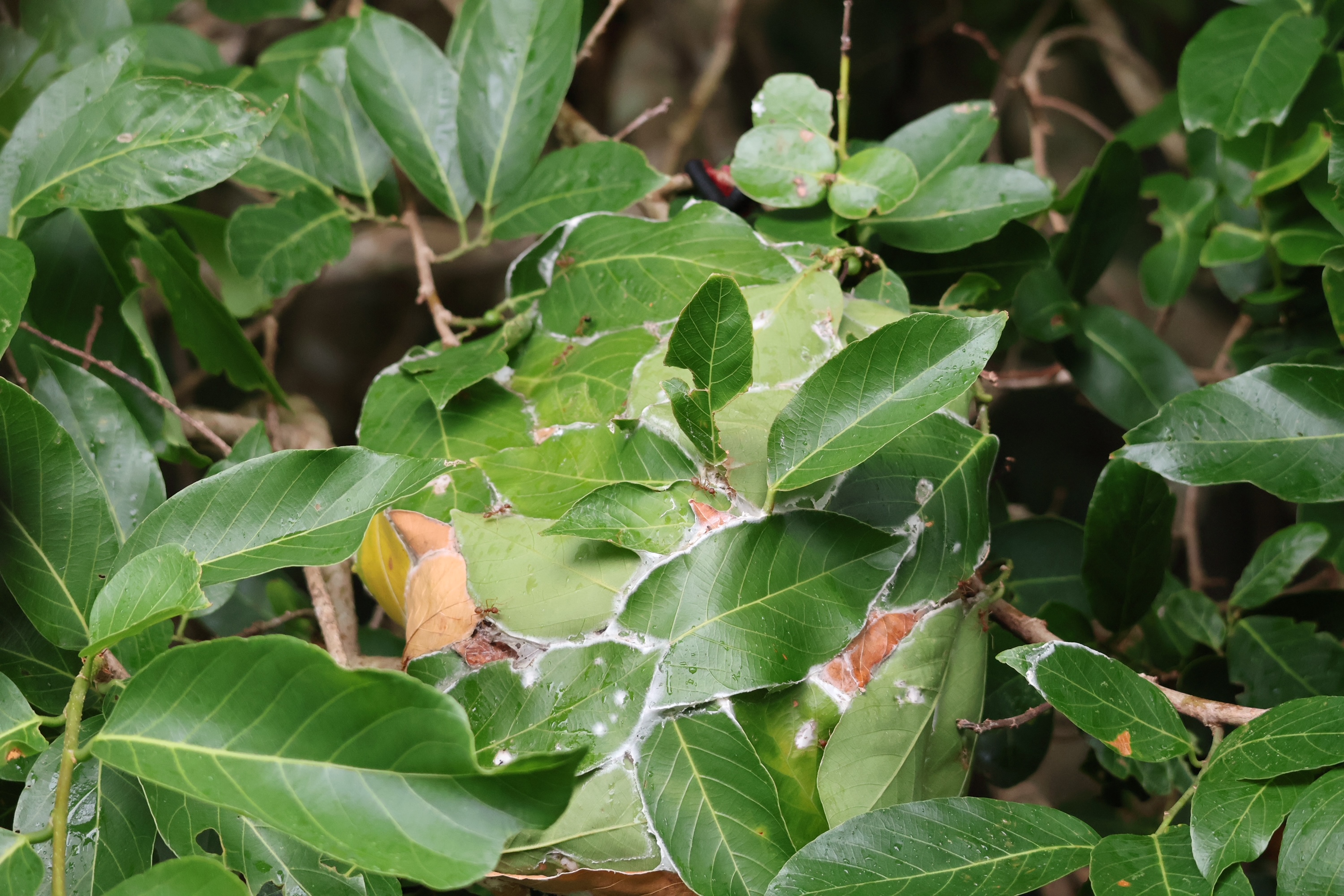
Tailor ants live in trees. They ‘tailor’ or weave living leaves together to create nests. Worker ants form long chains to pull the leaf edges together while others carry ant larvae in their jaws and use the silk the grubs secret as a natural ‘glue’ to bind the leaves together.
Fire ants build nests that appear as irregular mounds of loose soil or flat patches ranging from flat piles to domes up to 45 cm high. The nests have no obvious entry or exit holes. Ants emerge from underground foragers or swarm out of the sides when disturbed. Fire ants nests are usually found in warm, open, and sunny areas such as lawns, garden beds, near water sources, and on newly disturbed ground.
Army ants do not construct permanent nests out of soil, wood, or leaves. Instead, they assemble temporary, living nests called bivouacs. Bivouacs are const-shaped structures that house the queen and larvae and are built from the living bodies of the worker ants by interlocking their legs and mandibles. Bivouacs have internal chambers and tunnels to control temperature and humidity. As army ants colonies are constantly on the move, a new bivouac is assembled nearly every night. The colony stays in a fixed location for several weeks while the queen is laying eggs and the larvae are developing.
Foraging and hunting
Tailor ants are aggressive and defend their canopy territories by biting and spraying formic acid. Tailor ants are omnivores and hunt and eat a wide variety of crop-destroying insects and other small arthropods. They ‘farm’ sap-sucking insects like scale buys and mealybugs, protecting them from predators in exchange for their sweet, carbohydrate-rich liquid excretions. Tailor ants also consume floral and extrafloral nectar, fruit juices and plant wound secretions.
Fire ants are highly aggressive, opportunistic omnivores that hunt and scavenge using complex underground tunnel networks that extend up to 10 metres from the central mound. Individual scouts explore the surface and when a large prey is found, the scout lays a chemical pheromone trail as it returns to the nest. The pheromone acts as a biochemical alarm and recruitment trigger. The resting ants (about two thirds of the nest) awaken and follow the trail forming a dense trail of thousands of ants that overwhelm and subdue the prey. Fire ants consume live and dead insects as well as immobile, sick, or helpless animals including baby birds and reptiles. Like tailor ants, fire ants ‘farm’ sap-sucking insects like aphids to harvest their sugar-rich secretions. Fire ants also collect and eat seeds.
Army ants are ground-dwelling, mass-raiding predators. During their massive daily foraging raids, the colony can overwhelm hundreds of thousands of prey to feed their queen and growing larvae. Army ants eat insects and arachnids including spiders, scorpions, crickets, beetles, caterpillars and termites. Army ants also raid the nests of other ant species and consume their eggs, larvae and pupae. Sometimes, army ants will overwhelm slow-moving or trapped smaller animals such as baby birds, lizards, and frogs. Army ants use their powerful, scissor-like jaws to slice their prey into transportable fragments which they carry back to their bivouacs.
Physical traits and defense
Tailor ants workers are uniformly sized and have excellent eyesight for navigating tree branches. The aggressively defend their canopy with painful bites combined with spraying formic acid directly into the wound.
Fire ants workers range in size from 2 mm to 6 mm. If a fire ants mound is disturbed or vibrated, workers immediately rush out and release alarm pheromones into the air to alert the entire colony to defend the nest. Fire ants immediately swarm vertical surfaces and will rapidly climb up legs, tools or structures in vast numbers. Fire ants sting in a highly synchronized, two-stage maneuver whereby the ant latches onto skin or clothing using its strong mandibles. The ant then tucks its abdomen under its body and inserts its stinger, injecting a toxic venom called solenopsin. The ant pivots its head in a circular pattern repeatedly stinging the victim multiple times from a single anchored bite site.
Many species of army ants are completely blind and they rely heavily on complex pheromone trails. The have highly developed mandibles for tearing prey apart. There is an extreme size difference between the workers and the much larger, scissor-jawed soldier ants used for defense.
The gallery below features my photographs of tailor ants taken at Cape Vidal in Kwa-Zulu Natal in January this year.
This is my YouTube video fo angry tailor ants. They shake when they are disturbed.
About Robbie Cheadle

Roberta Eaton Cheadle, is a South African writer and poet specialising in historical, paranormal, and horror novels and short stories. She is an avid reader in these genres and her writing has been influenced by famous authors including Bram Stoker, Edgar Allan Poe, Amor Towles, Stephen Crane, Enrich Maria Remarque, George Orwell, Stephen King, and Colleen McCullough.
Roberta has two published novels and a collection of short stories and has horror, paranormal, and fantasy short stories included in several anthologies. She is also a contributor to the Ask the Authors 2022 (WordCrafter Writing Reference series).
Roberta is also the author and illustrator of seventeen children’s books, illustrator to a further three children’s books, and the author and illustrator of four poetry books published under the name of Robbie Cheadle, and has poems and short stories featured in several anthologies under this name.
Roberta’s blog features discussions about classic books, book reviews, poetry, and photography. https://roberta-writes.com/.
Find Roberta Eaton Cheadle
Blog: https://wordpress.com/view/robertawrites235681907.wordpress.com
Bluesky: https://bsky.app/profile/robbiecheadle.bsky.social
Facebook: https://www.facebook.com/robertawrites
Amazon: https://www.amazon.com/Roberta-Eaton-Cheadle/e/B08RSNJQZ5
___________________________________________
Like this post? Are you a fan of this blog series? Did you know you can sponsor your favorite blog series or even a single post with an advertisement for your book? Stop by the WtbR Sponsor Page and let me advertise your book, or you can make a donation to Writing to be Read for as little as a cup of coffee, If you’d like to show your support for this author and WordCrafter Press.
__________________________________________
This segment of “In Touch with Nature” is sponsored by the Midnight Anthology Series and WordCrafter Press.

Midnight Roost: Weird and Creepy Stories: 20 authors bring your nightmares to life in 23 stories of ghosts, paranormal phenomenon and the horror from the dark crevasses of their minds. Stories of stalkers, both human and supernatural, possession and occult rituals, alien visitations of the strange kind, and ghostly tales that will give you goosebumps. These are the tales that will make you fear the dark. Read them at the Midnight Roost… if you dare. https://www.amazon.com/Midnight-Roost-Kaye-Lynne-Booth-ebook/dp/B0CL6FPLVJ
Midnight Garden: Where Dark Tales Grow: 17 authors bring you 21 magnificent dark tales. Stories of magic, monsters and mayhem. Tales of murder and madness which will make your skin crawl. These are the tales that explore your darkest fears. Read them in the Midnight Garden… if you dare. https://www.amazon.com/Midnight-Garden-Where-Tales-Anthology-ebook/dp/B0DJNDQJD3
Midnight Oil: Stories to Fuel Your Nightmares: 14 authors bring you 16 dark tales that explore your deepest fears. These are the stories which nightmares are made of. Tales of monsters, mayhem, and madness which will make you shiver in the dark. Read them while you burn the Midnight Oil… if you dare. https://books2read.com/Midnight-Oil
Discover more from Writing to be Read
Subscribe to get the latest posts sent to your email.



















Oh that’s a great poem and can’t wait to read the others and some fun creepy stories, Kaye has put together!!💕
LikeLiked by 1 person
Thank you, Cindy.
LikeLiked by 2 people
You’re so welcome.. loved them all💕
LikeLiked by 1 person
🤗
LikeLiked by 2 people
What an interesting post Robbie.
Thank you for sharing.
LikeLiked by 1 person
Thank you, Maggie. I found it interesting to learn about the different ants.
LikeLiked by 2 people
I agree we tend to forget that there are varieties in insects and animals too 🤗
LikeLiked by 1 person
🐜
LikeLiked by 2 people
Fascinating ant information, Robbie!
LikeLiked by 1 person
Thank you, Dave
LikeLiked by 2 people
Fascinating, Robbie. It’s interesting how these 3 different ants have such different lives.
And I enjoyed your haiku.
LikeLiked by 1 person
Thank you, Viv. Similar but different, just like all species.
LikeLiked by 1 person
Interesting information, Robbie. I had no idea about all these types of ants!
LikeLiked by 1 person
I knew about them but only knew a little of what I shared here. The research was so interesting for me 🐜
LikeLiked by 2 people
🐜
LikeLiked by 1 person
Fascinating details about these three types of ants. The vibrating tailor ants are wild. I’ve stumbled into fire ants and been attacked. It’s not fun. Luckily I responded quickly and was only bitten a few times, not a mass attack.
LikeLiked by 1 person
Fire ants sound horrible, Brad. They are classified as pests while tailor ants are considered helpful because they eat creatures that damage plants.
LikeLiked by 2 people
Very interesting and informative, Robbie.
The ant then tucks its abdomen under its body and inserts its stinger, injecting a toxic venom called solenopsin. The ant pivots its head in a circular pattern repeatedly stinging the victim multiple times from a single anchored bite site.
Ouch!
LikeLiked by 2 people
I know, such vicious little creatures.
LikeLiked by 2 people
Unstoppable!
LikeLiked by 1 person
😱
LikeLiked by 1 person
Such pleasant little things 😊 Fire ants have made their way to Australia and there is an eradication program in place, vicious little things. I was interested in the other two as I knew nothing of them, fascinating.
LikeLiked by 2 people
Oh my, I didn’t know you got fire ants in Australia. You have enough of your own venomous creatures without getting new ones.
LikeLiked by 1 person
Super poem, Robbie, but those ants… eish!!
LikeLiked by 1 person
Tailor ants are considered to be useful. I think they are fabulous.
LikeLiked by 2 people
I think all insects have their place. Just not in mine. As you who follow me on FB know, I had an ant infestation while living in my previous apartment. Now, I have a phobia.
.
That having been said, someone was visiting the other day, and we caught a spider, and sent it out to live another day. But those black invading ants, I just do not know if I could be that nice.
LikeLiked by 1 person
I understand. We had an ant problem and I had to put out ant traps. You can’t cohabitate with ants or rats. Spiders I also catch and release.
LikeLiked by 1 person
the fire ants terrify me
LikeLike
They sound like vicious little things. Mind you, army ants sound pretty grim too.
LikeLiked by 2 people
Thank you for this Robbie- it was so interesting and informative!
LikeLiked by 1 person
Hi Violet, I’m pleased you found this interesting. I enjoyed reading about these ants 💓
LikeLiked by 2 people
It’s great to read Robbie’s fascinating poem on angry ants, absorb all her information on ants, and see here fantastic pictures and videos! It’s wonderful that it’s all posted here, Barbara!
LikeLiked by 1 person
Thank you, Tim. I found the research about fire and army ants from the Americas very interesting. Ants are so organized.
LikeLiked by 3 people
You’re welcome, Roberta. 😍 I appreciate getting the information and seeing the pictures and videos.
LikeLiked by 1 person
💚, nature is very interesting
LikeLiked by 2 people
Yes, Roberta, SO interesting! 😍
LikeLiked by 1 person
💖
LikeLiked by 2 people
Tailor ant nests are so creative; nature is amazing. The army ant nests are a little creepy. And fire ant nests … well, we have a whole yard full of them, and they are why I never stand still in our yard. Their sting isn’t that bad, but stings leave tiny, itchy blisters that look like pimples and last for DAYS.
LikeLiked by 2 people
Fire ants sound like vicious little creatures but I guess you learn to strategies and manage them 💞
LikeLiked by 2 people
Love the poem, and the facts about the ants.
LikeLiked by 1 person
I’m pleased to know this 🤗💞
LikeLiked by 2 people
😀
LikeLiked by 1 person
*shudder* It’s carpenter ants we have to guide against at our place. They can do some serious damage to wooden structures.
LikeLiked by 2 people
Hi Liz, we get carpenter ants here especially in Mpumalanga where part of the Kruger National Park is situated.
LikeLiked by 2 people
I was wondering if you did! (I thought it likely.)
LikeLiked by 1 person
💓
LikeLiked by 2 people
Sounds like the white ants in Australia.
LikeLiked by 2 people
These are big and black.
LikeLiked by 1 person
💚
LikeLiked by 2 people
After I wrote that I realised the white ants are actually termites.
LikeLiked by 2 people
We had those in Virginia. Destructive little creatures. ☹️
LikeLiked by 2 people
We get white ants here too. They’ll eat a whole painting.
LikeLiked by 3 people
Yikes!
LikeLiked by 2 people
My mother lived in Mississippi when she was growing up. She said the fire ants were bad where she lived, and that one day they were hanging out wash, and my uncle who was about 1 and a half or 2 years old sat in a mound of their dirt, and was digging in it when they turned to look. She said the ants attacked him.
They had to take him to the hospital because they bit him so badly.
My uncle says of course, that he does not remember this but even so he has always had a great dislike for insects.
LikeLiked by 2 people
Oh, that is a horrible thing to happen to a little boy. I’m not surprised he doesn’t like insects after that.
LikeLiked by 1 person
My mother flipped out and when I was born I had an allergy to all stinging and biting insects.
I still have reactions but I have not been stung or bitten badly in years. Age brings more caution.
LikeLiked by 1 person
Yes, I get blood poisoning from the bacteria carried by bees and wasps. I have a bad reaction to other bites too. I am careful 🐝
LikeLiked by 1 person
That was really scary
LikeLiked by 1 person
😱🐜
LikeLiked by 1 person
I think there is a story idea in ants eating a whole painting! Imagine the poor artist arriving at his studio to put the last touches to his masterpiece.
LikeLiked by 1 person
Indeed. Please write it but don’t let the ants eat one of my paintings 😂🤣
LikeLiked by 2 people
This is really cool information.
LikeLiked by 1 person
Thanks Craig. Perhaps you could put a crazy version in The Hat 😉
LikeLiked by 2 people
Could happen.
LikeLiked by 1 person
💚
LikeLiked by 1 person
Ants are interesting creatures, because of their social structures and cooperative behaviour, but I’d rather see them outside rather than in my house. I’d never heard of tailor ants; thanks for this info, Robbie!
LikeLiked by 1 person
Hi Audrey, we have some pretty interesting creatures here. Tailor ants are considered useful.
LikeLiked by 2 people
[…] https://writingtoberead.com/2026/06/24/in-touch-with-nature-tailor-ants-versus-army-ants/ […]
LikeLiked by 1 person
When we went to Australia we soon noticed the ants were more aggressive than English ants and if you brushed them off they smelt awful, formic acid?
The English plant pot ants live in my garden and get very annoyed if I move a pot. What were tidy paving stones have become a lush ants nest with tons of soil brought to the surface!
I had a serious tidy up of my potting shed, tossing boxes and trays onto the lawn upside down so spiders etc could escape before I washed them. When I started picking them up the ants had already made nests and laid eggs. They were not pleased when I took their roof away, but they were soon at work picking up eggs and rushing around. Not sure if they had a plan or were panicking.
LikeLiked by 1 person
Ants are very organized and always have a plan. Australia is full of all sorts of scary creatures. It has the most venomous creatures in the world.
LikeLiked by 2 people
Yes the white ants everyone dreaded in the woodwork are actually termites.
LikeLiked by 1 person
Fascinating, Robbie. Don’t mess with fire ants!
LikeLiked by 1 person
Wonderful post, Robbie!
LikeLiked by 1 person
Thank you, Dawn
LikeLiked by 1 person
Good grief!
Definitely a small, but terrifying insect in many ways.
Of all the creatures on the planet, they seem closest to man, in the collective sense: they will make war on other ants, gather military by the thousands to defend when attacked, kill for food, are omnivorous, take slaves to do work or produce sap, but mostly that they will war.
Whew! Thanks Robbie and Kaye Lynn!
PS… I LOVE the movie THEM (about giant ants from radiation… one of many 1950’s Creature Features)
LikeLiked by 1 person
Ants do make good story fodder, Resa. 😊
LikeLiked by 1 person
🐜🤎
LikeLiked by 1 person
🥰
LikeLike