Read and Cook – This Is How We Work: Stories, Memoirs and Poems about Social Dimensions of Work and Stained Glass Biscotti for the Annual Cookie Exchange
Posted: December 10, 2025 Filed under: Recipes, Review, Robbie Reads and Cooks | Tags: #baking, #Bookreview, #non-fiction, #ReadandCook, #RobbieCheadle 90 CommentsToday, I am delighted to share my review of a unique anthology centering around work experiences in the broadest sense of the word work. This Is How We Work: Stories, Memoirs and Poems about Social Dimensions of Work was compiled by contributing editor Yvette Prior.
This Is How We Work: Stories, Memoirs and Poems about Social Dimensions of Work
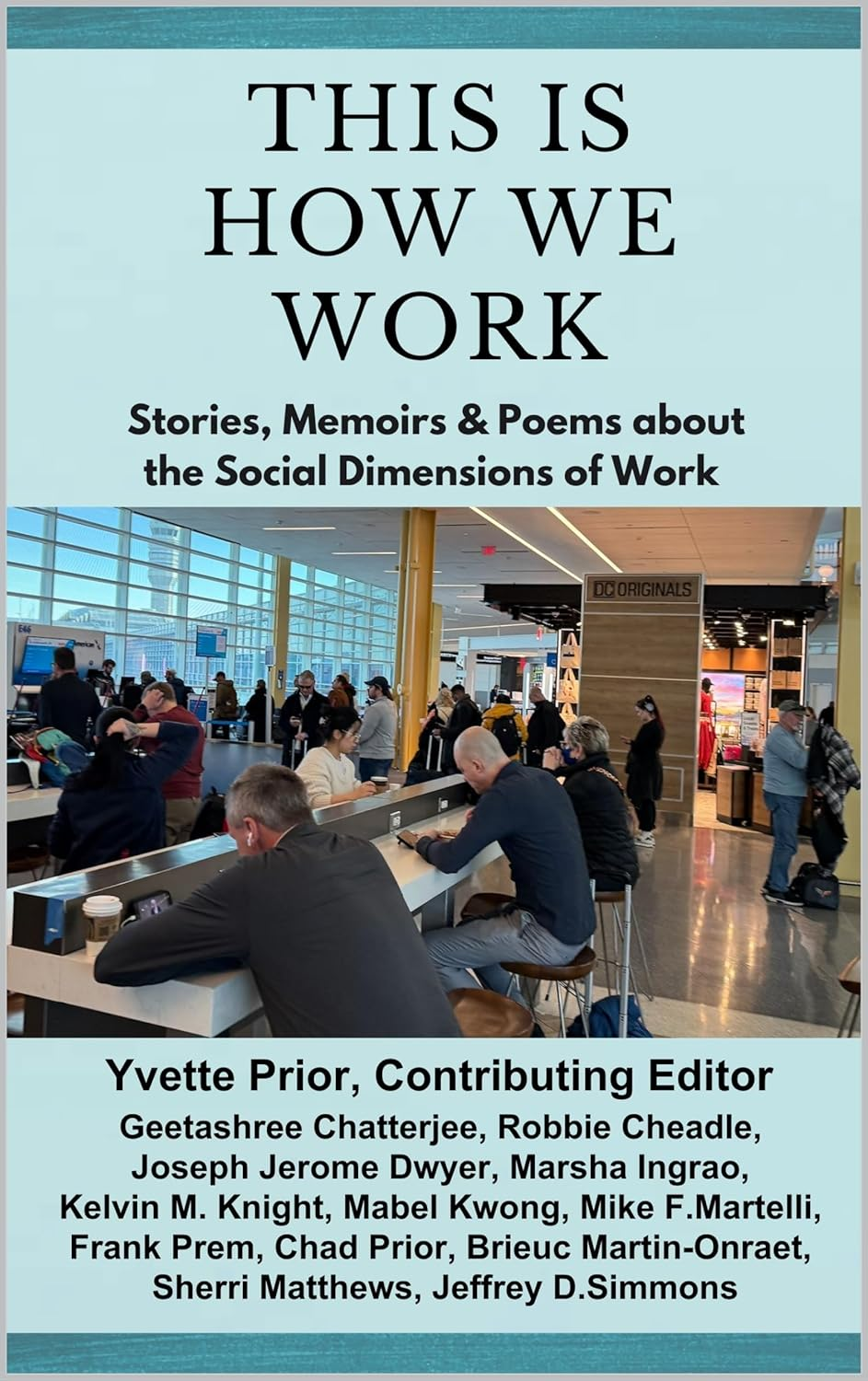
This Is How We Work is a unique collection of stories, memoirs and poems which all centre around the theme of the workplace. It is a most insightful and interesting collection as the various contributors from around the world all engage/engaged in different forms of work, many quite different from my own experiences in the corporate world.
Chapter 1 by Yvette Prior, the editor and a co-contributor, provides insight into why she selected this theme for the anthology and sets out the aims of the anthology for readers. It ends with a wonderful quote: “We work to live, but stories help us understand why we live, and sometimes, why we work.”
All of the contributions are compelling and give great insight into the evolution of the contributors careers and how their ideas on work changed over time. I have experienced this happening from my own perspective in my job so it is very relatable for me. I am going to share a bit more about the contributions that resonated the most with me.
Chapter 3, The Quiet Work of Love by Sherri Matthews was particularly useful and, in many ways heart rending, for me. Sherri depicts her journey as a caregiver to her mother as she aged and became less capable. I have followed this journey to a lessor extent with my aging aunt and am also following it with my own aging parents. The emotional angst of watching those we love giving up everything they enjoy and care about over time and becoming frail is hard – very hard. Sherri’s story was relatable and a mixture of encouraging and horrifying as I read it.
Chapter 4, The Creative Dream Job That Wasn’t So Dreamy, by Mabel Kwong also interested me greatly. I am a chartered accountant with a highly creative bend and spend a lot of my spare time writing and painting. Up until recently, I cherished the idea of turning these ‘hobbies’ into income producing activities. Prior to reading Mabel’s story, I had already arrived at the conclusion that turning creative outlets into work changed them in a negative way. When you paint commissions, you lose control over the creative output on many levels. Painting on demand is very different from someone seeing something you have created and asking to buy it as it is. Commissions means dancing to the purchasers tune which curtails your own creative ideas. It is the same with writing. If you write for the traditional publishing market, you write to the rules of the traditional publishers. That doesn’t work for me and I have never attempted to find a traditional publisher for my work. Mabel’s story of disillusionment with paid writing confirmed my own views, despite the fact that Mabel did gain a great deal from the experience and she grew as a writer. Anyone contemplating writing for a living should read this memoir.
Chapter 6, The Paper Knife Incident by Brian Martin-Onraet, was a delightfully entertaining story about working in Gabon, Africa. It highlights differences in work ethics and circumstances of workers and also focuses on management choices and behaviours. Brian is an excellent writer and I hope he publishes more of his fascinating stories.
Chapter 7, Serving The Patient, Resisting The System: Work Across by Career by Mike F. Martelli, is riveting reading. Mike’s journey in the field of mental health was insightful into how the health system has changed over time and is now focused on patient turnaround rather than patient service. It was sad for me as a reader and I’m sure its incredibly disillusioning for medical practitioners who enter the system full of the eagerness to make a difference of youth. Although this piece focuses on the health industry, its content applies to many other fields like teaching and even corporate work.
Chapters 11, Eighty-five Degrees For Me by Marsha Ingrao, and 13, Asylum Ghosts (And No Escape Room) by Frank Prem (Poetry), both give incredible insight into the worlds of teaching and psychiatric nursing, respectively. I learned a great deal about these professions, which are in my mind callings, and my respect for the people who enter these professions increased tenfold.
Chapter 16, Chapter Summaries by Yvette Prior, is a lovely summary of each of the contributions including her personal thoughts on how these pieces and poems can benefit readers. Yvette also contributed some beautiful and thought provoking poems to the collection.
I highly recommend this meaningful collection.
This Is How We Work: Stories, Memoirs and Poems about Social Dimensions of Work is available form Amazon US here: https://www.amazon.com/This-How-We-Work-Dimensions-ebook/dp/B0FWC6BMFP/
Recipe: Stained Glass Biscotti

My recipe for December is Stained Glass Biscotti. It is also my contribution to Staci Troilo’s annual Cookie Exchange. You can read more about it here: https://stacitroilo.wordpress.com/2025/12/01/thanks-deals-treats. You can find all the cookie recipes from the last four years of the Cookie Exchange here: https://stacitroilo.wordpress.com/recipes/
This recipe comes from The Australian Women’s Weekly Christmas miniatures finger food and tiny treats. I have this book as a paperback and have used it to make Christmas treats for years.
This is a gallery of the book cover and two of the recipe pages:


Ingredients
165 grams caster sugar
2 medium eggs
200 grams plain/all purpose/cake flour
50 grams self raising flour
300 grams multi glace cherries (a mix of colours is preferable)
80 grams sliced/diced almonds
Method
Preheat the oven to 180 C or 350 F. Prepare your cookie baking tray using grease or oil spray.
Mix sugar and eggs in a mixing bowl until well combined and then stir in flour, cherries and nuts. Knead the doub on a floured surface until smooth. Divide the dough into two parts and roll each part into a long sausage/log. Place logs on the prepared baking trays and bake for 30 minutes. Remove from oven and cool for 10 minutes.
Reduce the oven temperature to 150 C or 300 F. Using a serrated edged knife, cut the logs into slices. Place the slices in a single layer on prepared baking trays and bake for a further 30 minutes until dry and crisp. I turn the biscuits half way through the second baking session.
Wishing you all a Merry Christmas and/or Happy Holidays
About Robbie Cheadle

Robbie also has two novels and a collection of short stories published under the name of Roberta Eaton Cheadle and has horror, paranormal, and fantasy short stories featured in several anthologies under this name.
You can find Robbie Cheadle’s artwork, fondant and cake artwork, and all her books on her website here: https://www.robbiecheadle.co.za/
Find Robbie Cheadle
Blog https://wordpress.com/home/robbiesinspiration.wordpress.com
Bluesky https://bsky.app/profile/robbiecheadle.bsky.social
YouTube https://www.youtube.com/channel/UCVyFo_OJLPqFa9ZhHnCfHUA
Goodreads https://www.goodreads.com/author/show/15584446.Robbie_Cheadle
_________________________________
Did you know you can sponsor your favorite blog series or even a single post with an advertisement for your book? Stop by the WtbR Sponsor Page and let me advertise your book, or you can make a donation to Writing to be Read for as little as a cup of coffee, If you’d like to show your support for this author and WordCrafter Press.
___________________________________
This segment of “Read and Cook with Robbie Cheadle” is sponsored by WordCrafter Press and their themed anthologies.

Tales From the Hanging Tree: Imprints of Tragedy: There exists a tree that is timeless, spanning across all dimensions, which absorbs every life as those who are hanged as they die… and it remembers every one. The stories within are a select few of the Tales From the Hanging Tree.
Curses: Chronicles of Darkness:
There are all types of curses.
Cursed places, cursed items, cursed people, cursed families.
Curses that last throughout time. Curses which can’t be broken. Curses which are brought upon ourselves. Curses that will kill you and those that will only make you wish you were dead.
Legends: Monsters That Go Bump in the Night: Coming in 2026
Share this:

Treasuring Poetry – Meet poet and blogger, Melissa Lemay, and a review of Bro ken Rengay
Posted: November 19, 2025 Filed under: Treasuring Poetry | Tags: #Bookreview, #Poetrycommunity, #TreasuringPoetry 57 Comments
My November Treasuring Poetry guest is poet and blogger, Melissa Lemay. Melissa is also the editor of Collaborature, an online journal for poetry and fiction. You can find Melissa on her blog here: https://melissalemay.wordpress.com/2025/11/06/creating-community-syllabic-poetry-more-with-colleen-chesebro/
You can find out how to submit to Collaborature here: https://collaborature.blogspot.com/p/submit.html
Tell us about Collaborature. What inspired the idea for this on-line poetry platform and what are your aims for it going forward?
Collaborature is an online only journal for poetry and fiction. The key point of every submission is that it must be written by more than one author, or include a collaboration of two or more individuals (eg: art and poetry).
Inspiration for this idea was a result of my collaborating with various writers, like David Bogomolny, Lesley Scoble, Nigel Byng, and Lakshman Bulusu. I found that I enjoyed the art of creating poetry together very enjoyable. It was from these collaborations, along with my participation in the poetry community on WordPress and places like dVerse and Tanka Tuesday, that I turned my focus toward collaborative work.
I searched the internet and found that there were very limited options for people to have their collaborative work published. I mulled it over for a while, what this space and creating it would look like. Through encouragement of friends, and with help from Nigel coming up with the name, I decided to launch a journal in January of this year.
Submissions to Collaborature have slowed down a great deal. Initially, I scheduled one post for each publishing day. The amount of submissions I received was so great that I began to schedule two posts a day. I did this to reduce the wait time for publishing. Even now, I am scheduling a couple months out. Perhaps this was an error, and I should have kept to one per day. Now that submissions have slowed down, I have enough works to take us through January. If people aren’t interested in submitting, then unfortunately I won’t be able to maintain this publication schedule, and may even need to shut down Collaborature altogether. This is not my dream, but I accept that things are constantly changing, and that whatever there is a need for will flourish. It has been a great first year and a wonderfully engaging experience. I have gotten to know more friends from around the world and build relationships with some of the writers who submit to Collaborature.
How do you go about writing collaborative poetry? I am sure many poets would like to try but don’t know how to go about collaborating with a poem.
Initially, I wanted to host strictly collaborative poetry that was written by multiple authors at Collaborature. Even before it launched, I considered that it was such a niche market and might be difficult to gather enough submissions to have the journal running the way I envisioned. I wanted to have multiple posting days a week, preferably a couple posts per day. I realized that people may not submit enough poetry and fiction to have continued publication. So, I allowed submitters to collaborate by writing ekphrastic poetry, quoting other authors, and so on, in order to broaden the category for the journal’s purposes.
To write truly collaborative poetry in the present moment, one must have a partner to work with. People make this more difficult than it needs to be. In my experience, part of the problem is that people are hesitant to reach out to other people, for whatever reasons. Time is also a factor. I hear that from people, that they just don’t have time to collaborate.
My collaborations started via email. I think David’s Poetry Partners was a big inspiration. His is a great example of writing collaborative poetry. Poets submit a poem to him and he responds with a poem of his own, and then he publishes these pairings on his blog. This is a perfect example of how to write collaborative poetry. Well done, David!
In my mind, collaboration really can take on a broader view. Any time two people work together, in essence this is collaborative. Just as we are all connected and our actions every day influence other people around us, so do our words on the page. I don’t think it is an “easy out” to sit down and write a response poem to a poem written by someone who is deceased. You’re still working with that person’s ideas. Had they not had them, you would not have been prompted to create that response. So, I think this should be counted towards collaborative work.
However, I would love to see people truly connecting with one another. It can be as simple as you writing a line and sending it to me, then I respond with a line, then you respond with another line, and so on. Or send a short poem to a friend, and and them to respond with a short poem. There are tons of forms that lend themselves to collaborative work effectively. A lot of the Japanese forms were begun through collaborative work. Renga is a great example. This form started over 700 years ago, which tells me that people have had the desire far and wide and for a long time to engage collaboratively with one another.
My suggestion: if you have a friend and you’d like to try writing collaborative poetry (or fiction), get together in person, on the phone, or via email, and talk about your ideas. Decide how you will write, whether line by line, or maybe you’ll try a form like renga. Carol Anne and I have written acrostics together for each month of the year; we each take a letter, write a line, and alternate back and forth. You may see them all here: https://collaborature.blogspot.com/search?q=Carol+Anne+and+Melissa+Lemay
A quick internet search will return lots of results with different collaborative forms or ideas for collaborating together. Here are a few sources:
https://poets.ca/collaborative-poetry/
https://www.writersdigest.com/write-better-poetry/list-of-50-poetic-forms-for-poets
Tell us about Bro ken Rengay. How did this collection of collaborative poems come into being?
Bro ken Rengay came from my introduction of Rengay to Nolcha Fox and Barbara Leonhard. I became friends with both of them through submitting to different websites where they are editors, as well as responding to prompts Nolcha posted in various places. Nolcha and Barbara have published books both together and separately. I have read some of their writing and thought it would be fun to write together, so I reached out. Thankfully, they also liked the idea.
I had recently discovered Rengay, and I suggested we use this form. We were off to the races! We share similar senses of humor and thoughts about life. So, writing together was a breeze. Our voices compliment one another nicely. Bro ken Rengay includes around 30 published works. We have more in our arsenal.
Who is your favourite poet and why?
I don’t really have a favorite poet, although I have many whom I enjoy. Ai, Gwendolyn Brooks, Charles Bukowski, Emily Dickinson, Allen Ginsberg, Dorianne Laux, Sylvia Plath, Assotto Saint, Charles Simic, Dylan Thomas… There are also many WordPress poets whom I admire, too many to name, but a handful: David Bogomolny, Robbie Cheadle, Colleen Chesebro, Kim M. Russell, Kerfe Roig, Lesley Scoble, Merril D. Smith, Andrew Wilson… Okay, that’s more than a handful…
What is your favourite poem?
I have two favorite poems, and they’re both fairly short. I think they compliment each other quite well, they exhibit the tension of the duality of human existence and spirit, and I have been deeply embedded in both sides of the coin. I hope you enjoy them.
“Cause and Effect”
By Charles Bukowski
the best often die by their own hand
just to get away,
and those left behind
can never quite understand
why anybody
would ever want to
get away
from
them
“For the Sake of Strangers”
By Dorianne Laux
No matter what the grief, its weight,
we are obliged to carry it.
We rise and gather momentum, the dull strength
that pushes us through crowds.
And then the young boy gives me directions
so avidly. A woman holds the glass door open,
waiting patiently for my empty body to pass through.
All day it continues, each kindness
reaching toward another—a stranger
singing to no one as I pass on the path, trees
offering their blossoms, a child
who lifts his almond eyes and smiles.
Somehow they always find me, seem even
to be waiting, determined to keep me
from myself, from the thing that calls to me
as it must have once called to them—
this temptation to step off the edge
and fall weightless, away from the world.
My review of Bro ken Rengay
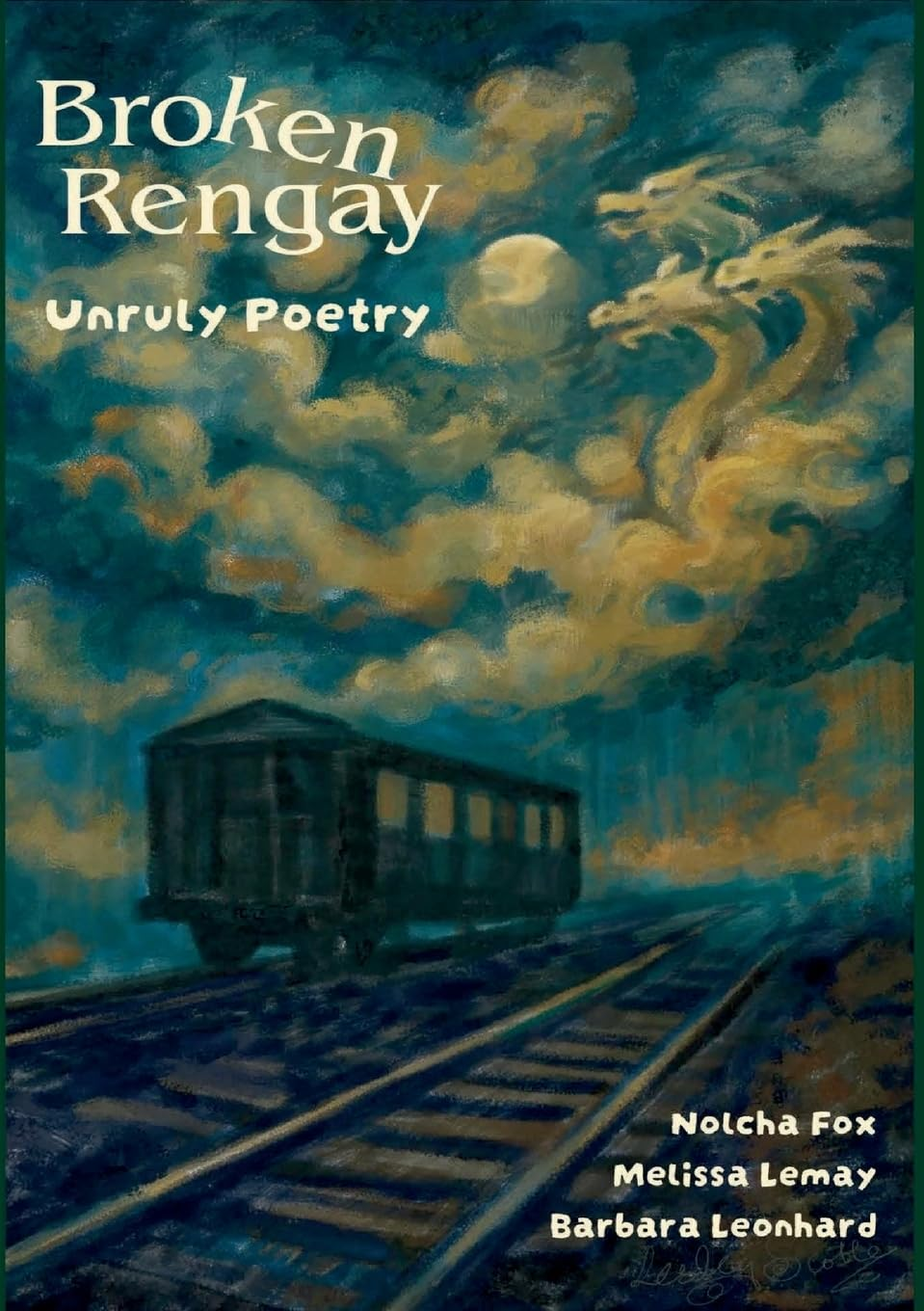
I am always hugely admiring of poetry and book collaborations. These three talented poets have managed to stitch the poems in this interesting book together in such a seamless way you would not know that they are written by more than one person.
The poems cover a spectrum of topics from experiences to emotions to aging and they all inject a thread of dark humour into the mundaneness of the human condition. Let’s be honest, daily life is generally pretty ordinary except when pain or joy make their ad hoc appearances and to be able to laugh at our daily grind is a wonderful thing.
This extract from ‘Everybody Knows My Name’ is an example of this humour:
“baskets of laundry
hanging out in the hallway
calling my name
I changed my name
and I don’t speak laundry
I speak frozen custard, French vanilla
country drives to count the deer
beer and pizza on date night”
‘Pain Will Do That’ is a poem that exposes the debilitating nature of on-going pain and how we are forced to face it and deal with it as we age. This is a short extract:
“pain is the perfect weight loss plan
food tastes bitter
even cheesecake makes me flee
holding a pen too long –
my wrists ask me for Ibuprofen
if I could, I’d challenge pain to a duel
my titanium joints, my weapons
I’m a cyborg, pain, get ready!”
These poems highlight the humanity of the poets and bring the reader into their worlds of ups and downs, achievements and disappointments. This is a relatable collection of poems that will make you feel better about your own life and give you some rose coloured spectacles through which to view life.
Purchase Bro ken Rengay from Amazon US here: https://www.amazon.com/Bro-ken-Rengay-Unruly-Poetry/dp/1962374572
About Robbie Cheadle

South African author and illustrator, Robbie Cheadle, has written and illustrated sixteen children’s books, illustrated a further three children’s books, and written and illustrated three poetry books. Her work has also appeared in poetry and short story anthologies.
Robbie also has two novels and a collection of short stories published under the name of Roberta Eaton Cheadle and has horror, paranormal, and fantasy short stories featured in several anthologies under this name.
You can find Robbie Cheadle’s artwork, fondant and cake artwork, and all her books on her website here: https://www.robbiecheadle.co.za/
________________________
Did you know you can sponsor your favorite blog series or even a single post with an advertisement for your book? Stop by the WtbR Sponsor Page and let me advertise your book, or you can make a donation to Writing to be Read for as little as a cup of coffee, If you’d like to show your support for this author and WordCrafter Press.
__________________________
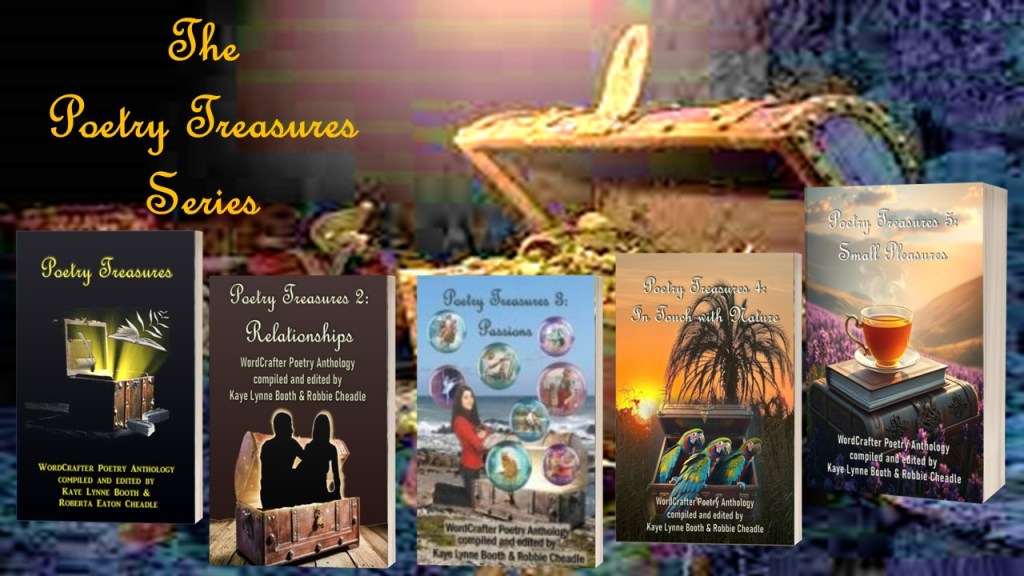
This segment of “Treasuring Poetry” is sponsored by WordCrafter Press and the Poetry Treasures series.
Get Your Copy Today!
Poetry Treasures: https://books2read.com/PoetryTreasures
Poetry Treasures 2: Relationships: https://books2read.com/PT2-Relationships
Poetry Treasures 3: Passions: https://books2read.com/u/b5qnBR
Poetry Treasures 4:In Touch With Nature: https://books2read.com/PT4-Nature
Poetry Treasures 5: Small Pleasures: https://books2read.com/PT5-SmallPleasures




















